Athens Historical Landmarks
1. The Parthenon (Acropolis)
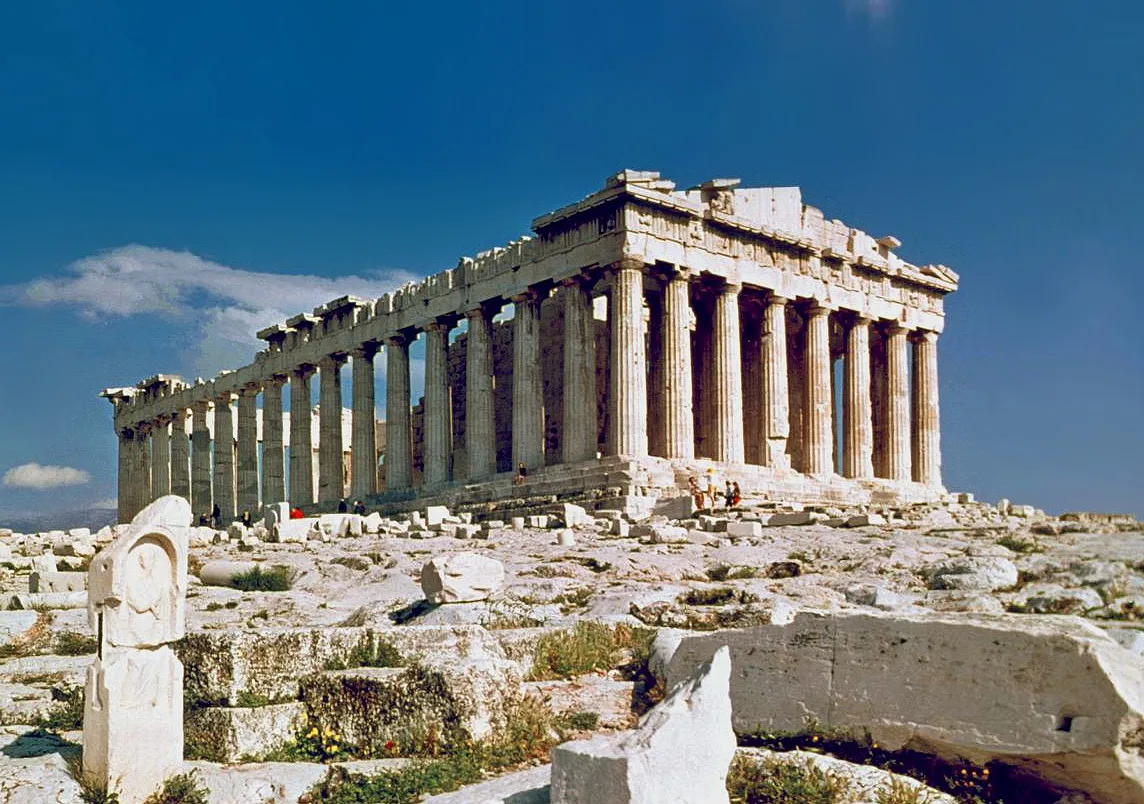
Photo: Steve Swayne / CC BY 2.0
What Your Eye SeesA rectangular temple of pale Pentelic marble crowning the Acropolis hill, ringed by massive Doric columns visible from nearly every point in the city below.
ContextAthens had just defeated the Persian Empire and needed to declare itself the center of the Greek world. Pericles redirected the Delian League treasury, money collected from allied city-states for mutual defense, to fund a building program that was, in practice, an imperial propaganda project. The Parthenon was the centerpiece of that building programme.
On ScreenThe Acropolis and Parthenon are explorable in the game Assassin's Creed Odyssey (2018).
Source: UNESCO (Acropolis, Athens); Greek Ministry of Culture; Wikipedia (Parthenon); Wikipedia (Parthenon); Assassin's Creed Odyssey production notes
 Did
DidYou
Know
Inside the Parthenon's main chamber once stood a 12-metre-tall statue of Athena Parthenos made of gold and ivory, costing more than 200 warships. A pool of water lay in front of it to maintain the humidity that kept the ivory from cracking, a 5th-century BC climate control system.
Share→ The Optical Illusions
Look closely at the Parthenon, it has no straight lines. Its columns bulge slightly outward (entasis), the platform curves gently upward at the centre, and the columns tilt inward, refinements that correct the eye's distortions, a hallmark of High Classical stonework.
→ The Metope Reliefs
Look at the 92 metopes, which carried carved battle scenes, the Centauromachy (Lapiths against centaurs), the Trojan War and other myths. Most were shattered in 1687, when the Venetians bombarded the Parthenon while the Ottomans used it as a gunpowder magazine.
→ The Lost Central Groups
Look at the eastern pediment, whose central marble group showing the birth of Athena was removed in late antiquity and is now lost. Scholars can only guess at their arrangement from the empty cuttings still visible in the pediment floor.
Sources: Wikipedia
 Ancient Roots
2. Temple of Hephaestus
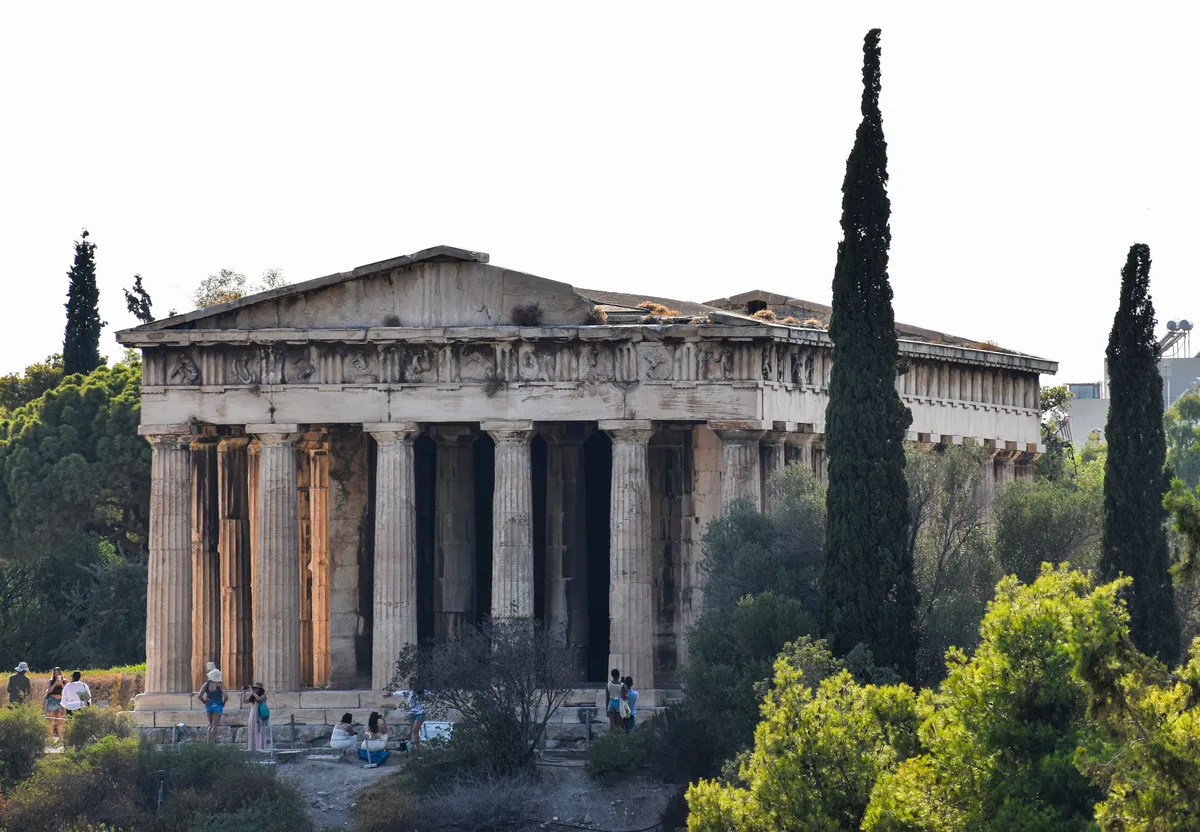
Photo: Julian Lupyan / CC0
What Your Eye SeesA remarkably intact Doric temple standing in the Ancient Agora below the Acropolis, with its roof and colonnade almost entirely preserved.
ContextWhile the Parthenon gets the attention, this temple dedicated to the god of metalworking and craftsmanship is the best-preserved ancient Greek temple on Earth. It survived because it was converted into a Christian church in the 7th century, giving it continuous maintenance that the Parthenon never received.
On ScreenThe Temple of Hephaestus appears in the game Assassin's Creed Odyssey (2018).
Source: Greek Ministry of Culture; Wikipedia (Temple of Hephaestus); Wikipedia (Temple of Hephaestus); Assassin's Creed Odyssey production notes
DidYou
Know
The temple sits directly above the ancient metalworking district of Athens. Archaeologists found bronze-casting pits and forge remains surrounding the foundation, confirming that Hephaestus was worshipped literally on top of the workshops dedicated to his craft. The god of the forge had his temple built over actual forges.
Share→ The Coffered Ceiling
Stand beneath the colonnade and look up: the marble ceiling above the peristyle is carved into coffered panels, each framed by deep-cut mouldings. It is one of the few places in Greece where a Classical temple's original ceiling still survives overhead, in most temples such ceilings were lost to earthquakes and centuries of reuse.
→ The Christian Layers
Look at the interior walls for carved crosses and Byzantine inscriptions from the temple's centuries as a church; the apse stood on the eastern side. During this period the building was known as Agios Georgios (St. George).
→ The Uncarved Metopes
Walk around the colonnade and notice how uneven the carving is: only 18 of the 68 metopes were ever sculpted, and they are concentrated on the east side, visible from the Agora. The ten metopes of the east front show the Labours of Heracles and four more on the north and south corners show the deeds of Theseus, the rest were left plain, perhaps painted.
Sources: Wikipedia
Ancient Roots
 Spiritual Seeker
3. Theatre of Dionysus
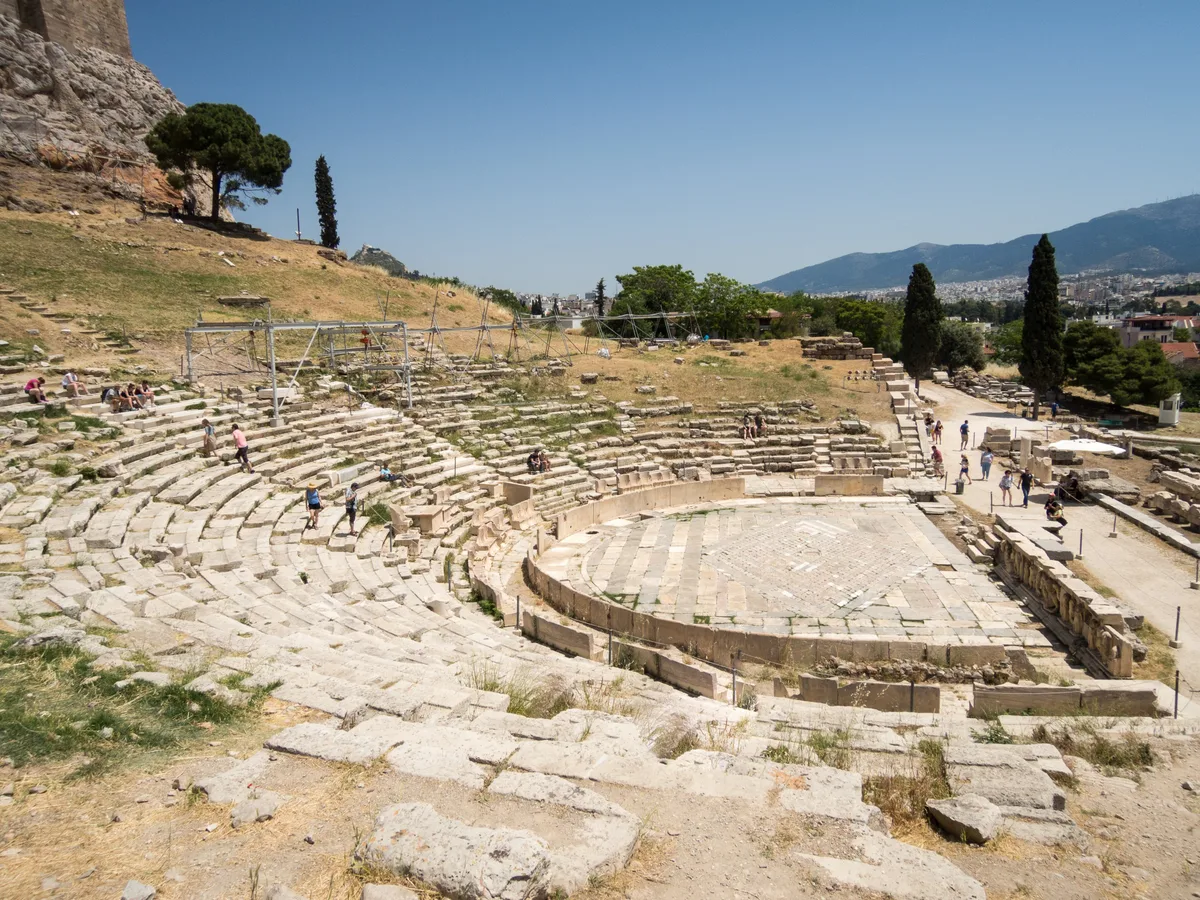
Photo: dronepicr / CC BY 2.0
What Your Eye SeesA large semicircular stone theatre carved into the southern slope of the Acropolis hill, with tiered marble seating facing a circular orchestra floor.
ContextThis is where theatre was invented. Not metaphorically, literally. The plays of Aeschylus, Sophocles, Euripides, and Aristophanes premiered on this stage. Every concept of dramatic structure, tragic irony, and comedic timing that film schools teach today traces back to performances held in this specific semicircle of stone.
On ScreenThe Theatre of Dionysus features in the game Assassin's Creed Odyssey (2018).
Source: UNESCO (Acropolis, Athens); Greek Ministry of Culture; Wikipedia (Theatre of Dionysus); Wikipedia (Theatre of Dionysus); Assassin's Creed Odyssey production notes
DidYou
Know
The front-row seats are not ordinary stone benches, they are individual marble thrones with carved names and titles. The center throne, the most ornate of all, was reserved for the Priest of Dionysus. Attending theatre in Athens was not entertainment; it was a civic and religious obligation, and your seat literally displayed your rank in society.
Share→ The Rock-Cut Cavea
The theatre is not a clean semicircle, its seating curve runs well past 180 degrees, and the upper rows were cut directly into the rock of the Acropolis. Stand at the back and you can see where the katatome, the curved cutting into the hillside, forms the northern limit of the auditorium.
→ The 'Dancing Floor'
Look at the orchestra, the word literally means 'dancing floor', the level circular space where the chorus performed in early drama. A drainage channel (the euripos) runs around it to keep the performance area clear of rainwater.
→ Seats In Wedges
Look at the great curved cavea, which could hold many thousands, divided into wedge-shaped sections (kerkides) separated by stairways, the basic radial seating layout that stadiums still copy today.
Sources: Wikipedia; ancient-greece.org
Ancient Roots
4. Erechtheion (Caryatid Porch)
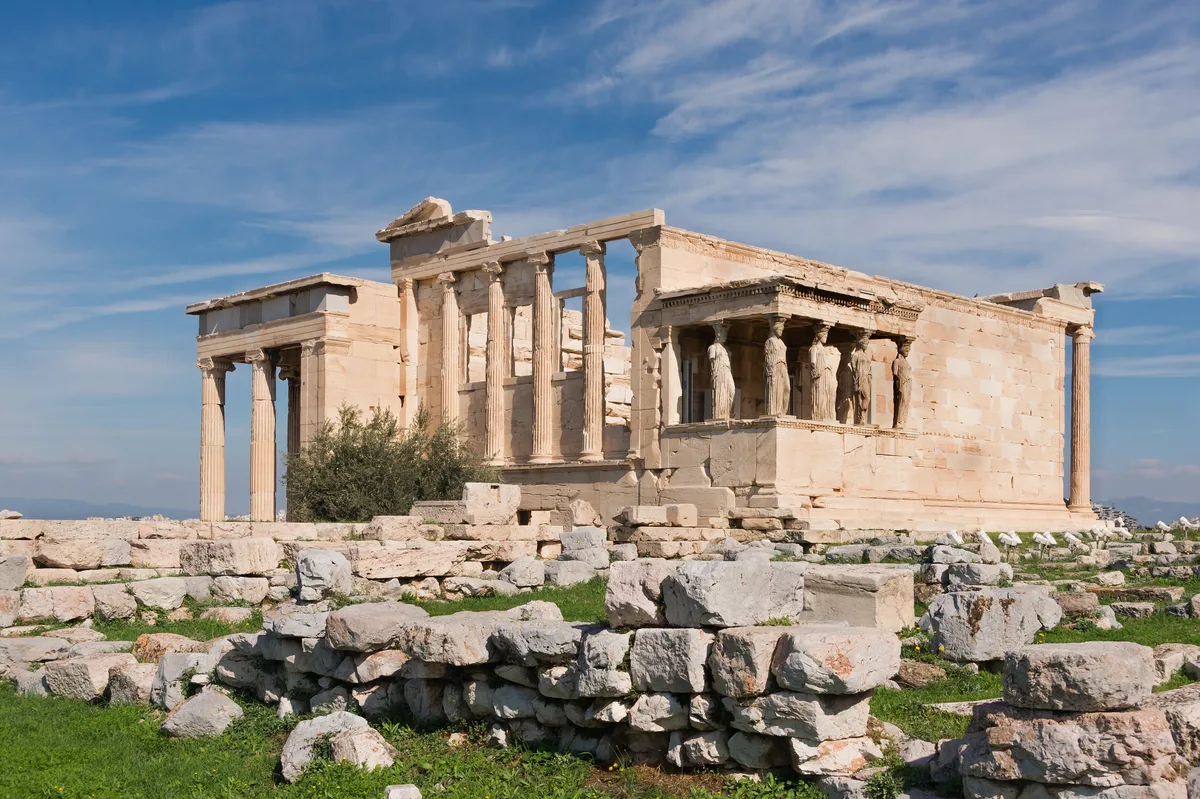
Photo: Jebulon / CC0
What Your Eye SeesAn asymmetric marble temple on the Acropolis with an iconic south porch where six sculpted female figures serve as load-bearing columns.
ContextThe Erechtheion sits on the most sacred ground on the Acropolis, the spot where Athena and Poseidon are said to have competed for patronage of the city. Its unusual asymmetric plan is not a design choice but a necessity: the temple had to accommodate multiple shrines and sacred relics at different ground levels on an uneven rock surface.
On ScreenThe Erechtheion's Caryatid Porch is recreated in the game Assassin's Creed Odyssey (2018).
Source: UNESCO (Acropolis, Athens); Greek Ministry of Culture; Wikipedia (Erechtheion); Wikipedia (Erechtheion); Assassin's Creed Odyssey production notes
DidYou
Know
The six Caryatids you see today are replicas. Five originals are locked in the Acropolis Museum's climate-controlled gallery, and the sixth has been in the British Museum since Lord Elgin removed it in 1801. Each figure stands in a slightly different pose to distribute the roof load differently, meaning they function as individual engineering solutions disguised as identical sculptures.
Share→ The Structural Hair
Look at the Caryatids' hair, carved thick and full down the back of the neck, a deliberate design that strengthens the column's most slender point, helping the marble figures bear the roof they carry.
→ The Olive Tree Mark
Look beside the west front for the olive tree marking the legendary contest between Athena and Poseidon, the goddess won Athens by giving it the olive. The tree you see is a replanting; olive trees have marked this spot since antiquity.
→ The Salt Spring
Look at the rock where, according to myth, Poseidon struck with his trident and a salt spring gushed out, while the mark in the ceiling above is said to show where Zeus hurled his thunderbolt to settle the rivalry. The lore is stitched into the building's fabric.
Sources: Acropolis Museum; Wikipedia
Ancient Roots
5. Odeon of Herodes Atticus
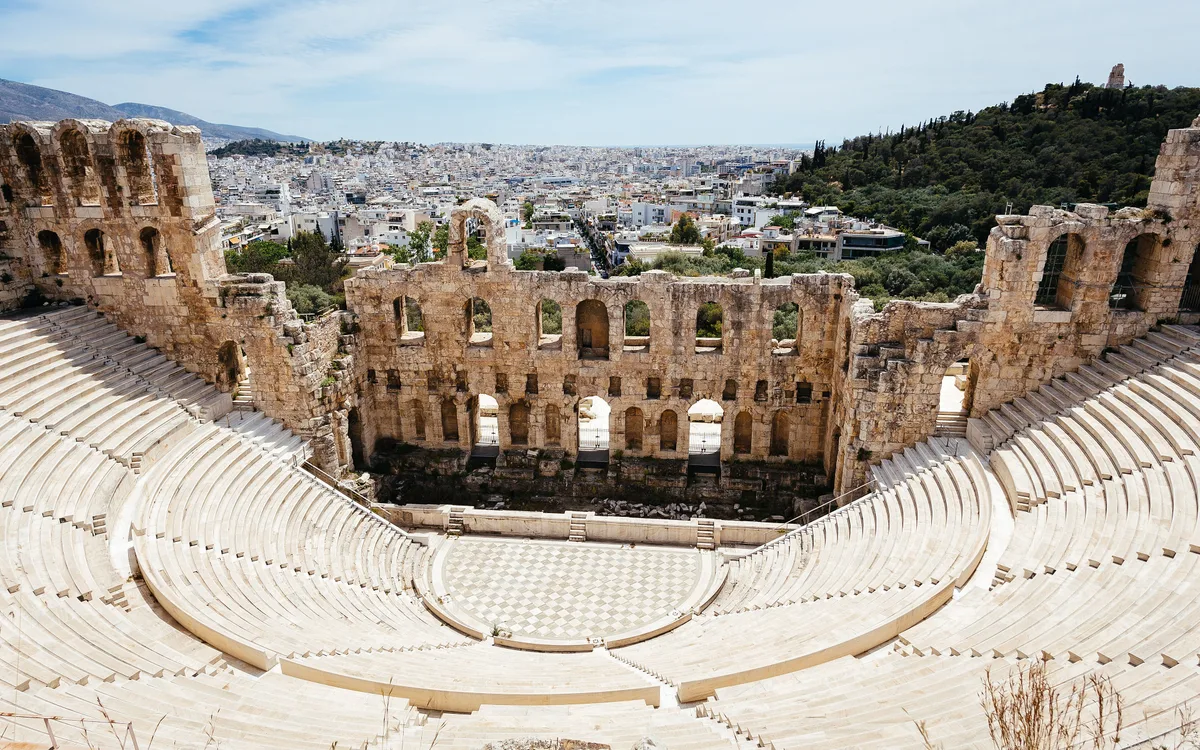
Photo: Robert Anders from Hamburg, Germany / CC BY 2.0
What Your Eye SeesA steep stone amphitheatre with a tall arched rear wall nestled into the southwestern slope of the Acropolis, still used for live performances today.
ContextThis was not a public works project, it was a grief monument. Herodes Atticus, one of the wealthiest men in the Roman Empire, built this theatre in 161 AD in memory of his wife Regilla. He personally funded the entire construction, including the cedar roof that once covered the 5,000-seat auditorium.
Source: UNESCO (Acropolis, Athens); Greek Ministry of Culture; Wikipedia (Odeon of Herodes Atticus)
DidYou
Know
A 2017 acoustic study of ancient Greek theatres (Eindhoven University) rated the Odeon the most speech-intelligible of the three tested: a strongly projected voice reaches the top row without help. Centuries before microphones, its shape alone did the work, and today's summer concerts still use almost no amplification.
Share→ The Three-Story Wall
Look at the stage wall (scaenae frons), originally a tall, richly decorated structure of marble columns and statues with a roof, a towering backdrop that also helped direct performers' voices out over the stone seating.
→ The Restoration Seam
Look for the grey sections of modern restoration. Restorers must keep new material visually distinct from the yellowish ancient marble, so the boundary between old and new is plainly visible across the monument.
→ The Roman Vaulting
Look beneath the seating for the concrete barrel vaults, unlike Greek theatres cut into hillsides, this Roman-built odeon supported its cavea on vaults, and the lower arcades still reveal those Roman techniques.
Sources: Wikipedia
Ancient Roots
6. Tower of the Winds (Horologion)
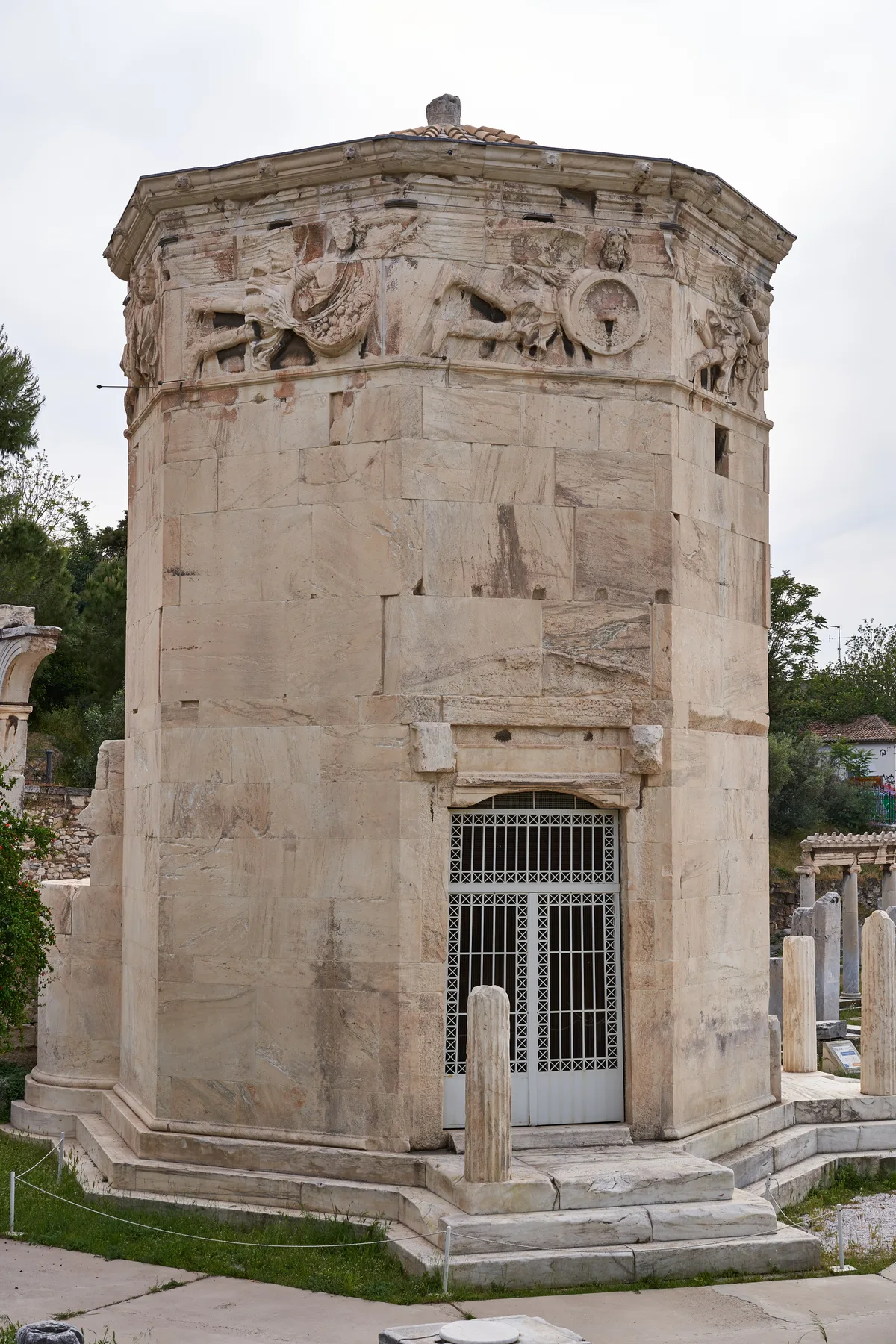
Photo: George E. Koronaios / CC BY-SA 2.0
What Your Eye SeesAn octagonal marble tower standing in the Roman Agora, with carved relief figures on each of its eight faces and a conical roof.
ContextBuilt around 50 BC by the Syrian astronomer Andronicus of Cyrrhus, this is the world's first known meteorological station. It combined a sundial, water clock, and wind vane into a single public instrument, letting Athenians read the time, wind, and season. Carved from Pentelic marble, it is among the best-preserved buildings of classical antiquity; its dials rose high over the Roman Agora so citizens could read the hour at a glance, an early public clock tower.
Source: Greek Ministry of Culture; Wikipedia (Tower of the Winds)
DidYou
Know
The eight carved figures on the Tower of the Winds each personify a specific wind direction with its own personality: Boreas (North) is a harsh old man blowing a conch, while Zephyros (West) is a gentle youth scattering flowers. A bronze wind vane on top pointed to the relevant figure, telling Athenians the wind's expected character.
Share→ The Sundial Faces
Look at the carved lines across several faces, which form sundials laid out so the sun's shadow is read differently on each side. Around the tower, the passing of the day could be followed from whichever face the sun was striking.
→ The Marble Cone Roof
Look up at the low conical roof of twenty-four trapezoidal marble slabs, held together by a circular keystone and carved to imitate roof tiles. The main roof is keyly original, an exceptionally rare survival in an ancient building.
→ The Lions' Head Water Spouts
Look up at the cornice above the frieze: it is decorated with lions' heads carved in relief, each one functioning as a water spout. On a rainy day, water would once have poured from the mouths of these marble lions, high above the Roman Agora.
Sources: Wikipedia; World History Encyclopedia
Ancient Roots
What is the best-preserved Greek temple in the world?
The Temple of Hephaestus on the Ancient Agora of Athens, built between 449 and 415 BC. Its remarkably intact colonnade and partially surviving roofline make it the most complete surviving ancient Greek temple, owing to its conversion into a church in the 7th century AD which protected it from quarrying.
How old is the Parthenon?
The Parthenon was built between 447 and 432 BC, making it over 2,400 years old. It was designed by architects Ictinus and Callicrates under the supervision of the sculptor Phidias, who also created the colossal gold-and-ivory statue of Athena Parthenos that once stood inside.
What is the Tower of the Winds?
The Tower of the Winds (Horologion of Andronikos Kyrrhestes) on the Roman Agora is the world's first known meteorological station, built in the 1st century BC. Its eight sides carry sundials, a water clock (klepsydra) inside measured time at night, and wind-direction reliefs adorned the exterior.
These landmarks reward close attention. Vestigia is a field companion for people who look longer, with curated context, architectural detail, and the stories most visitors walk past. Free on the App Store and Google Play.