Bangkok Historical Landmarks
1. The Grand Palace
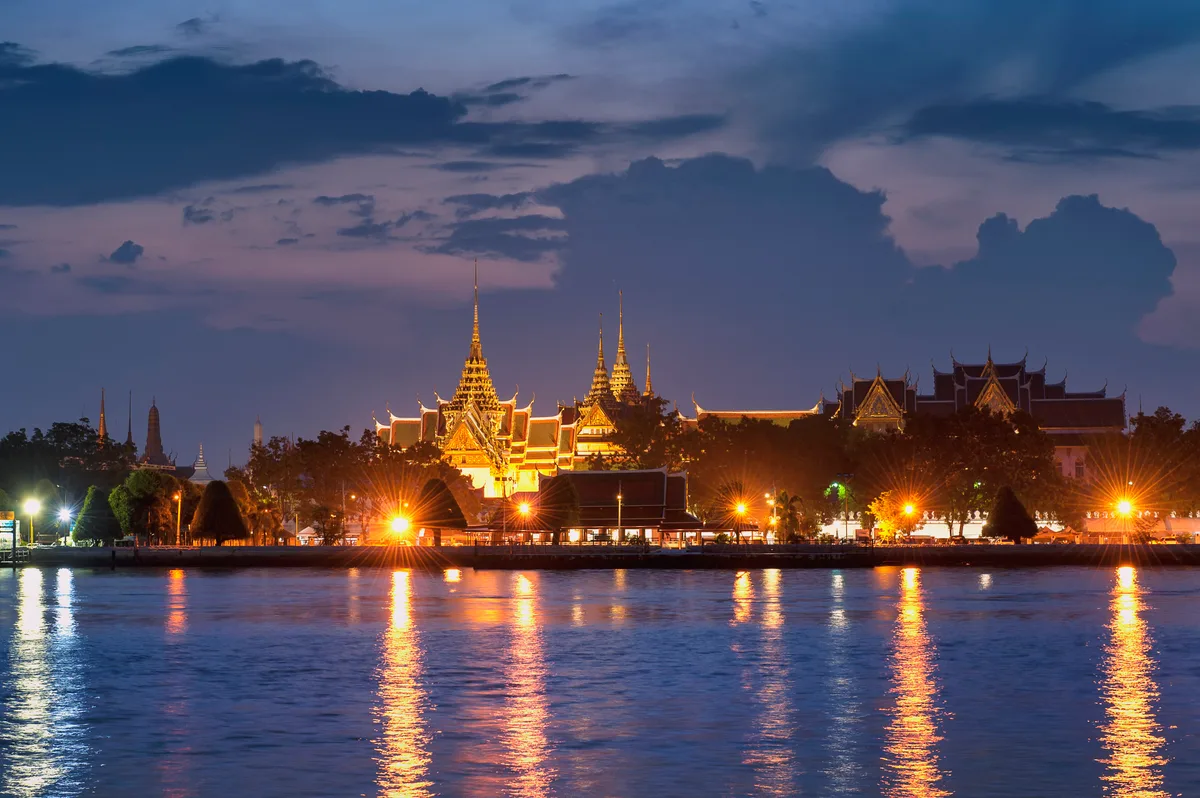
Photo: Preecha.MJ / CC BY-SA 4.0
What Your Eye SeesA sprawling complex of over 100 ornate buildings with gilded spires, colourful porcelain-tiled roofs, and tiered eaves, enclosed by whitewashed walls stretching along the Chao Phraya River.
ContextBuilt in 1782 when King Rama I, founder of the Chakri dynasty, moved the capital from Thonburi to Bangkok. For over 140 years it served as the official royal residence and seat of government, enclosed behind nearly 2 km of walls and home to more than 100 buildings, throne halls and temples. It remains the spiritual heart of the Thai monarchy.
On ScreenThe Grand Palace and Wat Phra Kaew served as Bangkok's backdrop in the film Around the World in 80 Days (1956).
Source: Tourism Authority of Thailand; Wikipedia (Grand Palace); Wikipedia (Grand Palace); Around the World in 80 Days production notes
 Did
DidYou
Know
Inside the Grand Palace stands a model of Cambodia's Angkor Wat, commissioned by King Rama IV in 1866 after an earlier scheme to dismantle and move the real temple to Bangkok was abandoned. It was a show of Siamese power over a region then a vassal of Siam.
Share→ The Westerner With A Thai Hat
The Chakri Maha Prasat throne hall in the central court marries an Italian Renaissance-style marble facade with a traditional Thai roof of three gilded spires, a combination locals nicknamed 'the Westerner with a Thai hat'. The dome the architect planned was swapped for a tiered Siamese roof before completion.
→ Porcelain Tile Roofs
The temple roofs are layered with glazed porcelain tiles in green and orange, a hallmark of Rattanakosin royal architecture. Look up at the tiered eaves: each level carries its own row of tiles, and the colours intensify towards the gilded ridge.
Sources: Wikipedia (Chakri Maha Prasat Hall); The Nation; Wikipedia (The Grand Palace)
 Eastern Spirit
2. Wat Phra Kaew (Temple of the Emerald Buddha)
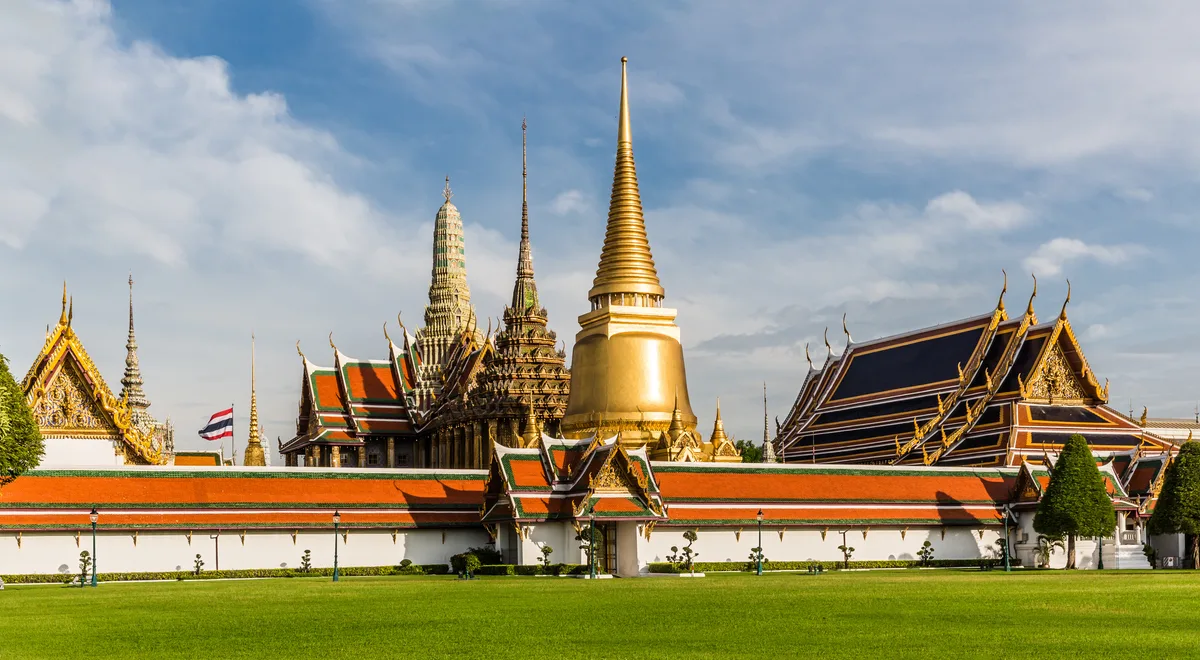
Photo: Original image: Ninara from Helsinki, Finland. Edit: TSP / CC BY 4.0
What Your Eye SeesA dazzling temple within the Grand Palace grounds with a golden chedi, ornate gable ends, and a central ubosot housing the most sacred Buddha image in Thailand.
ContextBuilt in 1782 alongside the Grand Palace by King Rama I, Wat Phra Kaew is Thailand's most sacred temple and the royal chapel of the Chakri dynasty rather than a working monastery. It houses the Emerald Buddha, a 66-centimetre figure of green jade whose early history vanishes before 1434, when it surfaced in Chiang Rai. The image is so revered that only the king may touch it.
On ScreenThe Temple of the Emerald Buddha appears in the film Around the World in 80 Days (1956).
Source: Tourism Authority of Thailand; Wikipedia (Wat Phra Kaew); Wikipedia (Wat Phra Kaew); Around the World in 80 Days production notes
DidYou
Know
The Emerald Buddha was discovered in 1434 when lightning split a chedi at Chiang Rai, and travelled through Laos and Thailand for centuries before reaching Bangkok in 1784, where the king still changes its robes three times a year for the seasons.
Share→ Golden Chedi
The golden Phra Si Rattana Chedi is a Sri Lankan-style stupa built as a brick core in 1855 to hold a Buddha relic given to King Rama IV. Its surface is clad in thousands of small gold mosaic tiles, recently replaced with gilded mosaic specially imported from Italy.
→ The Demon Guardians
The 12 giant yaksha demon guardians are not carved from stone: each stands about 5–6 metres tall, modelled in stucco over a frame and decorated with glazed porcelain and paint. They guard the temple gates as characters from the Ramakien epic, Thailand's version of the Ramayana.
Sources: Wikipedia (Wat Phra Kaew); Chedi mosaic studies (dergipark.org.tr); seaarts.sac.or.th (Yakṣas at the Temple of the Emerald Buddha); World History Encyclopedia
 Spiritual Seeker
3. Wat Arun (Temple of Dawn)
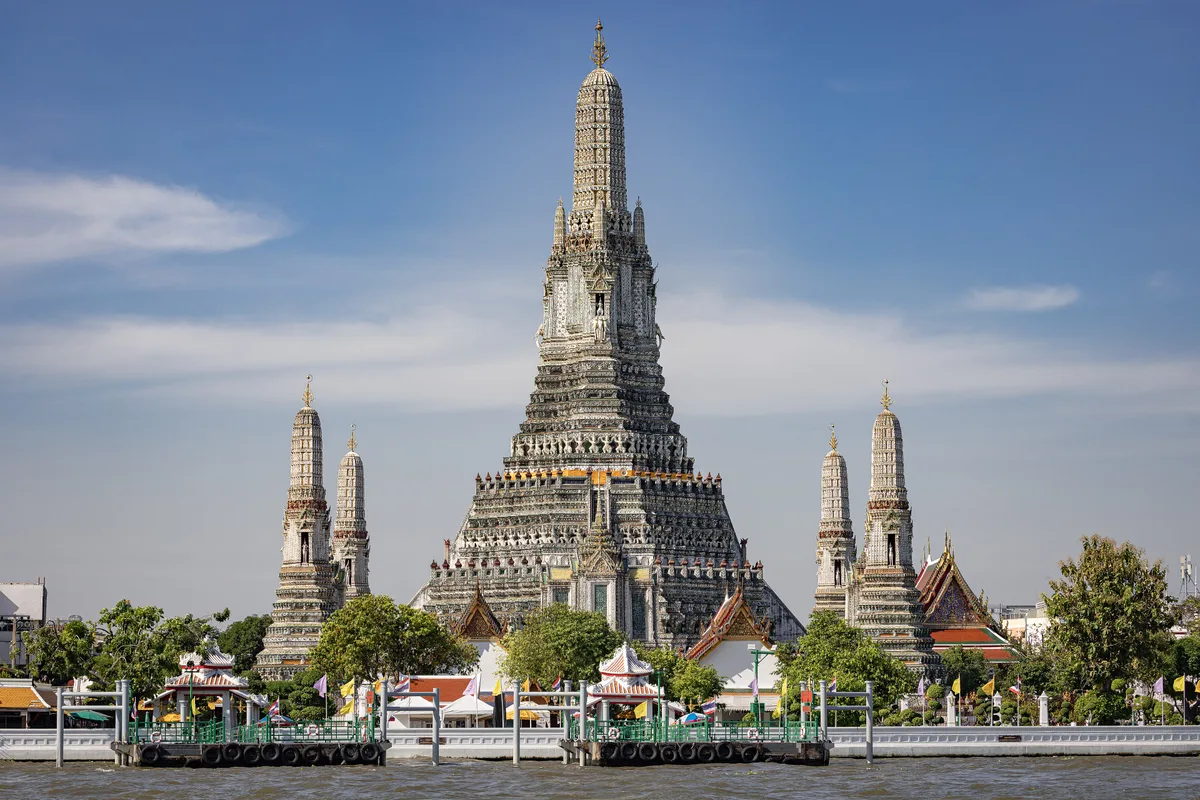
Photo: Mastertongapollo / CC BY-SA 4.0
What Your Eye SeesA towering 79-metre central prang (Khmer-style spire) covered in colourful porcelain fragments, rising from the west bank of the Chao Phraya, with smaller satellite prangs at each corner.
ContextOriginally a 17th-century shrine called Wat Makok, Wat Arun takes its name from Aruna, the Hindu god of dawn, and was rebuilt as a royal temple after King Rama II raised its central prang in the early 1800s. The 82-metre tower, encrusted with Chinese porcelain and seashells, stands on the west bank of the Chao Phraya and once briefly sheltered the Emerald Buddha.
On ScreenWat Arun was filmed for the movie Mortal Kombat (2021) and features in the Korean drama King the Land (2023).
Source: Tourism Authority of Thailand; Wikipedia (Wat Arun); Wikipedia (Wat Arun); Mortal Kombat (2021) production notes; King the Land production notes
DidYou
Know
The central prang of Wat Arun is crusted with colourful porcelain fragments and seashells, much of it broken china that had once served as ballast on trading ships from China. After the ships unloaded, the discarded shards were set into plaster as temple decoration, a shimmering surface that catches the dawn light, which is how the temple earned its name.
Share→ The Gods On Three-Headed Elephants
In niches around the upper tiers of the central prang sit figures of the god Indra riding his three-headed elephant Erawan. Climb to the second terrace and you meet them at nearly eye level, each tiny god and elephant framed by the surrounding crust of porcelain and shells.
→ Steep Prang Stairs
The steps up the central prang are among the steepest temple stairs in Bangkok, roughly 70 degrees, with only a handrail and ropes for the descent. From the first terrace the reward is a panorama over the Chao Phraya to Wat Pho and the Grand Palace on the opposite bank.
→ The Four Satellite Prangs
The central tower is flanked by four smaller corner prangs, also encrusted with porcelain and shells. The whole structure is Khmer-style corn-cob architecture crowned by a pointed finial shaped like the trishula, the three-pronged trident of the god Shiva.
Sources: Wikipedia (Wat Arun); thaiwebsites.com; hellothaigo.com
Eastern Spirit
Spiritual Seeker
4. Wat Pho (Temple of the Reclining Buddha)
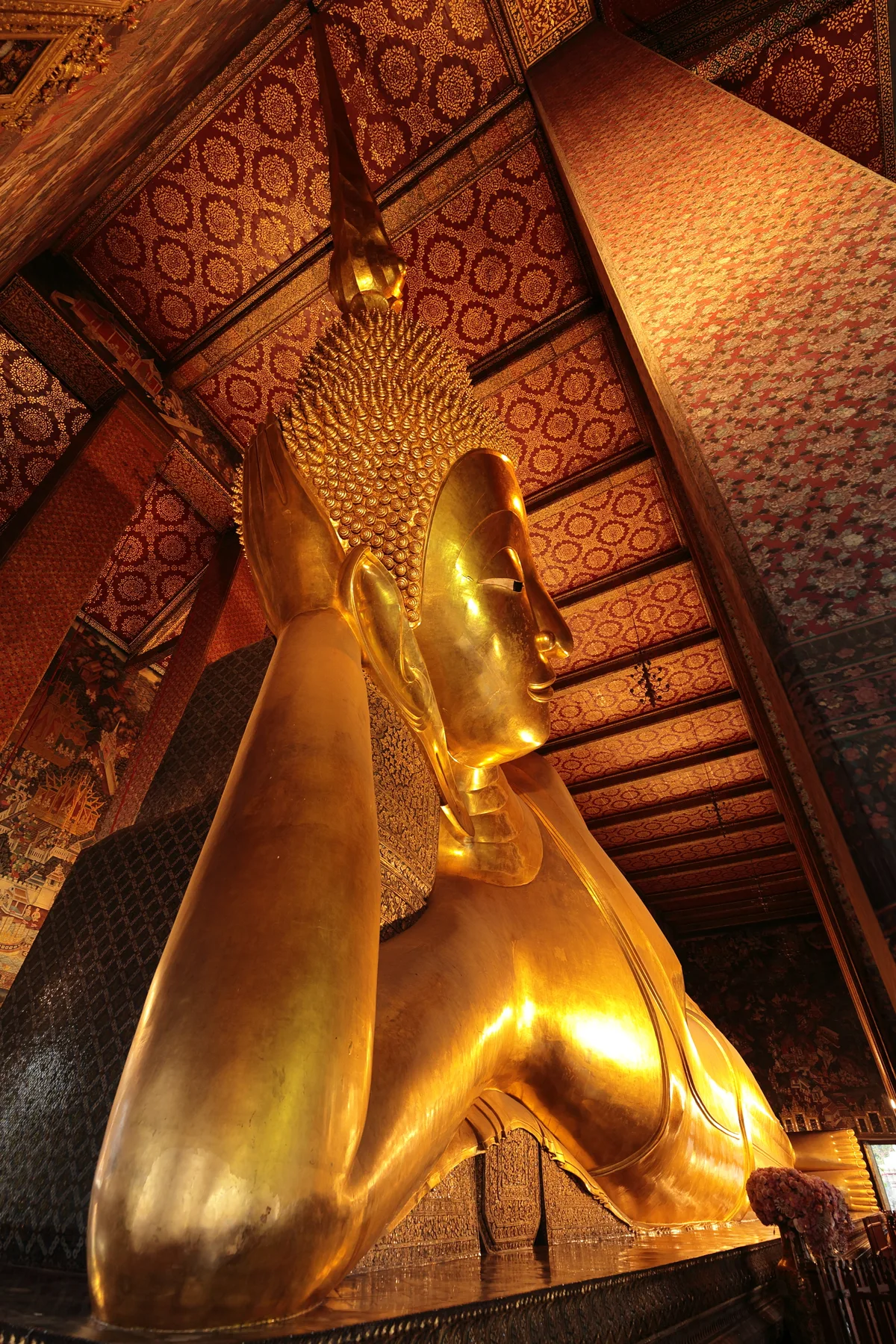
Photo: Mastertongapollo / CC BY-SA 4.0
What Your Eye SeesA vast temple complex housing a 46-metre-long gold-leaf-covered Reclining Buddha that fills an entire hall, feet inlaid with mother-of-pearl depicting 108 auspicious scenes.
ContextDating to the 16th century as the Ayutthaya-era Wat Photaram, Wat Pho was rebuilt by King Rama I in 1782 and greatly expanded by King Rama III, growing into Bangkok's largest temple complex at some 80,000 square metres. It holds the largest collection of Buddha images in Thailand and its stone inscriptions on traditional medicine are listed by UNESCO's Memory of the World.
On ScreenWat Pho's grounds appear in the Bangkok episodes of The Night Agent season two (Netflix, 2025), filmed across the temple district.
Source: Tourism Authority of Thailand; Wikipedia (Wat Pho); Netflix (The Night Agent); masteryfilms.com
DidYou
Know
The Reclining Buddha is 46 metres long and 15 metres tall, covered in gold leaf over a plaster and brick core. Its feet alone are 5 metres long, each inlaid with 108 auspicious scenes in mother-of-pearl. Wat Pho is also the birthplace of traditional Thai massage.
Share→ The First University
In 1831–41, King Rama III had around 1,431 stone plaques on medicine, literature, history and religion inscribed and set into the temple walls, turning Wat Pho into an open-air 'university' for the public. The inscriptions include pressure-point diagrams for Thai massage, and the archive is listed in UNESCO's Memory of the World register.
→ The Reclining Pose
The giant image lies on its right side with the head propped, the sihasaiyas, or sleeping-lion posture, representing the Buddha entering parinirvana (final nirvana) at the end of his life as Gautama.
→ The Four Great Chedi
Behind a white wall stand the four great chedi of Wat Pho, the Phra Maha Chedi Si Rajakarn, each 42 metres tall and clad in glazed tiles of a different colour, green, white, yellow and blue, honouring the first four kings of the Chakri dynasty. The green one shelters a 16-metre standing Buddha rescued from Ayutthaya.
Sources: UNESCO (The Epigraphic Archives of Wat Pho); Wikipedia (Wat Pho); watpho.com
Spiritual Seeker
5. Wat Traimit (Temple of the Golden Buddha)
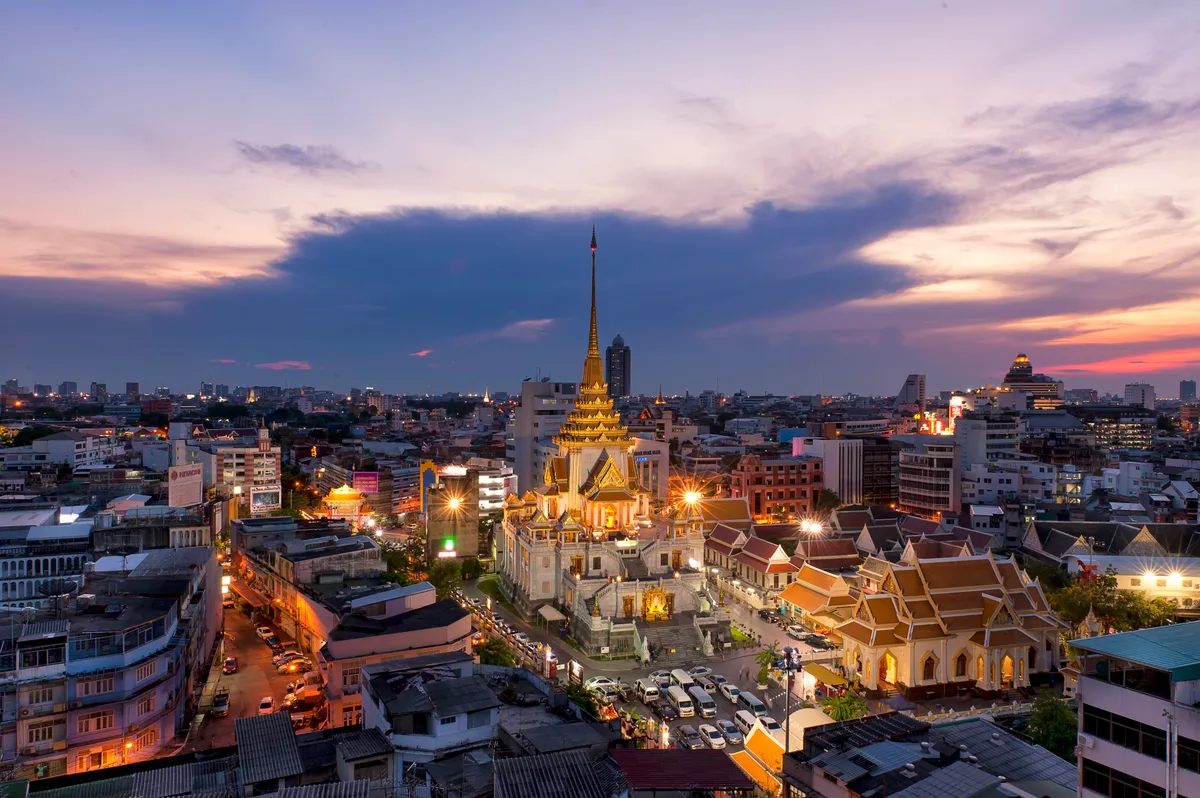
Photo: Preecha.MJ / CC BY-SA 4.0
What Your Eye SeesA modern temple structure with a Mondop-style hall, housing a 3-metre-tall solid gold Buddha statue weighing 5.5 tons.
ContextThe Golden Buddha that gives Wat Traimit its fame was cast in the 13th-century Sukhothai style and then concealed under a plaster shell for roughly 200 years to hide it from invaders. When the coating finally cracked open during a 1955 move, it was revealed as the world's largest solid gold Buddha, a 5.5-tonne image now enshrined in Bangkok's Chinatown.
Source: Tourism Authority of Thailand; Wikipedia (Wat Traimit)
DidYou
Know
The Golden Buddha is the world's largest solid gold statue, weighing 5.5 tonnes and valued at around $250 million, and it surfaced by accident in 1955 when, during a move, it slipped from its crane cables and the plaster shell cracked open to reveal the gold beneath.
Share→ The Sukhothai Silhouette
The statue's slender proportions, tapered cone-shaped ushnisha and flame-like halo mark it as Sukhothai-period work (c. 13th–14th century). Notice how the fine hair curls rise to a point of flame at the crown of the head.
Sources: Wikipedia (Wat Traimit); Wikipedia (Sukhothai art)
Spiritual Seeker
6. Jim Thompson House
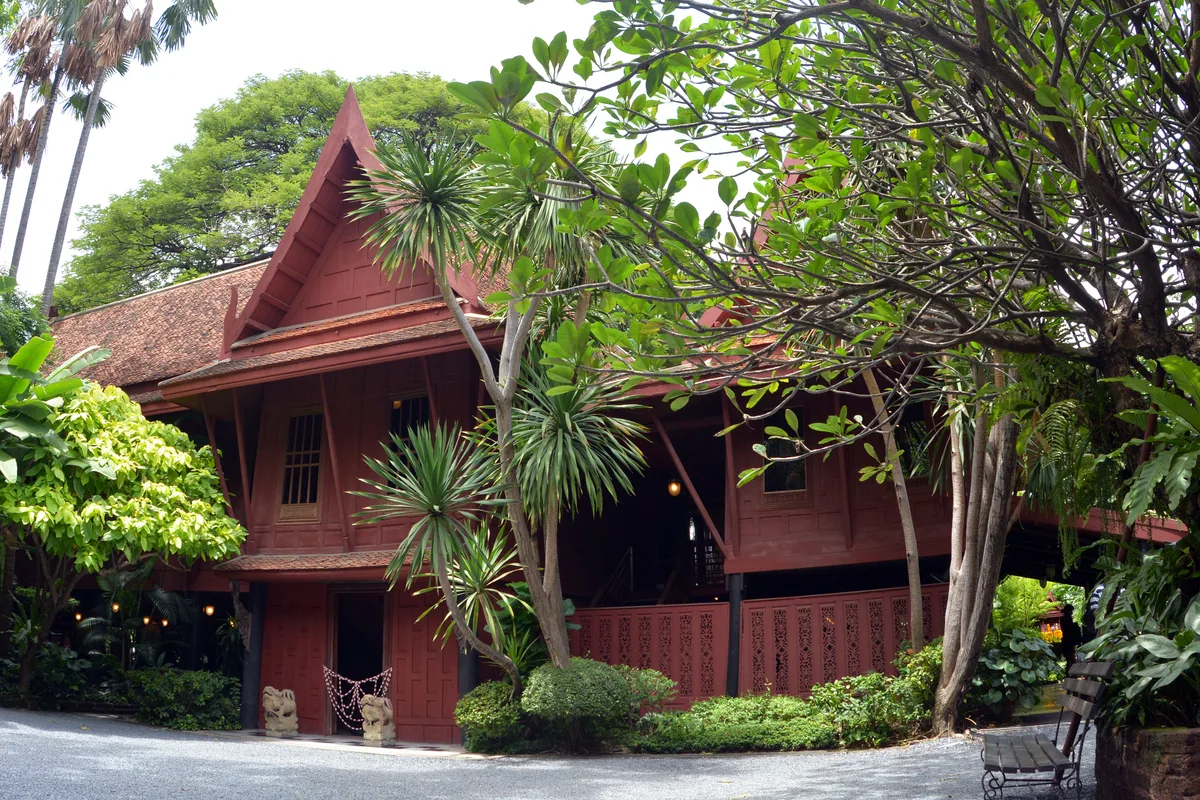
Photo: Don Ramey Logan / CC BY-SA 3.0
What Your Eye SeesA green garden compound with six traditional Thai teak houses raised on stilts, surrounded by tropical plants and a klong (canal). The houses are connected by raised walkways.
ContextBuilt in 1959 by Jim Thompson, the American architect and former intelligence officer who revived the Thai silk industry after World War II. The house is assembled from six traditional teak houses purchased across the country and reassembled on the Saen Saep canal. Thompson vanished on a walk in Malaysia's Cameron Highlands in 1967, and the unsolved mystery still draws visitors.
Source: Jim Thompson House (official); Wikipedia (Jim Thompson House)
DidYou
Know
Thompson reassembled six teak houses from different regions and periods of Thailand onto one plot beside the Saen Saep canal using traditional joinery, not a single nail was used, so the houses could later be taken apart and moved again.
Share→ A Museum Of Southeast Asian Art
The rooms double as a gallery of Thompson's collecting: ancient Buddha images from the Dvaravati, Sukhothai and Ayutthaya periods, vivid five-colour Bencharong porcelain made in China for the Thai court, Ming ceramics and Burmese wood carvings, one of the finest private collections of Southeast Asian art assembled by a Westerner.
→ Raised Stilts
Each house sits about a metre off the ground on timber stilts. The open gap let air circulate beneath the living floor in the tropical heat and kept the close-set teak planks clear of damp earth and flooding river water.
→ The Weavers Across The Canal
The compound faces the Saen Saep canal, and directly across the water lies Ban Krua, the Muslim weaving village whose silk weavers Thompson worked with. He used to row across the klong daily before he built the house, and the old weavers' quarter is still visible from the garden.
Sources: Wikipedia (Jim Thompson House); jimthompsonhouse.org; Cultural Heritage Online (Jim Thompson House Museum); amazingthailand.com.au
Eastern Spirit
7. Democracy Monument
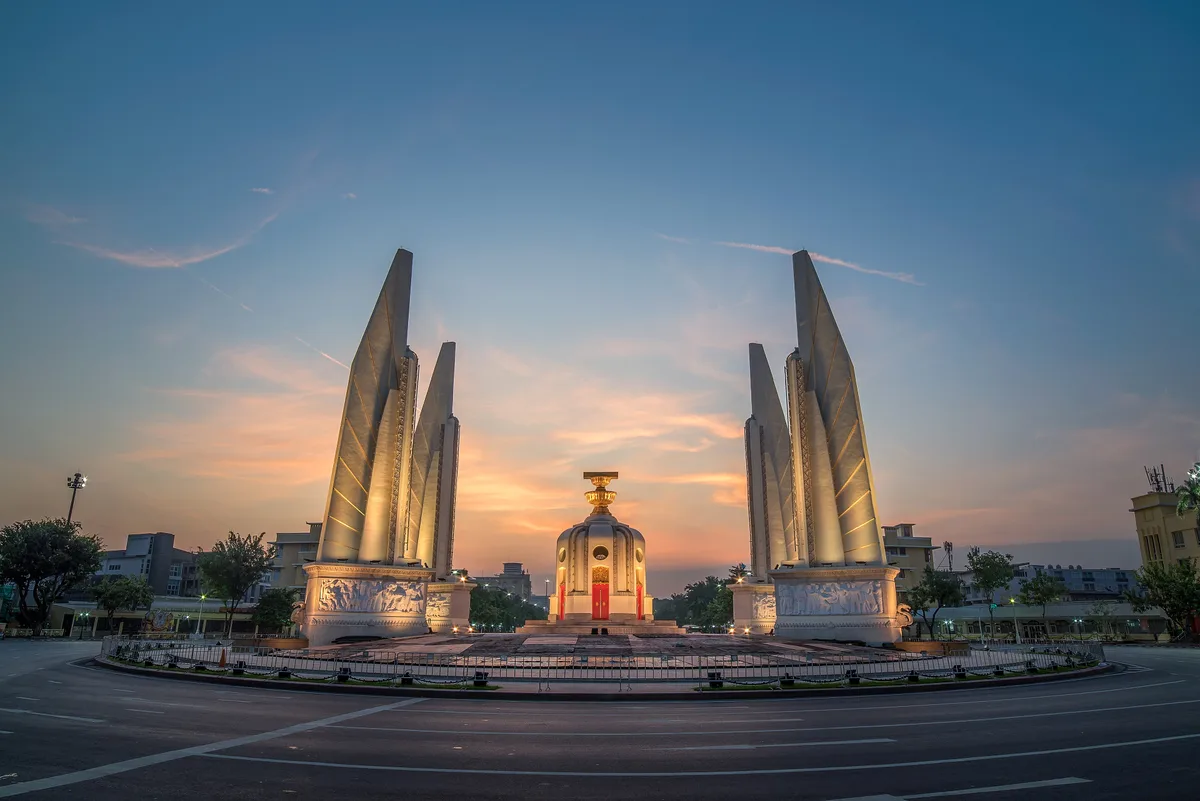
Photo: Nawit science / CC BY-SA 4.0
What Your Eye SeesA central Art Deco monument with four wing-like structures framing a central spire, standing in the middle of a busy roundabout on Ratchadamnoen Avenue.
ContextBuilt in 1939 to commemorate the 1932 Siamese Revolution that transformed Thailand from an absolute monarchy to a constitutional one. Designed by the Italian-born sculptor Corrado Feroci (later Silpa Bhirasri, regarded as the father of modern Thai art), the monument stands at the heart of Ratchadamnoen Avenue as a recurring stage for political protest and national debate.
On ScreenBangkok's Democracy Monument appears in the James Bond film The Man with the Golden Gun (1974).
Source: Wikipedia (Democracy Monument, Bangkok); Wikipedia (Democracy Monument); The Man with the Golden Gun production notes
DidYou
Know
The Democracy Monument is carefully calibrated political architecture: the four wings are each 24 metres tall to mark June 24, the date of the 1932 revolution; the central pedestal is 3 metres high, recalling June as the third month of the traditional Thai calendar; and 75 cannons around the base encode the year 2475 BE.
Share→ Six Gates, Six Principles
The central turret has six doors, each guarded by a sword, standing for the six principles proclaimed by the People's Party (Khana Ratsadon): independence, internal peace, equality, freedom, economy and education. Above the doorways a figure of Arun, the god of dawn, symbolises a new day for an absolute monarchy toppled.
→ The Constitution On Golden Bowls
At the summit of the turret, a carved palm-leaf manuscript box holding the 1932 Constitution rests on two golden offering bowls. From the edge of the roundabout, look up and you can just make out the gilded bowls glinting high above the wings.
Sources: Wikipedia (Democracy Monument, Bangkok); revolutionaryobjects.org; Tourism Authority of Thailand
 Renaissance
 Modernist
8. Wat Saket (Golden Mount)
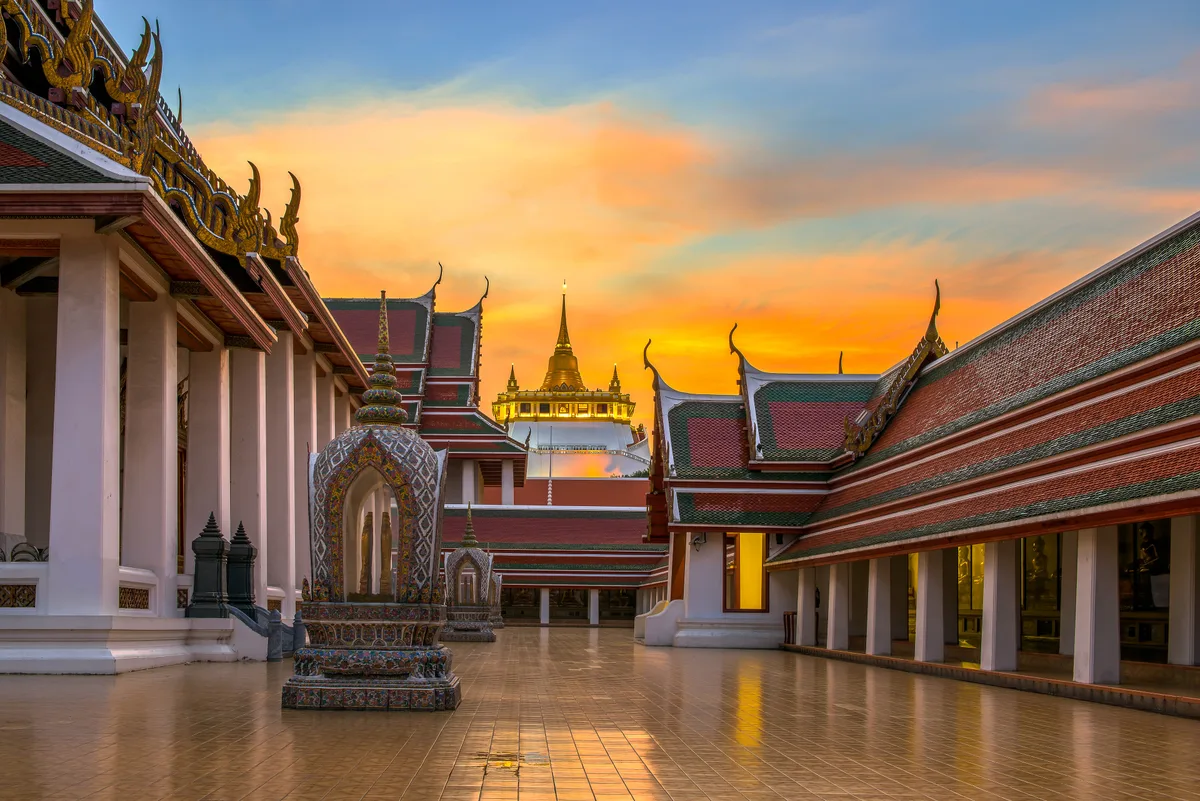
Photo: BerryJ / CC BY-SA 4.0
What Your Eye SeesA gleaming golden chedi atop an artificial hill rising roughly 77 metres above the surrounding flat cityscape, accessible by a spiralling staircase lined with bells.
ContextBuilt in the 19th century, Wat Saket is dominated by Phu Khao Thong, the Golden Mount: an 80-metre artificial hill crowned by a gilded chedi. King Rama III began a great chedi here, but it collapsed as Bangkok's soft soil gave way; King Rama IV later stabilised the mound and King Rama V completed the spire, which enshrines a Buddha relic.
Source: Tourism Authority of Thailand; Wikipedia (Wat Saket)
DidYou
Know
The relic at the summit was a diplomatic gift from the British: part of a cache unearthed at Buddha's birthplace in 1898 and presented to King Rama V by the government of India, then under British rule.
Share→ The Wartime Concrete Walls
The lower slopes of the Golden Mount are ringed by grey concrete retaining walls, added during the Second World War to stop the loose fill of the hill from eroding away. From the base you can see the seam where the grey casing meets the older, tree-covered earth above.
→ The Spiralling Staircase
The climb snakes around the hill in a clockwise spiral of roughly 300-plus steps, climbing past a long line of bronze bells hung along the railing, visitors traditionally ring them as they go up. From the summit terrace, the whole of old Bangkok opens out below.
→ The Golden Chedi Surface
The crowning chedi is surfaced with thousands of small gold mosaic tiles fitted edge to edge. Stand close and you can see the dark grout lines forming a geometric grid; step back and the grid disappears, leaving the mount looking like a solid mass of gold.
Sources: Wikipedia (Wat Saket); Lonely Planet; thetravelscribes.com
Eastern Spirit
Why is there a model of Angkor Wat inside Bangkok's Grand Palace?
King Rama IV commissioned the model in 1866 after an earlier plan to dismantle and move the real Angkor Wat to Bangkok was abandoned. Built when the region was a vassal of Siam, the model was a deliberate show of Siamese power. The palace itself dates to 1782, when King Rama I moved the capital from Thonburi to Bangkok, and for over 140 years it was the official royal residence and seat of government behind nearly 2 km of walls.
Where is Thailand's famous Reclining Buddha?
At Wat Pho in Bangkok, the Temple of the Reclining Buddha. The statue is 46 metres long and 15 metres tall, covered in gold leaf over a plaster and brick core, with feet alone 5 metres long, each inlaid with 108 auspicious scenes in mother-of-pearl. Wat Pho is also the birthplace of traditional Thai massage, and its stone inscriptions on traditional medicine are listed by UNESCO's Memory of the World programme.
Why is Wat Arun called the Temple of Dawn?
The temple is named for Aruna, the Hindu god of dawn, and its 82-metre tower catches the first light of the sun. The central prang (the tower) is crusted with Chinese porcelain and seashells, much of it broken china that had served as ballast on trading ships from China; after the ships unloaded, the discarded shards were set into plaster as decoration. It began as a 17th-century shrine, and the tower briefly sheltered the Emerald Buddha.
These landmarks reward close attention. Vestigia is a field companion for people who look longer, with curated context, architectural detail, and the stories most visitors walk past. Free on the App Store and Google Play.