Cairo Historical Landmarks
1. Pyramids of Giza
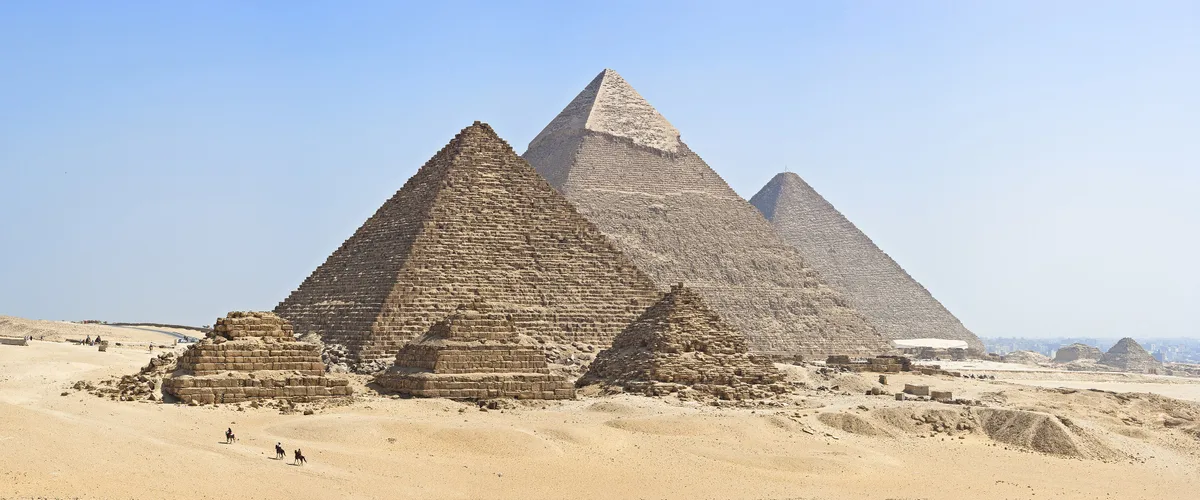
Photo: KennyOMG / CC BY-SA 4.0
What Your Eye SeesThree colossal limestone pyramids rising from the Giza Plateau, with the Great Pyramid of Khufu reaching 139 metres. The Sphinx crouches nearby, its head angled toward the rising sun.
ContextBuilt during the Fourth Dynasty of the Old Kingdom (c. 2560 BC), the Pyramids of Giza are the only surviving Wonder of the Ancient World. They served as tombs for Pharaohs Khufu, Khafre, and Menkaure. The Great Pyramid of Khufu originally stood 146.6 metres tall and remained the world's tallest human-made structure for roughly 3,800 years. Raised from an estimated 2.3 million stone blocks over two decades, it crowns a royal necropolis on the Giza plateau.
On ScreenThe Giza pyramid complex appears in The Mummy (1999), Transformers: Revenge of the Fallen (2009), the James Bond film The Spy Who Loved Me (1977) and the game Assassin's Creed: Origins (2017).
Source: UNESCO (Memphis and its Necropolis – the Pyramid Fields of Giza); Wikipedia (Giza pyramid complex); Wikipedia (Giza pyramid complex); The Mummy production notes; Transformers production notes; Assassin's Creed: Origins
 Did
DidYou
Know
The Great Pyramid's original entrance was sealed with a 20-ton swivel door so precisely balanced it could be opened from inside with one hand yet was invisible from outside. In the 12th century, Sultan Al-Aziz Uthman attempted to demolish the pyramids but abandoned the effort after a year.
Share→ The Lost Casing Stones
The Great Pyramid was once covered in smooth white Tura limestone that gleamed in the desert sun. Almost all of it was stripped away over the centuries to build medieval Cairo, and today only a few giant base-level blocks of the original casing survive in place, a hint of the building's lost skin.
→ The Descending Passage
From the original concealed entrance high on the north face, a low corridor drops at about 26° deep into the bedrock beneath the pyramid. It has long been argued that its axis pointed towards Thuban, the pole star of Khufu's era.
→ The Oversized Sarcophagus
The sole object left in the King's Chamber is a sarcophagus cut from a single block of granite. It is too large to have been carried in through the passages after they were finished, it had to have been placed while the pyramid was still under construction.
Sources: Apollo; Wikipedia (Great Pyramid of Giza); Petrie
 Ancient Roots
 Time Traveler
2. The Great Sphinx
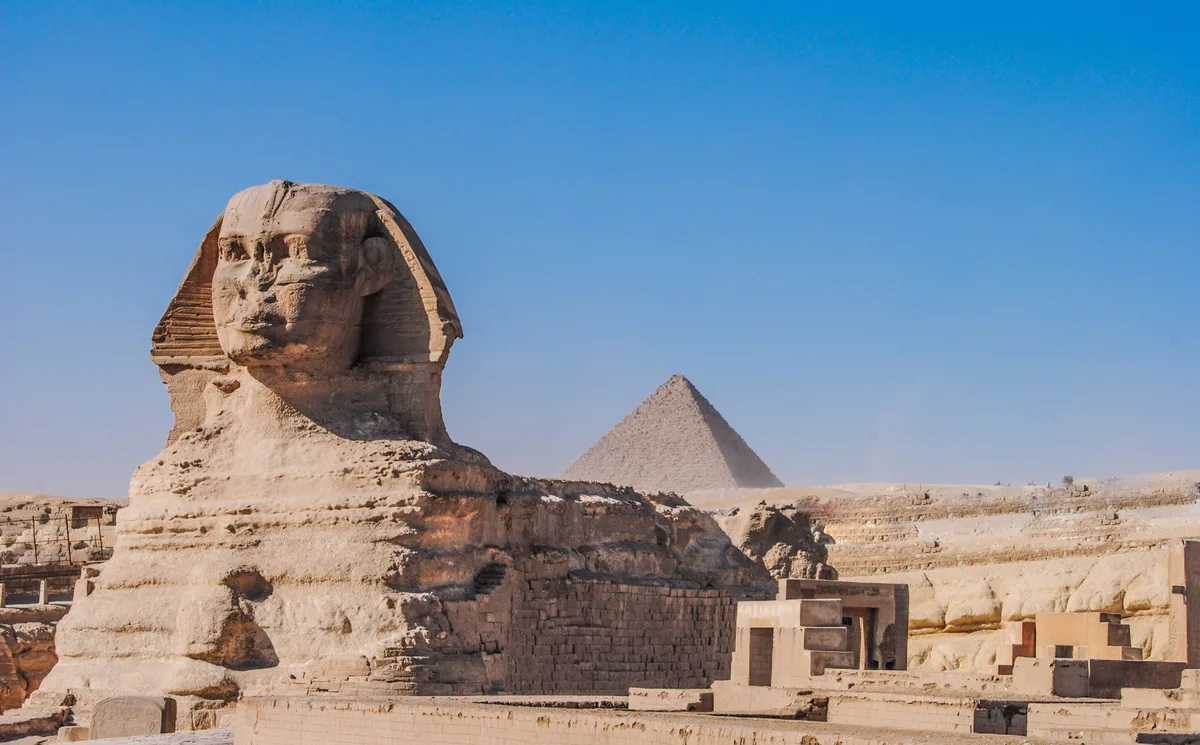
Photo: Hesham Ebaid / CC0
What Your Eye SeesA massive limestone statue with a human head and a lion's body, 73 metres long and 20 metres high, lying on the Giza Plateau with eroded body contours and a relatively intact face.
ContextCarved from a single ridge of limestone around 2500 BC during the reign of Pharaoh Khafre, the Sphinx is the oldest known monumental sculpture in Egypt and one of the largest single-stone statues in the world. Measuring about 73 metres from paw to tail and 20 metres to the top of its head, it fuses a reclining lion's body with a human face wearing the royal nemes headdress, a portrait scholars widely link to Khafre himself.
On ScreenThe Great Sphinx features in The Mummy (1999), Transformers: Revenge of the Fallen (2009) and the James Bond film The Spy Who Loved Me (1977).
Source: UNESCO (Memphis and its Necropolis); Wikipedia (Great Sphinx of Giza); Wikipedia (Great Sphinx of Giza); The Mummy production notes; Transformers production notes
DidYou
Know
The Sphinx was buried in sand up to its neck for much of its existence. It was only fully excavated between 1925 and 1936. Its missing nose, contrary to the myth of Napoleon's cannons, was removed long before, likely by a Sufi iconoclast in the 14th century.
Share→ The Contested Erosion
The Sphinx's body shows deep weathering that some geologists have controversially argued was caused by water rather than wind, a claim that would make the monument far older than mainstream Egyptologists date it, and one they reject. The debate remains unresolved.
→ The Missing Beard
The decorative plaited beard was probably added during the Eighteenth Dynasty and later broke away. A fragment, roughly a thirtieth of the whole, excavated by Caviglia in 1817 is held by the British Museum, with further pieces in Cairo.
Sources: Wikipedia (Great Sphinx of Giza); British Museum; Harvard (Giza)
Ancient Roots
Time Traveler
3. The Egyptian Museum
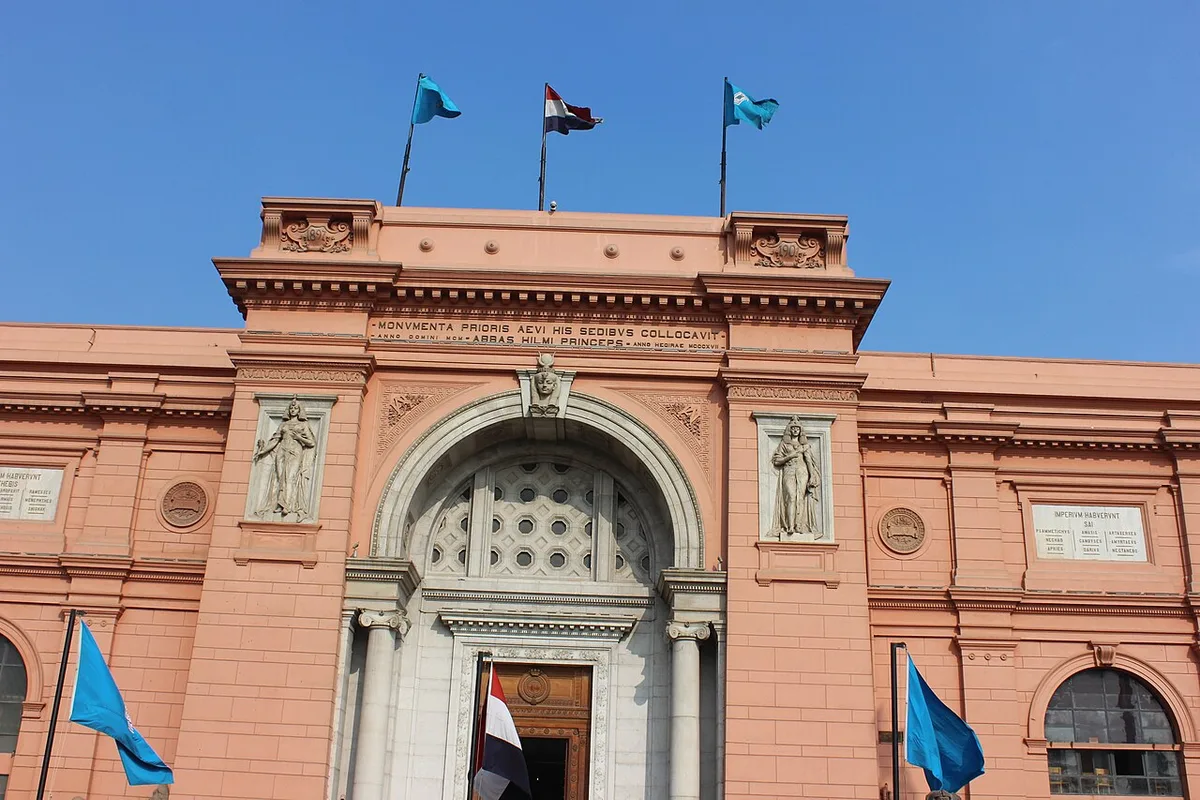
Photo: لا روسا / CC BY-SA 4.0
What Your Eye SeesA grand pink Neoclassical building in Tahrir Square, filled with two floors of Egyptian antiquities packed floor-to-ceiling in dimly lit galleries.
ContextBuilt in 1902, the Egyptian Museum houses the world's largest collection of Pharaonic antiquities, including the complete Tutankhamun collection of 5,398 objects. Designed by French architect Marcel Dourgnon, the Neoclassical building on Tahrir Square won an international competition launched in 1895 and opened on 15 November 1902 under Khedive Abbas Helmy II, its halls filled with statues, mummies and treasures spanning 5,000 years.
Its headline treasure is the gold funerary mask of Tutankhamun, recovered in 1922 by Howard Carter's excavation and now the museum's most celebrated object. Around it lie the mummies of pharaohs and halls of statuary documenting five millennia of Egyptian civilisation.
Source: Wikipedia (Egyptian Museum, Cairo); Britannica
DidYou
Know
During the 2011 Egyptian Revolution, civilian volunteers formed a human chain around the museum to protect it from looters. Of 1,000 objects damaged or stolen, 700 were later recovered, some found in the street, others in abandoned bags, a crowd-sourced restoration for a 4,000-year-old civilisation.
Share→ The Colossi In The Main Hall
The centrepiece of the museum's main hall is a single colossal limestone statue of Amenhotep III and his queen Tiye seated side by side, three of their daughters carved at their feet. At about seven metres tall, it is the largest family group statue to survive from ancient Egypt. Look closely at the king and queen: Tiye is cut at exactly the same height as her husband, a deliberate sign of her status, and her arm is placed around the king's waist. Watched over the atrium since the museum opened in 1902, it remains in Tahrir while the Tutankhamun treasures moved on to the Grand Egyptian Museum.
→ The Gilded Coffins Of Yuya And Thuya
One room holds the near-complete tomb treasure of Yuya and Thuya, parents of Queen Tiye and great-grandparents of Tutankhamun. Their tomb, KV46, was found almost intact in the Valley of the Kings in 1905, and its gilded funerary masks, nested coffins and furniture are displayed here: the richest burial to come out of the Valley before Tutankhamun's own, seventeen years later.
Sources: Wikipedia (Colossal Statue of Amenhotep III and Tiye); Ministry of Tourism and Antiquities; Wikipedia (Yuya); Wikipedia (KV46)
 Euro Heritage
 Renaissance
4. Mosque of Muhammad Ali (Alabaster Mosque)
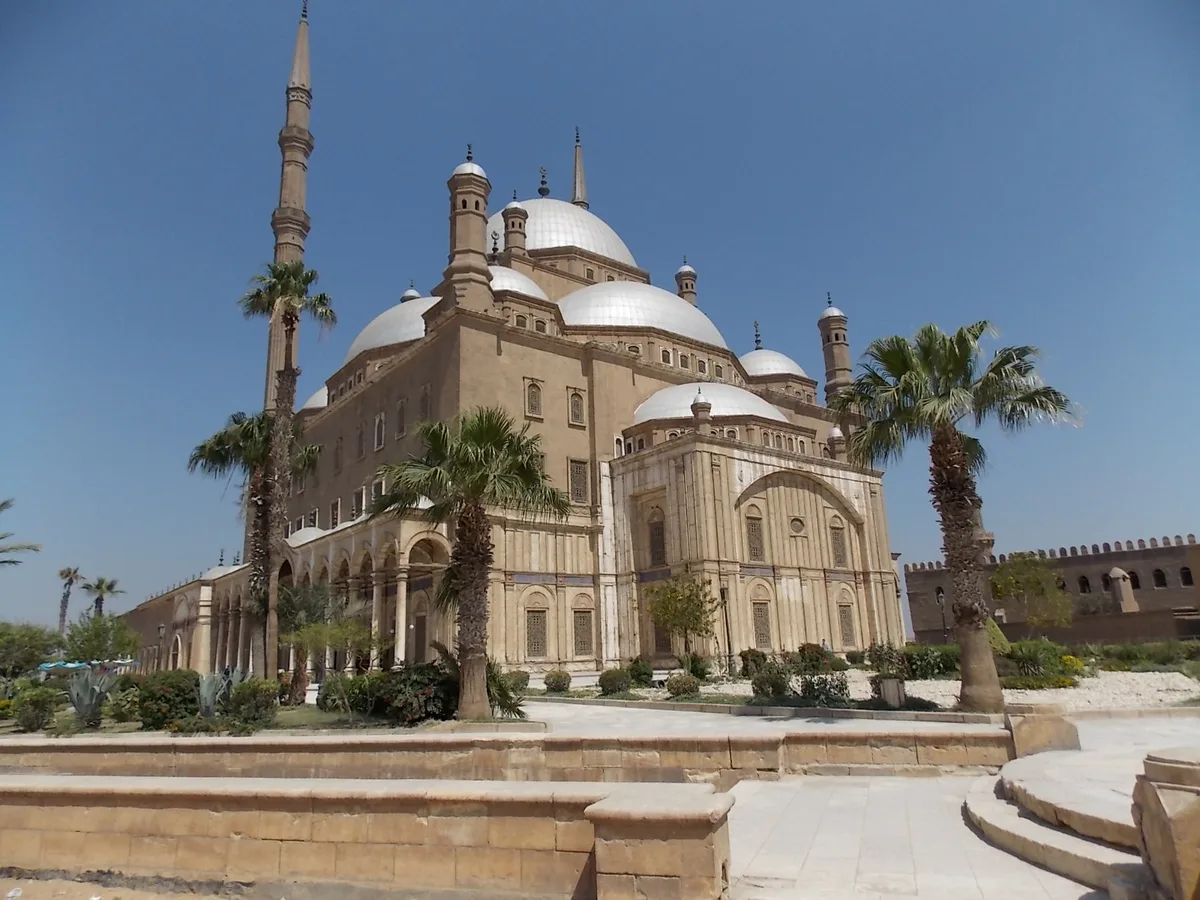
Photo: Ahmed Ragheb 97 / CC BY-SA 3.0
What Your Eye SeesA grand Ottoman-style mosque atop the Citadel of Saladin, with twin slender minarets, a central dome surrounded by half-domes, and walls encased in warm alabaster.
ContextBuilt between 1830 and 1848 by Muhammad Ali Pasha, the mosque dominates the Cairo skyline from within the Citadel of Saladin, raised on the site of demolished Mamluk palaces. It was built in Ottoman imperial style to symbolise Egypt's break from Mamluk rule, its interior and courtyard faced in local alabaster. Muhammad Ali himself is buried in a marble tomb within the mosque he commissioned.
Its dominant central dome and slender half-domes follow the Ottoman Baroque model of Istanbul's great mosques, a deliberate statement of Muhammad Ali's imperial ambitions. The complex crowns the Citadel, the fortified hill Saladin built in the 12th century to defend Cairo against the Crusaders.
Muhammad Ali's Ottoman Baroque dome was a conscious echo of Ortaköy Mosque on the Bosphorus: Sultan Abdülmecid I raised that neo-Baroque mosque in the 1850s in the same idiom, the clearest Istanbul answer to Cairo's ambition.
Source: UNESCO (Historic Cairo); Wikipedia (Mosque of Muhammad Ali)
DidYou
Know
The mosque is clad in 40,000 alabaster panels imported from the Beni Suef region, giving it its popular name and warm glow. Muhammad Ali chose the highest point of Cairo's Citadel so the twin 82-metre minarets are visible across the city.
Share→ The Silent French Clock
A gilded French clock in the courtyard was sent by King Louis-Philippe in the 1840s as part of a diplomatic exchange with Egypt involving the obelisk from Luxor that now stands in Paris. It is famously said the clock never worked.
→ The Ottoman Blueprint
Muhammad Ali ordered his mosque in the image of the great Ottoman dynastic mosques of Istanbul. Its central dome ringed by smaller half-domes deliberately echoes buildings such as the Sultan Ahmed ('Blue') Mosque and the New Mosque, a statement linking his new dynasty to the Ottomans.
Sources: Wikipedia (Muhammad Ali Mosque)
 Silk Road Legacy
 Spiritual Seeker
5. Al-Hussein Mosque
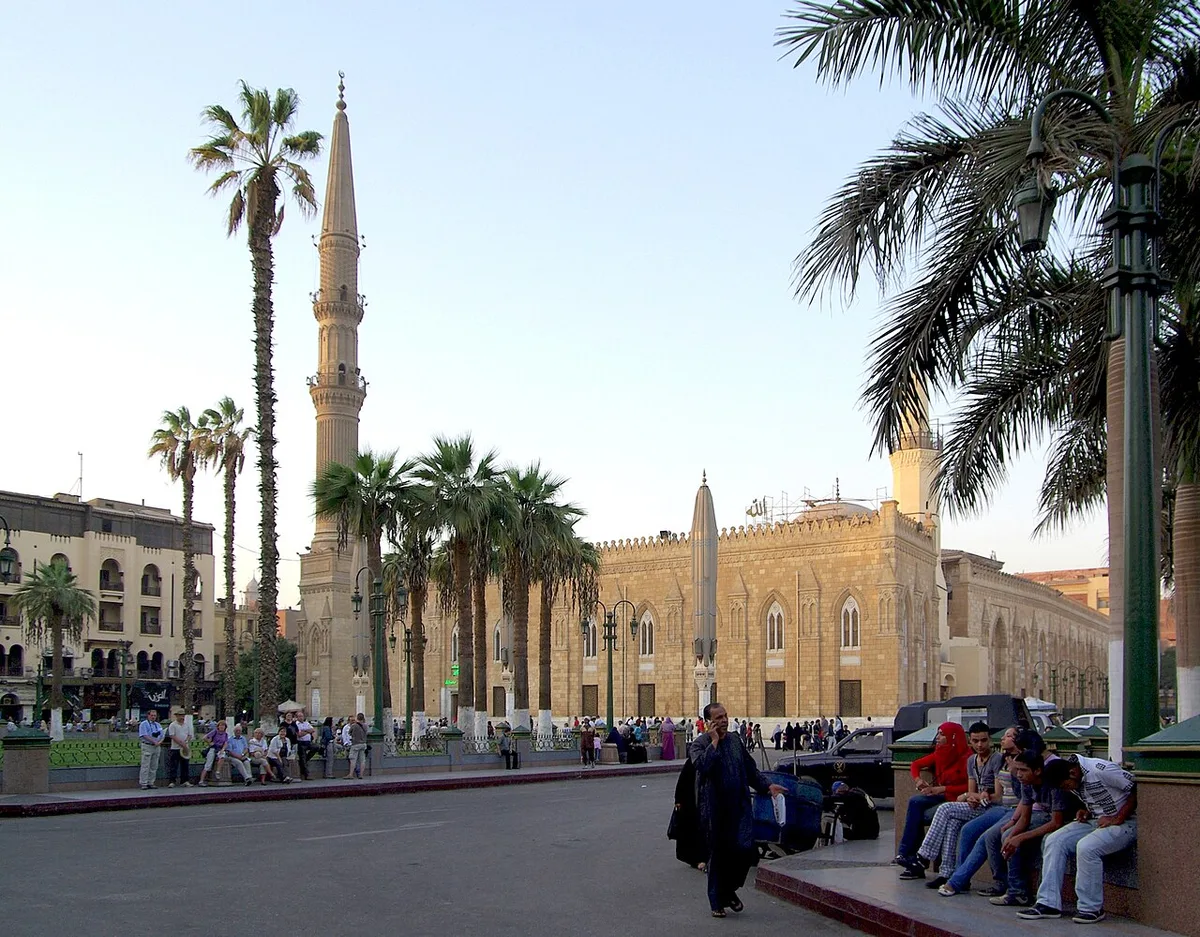
Photo: Berthold Werner / CC BY 3.0
What Your Eye SeesA grand mosque and mausoleum with a gold-domed shrine, flanked by a minaret, standing at the edge of the Khan el-Khalili bazaar.
ContextBuilt as a shrine in 1154 during the Fatimid era, Al-Hussein Mosque is one of the holiest sites in Egypt. It is believed to house the head of Husayn ibn Ali, grandson of the Prophet Muhammad, brought from Ashkelon in Palestine in 1153 as the Crusaders advanced. Rebuilt in Gothic Revival style by Khedive Isma'il in 1874, it stands beside Khan el-Khalili, its holiest relic enclosed by a silver mashrabiya screen.
Source: UNESCO (Historic Cairo); Wikipedia (Al-Hussein Mosque)
DidYou
Know
The shrine's holiest relic is the head of Husayn ibn Ali, killed at the Battle of Karbala in 680, and because the mosque is still an active place of worship, non-Muslims are not permitted inside; only the silver screen shielding the relic can be glimpsed from the courtyard.
Share→ The Ayyubid Minaret
The minaret above the Bab al-Akhdar gateway dates from 1237, added under the Ayyubids, the only surviving element of that rebuilding after the mosque was destroyed by fire in 1248.
→ Three Marble Doors
Three white-marble doors on the western side open directly onto the Khan el-Khalili bazaar. Locals call the doorway beside the dome the Green Gate.
Sources: Wikipedia (Al-Hussein Mosque); SIS
Silk Road Legacy
Spiritual Seeker
6. Sultan Hassan Mosque-Madrasa
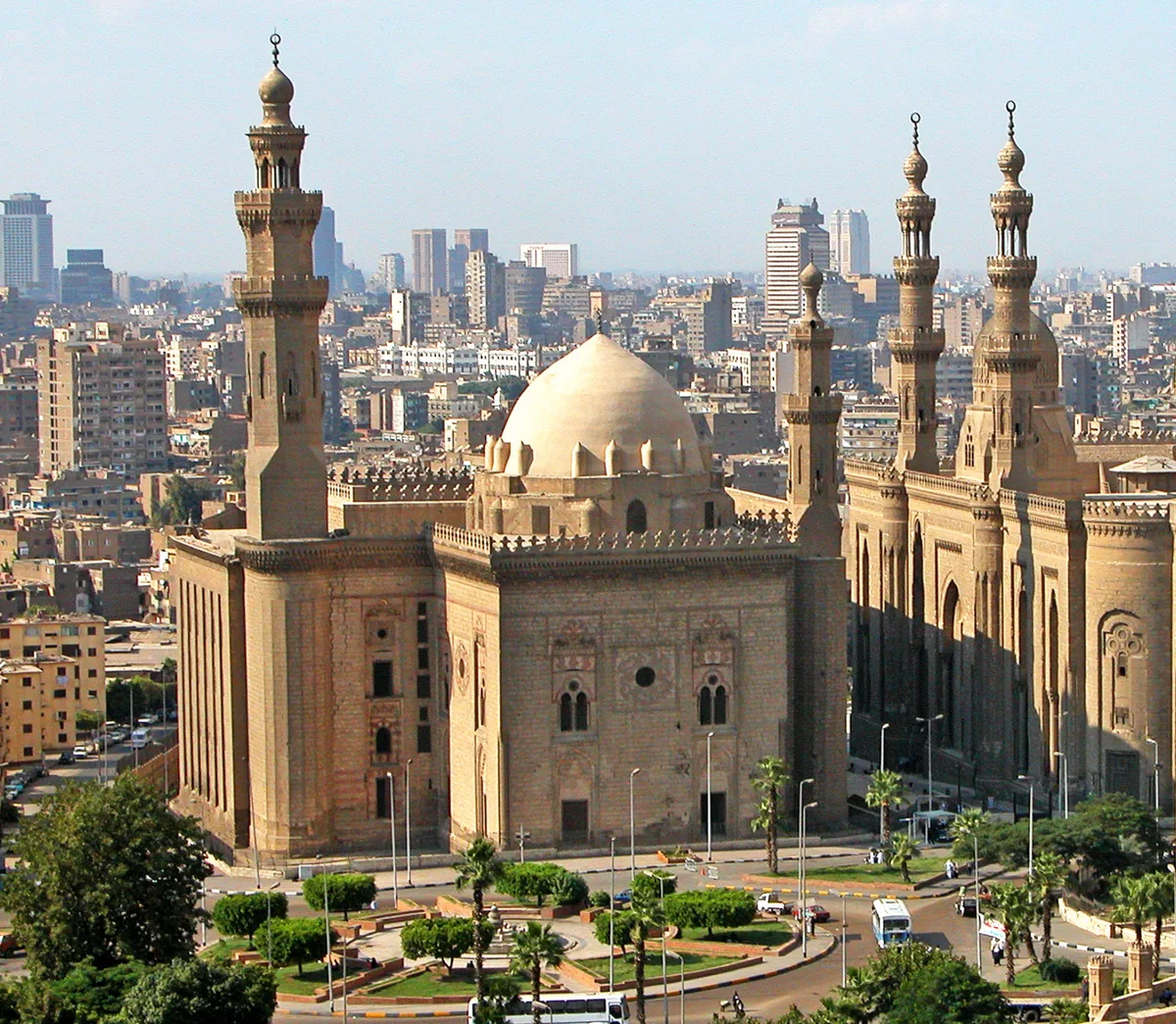
Photo: Dennis G. Jarvis / CC BY-SA 2.0
What Your Eye SeesA monumental Mamluk mosque with a towering 38-metre entrance portal, four iwans (vaulted halls) arranged around a central courtyard, and a striking striped masonry facade.
ContextBuilt between 1356 and 1363 under Sultan Hassan, the mosque-madrasa is considered the finest example of Mamluk architecture in Cairo and taught all four Sunni schools of law. Set in Salah al-Din Square below the Citadel, its cruciform plan centres on a vast courtyard with four towering iwans and four madrasas. Conceived on a colossal scale during repeated waves of the Black Plague, it remains among the largest medieval monuments in the Islamic world.
Source: UNESCO (Historic Cairo); Wikipedia (Mosque-Madrasa of Sultan Hassan)
DidYou
Know
The mosque's entrance portal rises 38 metres, the tallest of any medieval structure in Cairo. Construction was so ambitious that one of the four minarets collapsed, killing 300 people. Some of its stones were quarried from the Great Pyramid of Giza itself.
Share→ The Striped Walls
Courses of light and dark stone alternate across the walls in the ablaq technique, a hallmark of Mamluk architecture that turns plain masonry into a bold geometric pattern.
→ The Recycled Doors
The entrance's magnificent original bronze doors were taken in the early 15th century by a rival sultan, al-Mu'ayyad, to adorn his own mosque, where they remain to this day, a celebrated act of monument-robbing.
→ The Empty Tomb At The Qibla
The mausoleum in this complex stands directly behind the qibla wall, projecting out toward the Citadel, so worshippers pray facing it, an arrangement found in no other Mamluk religious building. Yet the tomb is empty: Sultan Hasan was assassinated in 1361 before the building was finished, and his body was never recovered. The chamber instead holds the remains of two of his sons.
Sources: Wikipedia (Mosque-Madrasa of Sultan Hasan)
Silk Road Legacy
Spiritual Seeker
7. Al-Azhar Mosque
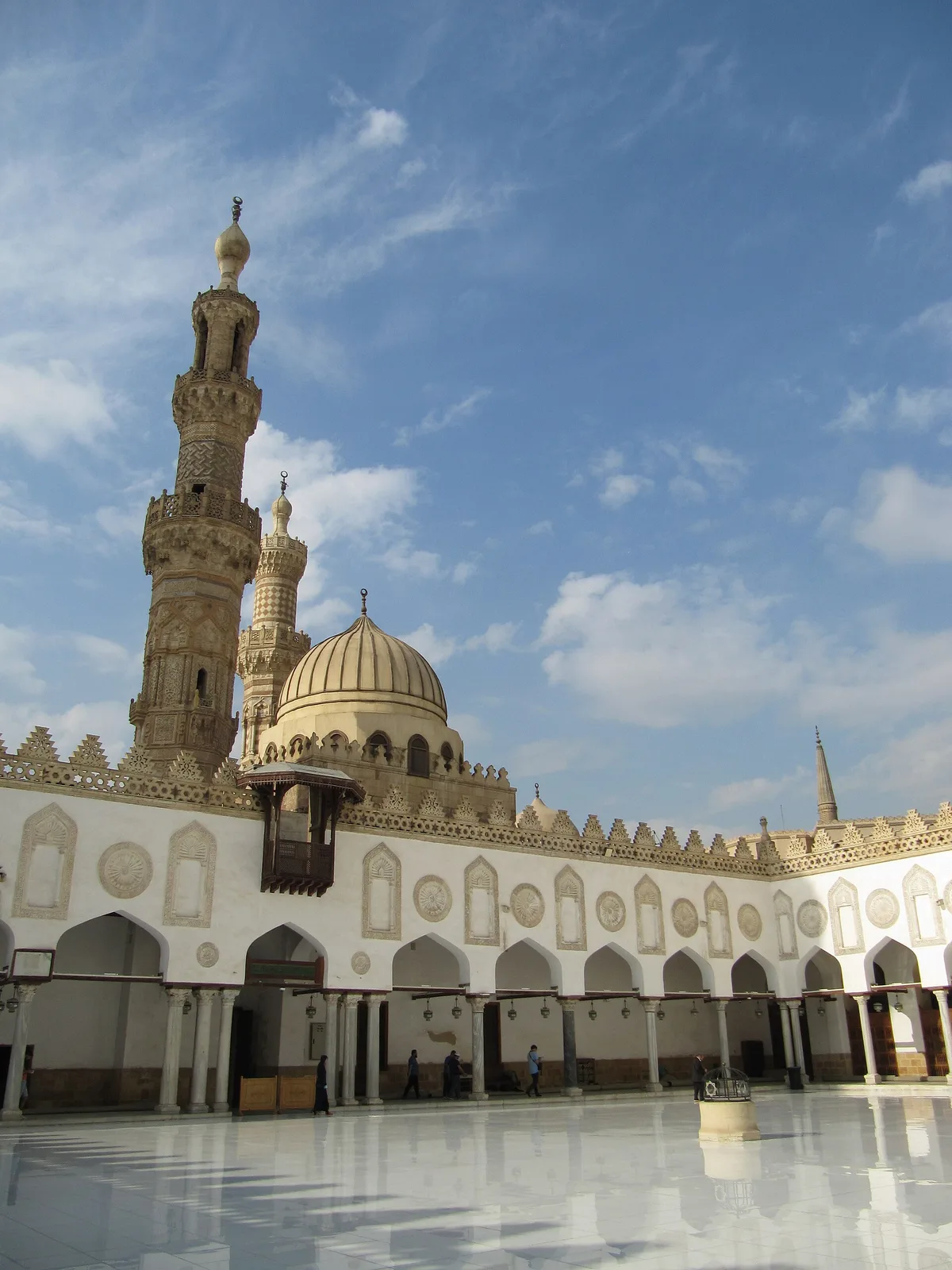
Photo: Wildoo78 / CC BY-SA 4.0
What Your Eye SeesA Fatimid-era mosque with multiple courtyards, five minarets from different periods, and a vast prayer hall with rows of marble columns.
ContextFounded in 972 AD by the Fatimid Caliphate, Al-Azhar is the oldest continuously operating university in the world. Commissioned by the general Jawhar al-Siqilli for Caliph al-Mu'izz after the founding of Cairo in 969, it was the city's first mosque and takes its name from Fatima al-Zahra. A centre of Islamic learning for over 1,050 years, its university was formally established in 988–989 with salaried teachers of law.
Source: UNESCO (Historic Cairo); Wikipedia (Al-Azhar Mosque)
DidYou
Know
Al-Azhar's teaching method has stayed unchanged for over 1,000 years: students sit in circles (halqas) around a sheikh in the courtyard, memorising classical texts by recitation before asking questions. A student who memorises the entire Quran receives an ijaza passed down in an unbroken chain.
Share→ Five Minarets, Five Centuries
Al-Azhar is unusual in that its five minarets are all different, added by different patrons across centuries, among them the Mamluk sultans Qaytbay and al-Ghuri, and the Ottoman amir Katkhuda in the 18th century. None date to the original Fatimid mosque, so the skyline is a layered record of the dynasties that followed.
Sources: Wikipedia (Al-Azhar Mosque); Archnet; Discover Islamic Art
Silk Road Legacy
Spiritual Seeker
8. Coptic Cairo (The Hanging Church)
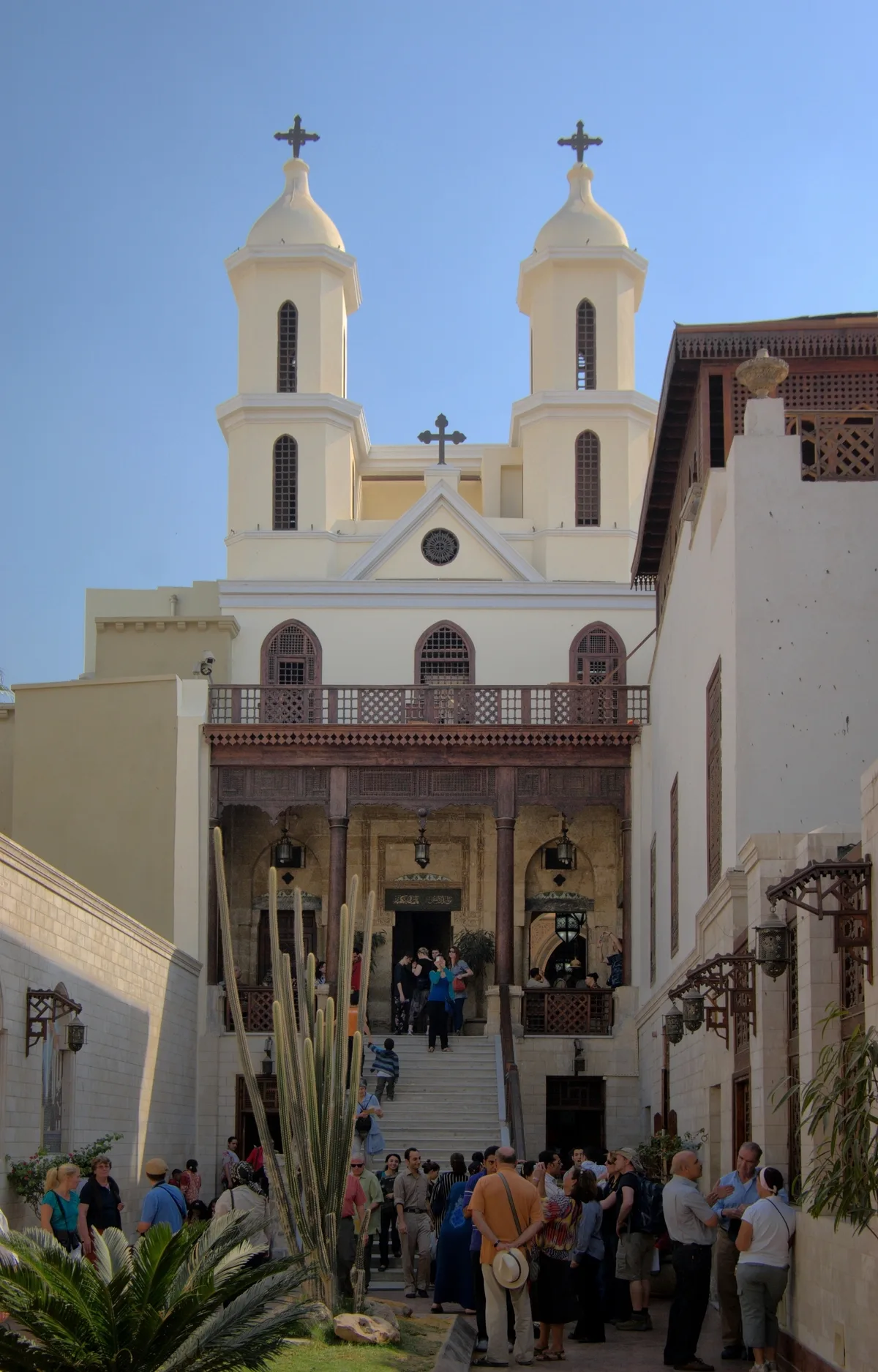
Photo: Berthold Werner / CC BY-SA 3.0
What Your Eye SeesA narrow church with a wooden roof shaped like Noah's Ark, 110 icons, and a marble pulpit supported by 13 columns. It is built above the stone gate of a Roman fortress.
ContextThe Hanging Church (al-Muallaqa) dates to the 3rd century and is dedicated to the Virgin Mary, making it one of the oldest Coptic churches in Egypt. It takes its name from its nave suspended above the southern gatehouse of the Babylon Fortress, the Roman citadel of Old Cairo. Rebuilt largely under Patriarch Abraham in the 10th century, it is reached by 29 steps, early travellers called it the Staircase Church, and its timber roof is shaped like Noah's Ark.
Source: UNESCO (Historic Cairo); Wikipedia (Hanging Church, Cairo)
DidYou
Know
The Hanging Church's nave is suspended over a Roman fortress gatehouse, built on top of the Babylon Fortress. The land surface has risen by about six metres since the Roman period, so the Roman tower is now mostly buried below ground, reducing the visual impact of the church's elevated position.
Share→ Over A Hundred Icons
The walls carry more than a hundred painted icons, spanning the 8th to the 18th centuries, including venerated images of the Virgin Mary and panels that reflect the church's long Coptic heritage.
Sources: Wikipedia (Hanging Church)
Ancient Roots
Spiritual Seeker
Why is the Sphinx nose missing?
The Great Sphinx’s nose was not shot off by Napoleon’s cannon, that is a popular myth. The 15th-century Arab historian al-Maqrizi records that in 1378 a Sufi zealot, Muhammad Sa’im al-Dahr, deliberately defaced the Sphinx’s face as an act of iconoclasm because local peasants were making offerings to it for better harvests. The broken nose (and the beard, now in the British Museum) reflects deliberate damage and centuries of weathering, not a single cannonball.
Was Cleopatra Egyptian or Greek?
Cleopatra VII was Macedonian Greek by descent: the Ptolemaic dynasty was founded by Ptolemy I, a general of Alexander the Great, and the family rarely spoke Egyptian. She was the first Ptolemaic ruler to learn the Egyptian language and ruled as a pharaoh in the eyes of her subjects. In 2026 the Cairo Scene documentary “Cleopatra: Her Real Story” revisited this with Egypt-based scholars, pushing back on foreign-cast portrayals. Her actual tomb has never been found and is believed to lie in Alexandria, not Cairo.
Why is the Hanging Church called hanging?
The Hanging Church (al-Muallaqa) in Coptic Cairo is named for its position above a gatehouse of the Roman Babylon Fortress, with its nave suspended over a passage. Built on the fortress's south bastions, it is approached by 29 steps, which led early travellers to call it the Staircase Church. The ground around it has risen about six metres since the Roman period, so the Roman tower that carries it is now mostly buried.
Why aren't the pyramids smooth anymore?
The pyramids of Giza were originally covered with polished white limestone from quarries at Tura, so their sides gleamed smoothly in the sun. Over the centuries most of these outer casing stones were stripped and reused to build the city of Cairo, and only a few remain at the bases of the pyramids today. In 1196 the Ayyubid sultan al-Malik al-Aziz, a son of Saladin, even tried to demolish the smallest pyramid, Menkaure, but gave up after eight months, leaving the huge vertical gash still visible on its north face.
How were the pyramid builders fed?
Archaeologists have excavated a settlement 400 metres south of the Sphinx called Heit el-Ghurab, or the Lost City of the Pyramid Builders, where the workforce lived. It included canteens, bakeries, breweries, grain silos and long galleries where workers slept. From the animal bones uncovered there, researchers estimate about 4,000 pounds of meat from cattle, sheep and goats was slaughtered every day to feed some 10,000 workers, alongside bread and beer.
These landmarks reward close attention. Vestigia is a field companion for people who look longer, with curated context, architectural detail, and the stories most visitors walk past. Free on the App Store and Google Play.