Kyoto Historical Landmarks
1. Kinkaku-ji (Golden Pavilion)
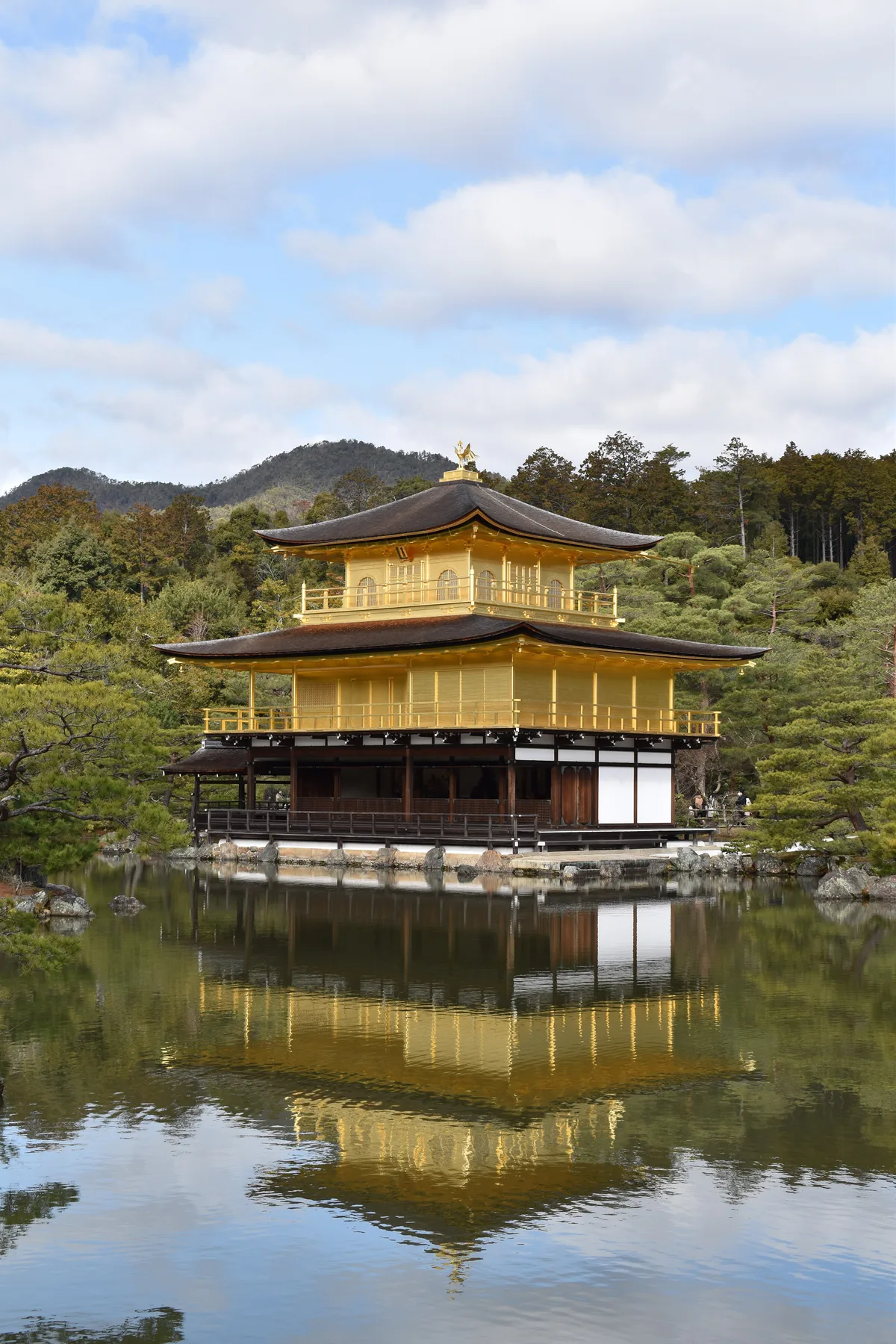
Photo: Nacaru / CC BY-SA 4.0
What Your Eye SeesA three-story pavilion entirely covered in gold leaf, reflected perfectly in a surrounding mirror pond set within a manicured garden.
ContextShogun Ashikaga Yoshimitsu built this as a retirement villa in 1397, deliberately blending three architectural styles across its three floors, Shinden aristocratic on the first, Bukke samurai on the second, and Zen temple on the third. The building was a political statement: one man claiming mastery over all three pillars of Japanese power.
Source: UNESCO (Historic Monuments of Ancient Kyoto); Wikipedia (Kinkaku-ji)
 Did
DidYou
Know
The pond before the pavilion, Kyōko-chi (Mirror Pond), was designed so the golden structure's reflection becomes part of the garden itself, a shakkei (borrowed scenery) technique. The original 1397 Muromachi garden layout survives intact, and the building uses 20 kilograms of gold leaf across the upper storeys.
Share→ The Bronze Phoenix
Perched on the very peak of the roof, a gilded phoenix, the hōō, turns its back on the city and gazes south. It is one of the few original elements to have survived the 1950 fire: the ornament had been taken down for repairs just before the blaze, and it was later re-created for the rebuilt pavilion.
→ The Cypress-Shingled Roof
From the viewing terrace the pavilion reads as solid gold, but the roofs are not gilded: they are shingled with countless thin planks of sawara cypress, weathered dark against the gleam of the storeys below. It is the one part of the famous silhouette most visitors pass without ever looking at.
Sources: Wikipedia; sacred-japan.net; Shokoku-ji (official Kinkaku-ji guide)
 Eastern Spirit
2. Fushimi Inari Taisha
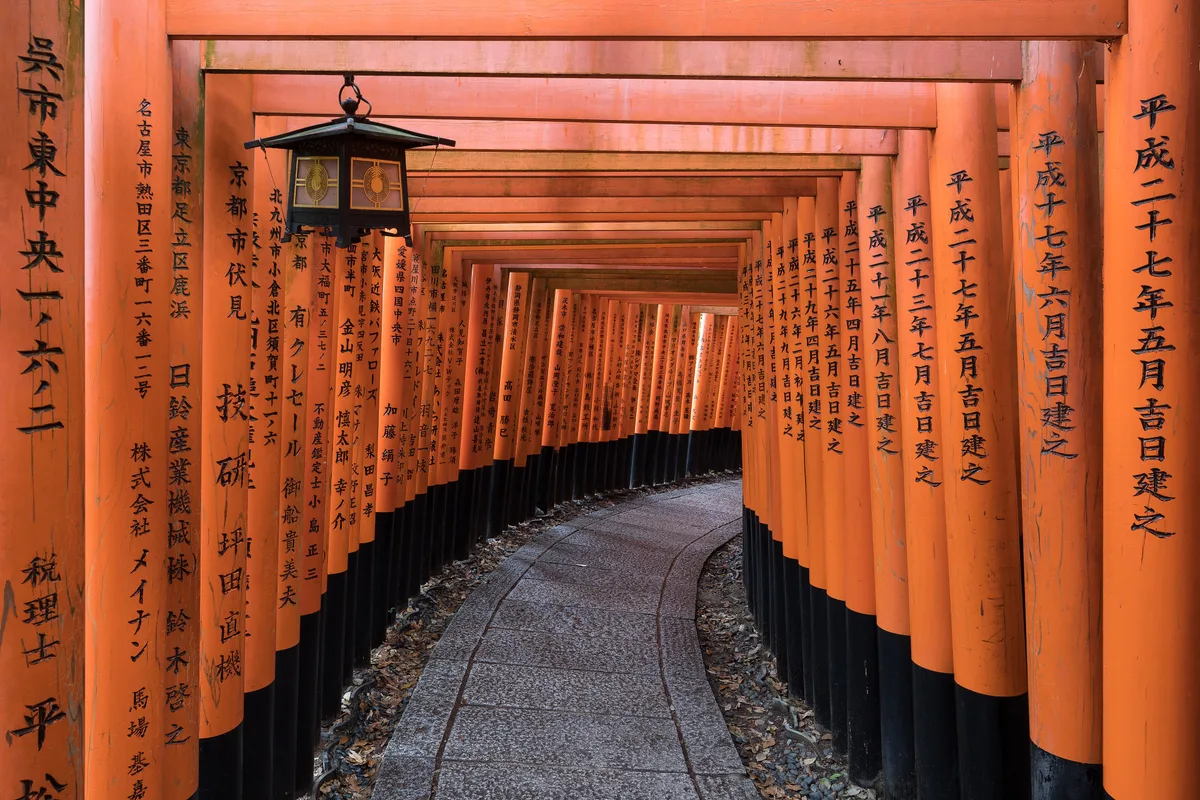
Photo: Basile Morin / CC BY-SA 4.0
What Your Eye SeesThousands of vermilion torii gates forming continuous tunnels that climb up the forested slopes of Mount Inari.
ContextFounded in 711 AD, this shrine predates Kyoto itself as a capital city. Inari is the deity of rice, commerce, and prosperity, the three forces that built Japan's merchant class. As trade expanded, businesses began donating torii gates as thank-you offerings, turning a modest hilltop shrine into an ever-growing corridor of commercial gratitude.
On ScreenFushimi Inari's vermilion torii gates appear in the film Memoirs of a Geisha (2005).
Source: UNESCO (Historic Monuments of Ancient Kyoto); Wikipedia (Fushimi Inari Taisha); Wikipedia (Fushimi Inari Taisha); Memoirs of a Geisha production notes
DidYou
Know
Each of the roughly 10,000 torii gates bears the donor's name and date on the back. The gates are not permanent, they are replaced every couple of decades as they weather, so the tunnel you walk through today is an entirely different structure than the one standing 30 years ago.
Share→ The Fox Messengers
Look at the rows of fox statues (kitsune), Inari's divine messengers, many clutch a different object in their mouth: a key (to the granaries), a jewel, a scroll, or a rice sheaf. Watch the mouths along the main approach.
→ The Miniature Gates
Look along the trail at the small shrines for stacks of hand-sized torii, donated by individual worshippers. Beside the company-funded tunnels near the base, where a single full-size gate starts around 400,000 yen, the miniatures show the same donation tradition scaled to a personal offering.
→ The Hideyoshi Gate
The two-storey Romon Gate at the shrine's entrance was donated in 1589 by Toyotomi Hideyoshi, the warlord who briefly united Japan, a gift from the country's most powerful man. Painted in the same bright vermilion as the torii tunnels behind it, it looms over the approach that most visitors hurry past.
Sources: Wikipedia; japan-guide.com; Wikipedia (Fushimi Inari Taisha)
 Spiritual Seeker
3. Kiyomizu-dera
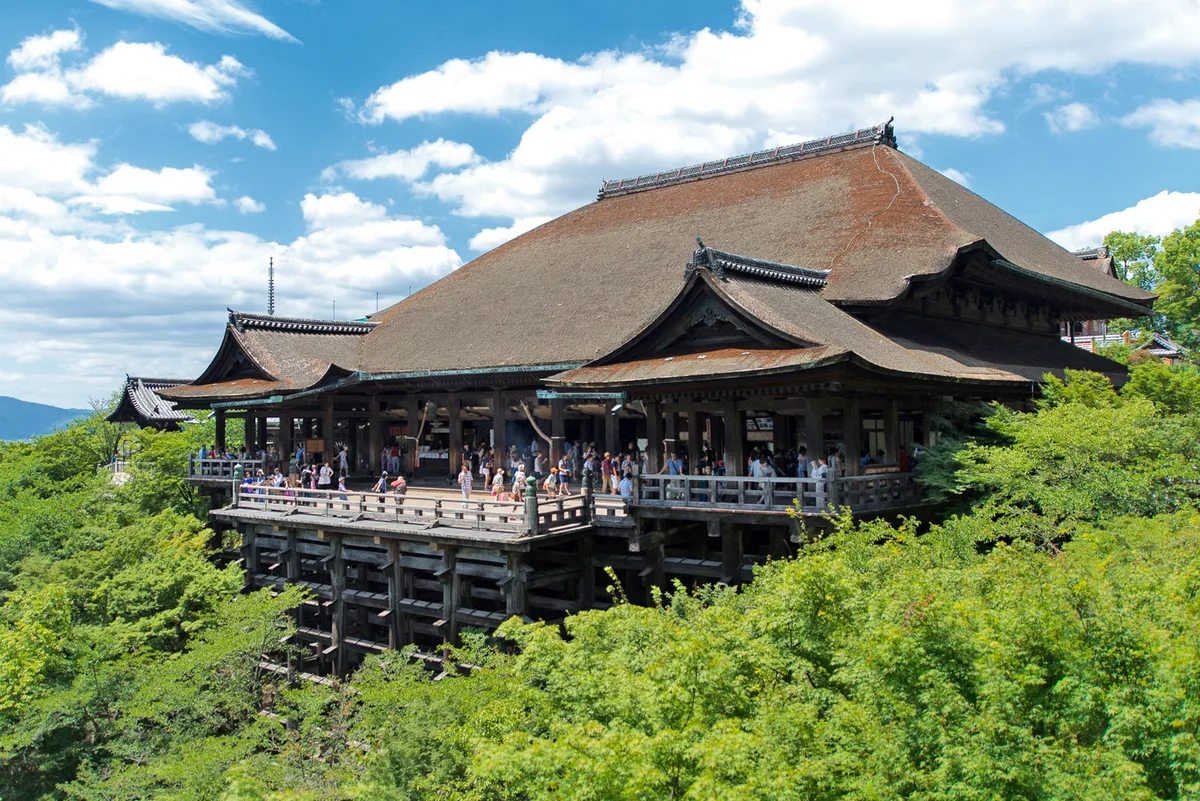
Photo: Jordy Meow / CC BY-SA 3.0
What Your Eye SeesA massive wooden temple perched on a hillside, its famous stage extending outward over a steep ravine supported by a forest of wooden pillars.
ContextThe temple takes its name from the Otowa waterfall ("kiyomizu" means pure water) that flows beneath the main hall. Founded in 778 AD, it has been destroyed and rebuilt multiple times. The current structure dates to 1633, ordered by Shogun Tokugawa Iemitsu during a period of political consolidation where temple reconstruction served as a display of Shogunate authority.
The Tokugawa hand that ordered this rebuild reached Edo as well: Zojo-ji became the family temple and Ueno Toshogu enshrines Ieyasu as a deity.
On ScreenKiyomizu-dera's pagoda features in the film Memoirs of a Geisha (2005).
Source: UNESCO (Historic Monuments of Ancient Kyoto); Wikipedia (Kiyomizu-dera); Wikipedia (Kiyomizu-dera); Memoirs of a Geisha production notes
DidYou
Know
The main stage is supported by 139 massive zelkova pillars assembled without a single nail, using only traditional joinery. The Japanese expression "jumping off the stage at Kiyomizu" means taking the plunge, during the Edo period, 234 people actually jumped from the 13-metre stage as an act of faith.
Share→ The Niōmon Guardians
Look up as you pass through the Niōmon, the temple's two-storey main gate, where a pair of fierce guardian figures, the Niō, glare down with coiled muscles. One mouth is open (the cosmic 'A'), the other closed ('Un'), together standing for the beginning and end of all things.
→ The Three Streams
The Otowa waterfall spouts three separate steams, each said to confer a different blessing, longevity, study, and love. Visitors drink from just one, and the length of the queue under the worn bamboo cups tells you which is most sought after.
Sources: Wikipedia; foresyteapp.com
Eastern Spirit
4. Nijo Castle
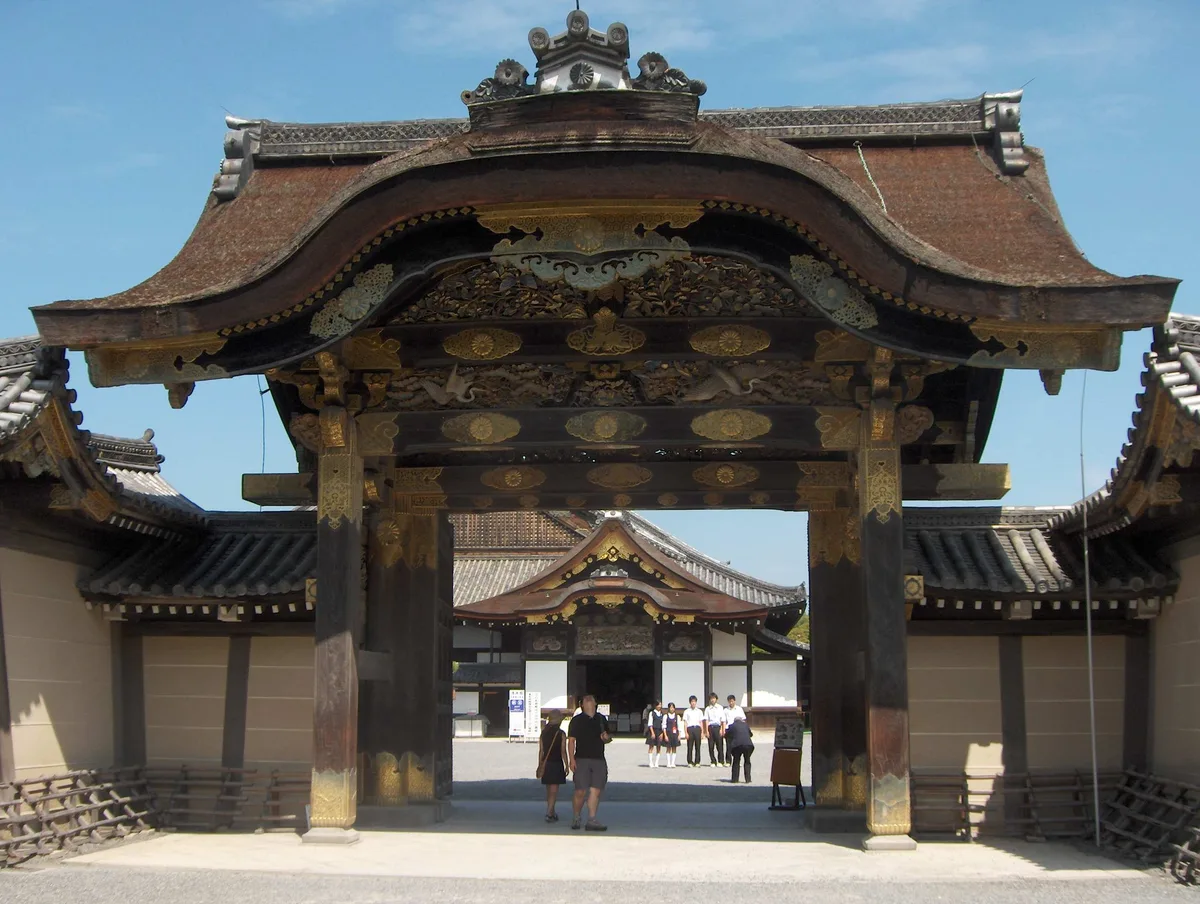
Photo: Unknown (public domain) / Public domain
What Your Eye SeesA sprawling castle complex surrounded by stone walls and wide moats, with ornate carved wooden gates and low-profile palace buildings inside.
ContextTokugawa Ieyasu built Nijo Castle in 1603 as a Kyoto headquarters for the Shogunate, a direct power statement placed inside the Emperor's own capital city. The castle was designed not primarily for military defense but for political intimidation: its interiors are meant to overwhelm visiting feudal lords with displays of wealth and artistic mastery.
Ieyasu's Shogunate also anchored Edo, Zojo-ji served as the Tokugawa family temple and Ueno Toshogu enshrines him as a god.
On ScreenNijo-jo Castle served as the Emperor Meiji palace exterior in The Last Samurai (2003), with court scenes shot around its Ninomaru grounds.
Source: UNESCO (Historic Monuments of Ancient Kyoto); Wikipedia (Nijō Castle); IMDb (The Last Samurai); movie-locations.com
DidYou
Know
The Ninomaru Palace's corridors have 'nightingale floors' (uguisubari): boards that chirp when walked on because metal clamps rub against nails beneath. Long told as a deliberate anti-intruder alarm, the castle's own signage now states the singing sound arose by chance from wear, not by design.
Share→ The Karamon Gate
The entrance to Ninomaru Palace is the Karamon, a Chinese-style gate with a sweeping gabled roof and panels crowded with carvings, dragons and tigers, cranes, turtles and butterflies set on a ground of gold. It is among the most lavishly decorated gates in Japan, and was moved here from Fushimi Castle in 1626.
→ A Palace Of Paintings
Look at the walls of Ninomaru Palace, covered in large-scale Kanō school paintings on gold-leaf grounds, each reception room decorated to match the rank of the visitor it received, the most lavish chambers reserved for the shogun himself.
→ The Hidden Hollyhock
The Tokugawa family crest, a triple hollyhock leaf (mitsuba aoi), still appears on the Karamon's roof-end tiles and metal fittings. After the Meiji Restoration the clan's emblem was removed wherever possible and replaced with the imperial chrysanthemum, yet restoration work found traces of the old hollyhock still hidden beneath the new crest.
Sources: Wikipedia; Nijo Castle official; leafkyoto.net
Eastern Spirit
5. Ginkaku-ji (Silver Pavilion)
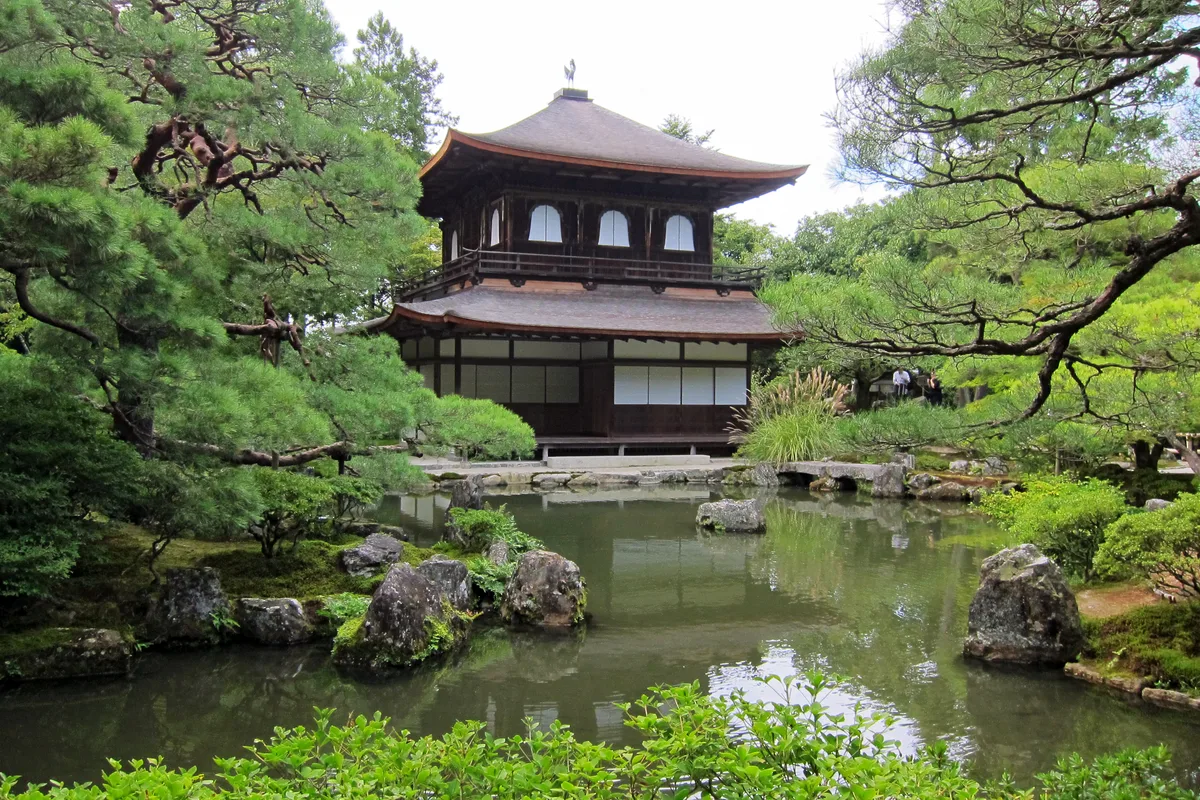
Photo: Oilstreet / CC BY 2.5
What Your Eye SeesA modest, dark-wood two-story pavilion beside a meticulously raked sand garden and a sculpted sand cone known as the Moon Viewing Platform.
ContextShogun Ashikaga Yoshimasa built this in 1482 as a deliberate counterpoint to his grandfather's Golden Pavilion. While the Golden Pavilion celebrated material excess, the Silver Pavilion embraced the aesthetic of wabi-sabi, beauty in imperfection and restraint. Yoshimasa never actually covered the pavilion in silver; the name came later as a contrast to its golden sibling.
Source: UNESCO (Historic Monuments of Ancient Kyoto); Wikipedia (Ginkaku-ji)
DidYou
Know
Yoshimasa built this retreat while Kyoto burned in the Ōnin War. He withdrew from governing to pursue tea ceremony, flower arrangement, and ink painting while his capital collapsed around him. The pavilion is the monument to one ruler's choice of aesthetics over politics, a choice that shaped Japanese art for 500 years.
Share→ The Moon Viewing Cone
Look at the conical mound of sand before the pavilion, the Kogetsudai, traditionally said to catch the moonlight; the sand is mixed with crushed mica, whose faint glint makes the mound glow softly in the dark.
→ The Daily Ritual Of Sand
Look at the flat 'Sea of Silver Sand' (Ginshadan) and the cone beside it, kept in perfect form by careful raking, a task the temple maintains so precisely that the surface reads as freshly made, a discipline at the very heart of the garden's aesthetic.
Sources: Wikipedia
Eastern Spirit
6. Arashiyama Bamboo Grove & Tenryu-ji
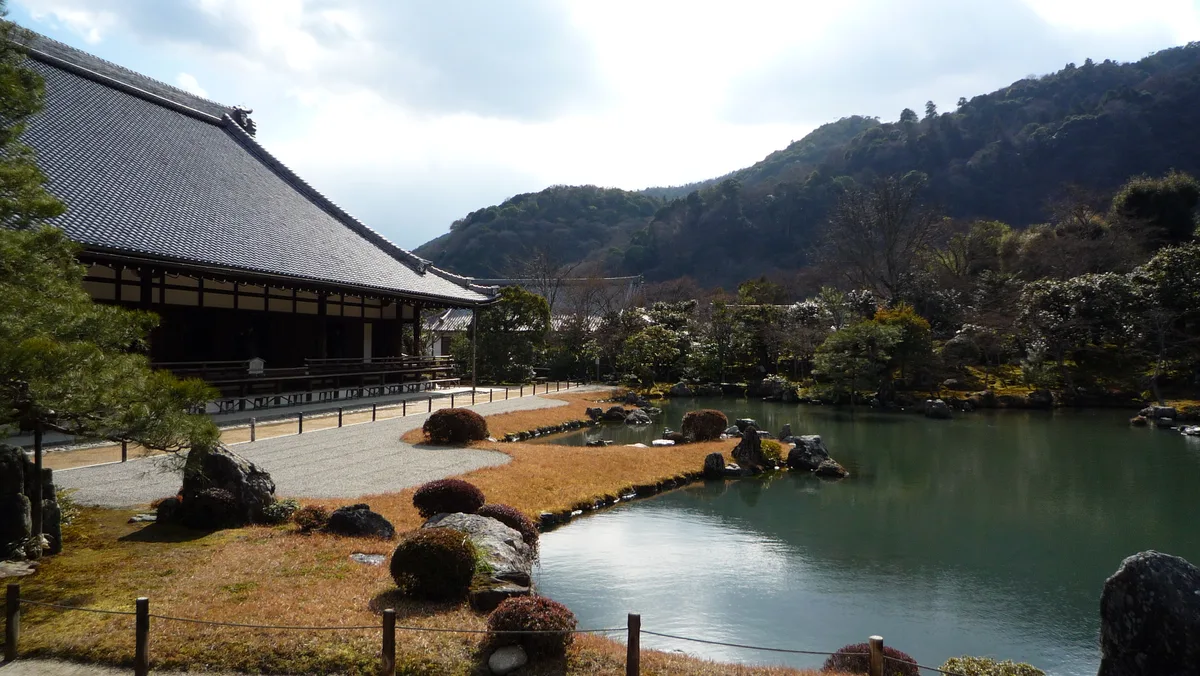
Photo: osakaosaka / CC BY-SA 3.0
What Your Eye SeesTowering bamboo stalks forming a natural green tunnel, leading to the Zen temple of Tenryu-ji and its celebrated garden overlooking the Arashiyama mountains.
ContextTenryu-ji was founded in 1339 by Shogun Ashikaga Takauji to appease the spirit of Emperor Go-Daigo, whom he had overthrown. Building a grand Zen temple to pacify a political rival's ghost was standard practice in medieval Japan, spiritual diplomacy conducted through architecture instead of warfare.
Source: UNESCO (Historic Monuments of Ancient Kyoto); Wikipedia (Tenryū-ji)
DidYou
Know
The Sōgenchi garden at Tenryu-ji was designed by Zen monk Musō Soseki, who used shakkei (borrowed scenery), incorporating the Arashiyama mountains as part of the composition. The garden has no rear boundary wall precisely because the mountains serve as the backdrop. This 14th-century trick predated Western 'vista gardening' by three centuries.
Share→ The Living Grove
The bamboos of the Arashiyama grove are moso bamboo, whose stalks can shoot up many metres in a single damp season from the underground network of rhizomes, a grove that never stops renewing itself.
→ The Cloud Dragon Ceiling
Above the Hatto (Dharma Hall), a vast cloud dragon painted by Kayama Matazō in 1997 stretches across 159 cypress panels laid flat on the ceiling. It is rendered in the happō nirami style, 'staring in eight directions', so that its eyes appear to follow you wherever you stand in the hall.
Sources: Wikipedia; tenryuji.com (official); Wikipedia (Tenryū-ji)
 Green Soul
Why is Kyoto's Golden Pavilion covered in gold?
Because its builder wanted a political statement. Shogun Ashikaga Yoshimitsu built the pavilion in 1397 as a retirement villa, deliberately blending three architectural styles, Shinden aristocratic on the first floor, Bukke samurai on the second, and Zen temple on the third, claiming mastery over all three pillars of Japanese power. The upper storeys are covered in 20 kilograms of gold leaf, and the pond in front was designed so the golden reflection becomes part of the garden itself.
How many torii gates does Fushimi Inari Taisha have?
Roughly 10,000, in the tunnels that climb the hillside above the shrine. Each gate bears the donor's name and date on the back, and businesses have donated them for centuries as thank-you offerings to Inari, the deity of rice, commerce and prosperity. The gates are not permanent: they are replaced every couple of decades as they weather, so the tunnel you walk today is an entirely different structure than the one standing 30 years ago. The shrine was founded in 711, before Kyoto itself was a capital.
These landmarks reward close attention. Vestigia is a field companion for people who look longer, with curated context, architectural detail, and the stories most visitors walk past. Free on the App Store and Google Play.