Mexico City Historical Landmarks
1. Metropolitan Cathedral
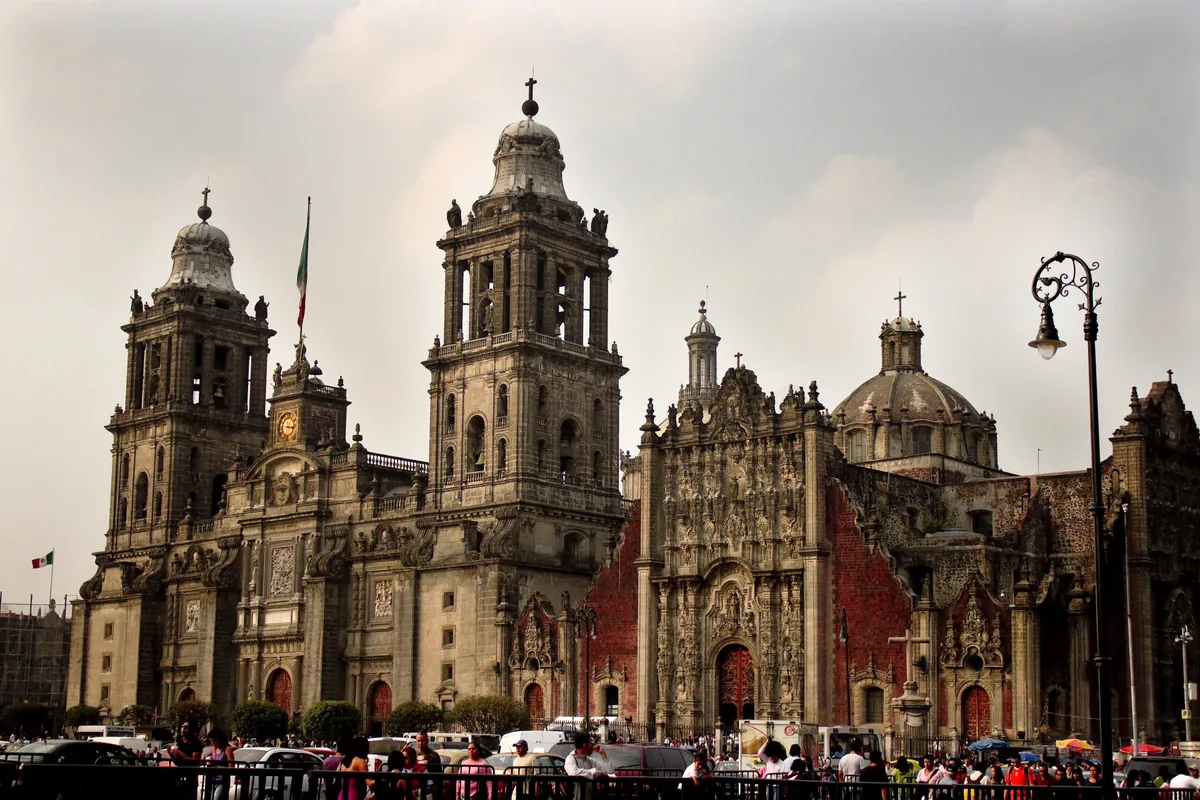
Photo: Ulisesmorales / CC BY-SA 3.0
What Your Eye SeesA colossal cathedral dominating the Zócalo with twin bell towers, a central dome, and a facade combining Gothic, Baroque, and Neoclassical elements. Its massive stone walls seem to shift under their own weight.
ContextBuilt between 1573 and 1813 on the site of the Aztec Templo Mayor, the Metropolitan Cathedral is the oldest and largest cathedral in the Americas. Designed by Claudio de Arciniega, it was raised from stone salvaged off the demolished Aztec precinct over 240 years, blending Renaissance, Baroque, and Neoclassical styles. Inside stand two of the largest 18th-century pipe organs in the hemisphere.
The cathedral took so long to build that two centuries of colonial work overlap its stone: begun in 1573, it was finished only in 1813, when Mexico's War of Independence was already spreading across the colony.
Source: UNESCO (Historic Centre of Mexico City); Wikipedia (Mexico City Metropolitan Cathedral)
 Did
DidYou
Know
By the early 1990s one corner of the cathedral had dropped about 2.4 metres more than its neighbours, so engineers turned the problem around with a technique called underexcavation: between 1993 and 1998 they removed some 4,220 cubic metres of clay from beneath the higher corners so the whole stone mass could settle back toward level. Visitors now walk a building that was, in effect, carefully levelled from underneath.
ShareThe Sagrario Next Door
Fused to the cathedral's east side is the Sagrario Metropolitano parish church, built between 1749 and 1768. Its exuberant churrigueresque facade, crowded with estípite columns, is considered one of the finest achievements of Mexican Baroque.
Sixteen Chapels And A Gilded Altar
The long interior is lined with sixteen side chapels, each with its own history and altars. Behind the main altar rises the Altar de los Reyes, a gilded Churrigueresque reredos carved in cedar in the 18th century.
Bell-Shaped Roofs Over The Zócalo
From the Zócalo, look up past the clock to where the two towers end in bell-shaped roofs of tezontle, a porous volcanic stone cased in chiluca, a paler local masonry stone. Between the towers hang 25 bells, 18 of them packed into the east tower and only seven in the west.
Sources: Wikipedia (Sagrario Metropolitano); Wikipedia (Mexico City Metropolitan Cathedral); Catedral Metropolitana
 Euro Heritage
 Baroque Master
 Spiritual Seeker
2. Templo Mayor
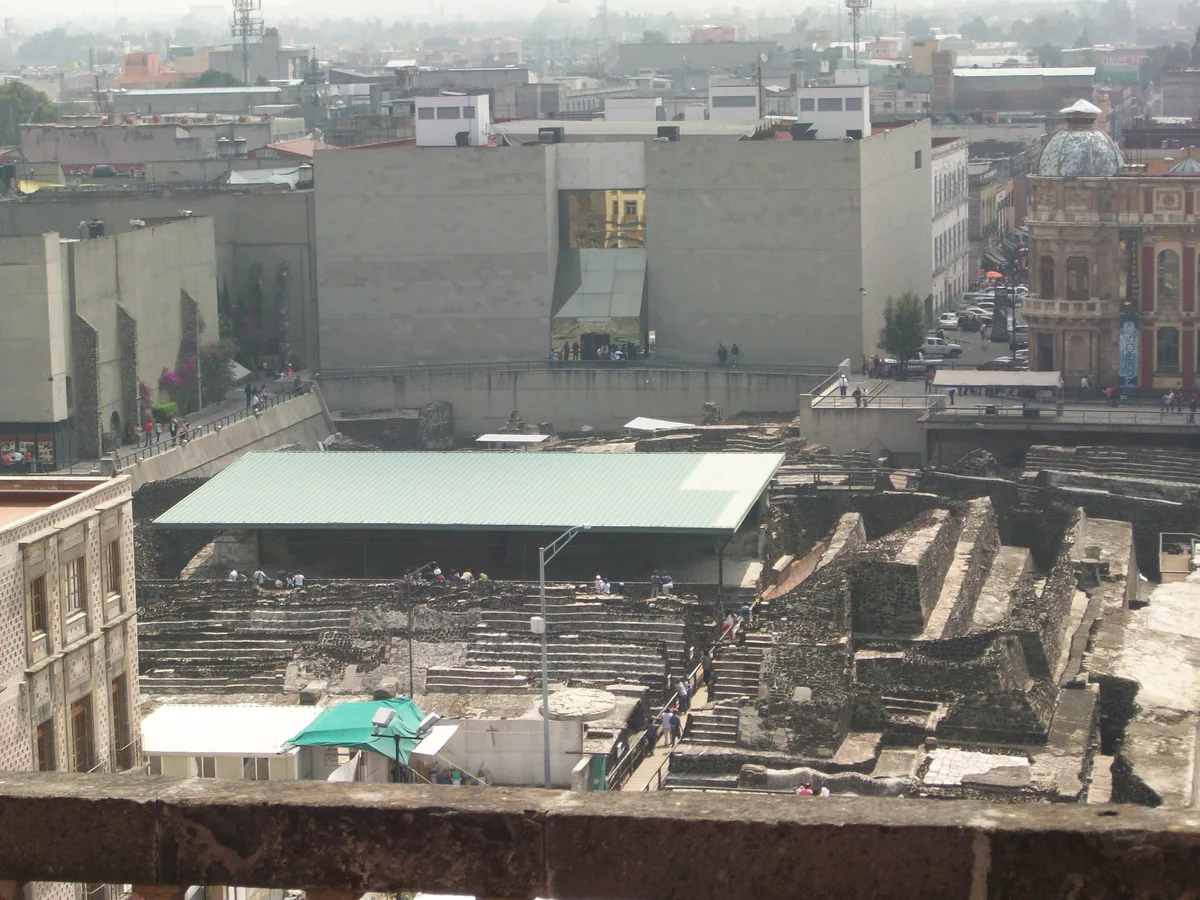
Photo: GAED / CC BY-SA 3.0
What Your Eye SeesAn excavated Aztec pyramid complex in the heart of downtown, with tiered platforms, stone serpent heads, and the remains of twin temples at its summit, surrounded by colonial buildings.
ContextThe Templo Mayor was the spiritual and political heart of Tenochtitlan, the Aztec capital founded in 1325. Destroyed by Hernán Cortés in 1521, its ruins were buried beneath the new Spanish city and forgotten for nearly 500 years. Its greatest enlargement came under Moctezuma I in the mid-15th century, raising a twin shrine to the gods of war and rain.
Source: UNESCO (Historic Centre of Mexico City); Wikipedia (Templo Mayor)
DidYou
Know
The Templo Mayor was rediscovered by accident in 1978 when electrical workers hit a massive Aztec monolith, the Coyolxauhqui Stone, triggering one of the 20th century's most dramatic excavations. The Aztecs had built seven successive temples on the same spot, one over the previous.
Share→ Twin Stairs, Twin Shrines
Two staircases still climb side by side up the great pyramid, each once led to a separate shrine on the summit: the rain god Tlaloc's on the left, and Huitzilopochtli's, the god of war and the sun, on the right. The shrines themselves are long gone, but the twin stairways preserve the temple's dual design.
→ The Serpents At The Foot Of The Stairs
Beside the base of the great staircase stand four carved serpent heads, while at the platform's ends two long undulating serpents keep traces of their original colour. They represent Quetzalcóatl, the feathered serpent, whose image flanked Aztec temple stairways throughout the city.
→ A Skull Rack In The Precinct
The surrounding ceremonial precinct also held a tzompantli, or skull rack, on which victims' heads were displayed. Excavations in the 2010s revealed a neighbouring tower built from hundreds of human skulls.
Sources: Wikipedia (Templo Mayor); INAH; INAH (Templo Mayor)
 New World
3. Palacio de Bellas Artes
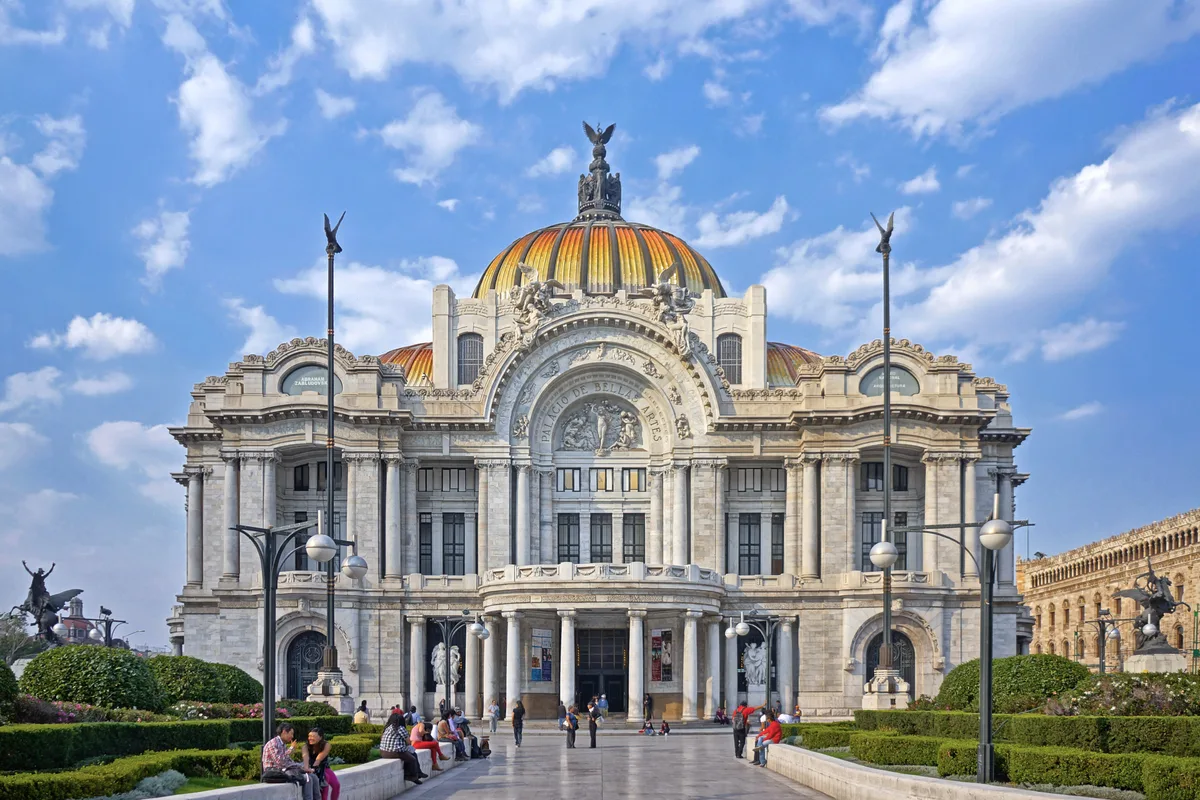
Photo: Xavier Quetzalcoatl Contreras Castillo / CC BY-SA 3.0
What Your Eye SeesA stunning white marble palace with an Art Nouveau exterior and Art Deco interior, topped by a yellow-tiled dome and bronze sculptures. Its translucent curtain stage curtain shows the Valley of Mexico.
ContextConstruction began in 1904 under Porfirio Díaz and was completed in 1934, interrupted by the Mexican Revolution. Designed by Italian architect Adamo Boari, the palace is Mexico's premier cultural venue, staging opera and ballet and displaying murals by Diego Rivera at the heart of the Alameda park.
Source: UNESCO (Historic Centre of Mexico City); Wikipedia (Palacio de Bellas Artes)
DidYou
Know
The Palacio de Bellas Artes has sunk some four metres into the soft clay of the old lakebed since 1904, so the main entrance now sits below street level. It stacks two eras in one building: an Art Nouveau exterior and an Art Deco interior. Its curtain, made by Tiffany Studios, weighs more than twenty tonnes.
Share→ Wrapped In Carrara Marble
The entire exterior is clad in Italian Carrara marble, which gives the palace its distinctive white sheen and set it apart from neighbouring buildings.
→ Rivera's Rebuilt Mural
Upstairs hangs Diego Rivera's 'El Hombre, Controlador del Universo', a re-creation of the mural the Rockefeller family destroyed in New York in 1934 because Rivera had painted Lenin into it.
→ The Winged Horses Of The Plaza
On the esplanade in front of the palace stand four Pegasus statues by the Catalan sculptor Agustí Querol Subirats. They originally stood in the Zócalo before being moved here as part of Boari's design for the plaza.
Sources: Wikipedia (Palacio de Bellas Artes); Wikipedia (Palacio de Bellas Artes; Man at the Crossroads); Mexico City government
 Renaissance
 Modernist
4. Chapultepec Castle
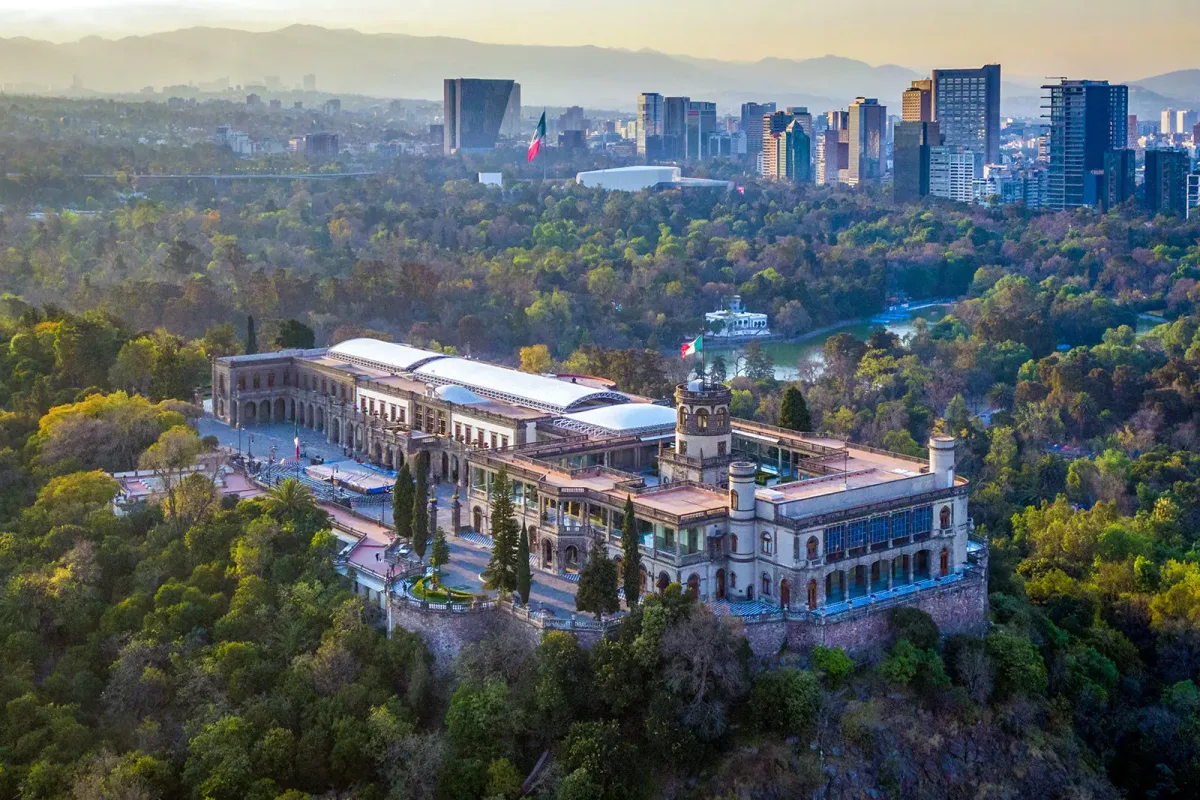
Photo: Sisgeo / CC BY-SA 4.0
What Your Eye SeesA grand palace atop a wooded hill, with a neoclassical facade, manicured gardens, and panoramic views of the sprawling city below.
ContextConstruction began in 1785 under Viceroy Bernardo de Gálvez as a summer residence for the viceroys of New Spain. It later served as a military academy, the home of Emperor Maximilian I and Empress Carlota during the Second Mexican Empire (1864–1867), and the presidential residence until 1934, when it became the National Museum of History.
Maximilian I was the Austrian archduke Ferdinand Maximilian, who before taking the Mexican throne had launched the public fund that built a church of thanksgiving in Vienna, the Votivkirche, after his brother was attacked in 1853.
Source: Wikipedia (Chapultepec Castle); Britannica
DidYou
Know
Chapultepec Castle is one of only two royal palaces in North America to house reigning monarchs, Emperor Maximilian I and Empress Carlota lived here during the short-lived Second Mexican Empire (1864–1867). After his execution, Carlota spent her remaining 60 years in seclusion in a Belgian castle.
Share→ The Altar At The Foot Of The Hill
At the entrance to Chapultepec Park stands the Altar a la Patria (1952): six Carrara marble columns crowned with bronze eagles, honouring the Niños Héroes, the cadets who died defending the castle in the 1847 battle. In the central relief a figure of 'La Patria' cradles a fallen cadet, both wrapped in the Mexican flag, echoing the famous legend of the last defender.
→ A Garden On The Roof
Maximilian had the botanist Wilhelm Knechtel lay out a garden on the castle's roof for him and Carlota. The rooftop garden survives today, a calm space of plants and fountains with sweeping views over Chapultepec Park and the city.
→ A Mural Across The Stairs
The castle's grand staircase carries David Alfaro Siqueiros's 'Del Porfirismo a la Revolución' (1957–1966), a panorama almost 77 metres wide that sweeps up the stairway walls, one of the largest murals in Mexico.
Sources: Wikipedia (Monumento a los Niños Héroes); Bosque de Chapultepec; Wikipedia (Chapultepec Castle); INAH (National Museum of History)
Euro Heritage
5. Teotihuacán, Pyramid of the Sun
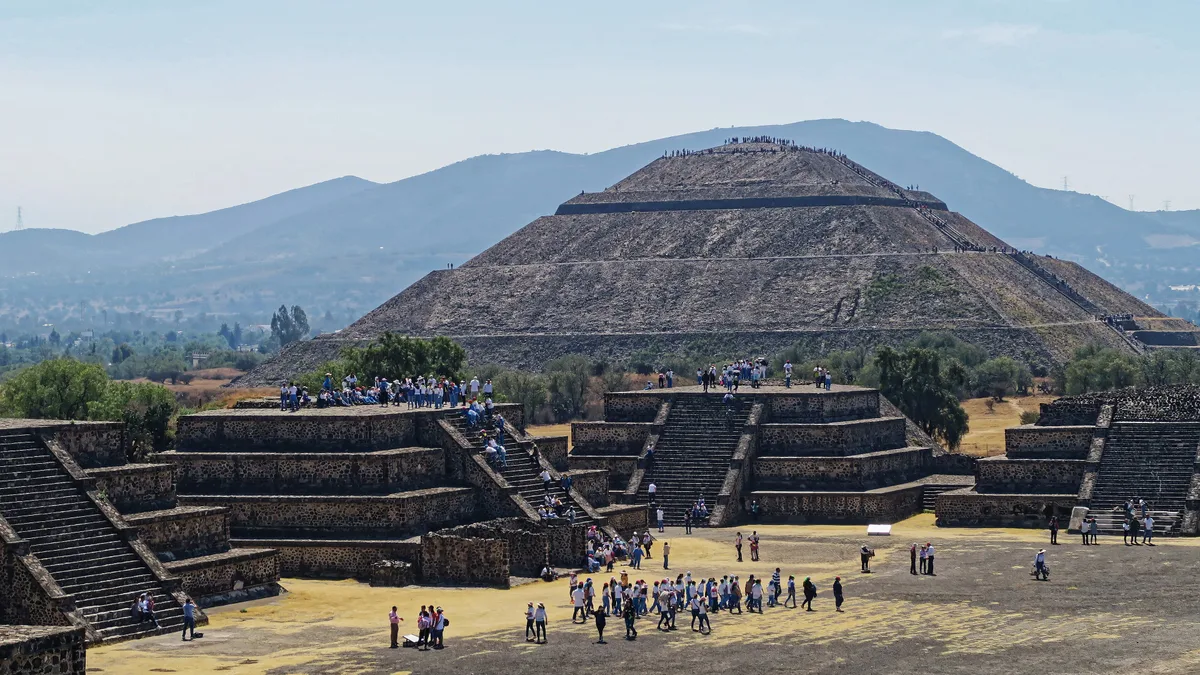
Photo: Burkhard Mücke / CC BY-SA 4.0
What Your Eye SeesA monumental stepped pyramid rising 65 metres above the Avenue of the Dead, flanked by the smaller Pyramid of the Moon and the vast Ciudadela complex, all set against a ring of mountains.
ContextBuilt around 100 CE, Teotihuacán was one of the largest cities of the ancient world, home to an estimated 100,000–200,000 people. The Pyramid of the Sun, among the largest structures of the Americas and the third-largest pyramid in the New World, dominates its central axis, the Avenue of the Dead. The city was mysteriously abandoned around 750 CE.
On ScreenThe Pyramid of the Sun was a filming location for the film Frida (2002).
Source: UNESCO (Pre-Hispanic City of Teotihuacán); Wikipedia (Teotihuacán); Wikipedia (Teotihuacan); Frida (2002) production notes
DidYou
Know
Beneath the Pyramid of the Sun lies a natural cave-tunnel that the builders reshaped and roofed over as a sacred space, its existence hidden until archaeologists found it in 1971.
Share→ One City, One Grid
The whole metropolis was laid out on a rigid, oriented grid around its north-south spine, the Avenue of the Dead, with the major plazas and pyramids placed on it, among the most formal urban plans in the ancient world.
→ A Controversial Restoration
In 1910, archaeologist Leopoldo Batres oversaw a reconstruction of the pyramid for Mexico's centennial celebrations. The work reshaped the ruin into the stepped tiers seen today, a restoration that scholars have long argued about.
Sources: Wikipedia (Teotihuacan); Wikipedia (Pyramid of the Sun)
New World
6. Frida Kahlo Museum (Casa Azul)
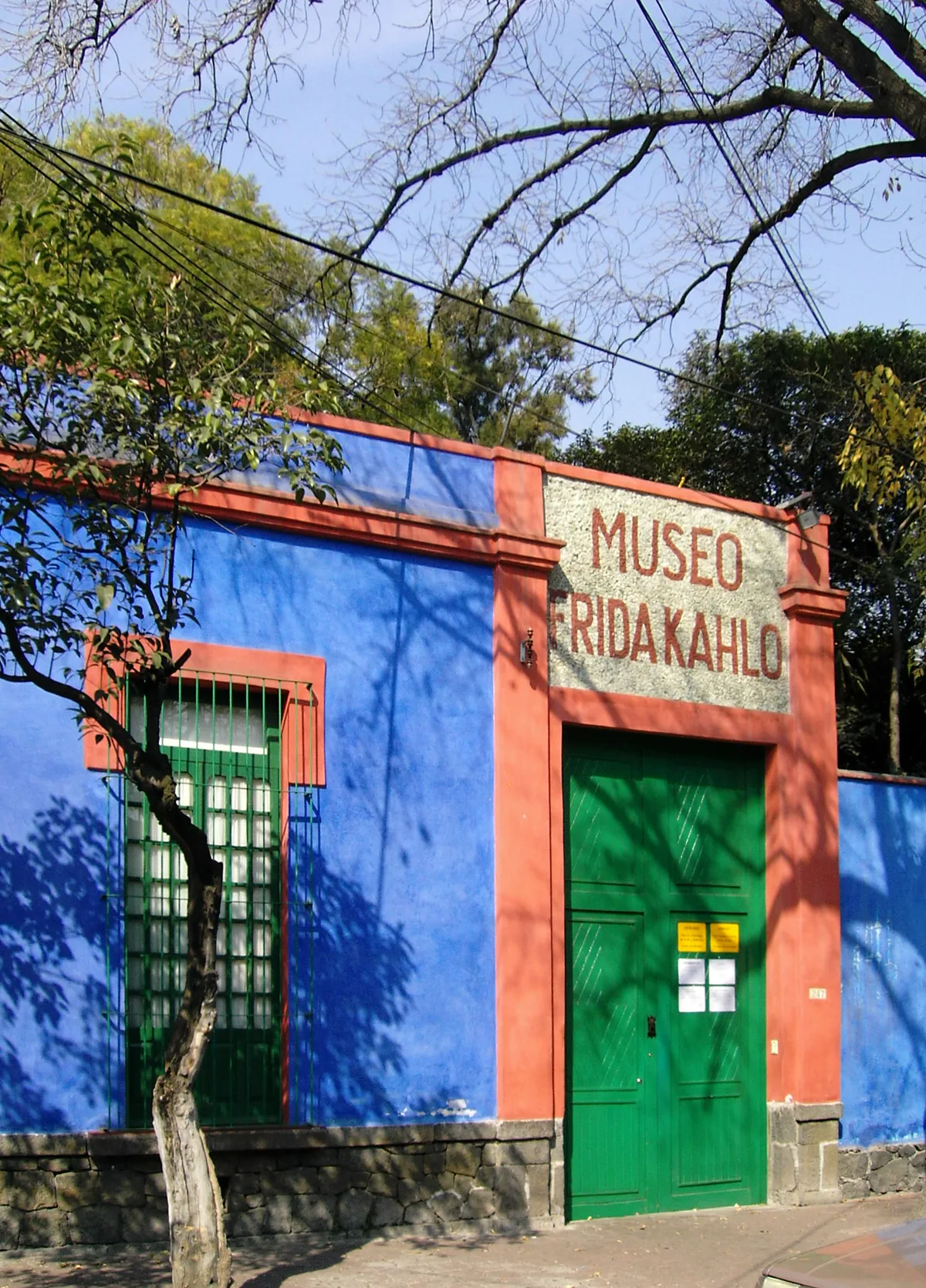
Photo: No machine-readable author provided. Nachtwächter assumed (based on copyright claims). / CC BY-SA 3.0
What Your Eye SeesA cobalt-blue colonial house in the Coyoacán neighbourhood, with a lush interior garden, pre-Columbian artefacts, and rooms preserved exactly as they were in the 1950s.
ContextThe cobalt-blue Casa Azul in Coyoacán was Frida Kahlo's birthplace, her lifelong home, and the room where she died. She shared it with her husband, muralist Diego Rivera, and the two turned it into a gathering place for artists and intellectuals. Today it preserves her rooms, studio, and pre-Columbian art collection almost unchanged.
On ScreenThe Frida Kahlo Museum appears in the film Frida (2002).
Source: Wikipedia (Frida Kahlo Museum); Wikipedia (Frida Kahlo Museum); Frida (2002) production notes
DidYou
Know
Casa Azul was built in 1904 by Frida's father, Guillermo Kahlo, a German-born photographer who taught her to observe with a camera's eye long before she painted, and it opened as a museum in 1958, preserved just as she left it.
Share→ The Mirror Above The Bed
Frida painted many of her famous self-portraits from her four-poster bed, where a mirror was fixed to the canopy so she could see her own face while bedridden after the 1925 bus accident.
→ A Miniature Pyramid In The Courtyard
In the garden courtyard stands a small stepped pyramid that Diego Rivera had built to display the couple's pre-Columbian figures. The miniature monument still holds a few of the ancient pieces the two artists collected over their lives.
→ More Than An Art House
Beyond the paintings, the museum preserves the couple's wider collections: papier-mâché Judas figures shown in the garden, votive retablos, and Mexican folk art.
Sources: Wikipedia (Frida Kahlo Museum); Museo Frida Kahlo; TripSavvy
Renaissance
7. National Palace
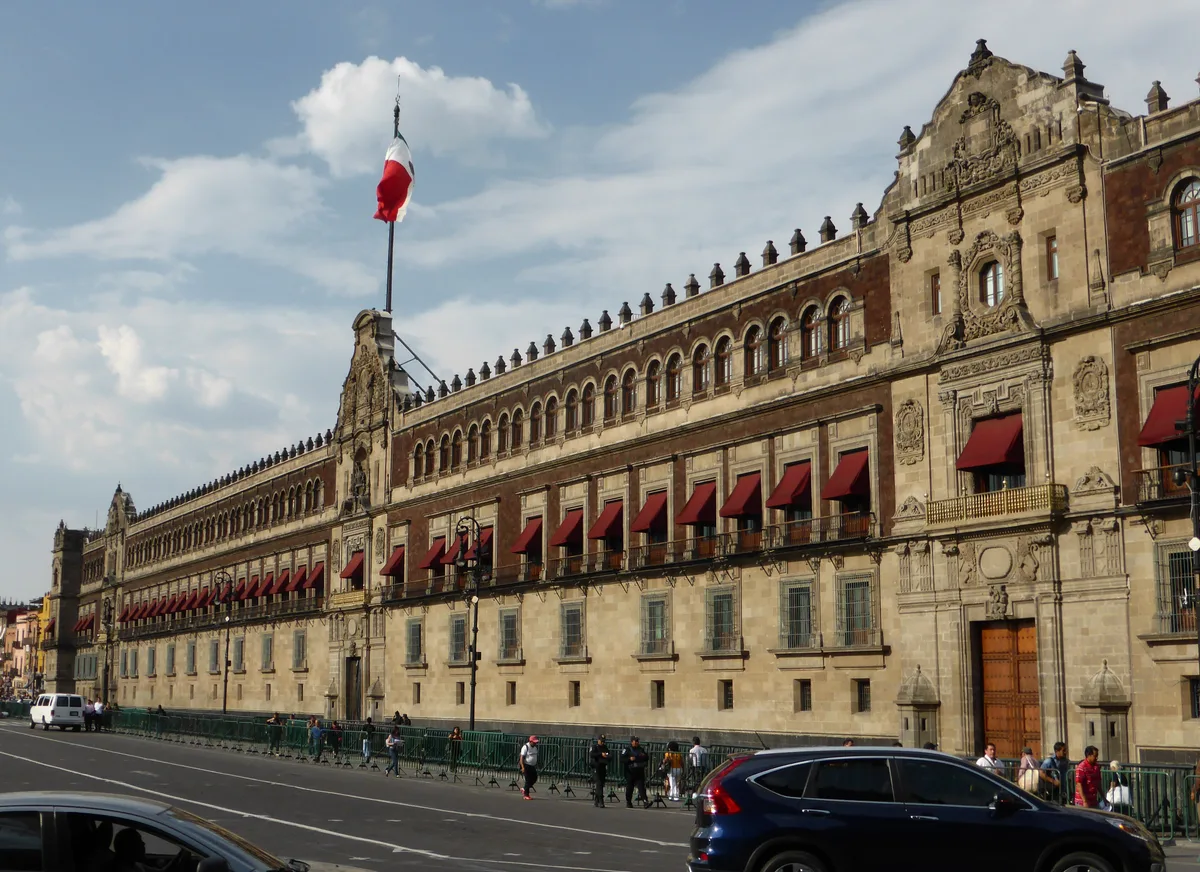
Photo: Dirk Ingo Franke / CC BY-SA 4.0
What Your Eye SeesA long Baroque palace occupying the entire east side of the Zócalo, with a distinctive red facade, balconied windows, and bell tower above the entrance.
ContextThe palace stands where Moctezuma II's palace once rose, on the east side of the Zócalo, and has been the seat of Mexican executive power for over 400 years, as viceregal palace, imperial residence, and presidential palace. Its red-tezontle facade encloses the patios built on the site of the Aztec ruler's New Houses.
Source: UNESCO (Historic Centre of Mexico City); Wikipedia (National Palace, Mexico City)
DidYou
Know
A grand staircase inside the National Palace carries Diego Rivera's epic history mural, painted 1929–1935, one of the largest murals in the world. It is a single continuous narrative climbed from the pre-Hispanic world and the Spanish conquest up to the Mexican Revolution, packed with hundreds of figures.
Share→ Rebuilt After The 1692 Riot
On 8 June 1692 a crowd set the palace ablaze during a corn-shortage riot, all but destroying it. Viceroy Gaspar de Sandoval had it rebuilt by Friar Diego Valverde, and the building lost its fortress look to gain the long Baroque facade seen today.
→ Hidalgo's Bell
Hanging above the central balcony is the very bell Father Miguel Hidalgo rang at Dolores on 16 September 1810 to call for rebellion. Brought to the palace in 1896, it is rung by the president every 15 September as he re-enacts the Grito de Dolores.
→ The Viceroy's Buried Columns
During foundation work, the carved column bases of the old viceregal palace were uncovered, and two were restored in place, still visible in the building today. Excavations in and around the palace have also found parts of Moctezuma's 'New Houses' beneath the current floors.
Sources: Wikipedia (National Palace of Mexico; Mexico City Riot of 1692); Grito de Dolores); Wikipedia (National Palace of Mexico)
Euro Heritage
Baroque Master
Why is the Templo Mayor in Mexico City excavated below street level?
Because the Aztec capital Tenochtitlan was destroyed by Hernan Cortes in 1521, and the new Spanish city was built directly on top of the ruins, where they lay forgotten for nearly 500 years. The Templo Mayor was rediscovered only in 1978, when electrical workers hit a massive Aztec monolith, the Coyolxauhqui Stone, triggering one of the 20th century's most dramatic excavations. Archaeologists found that the Aztecs had built seven successive temples on the same spot, one over the previous.
Which is larger, the Pyramid of the Sun or the Great Pyramid of Giza?
The Great Pyramid of Giza is taller, but the Pyramid of the Sun is among the largest structures of the Americas and the third-largest pyramid in the New World. Built around 100 CE, it dominates the Avenue of the Dead in Teotihuacan, one of the largest cities of the ancient world with an estimated 100,000 to 200,000 residents. Beneath the pyramid lies a natural cave-tunnel that the builders reshaped as a sacred space, its existence hidden until archaeologists found it in 1971.
These landmarks reward close attention. Vestigia is a field companion for people who look longer, with curated context, architectural detail, and the stories most visitors walk past. Free on the App Store and Google Play.