New York Historical Landmarks
1. Statue of Liberty
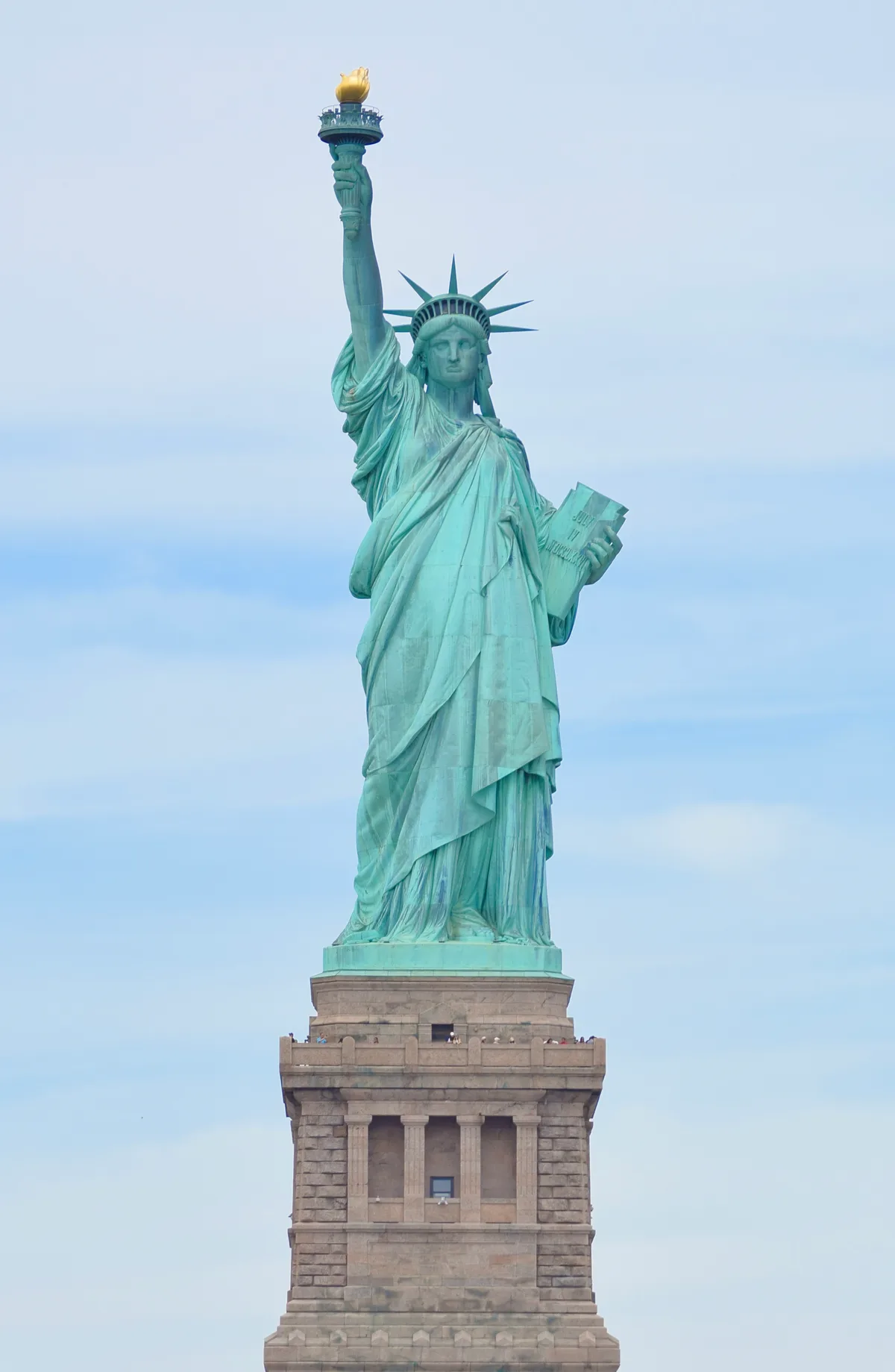
Photo: AskALotl / CC0
What Your Eye SeesA 93-metre copper statue of a robed woman holding a torch aloft, standing on Liberty Island in New York Harbour. Her crown features seven spikes, and a broken chain lies at her feet.
ContextA gift from France in 1886, the Statue of Liberty was designed by Frédéric Auguste Bartholdi. The internal iron framework was engineered by Gustave Eiffel, before he built the Eiffel Tower. Officially *Liberty Enlightening the World*, it was dedicated on October 28, 1886, after arriving from France in 350 pieces packed in 214 crates and being reassembled atop Richard Morris Hunt's pedestal.
The figure lifts a gilded torch in her right hand and cradles a tablet inscribed with the date of American independence, 4 July 1776. Her seven-rayed crown symbolizes the continents and seas, while the broken chain at her feet marks a nation's break from tyranny, a gift conceived as a token of Franco-American friendship.
Eiffel's hand also shaped the Eiffel Tower in Paris, the structure that made his name worldwide.
On ScreenThe Statue of Liberty anchors the famous final reveal of Planet of the Apes (1968) and also appears in X-Men (2000), Ghostbusters II (1989) and Independence Day (1996).
Source: UNESCO (Statue of Liberty); Wikipedia (Statue of Liberty); Wikipedia (Statue of Liberty); Ghostbusters II production notes
 Did
DidYou
Know
Long before the statue stood complete, its raised right arm and torch were exhibited on their own - first at the 1876 Philadelphia Centennial, then in Madison Square Park, New York - to raise money for the rest of the monument.
Share→ The Seven Spikes
Look up at the crown's seven rays: they were conceived as a radiate halo, the nimbus used since antiquity to top figures of divinities and sun gods. Visitors often read the seven rays as the seven continents or seas, but scholars note that was never confirmed; the crown was meant above all to signal enlightenment.
→ The Chains At Her Feet
Look down at the statue's feet to spot the broken chain and shackle, half-hidden by her robes and difficult to see from ground level. Conceived in the decades after the American Civil War, they were meant to commemorate the national abolition of slavery in the United States.
Sources: Wikipedia (Statue of Liberty)
 Euro Heritage
2. Empire State Building
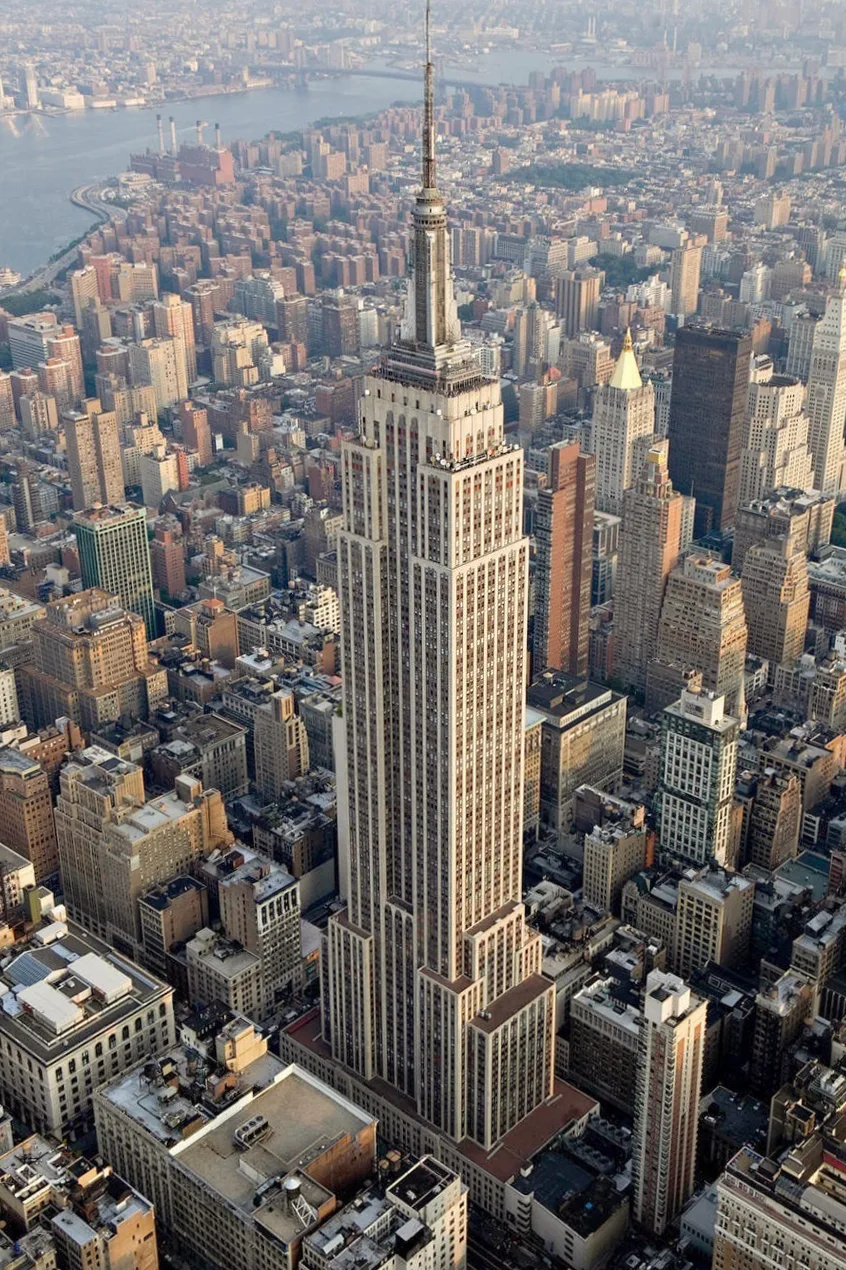
Photo: Sam Valadi / Public domain
What Your Eye SeesA 381-metre Art Deco skyscraper rising from Midtown Manhattan, with a distinctive stepped silhouette, a stainless-steel spire, and illuminated upper floors that change colour seasonally.
ContextBuilt in just 410 days during the Great Depression (1930–1931), the Empire State Building was designed by Shreve, Lamb & Harmon and rose to 1,454 feet at its tip. It was the world's tallest building for 40 years, until the World Trade Center towers surpassed it in 1970, and again became New York's tallest after their destruction in 2001.
Its tiered Art Deco crown, lit at night in colors marking holidays and events, became the defining image of the New York skyline. Public observatories near the top have drawn visitors since opening day to gaze down on the grid of Manhattan from 1,250 feet up.
On ScreenThe Empire State Building is where the giant ape climbs in King Kong (1933), and where Sleepless in Seattle (1993) ends with a reunion on its observatory.
Source: Wikipedia (Empire State Building); Britannica; Wikipedia (Empire State Building); King Kong production notes
DidYou
Know
On a foggy morning in July 1945, a US Army B-25 bomber crashed into the 79th floor of the tower, killing 14 people - yet the building was open for business again within days. Its spire was first meant as a dock for airships, but the winds up there defeated every attempt.
Share→ The Art Deco Lobby
Look up in the lobby: the Art Deco mural is an abstract 'Machine Age' composition inspired by the sky, it does not depict the building at all. For that, check behind the security desk at the west end, where an aluminum relief shows the skyscraper as it was originally built, before the antenna was added.
→ The 86th Floor Observatory
The 86th-floor observatory sits at 1,050 feet (320 metres) and pairs an enclosed viewing gallery with an open-air outdoor deck, a combination that keeps it open 365 days a year, whatever the weather.
→ The Lobby Doorways
Look up above the doors of the Fifth Avenue lobby, where small bronze motifs depict three of the trades that built the tower, Electricity, Masonry, and Heating. They are among the few places in the building where the Art Deco design tells a specific story rather than pure geometric pattern.
Sources: Wikipedia (Empire State Building)
 Renaissance
 Modernist
3. Chrysler Building
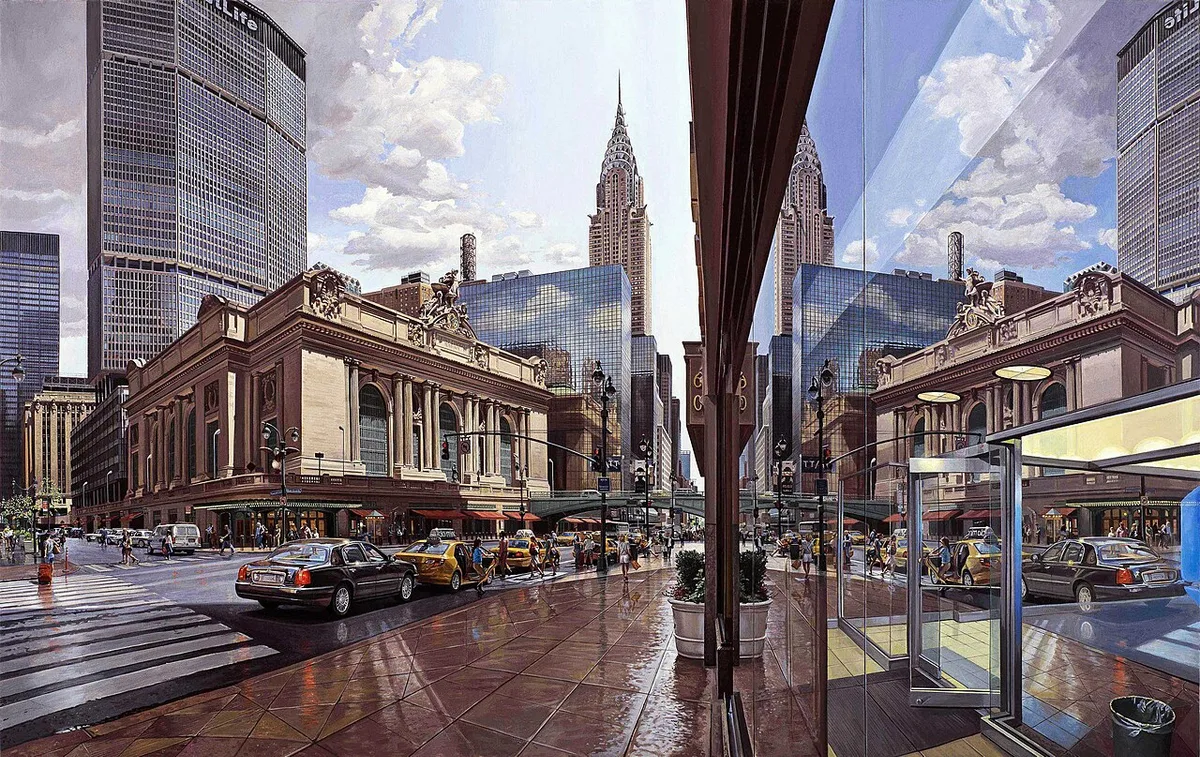
Photo: ROBERT NEFFSON / CC BY-SA 4.0
What Your Eye SeesA 319-metre Art Deco skyscraper with a distinctive stainless-steel crown formed of seven concentric arches, triangular sunburst windows, and eagle gargoyles at the corners.
ContextCompleted in 1930, the Chrysler Building was designed by William Van Alen for automobile magnate Walter P. Chrysler. At 1,046 feet it was the first structure ever to top 1,000 feet, and briefly the world's tallest, for 11 months, until the Empire State Building passed it. Its secret spire famously leapfrogged the rival 40 Wall Street during a heated 'race to the sky.'
On ScreenThe Chrysler Building features in the film Godzilla (1998).
Source: Wikipedia (Chrysler Building); Britannica; Wikipedia (Chrysler Building); Godzilla (1998) production notes
DidYou
Know
The crown's gleaming steel is Nirosta - its name means 'non-rusting steel' - an early stainless alloy used here for the first time in America. Architect William Van Alen won a bitter fee lawsuit against Walter Chrysler, but the fight wrecked his career.
Share→ The Eagle Gargoyles
Look up near the top of the tower, on the 61st floor, to the stainless-steel eagles, chosen as a nod to America's national bird, in keeping with the building's patriotic machine-age theme. For the direct link to the car, look at the 31st floor, where gargoyles echo the 1929 Chrysler radiator caps.
→ The Triangular Lobby
Step into the lobby and look around: it is triangular in plan, echoing the shape of the whole building. Its walls rise in huge slabs of African red granite, while bands of yellow Siena travertine run across the floor, marking the path from the entrance doors to the elevator banks.
Sources: Wikipedia (Chrysler Building)
Renaissance
Modernist
4. Brooklyn Bridge
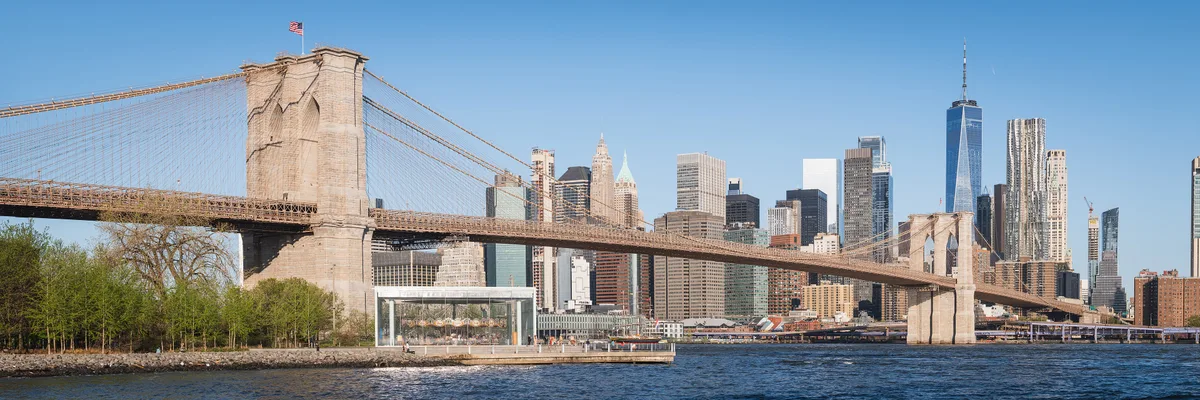
Photo: Christian David / CC BY-SA 4.0
What Your Eye SeesA suspension bridge of Gothic stone towers and steel cables spanning the East River, connecting Manhattan and Brooklyn. Its raised pedestrian walkway offers views of both skylines.
ContextOpened in 1883, the Brooklyn Bridge was designed by John A. Roebling, who died in a construction accident before work advanced. His son Washington Roebling took over as chief engineer, and after Washington was incapacitated by caisson disease, his wife Emily Warren Roebling saw the project through to completion. It was the world's longest suspension bridge for 20 years.
Its two granite towers, faced in local stone with pointed Gothic arches, were among the tallest structures in the city when built. The bridge was among the first to use massively steel-wire cables, a then-novel technology that let it span the East River and link Brooklyn to Manhattan as one city.
On ScreenThe Brooklyn Bridge was a filming location for Godzilla (1998), Once Upon a Time in America, Enchanted (2007) and The Amazing Spider-Man 2 (2012).
Source: Wikipedia (Brooklyn Bridge); Britannica; Wikipedia (Brooklyn Bridge); Godzilla (1998) production notes
DidYou
Know
To prove the bridge was safe after a stampede killed 12 people on its sixth day, P.T. Barnum marched 21 elephants across it in 1884, including Jumbo, his prized African elephant. The bridge's stone anchorages contain hidden vaulted chambers used as wine cellars. During the Cold War, a secret radiation-proof bunker was discovered inside the Manhattan anchorage.
Share→ The Gothic Towers
Look at the Gothic Revival pointed arches cutting through each tower, they are no mere ornament: a pair passes through so the two roadways can run straight through, engineering dressed in the robes of a medieval cathedral.
→ The Cable System
Each of the four main cables measures 40 centimetres in diameter and packs 5,282 galvanized steel wires, bundled into 19 strands of 278 wires each. It was the first suspension bridge to bundle its wires into strands, work that took months to tie.
→ The Raised Walkway
Walk the central promenade and look down: the raised walkway runs 5.5 metres above the traffic lanes. John Roebling designed it as a lofty, leisurely walking path, set above the noise of the carriages that crossed the bridge.
Sources: Wikipedia (Brooklyn Bridge)
Euro Heritage
 Gothic Soul
5. Flatiron Building
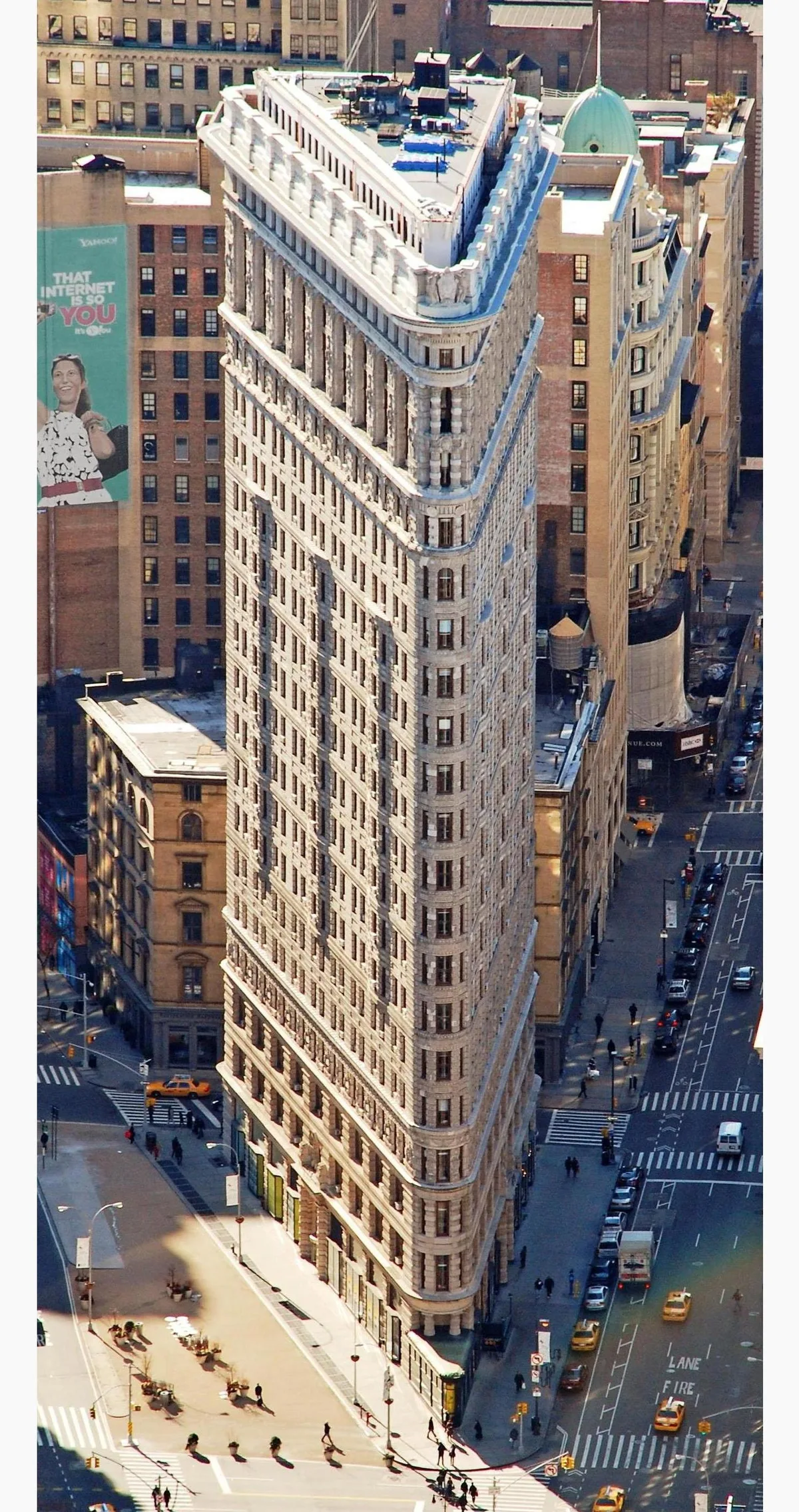
Photo: Imelenchon (original work) / Public domain
What Your Eye SeesAn 87-metre triangular steel-frame building clad in limestone and terracotta, rising to a narrow point at the intersection of Fifth Avenue and Broadway. Its wedge shape is one of the most famous silhouettes in New York.
ContextCompleted in 1902, the Flatiron Building, originally the Fuller Building, was designed by Daniel Burnham as one of the first steel-frame skyscrapers. Its 22 stories rise just 285 feet, yet its daring wedge shape, dictated by the triangle where Fifth Avenue meets Broadway, made it one of the most photographed and debated buildings in New York.
Its name comes from the flatiron, the household implement whose shape the narrow prow resembles. As one of the earliest steel-frame skyscrapers in the city, it proved that tall, slender towers could rise on a cramped triangular lot, a lesson that reshaped the Manhattan skyline.
On ScreenThe Flatiron Building appears in the films Spider-Man and Armageddon (1998).
Source: Wikipedia (Flatiron Building); Britannica (Flatiron Building); Wikipedia (Flatiron Building); Spider-Man production notes
DidYou
Know
When the Flatiron opened in 1902, New Yorkers claimed the wind funneling off its prow lifted women's skirts - and crowds gathered daily until police invented the cry '23 skidoo' to shoo them from the corner of 23rd Street.
Share→ The Razor Edge
Walk to the southern tip, where Fifth Avenue and Broadway converge into a single narrow point. The wedge-shaped footprint, wide along the side streets, tapering to a sharply pointed nose at the apex, is what earned the building its name from a clothes iron soon after it rose in 1902.
→ The Terracotta Details
Look up at the upper facades, clad in glazed terracotta made by the Atlantic Terra Cotta Company in Tottenville, Staten Island. The warm glazed panels were prized for their rich colour and hard-wearing, washable surface.
Sources: Wikipedia (Flatiron Building)
Euro Heritage
6. St. Patrick's Cathedral
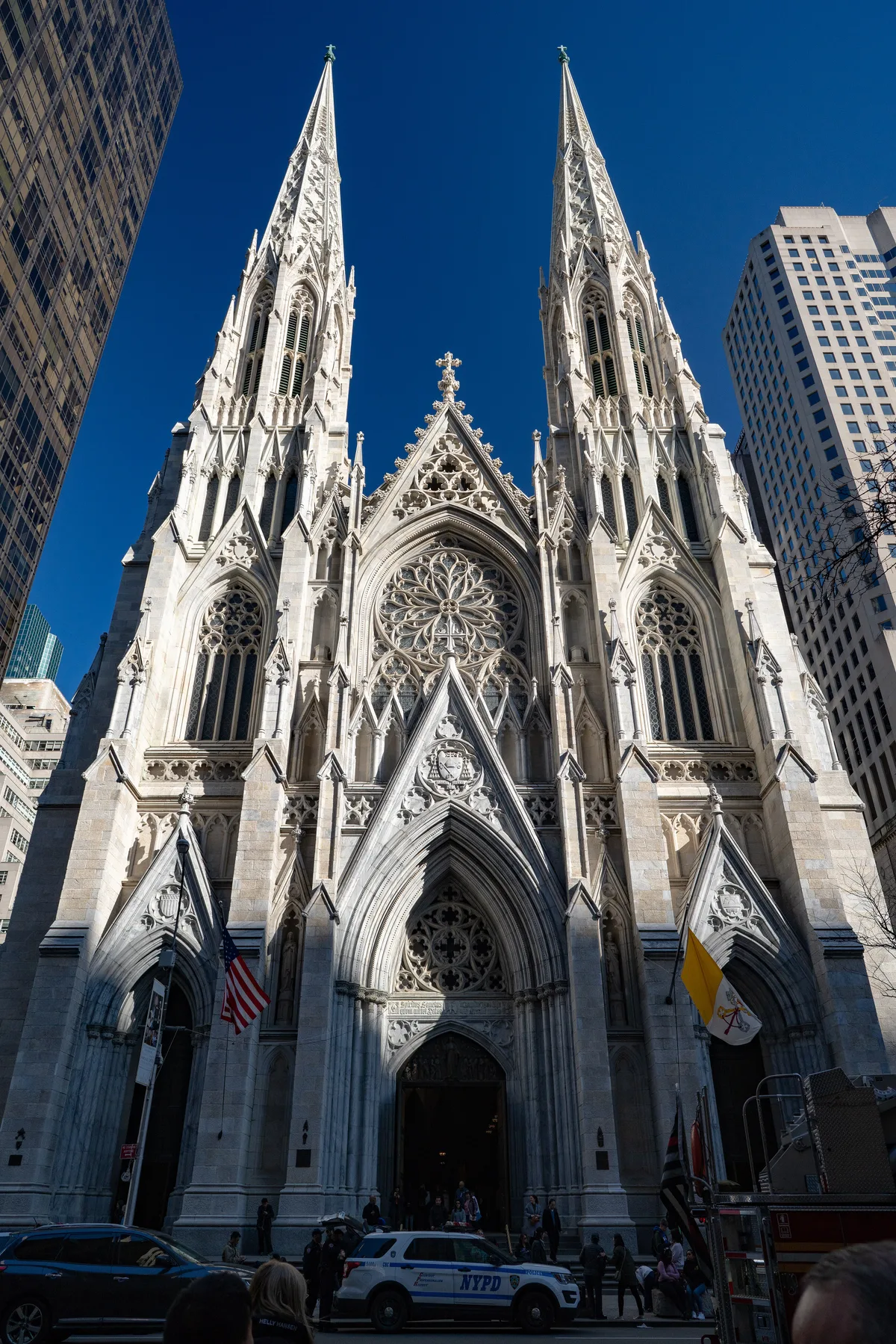
Photo: Nan Palmero from San Antonio, TX, USA / CC BY 2.0
What Your Eye SeesA white marble Gothic Revival cathedral with two 100-metre spires rising above Fifth Avenue, its lace-like stone tracery and rose window framed against the surrounding skyscrapers.
ContextDesigned by James Renwick Jr. and completed in 1878, St. Patrick's Cathedral took 20 years to build and was the largest cathedral in the United States when finished. Clad in white marble with twin 330-foot spires, it is the largest Gothic Revival Catholic cathedral in North America and was among the tallest structures in New York when completed.
Seat of the Archbishop of New York and mother church of the Roman Catholic archdiocese, St. Patrick's anchors the city's religious life a block from Rockefeller Center. Inside, a series of side chapels and more than 2,000 seats fill the slender white-marble nave, a quiet Gothic interior set against the glass towers of Midtown.
Source: Wikipedia (St. Patrick's Cathedral, New York); Britannica
DidYou
Know
St. Patrick's cornerstone was laid in 1858, when Fifth Avenue was open farmland; by the time the cathedral opened in 1878 the surrounding mansions had replaced the fields, and work had paused entirely during the Civil War.
Share→ The Rose Window
Look up above the Fifth Avenue entrance at the rose window, which measures 26 feet (8 metres) across and was designed by Charles Connick, an addition made long after the cathedral was completed. It is filled with blue glass flecked with red, green, white, and gold, and its centre depicts eight types of leaves ringed by trefoils and white doves.
→ The Marble Clash
Look closely at the twin spires and the main body: the cathedral is clad in Tuckahoe marble, while the spires, raised under a contract to George Mann & Co. of Baltimore and finished in 1888, were built of a slightly different Cockeysville marble from Maryland, carved from stone rather than copper so the two tones meet at the towers' bases. The cathedral's greatest restoration ran from 2012 to 2015, a $177 million project that cleaned and repaired the gleaming facade you see today.
Sources: Wikipedia (St. Patrick's Cathedral)
Euro Heritage
Gothic Soul
 Spiritual Seeker
7. Grand Central Terminal
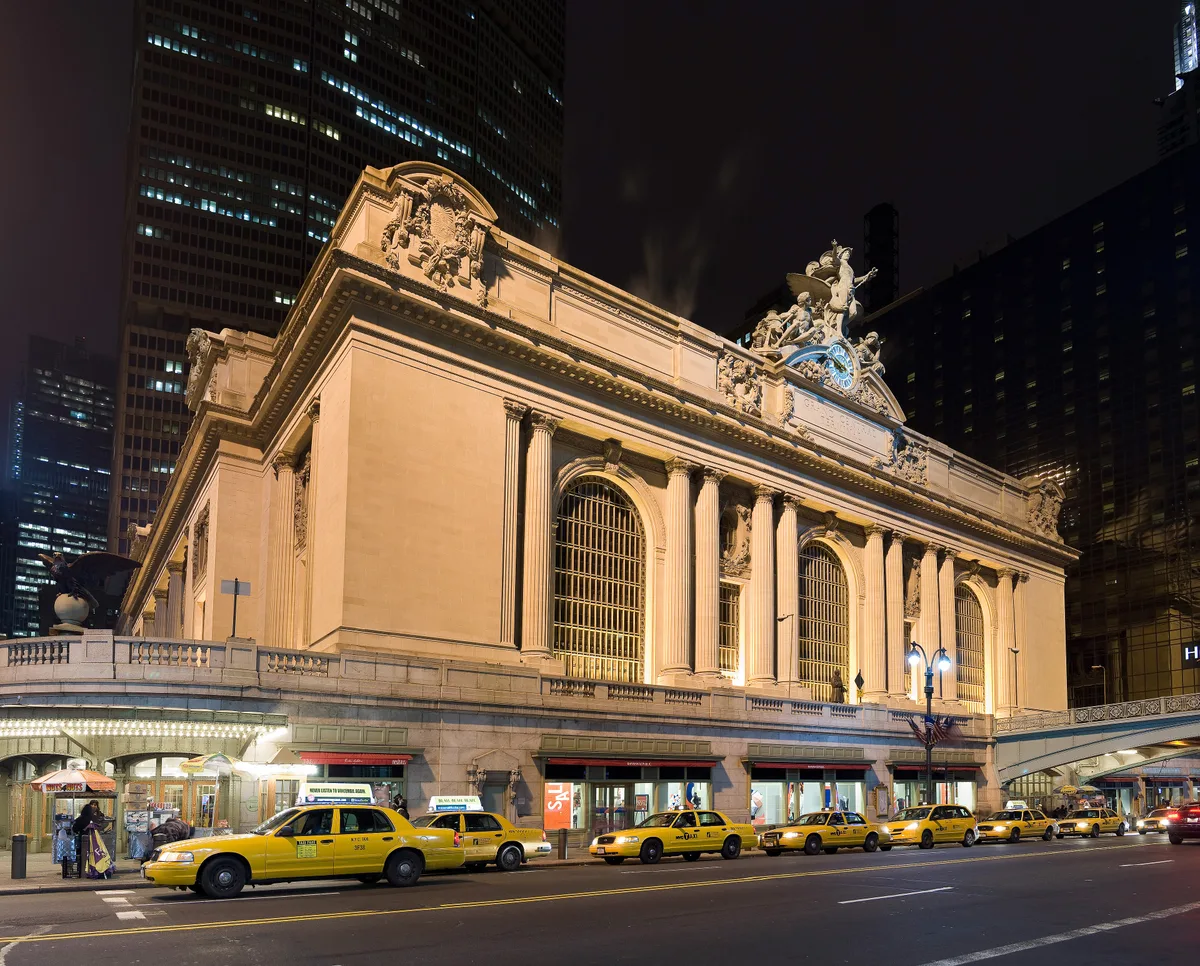
Photo: Fcb981 ; Eric Baetscher (attribution required) / CC BY-SA 3.0
What Your Eye SeesA Beaux-Arts train terminal with a 38-metre-high vaulted ceiling painted with the zodiac constellations, a grand marble staircase, and the iconic four-faced clock in the main concourse.
ContextOpened in 1913, Grand Central Terminal was designed by the firms Reed & Stem and Warren & Wetmore in the Beaux-Arts style for the Vanderbilt-family New York Central Railroad. The world's largest train station by platform count, with 44 platforms and 67 tracks, it serves over 750,000 visitors daily and replaced an earlier 1871 depot on the same site.
Its vast Main Concourse, with a soaring vaulted ceiling and a famous brass-and-opal clock at its center, has been the rendezvous point of New York for over a century. In the arched halls a quirk of acoustics lets a whisper carry across the marble, the so-called Whispering Gallery.
On ScreenGrand Central Terminal served as a backdrop for The Fisher King (1991) and The Avengers (2012).
Source: Wikipedia (Grand Central Terminal); Britannica; Wikipedia (Grand Central Terminal); The Fisher King production notes
DidYou
Know
Grand Central's starry ceiling is painted as the winter sky seen from outside the heavens - reversed, so God looks down on it - and in the 1970s the terminal was saved from demolition by a lawsuit that reached the US Supreme Court.
Share→ The Whispering Gallery
Step down to the low landing near the Oyster Bar and try the vaulted arches: whisper in one corner and someone in the diagonally opposite corner can hear you clearly, even over the noise of the concourse between you. The curve of the tiled vault carries the sound.
→ The Grand Staircase
Look at the two curved staircases rising from the Main Concourse, built of pink Tennessee marble. Only the West Stairs dates from 1913, the matching East Stairs was added during the terminal's 1990s restoration, completed in 1998, built to look as though it had always been there.
Sources: Wikipedia (Grand Central Terminal)
Euro Heritage
8. Castle Clinton
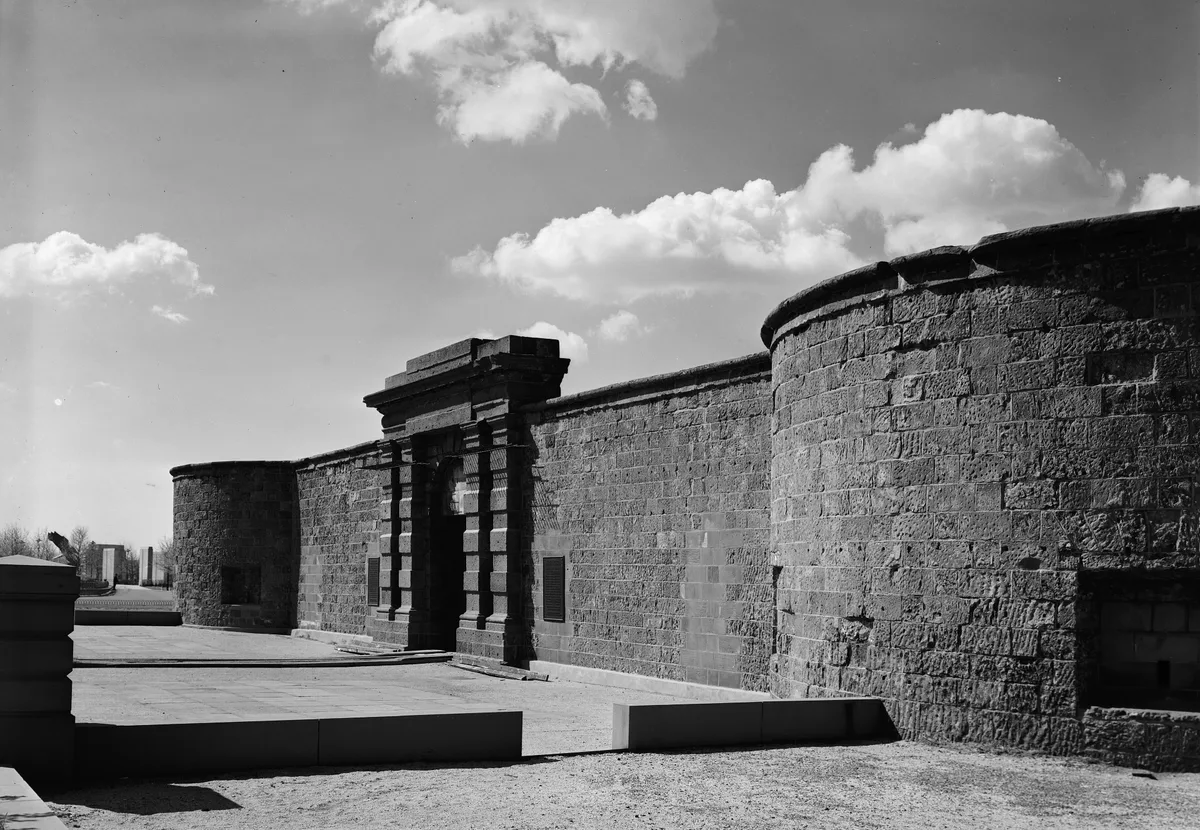
Photo: Unknown author / Public domain
What Your Eye SeesA circular brownstone fort with thick curved walls and a flat roof, sitting at the southern tip of Manhattan in Battery Park. It is one of the oldest surviving structures in New York City.
ContextBuilt between 1808 and 1811 as the Southwest Battery to defend New York Harbour, Castle Clinton never fired a shot in anger. Renamed Castle Garden in 1824, it hosted opera and P.T. Barnum's 1850 debut of Jenny Lind before serving as America's first immigration station, processing over 8 million immigrants between 1855 and 1890, then becoming an aquarium.
Source: Wikipedia (Castle Clinton); U.S. National Park Service (Castle Clinton)
DidYou
Know
Castle Clinton was engineered by John McComb Jr. - the architect also behind New York's City Hall - as a circular harbour battery built on an artificial island 60 metres offshore; the landfill that later tied it to Manhattan is why it now sits inland.
Share→ The Wall Thickness
Look at the curved walls: they are 2.4 metres (8 feet) thick, built to shrug off cannon fire, one reason the building survived while later structures around it did not. The reddish-brown sandstone of the outer wall has darkened to a warm brownstone tone against the harbour air, and much of what you see was restored to its original condition after a mid-20th-century fight to save the fort from demolition.
→ The Roofless Circle
Look up into the circular interior, open to the sky today, but that is a deliberate restoration. In its later life the space was repeatedly covered over: a theatre roof was added around 1845, then the interior was built up into a several-storey aquarium crowned by a green-and-yellow dome after 1896. When the fort reopened as a monument in 1975, its roof was largely removed to reveal the open parade ground as it looked in the 1810s.
→ The Gun Slits
The curved wall still holds its original arched gun loops, built to mount 28 thirty-two-pounder cannons, and they run unbroken around the facade. Look closely and you'll see many were later glazed with windows, after the fort's interior fire of 1876 the open mouths were filled in as the building kept changing purpose.
Sources: Wikipedia (Castle Clinton)
 Time Traveler
 City Hopper
9. Federal Hall
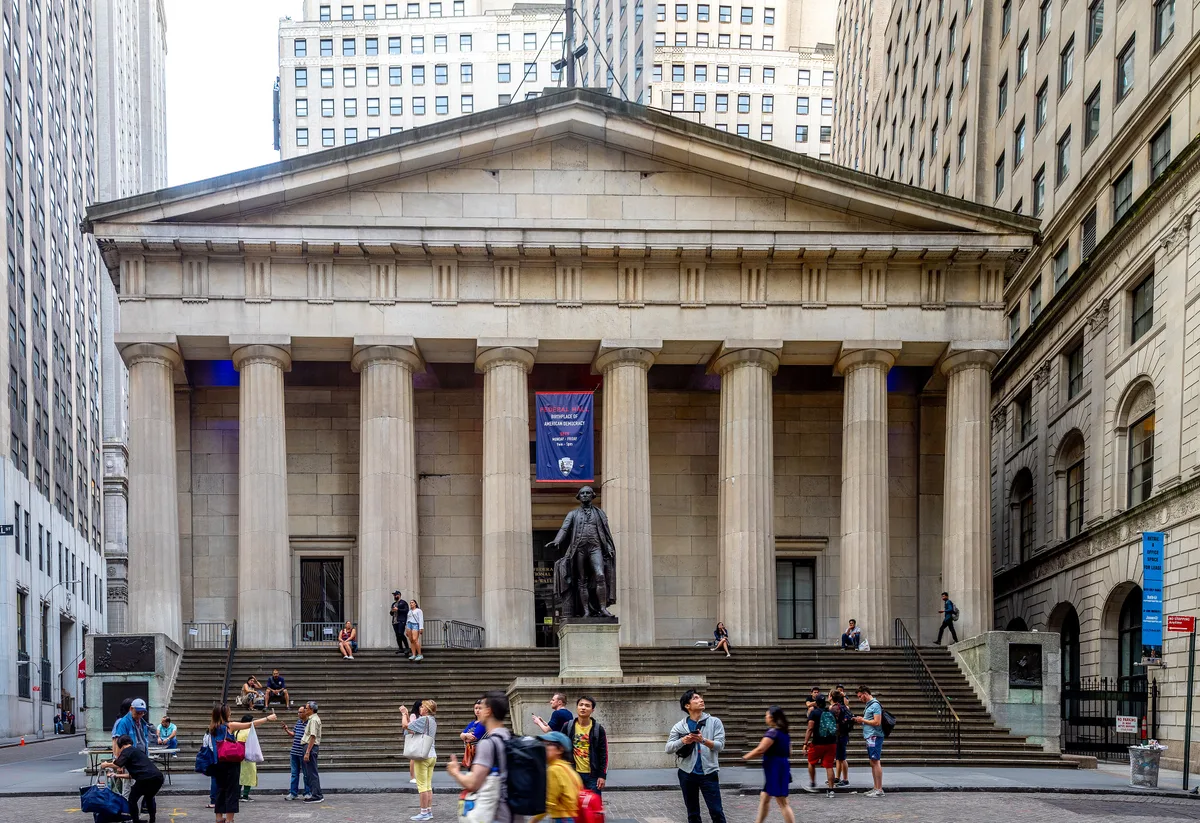
Photo: Ajay Suresh from New York, NY, USA / CC BY 2.0
What Your Eye SeesA marble Greek Revival temple with a row of Doric columns across its front, standing at the corner of Wall and Nassau Streets. A bronze statue of George Washington stands before the steps.
ContextThe current Federal Hall was completed in 1842 as the US Custom House, designed by Ithiel Town and Alexander Jackson Davis with a domed rotunda by John Frazee. But the site is older: on this exact spot, George Washington took the oath of office as the first President of the United States on April 30, 1789, and the Bill of Rights was adopted here that same year. In 1790 the seat of Congress left this site for Philadelphia, where it met at Congress Hall until the government moved south to the new capital on the Potomac. Federal Hall was the first home of the United States Congress, a role the Capitol in Washington has filled since 1800.
On ScreenFederal Hall appears in the film Godzilla (1998).
Source: Wikipedia (Federal Hall); U.S. National Park Service (Federal Hall); Wikipedia (Federal Hall); Godzilla (1998) production notes
DidYou
Know
Next to the present building stood the Tontine Coffee House, where stockbrokers met in the 1790s and helped give nearby Wall Street its name; the colonnaded marble hall you see replaced an earlier structure on the site.
Share→ The Washington Statue
Look at the bronze figure of Washington on the building's ceremonial front steps: sculpted by John Quincy Adams Ward and erected in 1883, it stands at the same height as the balcony of the original Federal Hall, where Washington took the oath in 1789, so the statue looks out over the crowd from the level where history happened.
→ The Eight Columns
Above the 18 granite steps, the facade's Doric colonnade deliberately echoes the Parthenon, a tribute to Greek democracy built into the heart of Wall Street. The whole building is sheathed in Tuckahoe marble from Westchester County; inside the rotunda, sixteen columns were each carved from a single block.
→ The Saved Balcony
Step inside the memorial to find a short section of the original Federal Hall's balcony railing and floor, preserved intact while the rest of the building was pulled down. Set against the new marble, the small, worn iron rail shows how modest the country's first federal building actually was.
Sources: Wikipedia (Federal Hall)
Euro Heritage
10. Trinity Church
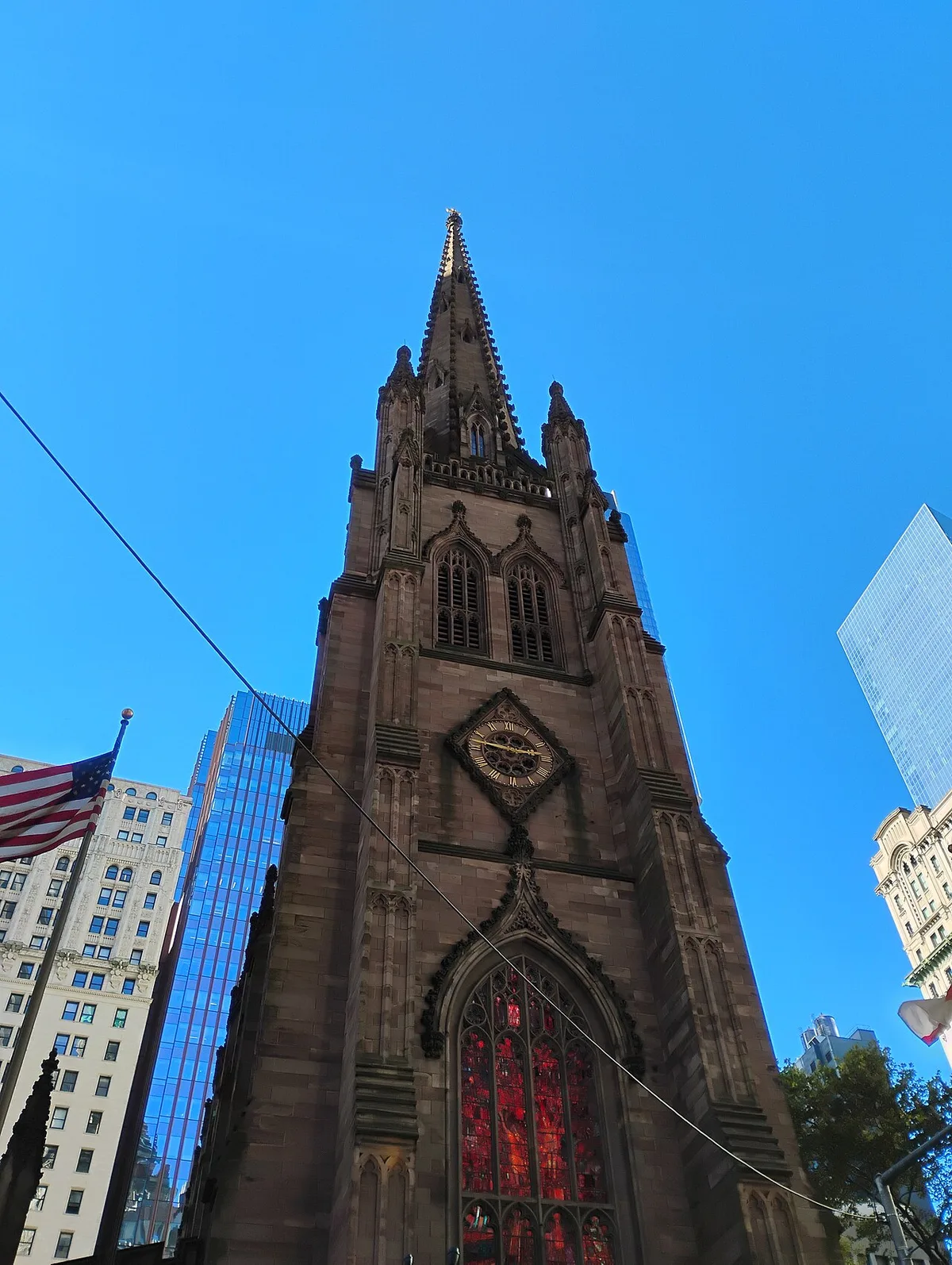
Photo: Ferfive / CC BY 4.0
What Your Eye SeesA brownstone Gothic Revival church with a tall single spire, rising above the glass towers of Wall Street. Its arched entrance and elaborate stone tracery sit surrounded by a tree-lined churchyard of historic graves.
ContextCompleted in 1846, Trinity Church was designed by British-born architect Richard Upjohn in the Gothic Revival style and was the tallest building in New York City for nearly 45 years, until 1890. It is the third church on this site, the parish was founded in 1697, and the first, built in 1698, was destroyed in the Great Fire of 1776 during the Revolutionary War.
Source: Wikipedia (Trinity Church, Manhattan); Britannica
DidYou
Know
Trinity's land was granted by Queen Anne in 1705 - 215 acres running up the west side of Manhattan - and the parish grew into one of the richest in the world, with a real-estate endowment now worth billions.
Share→ Hamilton's Grave
Look for Alexander Hamilton's grave in Trinity Churchyard, which wraps around the church at Wall Street and Broadway, the architect of America's financial system buried in the shadow of what became the world's most famous street. His grave is easy to find among the headstones of the young republic.
→ The Spire
The Gothic Revival spire rises 281 feet (86 metres) and is crowned with a gilded cross that catches the light over Wall Street. When completed in 1846 it became the tallest building in the United States, a record it held until 1869, and it remained New York's tallest structure until 1890.
→ The Front Door
Look at the three grand bronze doors at the church entrance, a gift from William Waldorf Astor, given in memory of his father, John Jacob Astor III. Dreamed up by the architect Richard Morris Hunt and installed in 1893, they are among the finest bronze portals on any Manhattan street.
Sources: Wikipedia (Trinity Church)
Euro Heritage
Gothic Soul
Spiritual Seeker
How does the Statue of Liberty’s height compare to the Empire State Building?
No. The Statue of Liberty stands about 93 metres (305 ft) from base to torch. The Empire State Building rises roughly 381 metres (1,250 ft) to its top, about four times taller. Liberty reads as intimate and human; the Empire State as vertical and overwhelming.
What are the must-see landmarks in New York City?
Our guide covers ten of the city's most notable historical landmarks: the Statue of Liberty, Empire State Building, Chrysler Building, Brooklyn Bridge, Flatiron Building, St. Patrick's Cathedral, Grand Central Terminal, Castle Clinton, Federal Hall, and Trinity Church, from Gilded-Age skyscrapers to Revolutionary-era sites.
What is there to see in Brooklyn?
The Brooklyn Bridge, completed in 1883, links Manhattan and Brooklyn with its Gothic stone towers and steel cables, one of the most photographed spans in the world and a defining piece of New York’s skyline.
Why does the Empire State Building have a spire?
It was designed in 1929 as a mooring mast for airships, its roughly 60-metre (200 ft) needle taking the building past 1,250 feet so dirigibles could tie up as a high-altitude gateway to Manhattan. Only one airship ever actually docked, a blimp that moored for about three minutes in September 1931, and no passenger service ever ran. The idea was abandoned, and the mast later carried the television and radio antenna, which is what the spire houses today.
These landmarks reward close attention. Vestigia is a field companion for people who look longer, with curated context, architectural detail, and the stories most visitors walk past. Free on the App Store and Google Play.