Paris Historical Landmarks
1. Eiffel Tower
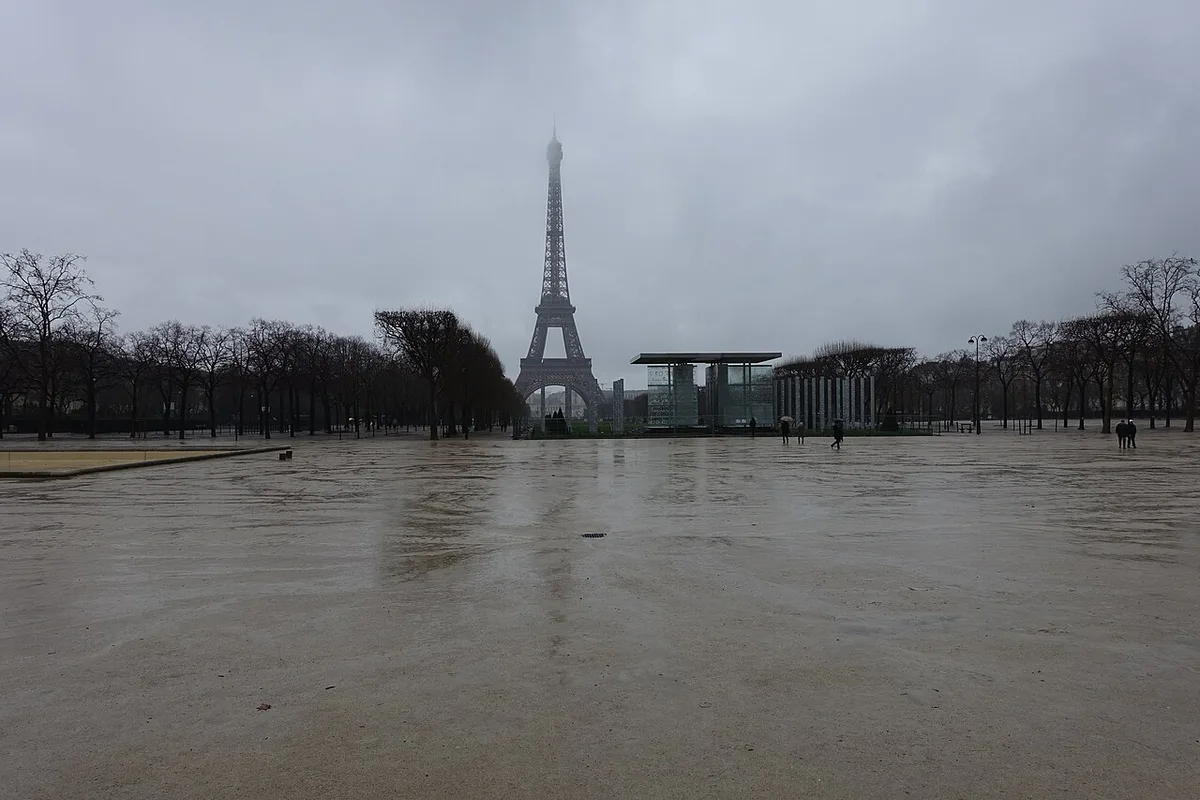
Photo: Guilhem Vellut / CC BY 2.0
What Your Eye SeesAn iron lattice tower rising 330 meters above the Champ de Mars, tapering upward from four massive arched legs.
ContextThe Third Republic needed a symbol to prove that democratic France could out-engineer imperial rivals. The 1889 World's Fair was the stage, and the tower was built as a temporary structure with a 20-year demolition permit. It survived only because it became indispensable as a radio transmission antenna.
The tower also made a memorable Bond entrance: in A View to a Kill (1985), Roger Moore's 007 meets a contact at the Jules Verne restaurant on the second floor, chases May Day (Grace Jones) to the top, and she parachutes off, a real, permitted leap by stuntman B.J. Worth.
Before the tower made him famous, Gustave Eiffel engineered the iron skeleton inside New York's Statue of Liberty.
On ScreenThe Eiffel Tower was a filming location for the James Bond film A View to a Kill (1985) and features in Mission: Impossible – Fallout (2018).
Source: UNESCO (Banks of the Seine); Wikipedia (Eiffel Tower); Wikipedia (Eiffel Tower); A View to a Kill production notes; Mission: Impossible – Fallout production notes
 Did
DidYou
Know
Gustave Eiffel did not design the tower alone, his engineers Maurice Koechlin and Émile Nouguier sketched the structural concept, and it was architect Stephen Sauvestre's decorative arches that won the 1889 competition. Eiffel was at first unenthusiastic, but championed it against the artists whose protest called it a monstrous eyesore. Built in 2 years, 2 months and 5 days, it cost the life of only one worker among the 300 on site, and 60 tonnes of paint to coat.
Share→ The Private Apartment
At the very top, Eiffel kept a small private apartment with wood panelling, a piano and scientific instruments, where he entertained guests, including the inventor Thomas Edison, who visited in 1889. The room is preserved today with wax figures of the two men.
→ The Riveted Lattice
Put your face close to the ironwork and you will see the pattern of the tower repeated at every scale: 18,038 separate parts joined by some 2.5 million rivets, each one hammered in place by hand. The lattice you see from the ground is the same puddled-iron mesh, once made elsewhere and bolted together here.
→ The Engraved Names
Seventy-two names of French scientists, engineers and mathematicians are carved around the tower, part of the same era in which a group of artists had signed a public protest calling the new tower a monstrous eyesore.
Sources: Wikipedia; Tour Eiffel (toureiffel.paris)
 Renaissance
2. Notre-Dame Cathedral
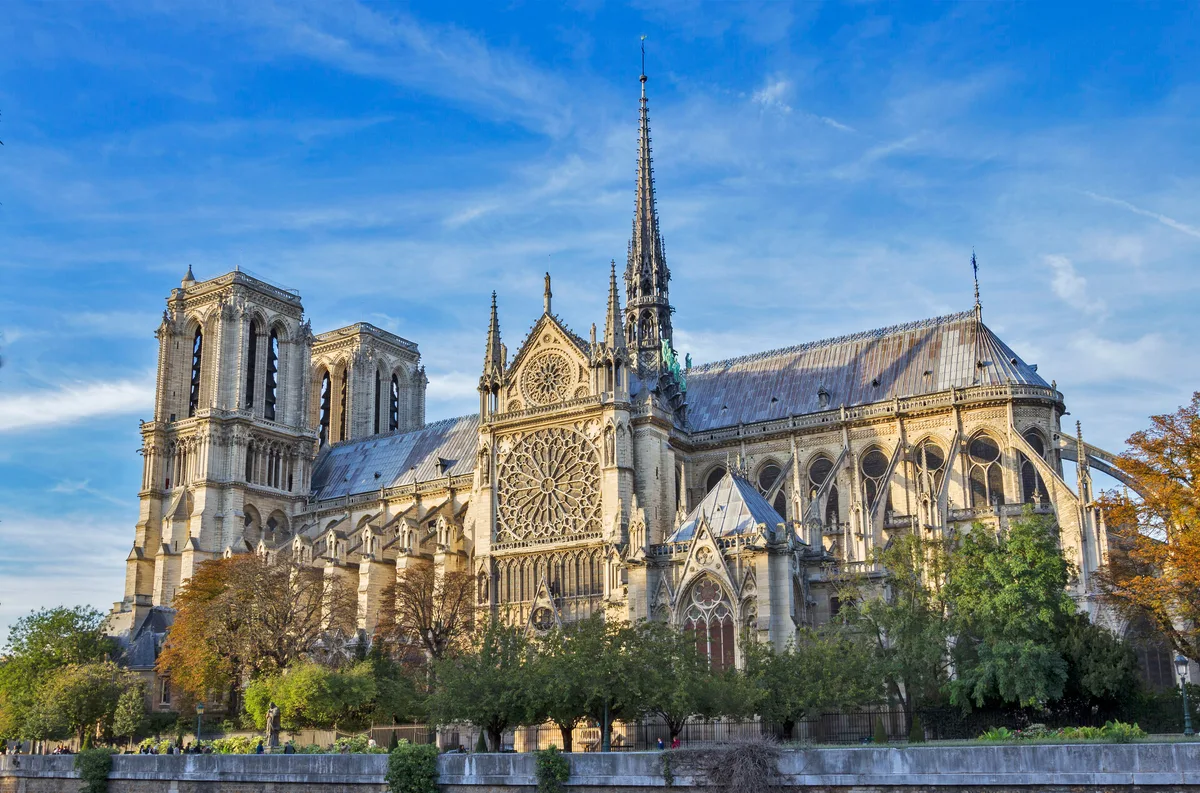
Photo: Ali Sabbagh / CC0
What Your Eye SeesA massive gothic cathedral on the Île de la Cité, defined by twin square towers, flying buttresses, and a forest of carved stone figures.
ContextBishop Maurice de Sully launched the project in 1163, laying the first stone in the presence of Pope Alexander III. Building took nearly 200 years, spanning the reigns of multiple kings. Its pioneering flying buttresses let the walls soar, making it the largest church in the Western world for decades, a deliberate projection of the Church's dominance over secular power.
On 15 April 2019 a fire tore through the cathedral, collapsing its 19th-century spire and badly damaging the roof, though the twin towers, stone vault, and many treasures survived. A vast restoration is returning the medieval Gothic cathedral to service, a project of national urgency in France.
On ScreenNotre-Dame Cathedral appears in the film The Hunchback of Notre-Dame (1996).
Source: UNESCO (Banks of the Seine); Wikipedia (Notre-Dame de Paris); Wikipedia (The Hunchback of Notre-Dame); production notes
DidYou
Know
The 28 statues above the entrance do not depict saints, they represent the Kings of Judah. During the French Revolution, angry mobs mistook them for French kings and decapitated all 28. The severed stone heads were lost for two centuries until workers discovered them buried in a basement during a 1977 renovation.
Share→ The Rose Windows
The cathedral's three great rose windows hold some of the oldest stained glass in the building, dating back to the 13th century. All three survived the 2019 fire, protected in large part by the stone vault and the surrounding masonry.
→ The Chimeras Are Not Medieval
The theatrical creatures that make Notre-Dame famous, the leering chimeras and the gargoyles perched on the balustrade, were added during Viollet-le-Duc's 19th-century restoration. Medieval builders did use water-spout gargoyles, but the dramatic figures on view today are a Romantic-era invention.
→ The Point Zéro Marker
Set in the pavement of the parvis, a short walk from the entrance, a bronze compass rose marks Point Zéro des Routes de France: the exact spot from which all French road distances are measured. The current marker dates from 1924, and the ground beneath it was once the site of a pillory where criminals were publicly punished.
Sources: Wikipedia; theparisianguide.com
 Euro Heritage
 Gothic Soul
 Spiritual Seeker
3. The Louvre (Cour Carrée)
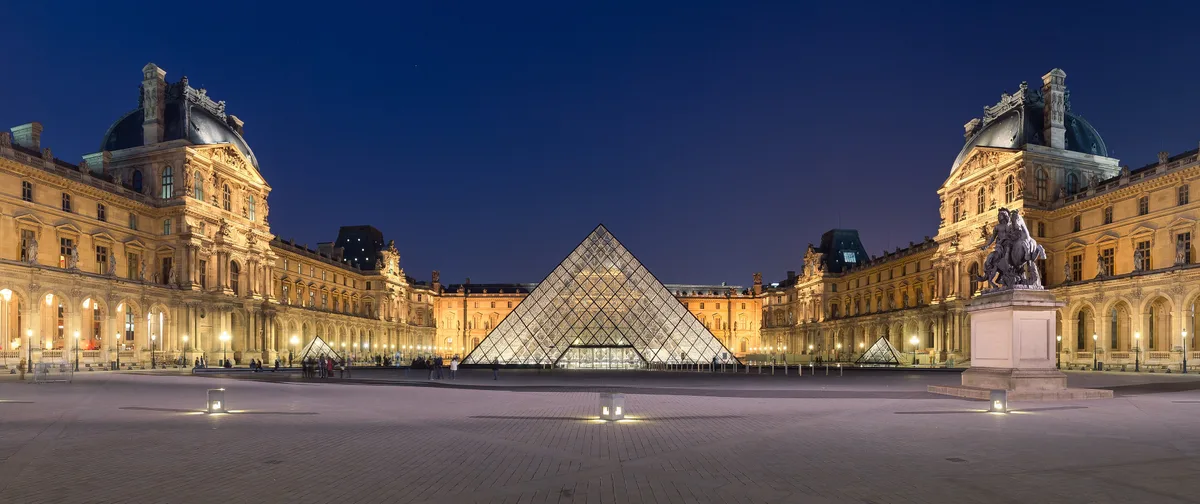
Photo: Benh LIEU SONG (Flickr) / CC BY-SA 3.0
What Your Eye SeesAn enormous Renaissance and Baroque palace complex surrounding a square courtyard, with the modern glass pyramid marking the main entrance.
ContextThe Louvre began as a 12th-century fortress built to defend Paris against Viking raids along the Seine. Every subsequent ruler expanded or reshaped the building to project their own vision of power, turning it from a defensive keep into a royal residence and finally into a public museum after the Revolution of 1793.
In 1989 a 21-metre glass pyramid by architect I. M. Pei opened as the museum's main entrance, at first controversial, now its signature. Today the Louvre is the most-visited museum in the world, its galleries spanning antiquities, European painting, and the Mona Lisa.
On ScreenThe Louvre features in the film The Da Vinci Code (2006).
Source: UNESCO (Banks of the Seine); Wikipedia (Louvre); Wikipedia (The Da Vinci Code); production notes
DidYou
Know
During World War II, the Louvre evacuated over 4,000 artworks to chateaus across France, including the Mona Lisa, moved six times in three years. The empty museum was then used by the German occupation to store looted Jewish art, a silent warehouse of stolen heritage while its own treasures were hidden.
Share→ The Medieval Fortress
In the Sully wing you can descend to the excavated foundations of the 12th-century castle built by Philip II, its moat and thick defensive walls are preserved and on view, letting you stand beside masonry from around 1190 that lay buried for centuries.
→ The Inverted Pyramid
In the Carrousel du Louvre a second, downward-pointing glass pyramid, also by I. M. Pei, sits over the shopping court. It is often described as the world's largest inverted skylight, and on sunny days a pool of light falls through it onto the floor below.
→ The 673 Panes
The great pyramid is made of 603 rhombus panes and 70 triangular ones, 673 panes in all, not the 666 of urban legend. Stand close and the geometry dissolves into a glittering lattice of diamonds and triangles.
Sources: The Louvre; Wikipedia
Euro Heritage
 Baroque Master
 Modernist
4. Sainte-Chapelle
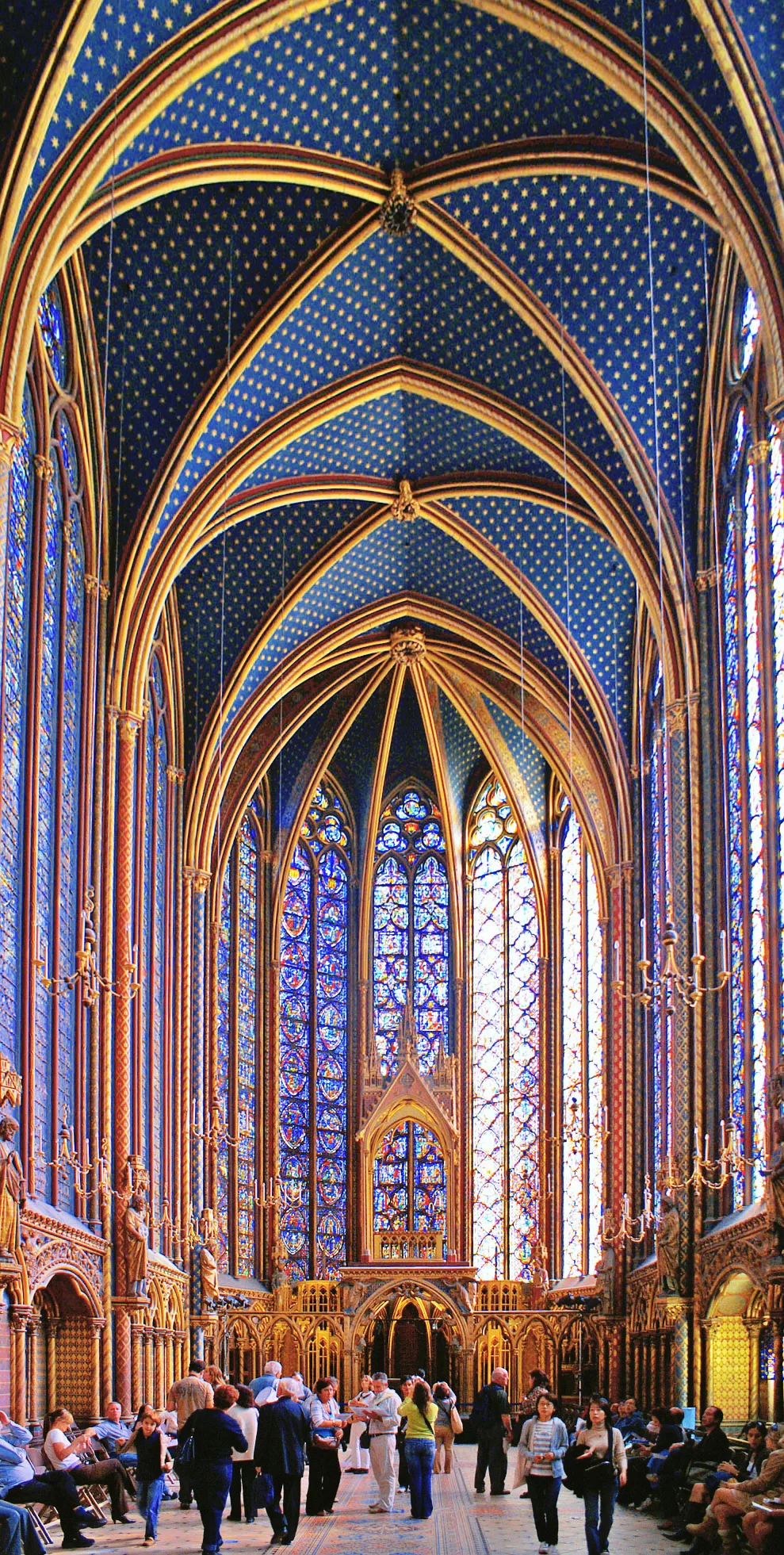
Photo: Didier B (Sam67fr) / CC BY-SA 2.5
What Your Eye SeesA narrow gothic chapel with impossibly tall stained-glass windows that seem to replace the walls entirely, flooding the interior with colored light.
ContextKing Louis IX commissioned this chapel not as a place of worship but as a monumental reliquary, a jewel box to house what he believed was the Crown of Thorns. He paid more for the relics than for the entire building. Built in under seven years and consecrated in 1248, it was the palatine chapel of the Capetian royal palace on the Île de la Cité.
Roughly 600 square metres of stained glass survive across its fifteen windows, almost all of it original 13th-century work, a greater expanse of medieval glass than anywhere else in Paris. Louis paid more for the Crown of Thorns alone than for the entire chapel built to shelter it.
Source: UNESCO (Banks of the Seine); Wikipedia (Sainte-Chapelle); Wikipedia (Sainte-Chapelle)
DidYou
Know
The 1,113 individual stained-glass panels tell the entire Biblical narrative from Genesis to the Apocalypse in chronological order, reading left to right and bottom to top. This was medieval visual storytelling for a population that could not read, a 13th-century equivalent of a graphic novel encoded in glass.
Share→ The Lost Spire
The original 13th-century spire was dismantled during the French Revolution. The one that rises today, about 33 metres tall, was added in the 1850s restoration, and the change of tone in the stone around the roofline still hints at where the older structure once stood.
→ The Rose Of The Apocalypse
The great rose window on the west front depicts the Book of Revelation, with the Lamb of God at its centre ringed by the four symbols of the evangelists. The glass was carefully restored in recent decades, bringing back the deep blues of the original palette.
→ Two Chapels In One
Sainte-Chapelle is built on two levels: the low, intimate lower chapel served the palace household, while the soaring upper chapel, its walls almost entirely of glass, was reserved for the king, a physical elevation that mirrored the hierarchy of the court.
Sources: Wikipedia
Euro Heritage
Gothic Soul
5. Panthéon
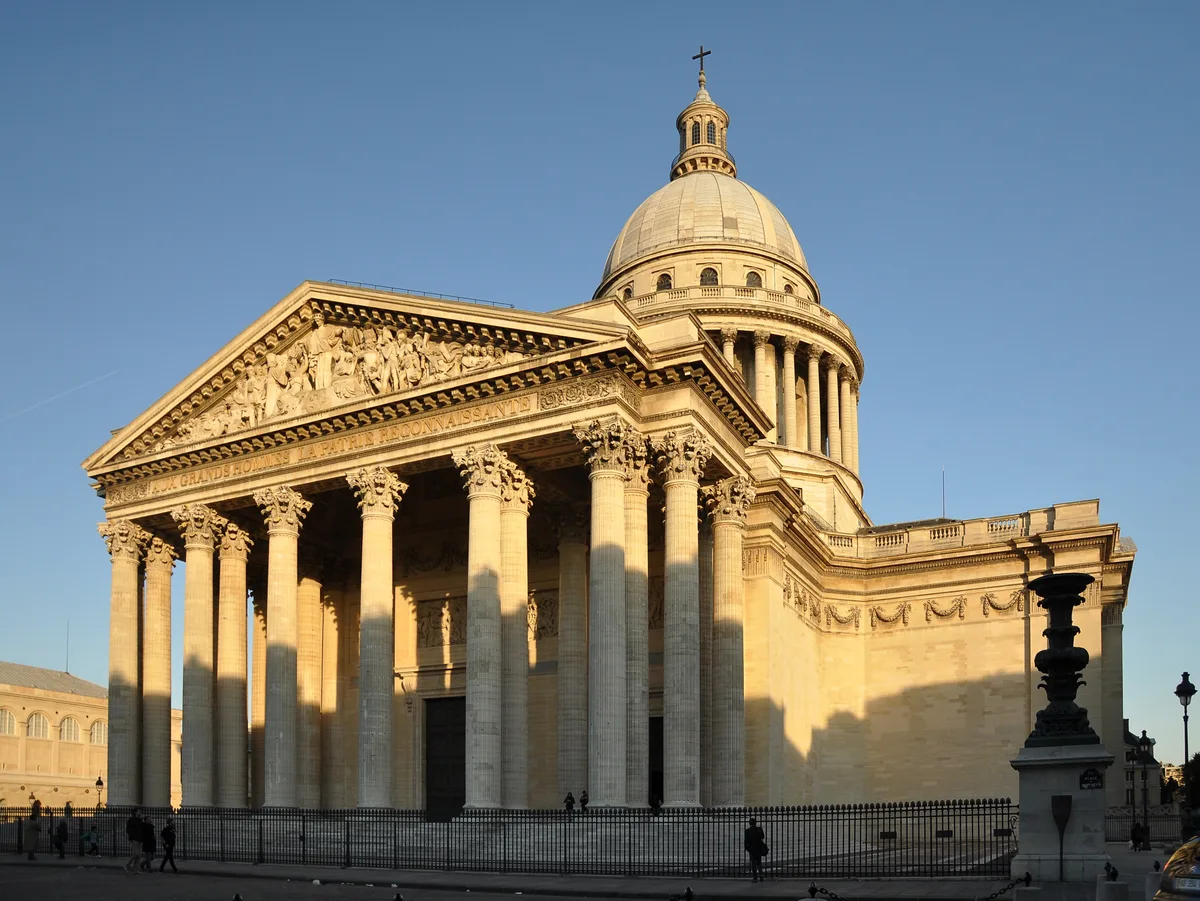
Photo: Moonik / CC BY-SA 3.0
What Your Eye SeesA neoclassical building crowned by a large dome, sitting atop the Montagne Sainte-Geneviève hill in the Latin Quarter.
ContextOriginally built as a church dedicated to Saint Geneviève, the French Revolution repurposed it as a secular temple to honor the great men and women of France. The building switched between church and secular mausoleum four times across different political regimes before settling into its current function.
Beneath the dome lie the remains of the nation's honored dead, Voltaire, Jean-Jacques Rousseau, Victor Hugo, Émile Zola, and Marie Curie among them. The building's vast neoclassical dome, inspired by the Pantheon of Rome and St Paul's Cathedral in London, was engineered by Jacques-Germain Soufflot as a monument to reason and the republic.
On ScreenThe Place du Panthéon appears on screen in The Walking Dead: Daryl Dixon (2023), where the group passes alongside the neoclassical façade, the square standing in stark contrast to the chaos around it.
Source: UNESCO (Banks of the Seine); Wikipedia (Panthéon, Paris); Visit Paris Region; IMDb (The Walking Dead: Daryl Dixon)
DidYou
Know
In 1851, Léon Foucault hung a 67-meter pendulum from the dome to publicly prove that the Earth rotates. The experiment worked, the pendulum's swing plane visibly shifted throughout the day, turning the Panthéon into a scientific instrument and making a church built for God the place where science demonstrated a fundamental law of physics.
Share→ The Triple Dome
The dome is actually three nested shells. Light enters through an oculus in the inner dome, creating the illusion that the space is taller than it is, while the middle shell supports the crowning lantern and the outer one forms the silhouette you see from the street.
→ The Golden Inscription
Across the pediment, carved in gilded letters, runs the motto of the republic: 'AUX GRANDS HOMMES LA PATRIE RECONNAISSANTE', 'To great men, the grateful homeland'. Below it, the sculpted fronton by David d'Angers shows the Nation, Liberty and History handing laurel crowns to the great men of France, both civil and military.
→ The Marble Groups At The Door
Flanking the main door under the peristyle stand two large groups of white marble sculpted by Hippolyte Maindron in 1853: Attila and Saint Geneviève, and Clovis receiving baptism. Their theatrical drama belongs to the 19th-century decoration of the building, added long after the church was begun.
Sources: Wikipedia; Musées d'Angers; napoleon.org
Euro Heritage
6. Palais Royal
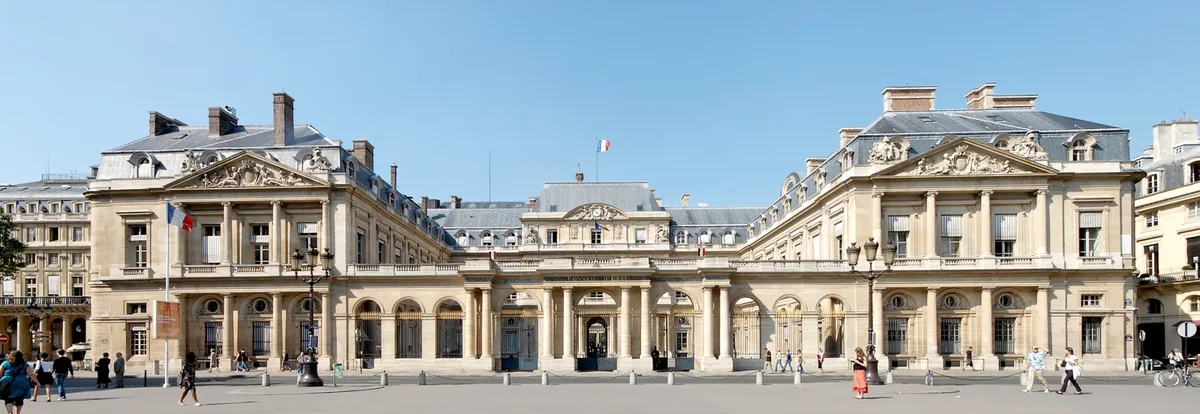
Photo: Marie-Lan Nguyen / Public domain
What Your Eye SeesAn elegant 17th-century palace enclosing a serene garden courtyard, bordered by uniform arcaded galleries. The courtyard entrance is marked by Daniel Buren's striped black-and-white columns.
ContextBuilt for Cardinal Richelieu as a personal residence, the Palais Royal later became the center of radical political activity. Because royal police could not enter the duke's private property, it became an uncensored zone where revolutionary pamphlets were distributed freely, making it the birthplace of the French Revolution's public discourse.
The palace's arcaded galleries and gardens became Paris's most fashionable meeting place and a hotbed of opposition; the Comédie-Française traces its stage to the Théâtre du Palais-Royal, where Molière performed for Louis XIV. What began as a cardinal's residence outlived every regime to become the city's free-speech crucible.
On ScreenPalais-Royal was a filming location for Mission: Impossible – Fallout (2018).
Source: UNESCO (Banks of the Seine); Wikipedia (Palais-Royal); Wikipedia (Palais Royal); Wikipedia (Palais-Royal); Mission: Impossible – Fallout production notes
DidYou
Know
On July 12, 1789, Camille Desmoulins stood on a table in the Palais Royal garden and delivered the speech that directly ignited the storming of the Bastille two days later. The most consequential moment in French revolutionary history did not happen in a government building, it happened in a private garden that functioned as Paris's first free speech zone.
Share→ The Buren Columns
Daniel Buren's installation 'Les Deux Plateaux' fills the courtyard with 260 black-and-white striped columns, installed in the mid-1980s. Their heights vary, some stand on the surface, others sink below court level, and the work was so controversial it nearly came down again.
→ The Worn Marble
Under the arcades, the black-and-white checkered marble floor laid in the 18th century still carries the worn paths of three centuries of strolling shoppers, the tread-worn zones trace the everyday traffic of the galleries more faithfully than any plan.
→ The Pol Bury Fountains
In the Galerie d'Orléans, between the courtyard and the garden, two fountains by the Belgian artist Pol Bury each hold seventeen polished stainless-steel spheres that turn slowly on their axes, driven by water flowing around them. Installed in 1985, their mirror surfaces reflect the surrounding arcades and, in summer, the crowds passing by.
Sources: Wikipedia; Palais Royal; aviewoncities.com
 Ancient Roots
Modernist
Ancient Roots
Modernist
7. Arc de Triomphe
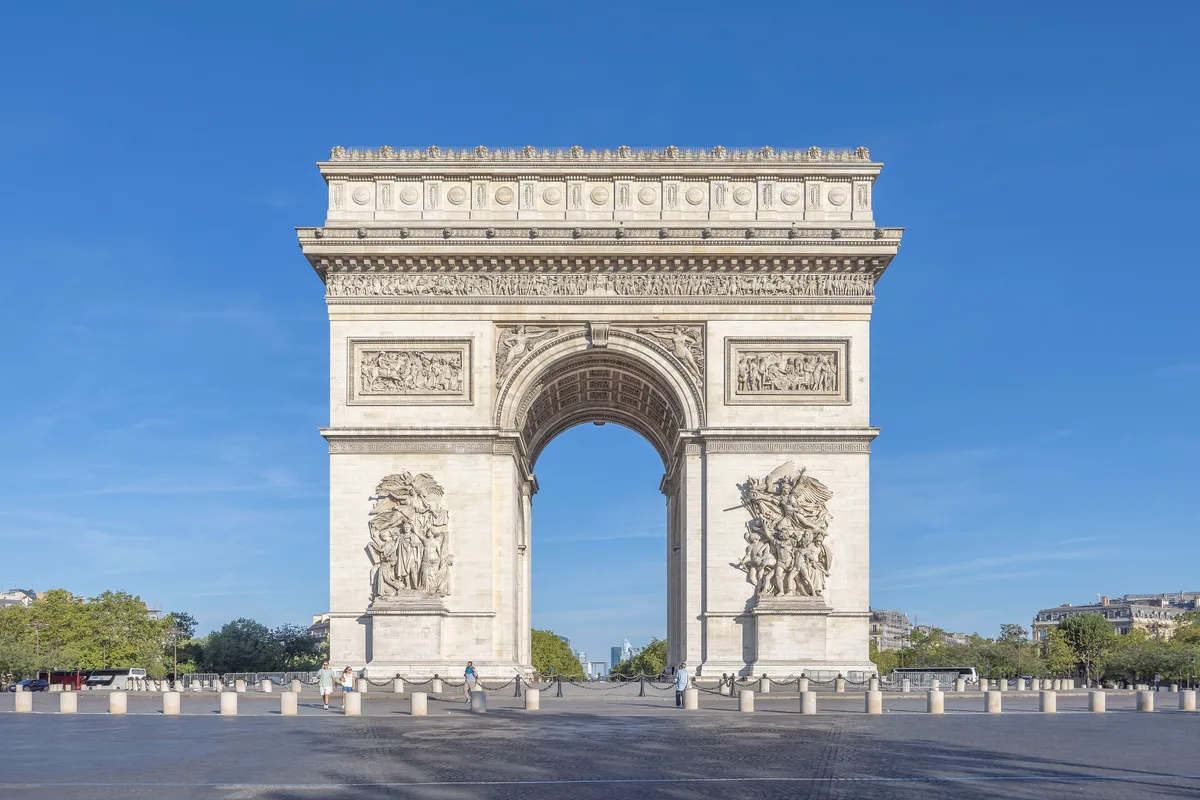
Photo: Zairon / CC BY-SA 4.0
What Your Eye SeesA 50-metre neoclassical triumphal arch standing alone at the centre of a star-shaped junction, its massive vault framing the Champs-Élysées beyond.
ContextNapoleon ordered the arch in 1806 after his victory at Austerlitz to honour the armies of the Revolution and the Empire. The architect Jean-Francois Chalgrin drew up plans inspired by the Arch of Titus in Rome, but doubled the scale. Construction dragged on through three political regimes, and the arch was not completed until 1836, fifteen years after Napoleon's death.
The most celebrated sculpture on the facade is Francois Rude's Departure of the Volunteers of 1792, popularly known as La Marseillaise, a winged figure of Liberty urging citizen-soldiers to defend the young Republic. Beneath the arch lies the Tomb of the Unknown Soldier from the First World War, interred on Armistice Day 1920, its eternal flame rekindled each evening.
On ScreenThe Arc de Triomphe and the roundabout around it anchor the motorbike chase in Mission: Impossible Fallout (2018), filmed with the surrounding streets closed to traffic. The arc also appears in the series Lupin (2021).
Source: Wikipedia (Arc de Triomphe); Britannica (Arc de Triomphe); CMN (Centre des Monuments Nationaux); IMDb (Mission: Impossible Fallout); Centre des monuments nationaux
DidYou
Know
The arch took 30 years to build, and when Napoleon entered Paris in 1810 with his bride Marie-Louise of Austria, he had a full-scale wooden mock-up erected so the procession would pass beneath a seemingly finished monument. The real arch was barely above ground level at the time.
ShareThe Battle Frieze
Run your eyes along the frieze below the cornice and you will find a procession of 528 figures in high relief, depicting soldiers, horses, and civic figures from the Revolutionary and Napoleonic wars. The carving is deeply undercut so that in certain light the figures cast sharp shadows against the stone, giving the flat surface a startling depth.
The 660 Names
The inner walls of the arch list the names of 660 French generals of the First Republic and First Empire. Those killed in battle have their names underlined. Walk through the vault and look up: the names wrap around you in neat columns, a roll call of an entire military generation.
The Eternal Flame
Since 1923, a flame has burned at the Tomb of the Unknown Soldier beneath the arch. It is rekindled every evening at 6:30 pm by members of veterans' associations. Rain or shine, the ceremony has not missed a single day in over a century.
Sources: Wikipedia (Arc de Triomphe); CMN (Centre des Monuments Nationaux); Wikipedia (Tomb of the Unknown Soldier); Paris Arc de Triomphe official site
Euro Heritage
8. Musée d'Orsay
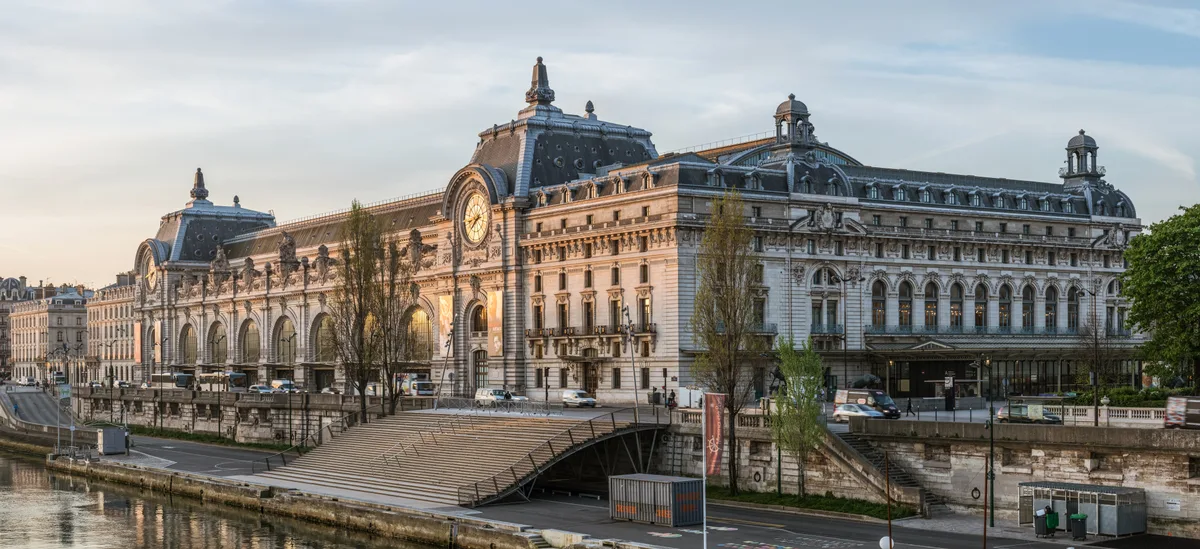
Photo: DXR / CC BY-SA 3.0
What Your Eye SeesA grand Beaux-Arts railway station on the Left Bank, its monumental clock faces still keeping time over a nave now filled with Impressionist masterpieces.
ContextThe Gare d'Orsay opened on 14 July 1900 for the Exposition Universelle, designed by Victor Laloux to disguise a modern electric railway station behind a limestone facade that would not offend the Louvre across the Seine. It was the first electrified urban terminal in the world, with sixteen underground tracks and a glass-roofed nave 138 metres long.
By 1939 the platforms were too short for longer trains, and the station fell into obscurity. Threatened with demolition in the 1960s, it was saved by the French Ministry of Culture and repurposed as a museum bridging the gap between the Louvre and modern art at the Pompidou Centre. President Francois Mitterrand inaugurated the Musee d'Orsay in December 1986, and it now houses the world's largest collection of Impressionist and post-Impressionist painting, including works by Monet, Renoir, Van Gogh, and Degas.
On ScreenThe Musée d'Orsay's galleries appear in Summer Hours (2008), the second film commissioned by the museum itself, starring Juliette Binoche, whose characters walk its halls.
Source: Wikipedia (Musée d'Orsay); Wikipedia (Gare d'Orsay); Britannica (Musée d'Orsay); Musée d'Orsay official site; Wikipedia (Summer Hours); Senses of Cinema
DidYou
Know
The station was built on the ruins of the Palais d'Orsay, which was burned down during the Paris Commune of 1871. For thirty years the charred walls stood as a reminder of civil war before Victor Laloux drew his plans over them. The station's electric trains were nicknamed "salt cellars" because of the boxy shape of the early locomotives.
ShareThe Station Clocks
Two enormous clocks face the Seine, once helping commuters catch their trains. Today, the top-floor Impressionist gallery runs directly behind them. Stand close and you look through the original clock face at the city beyond, the hour hand just inches from Monet's canvases.
The Glass Barrel Vault
The station's original glass-and-iron barrel vault stretches 138 metres overhead, flooding the central nave with natural light. Because the electric trains produced no steam or smoke, Victor Laloux could enclose the entire hall in glass, a technical novelty in 1900. Look up from the ground floor and you see the iron ribs curving toward the apex, each joint still bearing the marks of the original rivet work.
Gae Aulenti's Interior
Italian architect Gae Aulenti designed the museum's interior in the 1980s, building pale stone terraces and towers inside the vast train shed. Her design created human-scale galleries within the station's monumental volume, a difficult balancing act between preserving the building and displaying art.
Sources: Musée d'Orsay official site; Wikipedia (Gare d'Orsay); Google Arts & Culture; Wikipedia (Musée d'Orsay)
Modernist
Which Assassin's Creed game is set in Paris?
Assassin's Creed Unity (2014). Set during the French Revolution, it lets players climb Notre-Dame, the Louvre (the Tuileries) and the Panthéon as the assassin Arno Dorian. A striking postscript: after the 2019 Notre-Dame fire, architects reportedly consulted Ubisoft's meticulously modelled version of the cathedral to help guide the restoration.
What is the most visited museum in the world?
The Louvre in Paris, which received 8.9 million visitors in 2023. Its collection spans from antiquity to the mid-19th century and includes the Mona Lisa, the Venus de Milo and the Winged Victory of Samothrace. The museum occupies the former royal palace along the Right Bank of the Seine.
Is Notre-Dame open after the 2019 fire?
Yes. Notre-Dame Cathedral reopened on December 7, 2024, five years after the fire that destroyed its spire and roof. The restoration returned the cathedral to its 19th-century Viollet-le-Duc appearance, and the reopening ceremony drew heads of state from around the world.
These landmarks reward close attention. Vestigia is a field companion for people who look longer, with curated context, architectural detail, and the stories most visitors walk past. Free on the App Store and Google Play.