Sydney Historical Landmarks
1. Sydney Opera House
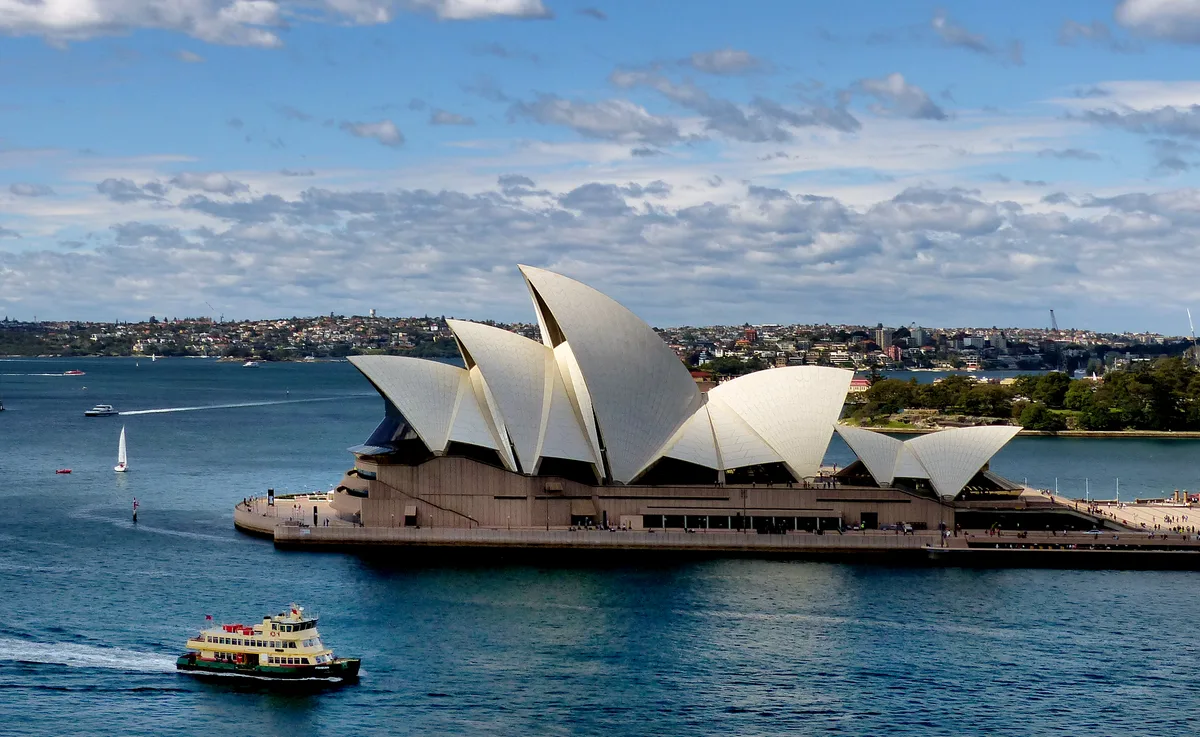
Photo: Bernard Spragg. NZ from Christchurch, New Zealand / CC0
What Your Eye SeesA soaring expressionist building with white ceramic-tiled shells rising from Bennelong Point, resembling billowing sails or overlapping waves against the harbour.
ContextDesigned by Danish architect Jorn Utzon, the Sydney Opera House won an international competition in 1957, chosen from 233 entries, and was completed in 1973 after Utzon's resignation in 1966 and completion by an Australian team led by Peter Hall. Its sail-like shells, clad in over a million Swedish-made tiles, have made it one of the 20th century's defining buildings; UNESCO listed it as a World Heritage Site in 2007.
On ScreenThe Sydney Opera House was a filming location for Mission: Impossible 2 (2000), The Matrix (1999) and Finding Nemo (2003).
Source: UNESCO; Wikipedia (Sydney Opera House); Wikipedia (Sydney Opera House); The Matrix production notes; Mission: Impossible 2 production notes
 Did
DidYou
Know
The project was budgeted at $7 million and scheduled for 4 years, it took 14 years and cost $102 million. The roof shells were impossible to build as designed until engineers discovered they could be cut from sections of a single sphere. Utzon resigned in 1966, never returned to see his masterpiece, and refused all payment.
Share→ The Chevron Tile Pattern
The roof carries 1,056,006 ceramic tiles laid in a subtle chevron pattern, mixing glossy white and matte cream tiles so the shells catch the light differently depending on the angle. Utzon spent three years developing the 'Sydney Tile' with the Swedish firm Höganäs.
→ The Concrete Ribs
The sails are not solid, each is built from precast concrete ribs, cast on site and post-tensioned into place. Working out their curved geometry demanded pioneering use of computers, one of the first times a building had been engineered this way; without them the roof could not have been built.
Sources: Sydney Opera House (official); SMH; Wikipedia; V&A (Computers and the Sydney Opera House); IStructE
 Modernist
2. Sydney Harbour Bridge
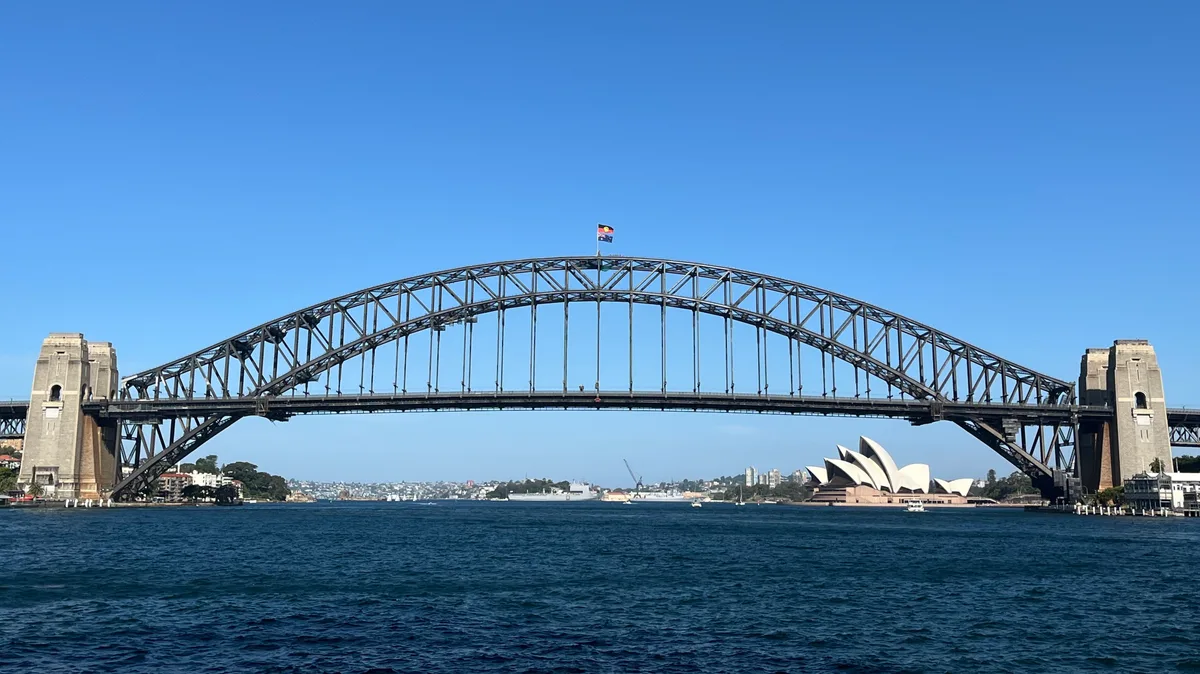
Photo: Servite et contribuere / CC0
What Your Eye SeesA massive steel arch bridge connecting the central business district to the North Shore, its arch rising 134 metres above the harbour. Known locally as the "Coathanger."
ContextOpened in 1932, the Sydney Harbour Bridge is the world's tallest steel arch bridge and a symbol of the city, nicknamed "the Coathanger." Chief engineer J.J.C. Bradfield drove the design, built by Dorman Long of England between 1923 and 1932 using six million hand-driven rivets; sixteen workers died during construction. It was a major public-works project through the Great Depression, employing some 1,400 people.
On ScreenThe Sydney Harbour Bridge was a filming location for Mission: Impossible 2 (2000).
Source: Australian National Heritage List; Wikipedia (Sydney Harbour Bridge); Wikipedia (Sydney Harbour Bridge); Mission: Impossible 2 production notes
DidYou
Know
At 134 metres high and 503 metres long, the arch packs 52,800 tonnes of steel, and at the 1932 opening a lone horseman slashed the ribbon with his sword, declaring the bridge open in protest at the official ceremony.
Share→ The Hidden Rivets
The bridge's rivets were heated until red-hot, around 1,000 °C, then hammered into place while still glowing. As each one cooled it shrank slightly, clamping the steel plates together with a grip no bolt could match.
→ The Southeast Pylon
Climb the 200 steps inside the south-east pylon and you reach the Pylon Lookout, open as a museum since 1934. The pylons are concrete towers faced with granite quarried at Moruya, 300 km to the south, where the stonemasons lived in a temporary settlement.
Sources: Wikipedia (Sydney Harbour Bridge); Heritage NSW; NSW Government
Modernist
3. Queen Victoria Building
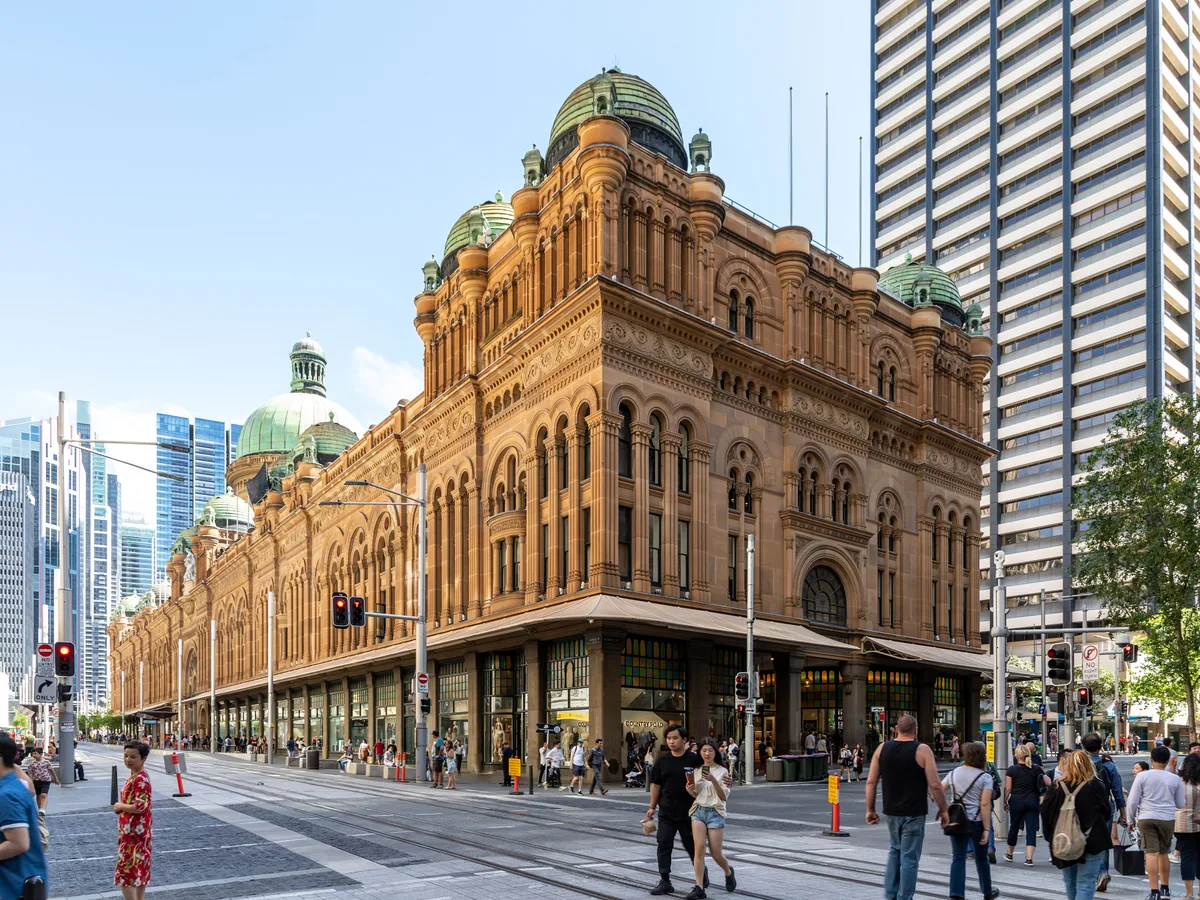
Photo: Dietmar Rabich / CC BY-SA 4.0
What Your Eye SeesA magnificent Romanesque-style building taking up an entire city block, crowned by a 50-metre central dome and filled with ornate stained glass, wrought-iron balconies, and a grand Royal Clock.
ContextCompleted in 1898 to honour Queen Victoria's Diamond Jubilee, the Queen Victoria Building was designed by city architect George McRae in Romanesque Revival style and built as a grand municipal market, filling an entire city block some 190 metres long. After decades of decline and near-demolition, it was rescued by Malaysian developer Ipoh Ltd and fully restored in 1986, its central copper-clad dome and stained glass revived as a shopping arcade.
Source: NSW State Heritage Register; Wikipedia (Queen Victoria Building)
DidYou
Know
Behind its Romanesque sandstone walls the building hid a concert hall and ballroom, yet it nearly bankrupted the city council and came close to demolition in the 1950s, until the Lord Mayor fought to save it.
Share→ The Royal Clock
Above the southern end, the Royal Clock re-enacts six scenes of English royal history on the hour, including King John signing the Magna Carta and the execution of Charles I. Built by Thwaites & Reed of Hastings to a design by Neil Glasser, it was unveiled in 1986 during the building's restoration.
→ The Cartwheel Window
Look for the great cartwheel window facing George Street: it carries the ancient arms of the City of Sydney, where the beehive stands for commerce, the sailing ship for trade, and the dolphins for the harbour. The windows on this side were recreated after the originals were damaged in the 1978 Hilton Hotel bombing.
Sources: Wikipedia (Royal Clock); University of Western Australia; QVB (official); Ausemade
 Euro Heritage
4. Art Gallery of New South Wales
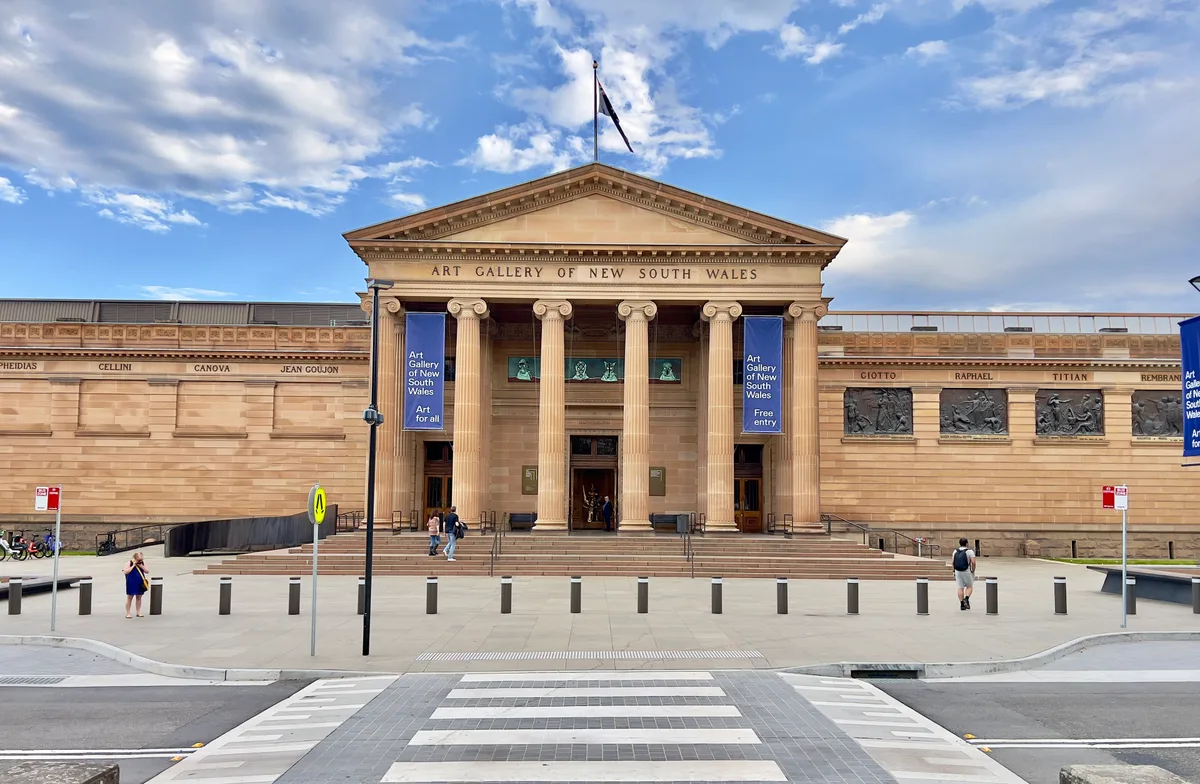
Photo: Chris Olszewski / CC BY-SA 4.0
What Your Eye SeesA Neoclassical sandstone building overlooking the Domain parklands, with a grand Ionic portico and a recent glass-and-steel contemporary wing projecting toward the harbour.
ContextFounded in 1871 and set in The Domain overlooking Sydney Harbour, the Art Gallery of New South Wales is one of Australia's largest and most visited art museums, with collections spanning Australian, European, and Asian art. Its building grew across three phases over 130 years and expanded again in 2022 with a major new wing, the Sydney Modern Project, doubling its exhibition space.
Source: Wikipedia (Art Gallery of New South Wales)
DidYou
Know
When the gallery opened, the first acquisition committee bought paintings by mail order from London without seeing them, selecting British watercolours through a London Selection Committee. The watercolours set a pattern of collecting British art that would continue for decades, revealing colonial cultural assumptions.
Share→ The Grand Ionic Portico
The neoclassical entrance was designed by Government Architect Walter Liberty Vernon, inspired by William Playfair's National Gallery in Edinburgh. The hexastyle portico carries six Ionic columns; the pediment above it was completed in 1902, its tympanum deliberately left bare for sculpture that was never added.
→ The Bronze Reliefs
Around the facade run bronze relief panels begun in 1900, illustrating 'distinctive historical art periods', Assyria, Egypt, Greece and Rome. Only four of the six intended panels were completed; above them, letters inset along the cornice spell the names of the master painters and sculptors the building was raised to celebrate.
Sources: Art Gallery of NSW (official history)
Euro Heritage
 Renaissance
Modernist
Renaissance
Modernist
5. Cadman's Cottage
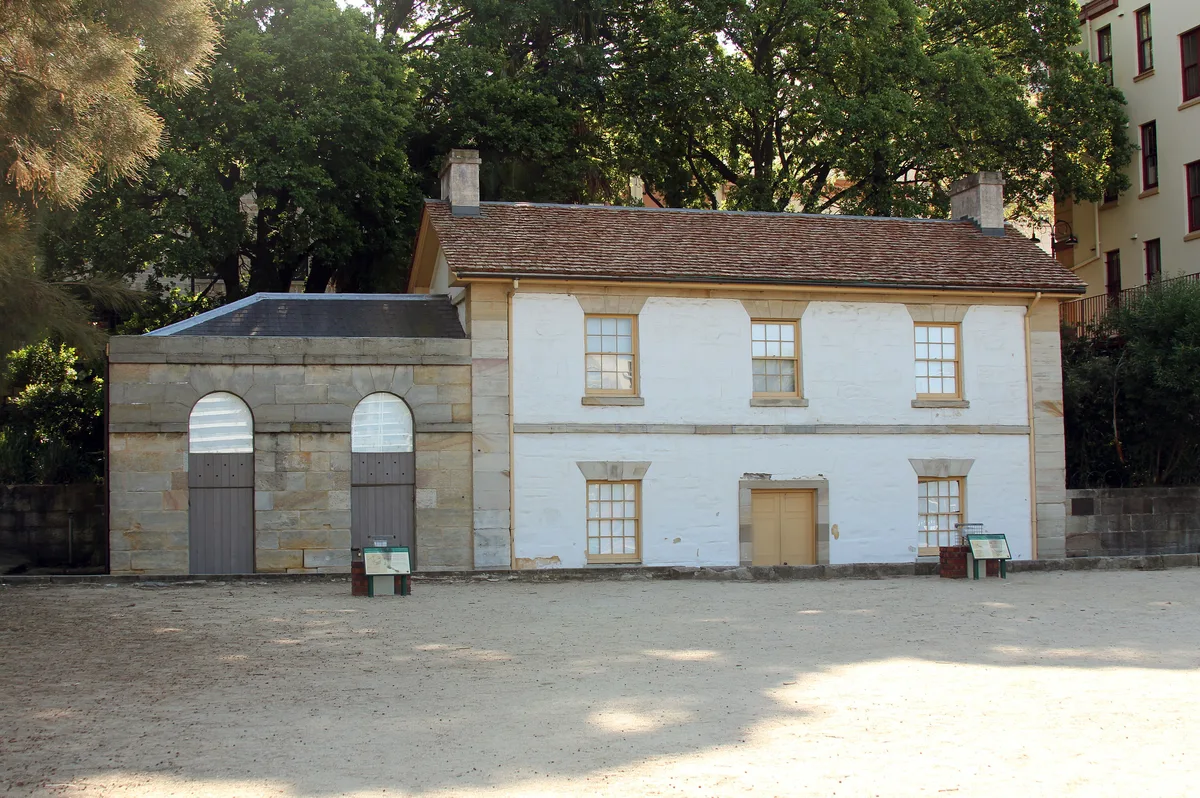
Photo: Julioenrekei / Public domain
What Your Eye SeesA small two-storey sandstone cottage with a steep shingled roof and iron-lattice windows, sitting on the edge of Circular Quay, dwarfed by the surrounding skyscrapers.
ContextBuilt in 1815–16 as the barracks for the government coxswains, Cadman's Cottage is the oldest surviving residential building in Sydney and the third-oldest overall. It is named for John Cadman, the longest-serving coxswain (1827–1845), who managed the Governor's fleet of boats; the Water Police later used it from the 1840s. Reclaimed land for Circular Quay has since left it about 100 metres from the water it once fronted.
Source: NSW State Heritage Register; Wikipedia (Cadman’s Cottage)
DidYou
Know
Only 28 years separated Cadman's Cottage from the First Fleet that founded Sydney, making this coxswains' barracks a rare physical link to the colony's convict beginnings, built while the settlement was still barely a generation old.
Share→ The Original Roof
Hidden beneath a corrugated-iron roof, workmen in 1972 found the building's original casuarina (she-oak) shingles, evidence that the modest cottage was once roofed with native Australian hardwood.
Sources: NSW Environment & Heritage; Wikipedia (Cadman's Cottage)
 Time Traveler
 Expedition Leader
6. St Mary's Cathedral
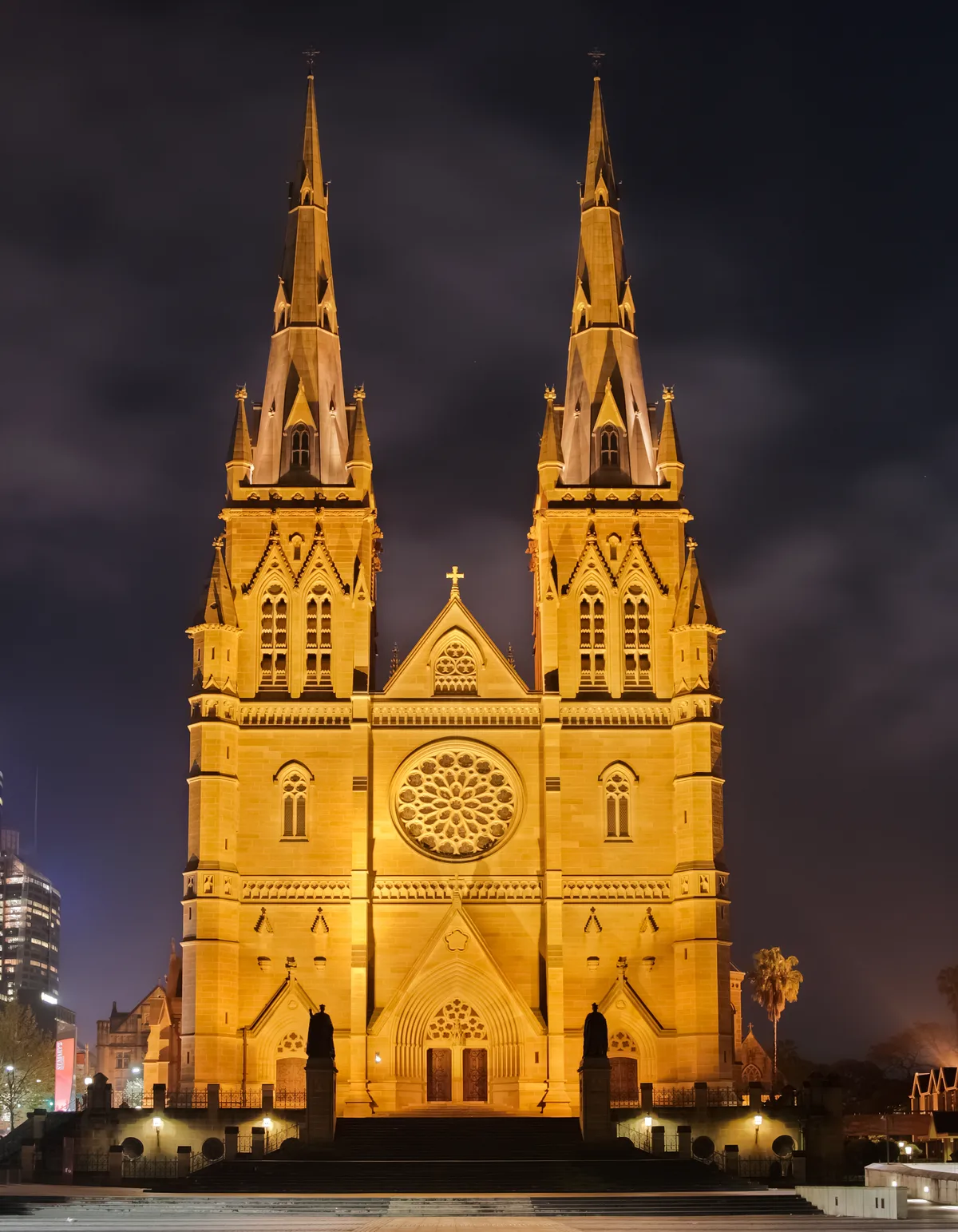
Photo: File:St Mary's Cathedral, Sydney HDR.jpg: Adam.J.W.C. derivative work: Georgfotoart / CC BY-SA 2.5
What Your Eye SeesA Gothic Revival cathedral built from local sandstone, with twin spires rising 74.6 metres. Its stained glass windows fill the interior with coloured light.
ContextConstruction of the present cathedral began in 1868 and its twin spires were finally raised in 2000, a 132-year build. After a fire destroyed the original 1865 cathedral, architect William Wardell (a former pupil of Pugin) designed its replacement in Geometric Decorated Gothic; built of honey-coloured Sydney sandstone, it is the mother church of Australian Catholicism and the largest cathedral in Australia.
Source: Wikipedia (St Mary’s Cathedral, Sydney)
DidYou
Know
St Mary's breaks a thousand-year-old rule of church building: Wardell abandoned the customary east–west orientation, turning the cathedral north–south instead because the fall of the land and the building's great length made the traditional axis impractical.
Share→ The Underground Crypt
Beneath the nave, stairs lead down to the cathedral's crypt, the resting place of Sydney's archbishops, from pioneer priest John Joseph Therry to Cardinal Moran and beyond. Its celebrated terrazzo mosaic floor, laid by the Italian Melocco brothers, is regarded as one of the finest mosaic floors in the world.
→ The Coronation Window
The great window at the sanctuary end is not a rose window but the Great North Window, depicting the Coronation of the Blessed Virgin Mary as Queen of Heaven and Earth. It was crafted in England by Hardman & Co. of Birmingham and shipped to Sydney in the late 1880s.
Sources: St Mary's Cathedral (official); Dictionary of Sydney; GlassArt AJ
Euro Heritage
 Gothic Soul
 Spiritual Seeker
Why did the architect of the Sydney Opera House resign?
Danish architect Jorn Utzon resigned in 1966, before the building was finished, and never returned to see his masterpiece. The project was budgeted at $7 million and scheduled for four years; it took 14 years and cost $102 million, and the roof shells were impossible to build until engineers discovered they could be cut from sections of a single sphere. Completed in 1973 by an Australian team led by Peter Hall, the Opera House was listed as a UNESCO World Heritage Site in 2007.
Why is the Sydney Harbour Bridge called the Coathanger?
Because of its unmistakable steel arch. Opened in 1932, it is the world's tallest steel arch bridge, 134 metres high and 503 metres long, packed with 52,800 tonnes of steel. At the opening ceremony a lone horseman slashed the ribbon with his sword, declaring the bridge open in protest at the official proceedings. The nickname stuck within months of the first steel spans being erected.
These landmarks reward close attention. Vestigia is a field companion for people who look longer, with curated context, architectural detail, and the stories most visitors walk past. Free on the App Store and Google Play.