Roman Sites in Italy
Italy is where the empire kept its stone longest: arenas that still perform, a buried town dug up with its people in it, imperial villas and port cities, and a capital where six imperial monuments stand within walking distance of each other. This is a reader's guide to the places the Roman Empire left standing in Italy, arranged from the most-visited to the more off-the-beaten-path, each paired with the single feature that makes it worth the stop.
All 18 sites, plotted on the map below.
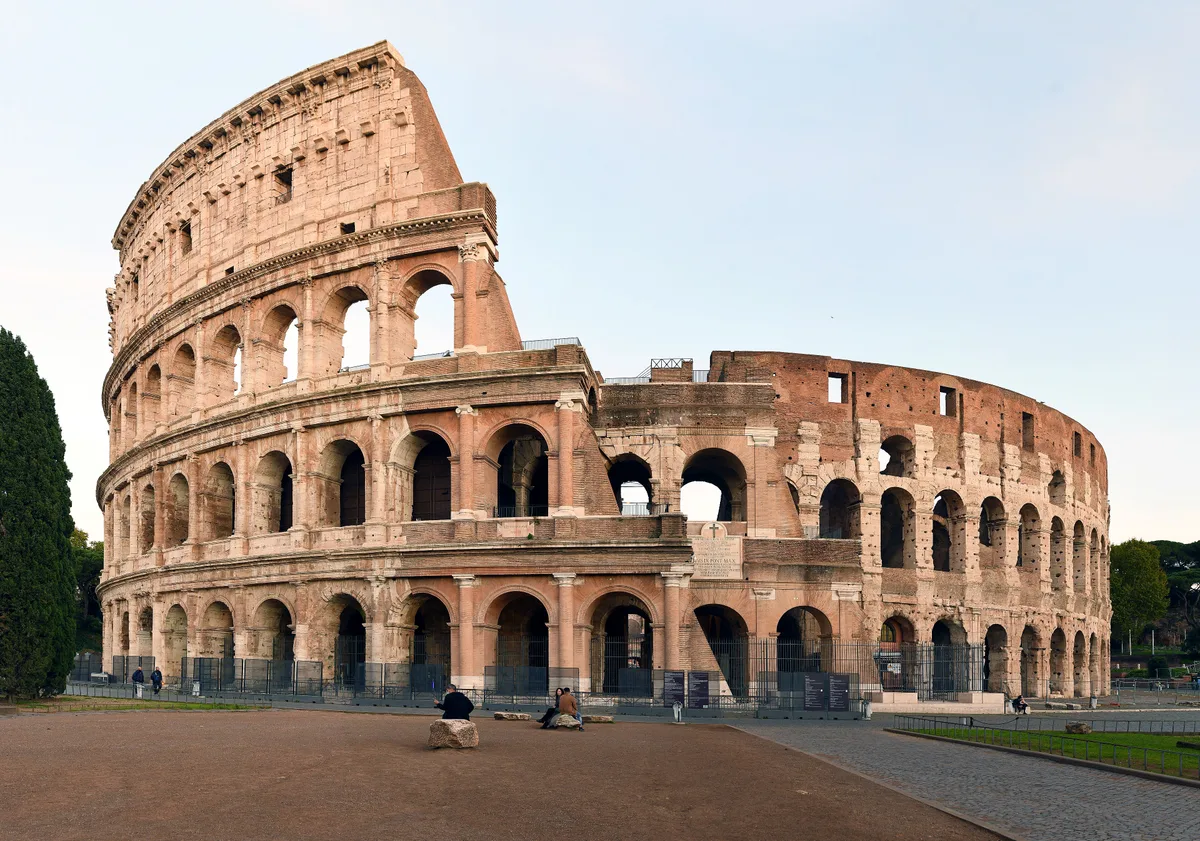
Photo: FeaturedPics / Wikimedia Commons (CC BY-SA 4.0)
At a Glance
- Period
- AD 72–80
- UNESCO
- Yes
- Notable structures
- Hypogeum, arena, four entrance arches
- Best season
- Apr–Jun, Sep–Oct
- Visiting hours
- Daily (seasonal)
- Recommended time
- 2–3 hours
- Entry
- Paid
Rome · Lazio
The Colosseum, the arena that staged Rome's spectacles
The Colosseum, begun under Vespasian and inaugurated by Titus in AD 80, was Rome's largest amphitheatre, seating between 50,000 and 80,000 for gladiatorial combat, animal hunts and staged naval battles. Earthquakes and centuries of stone-robbing stripped its marble, and by the Middle Ages the vast skeleton had become a fortified stronghold of rival Roman families.
What separates the visit from a photo stop is what remains of the arena floor: the hypogeum, a two-storey warren of tunnels and cages beneath where the sand once lay, worked by lifts and trapdoors that hoisted beasts and scenery into the light. From the upper walkway you look straight down into that machinery, the closest thing ancient Rome kept to a working circus.
The building owes its nickname to the colossal statue of Nero that once stood beside it, and the pale travertine of the four great arches on the outer facing is the original stone, patched after the earthquakes with the brick the Romans themselves used.
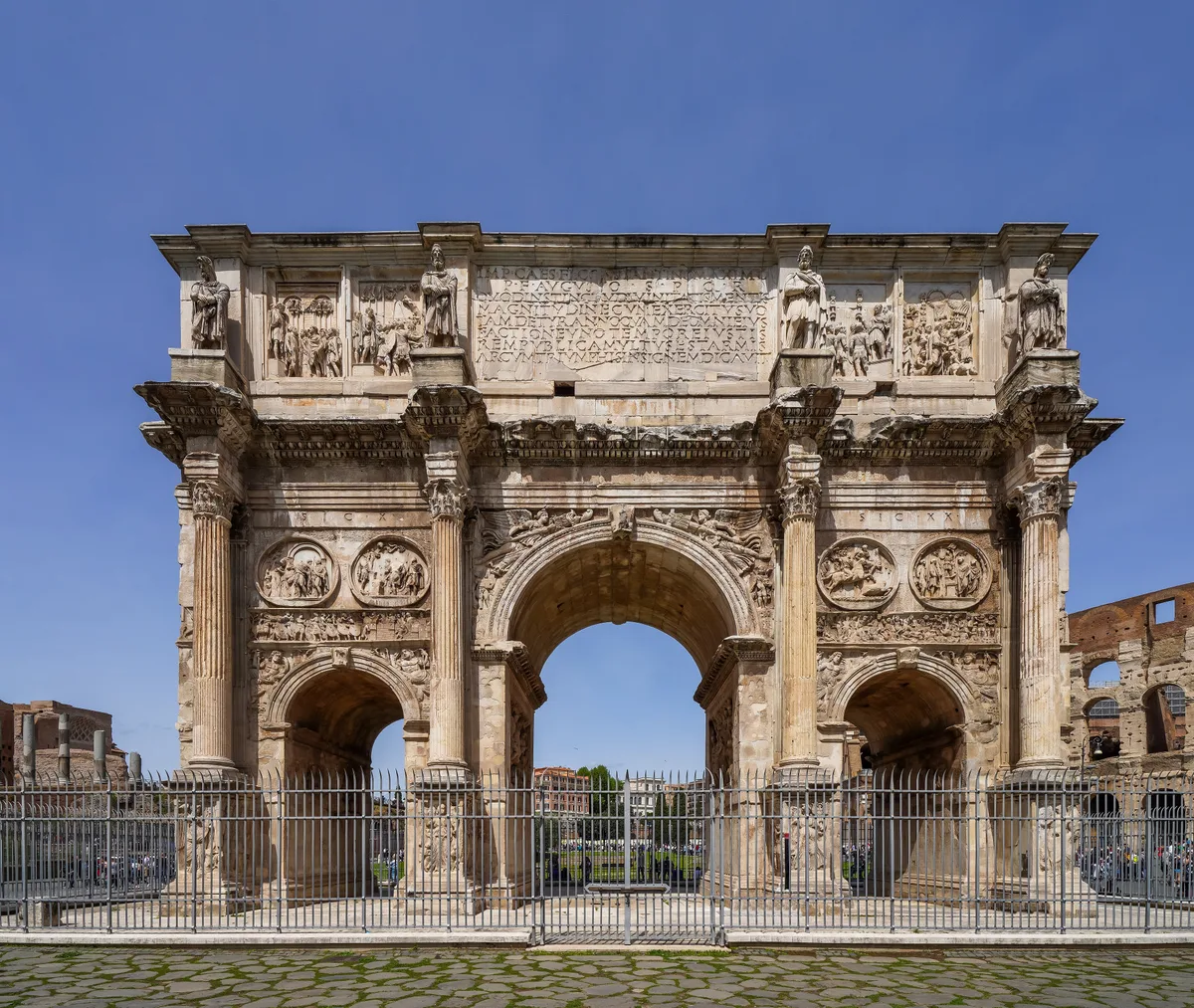
Photo: NikonZ7II (Paris Orlando) / Wikimedia Commons (CC BY-SA 4.0)
At a Glance
- Period
- AD 312–315
- UNESCO
- Yes
- Notable structures
- Reused reliefs from Trajan, Hadrian and Marcus Aurelius
- Best season
- Apr–Jun, Sep–Oct
- Visiting hours
- Always open (street level)
- Recommended time
- 30 minutes
- Entry
- Free
Rome · Lazio
The Arch of Constantine, the last great arch on Rome's road of triumph
In October 312 Constantine crossed the Milvian Bridge against his rival Maxentius, and Rome answered with its last great triumph arch. The Senate finished it within three years, cutting the tall central opening for the emperor's chariot and the two flanking arches for the columns of cavalry and foot soldiers, so the whole army pressed through the stone as a single piece of theatre. In AD 315 the monument was dedicated, and it survives nearly whole because it stood on the Via Triumphalis, the victors' route that ran from the Campus Martius to the Forum.
The arch repays a slow look for how it was decorated. Rather than commission new sculpture, the builders ransacked earlier monuments, lifting the perfect panels of Trajan, Hadrian and Marcus Aurelius and setting them around panels of coarser Constantinian carving. The result is a museum of two hundred years of imperial relief in a single facade. Then step through the central opening, the only way to cross the arch that remains the queen's own door, and the view ahead was the one Constantine saw: the road line toward the Forum, with the Colosseum behind you and the Palatine ahead.
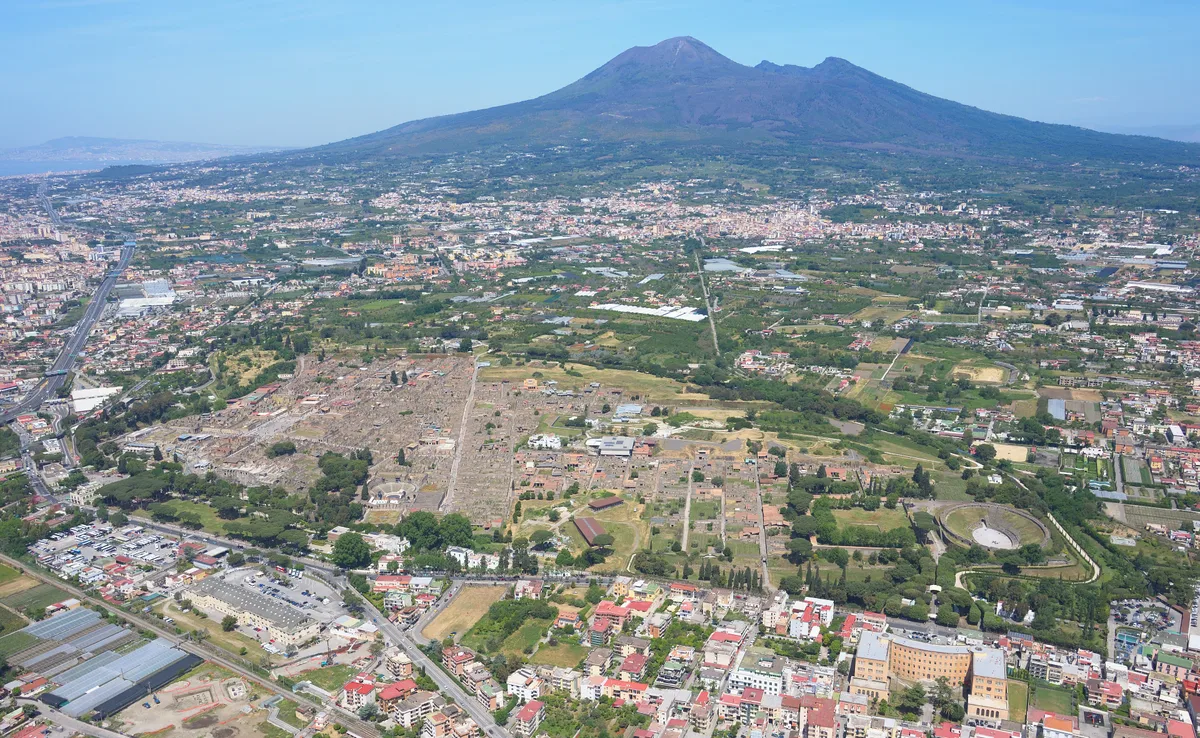
Photo: Carsten Steger / Wikimedia Commons (CC BY-SA 4.0)
At a Glance
- Period
- 6th c. BC – AD 79
- UNESCO
- Yes
- Notable structures
- Forum, amphitheatre, Villa of the Mysteries, plaster casts
- Best season
- Apr–Jun, Sep–Oct
- Visiting hours
- Daily (seasonal)
- Recommended time
- 4–5 hours
- Entry
- Paid
Naples · Campania
Pompeii, the town that kept its people as well as its walls
In AD 79 Vesuvius buried Pompeii, near Naples on the Bay of Naples, under metres of ash and rock while the town was still going about its day, and excavation, begun in 1748 and still continuing, has returned nearly two thirds of a Roman city: forums, temples, baths, an amphitheatre, shops, villas and streets whose paving stones date to the last hours of the town.
Pompeii's own trick is that it preserved people, not just buildings: in the 1860s the archaeologist Giuseppe Fiorelli poured plaster into the cavities left by decomposed bodies, and the casts dotted around the site are among the only images we have of individual Romans as they died. On a quiet corner of the site they remain the closest the ancient world comes to a portrait gallery.
The Villa of the Mysteries, just outside the walls, keeps the most complete cycle of Roman frescoes that still hangs where it was painted, a band of figures in vivid colours that has never been moved since AD 79.
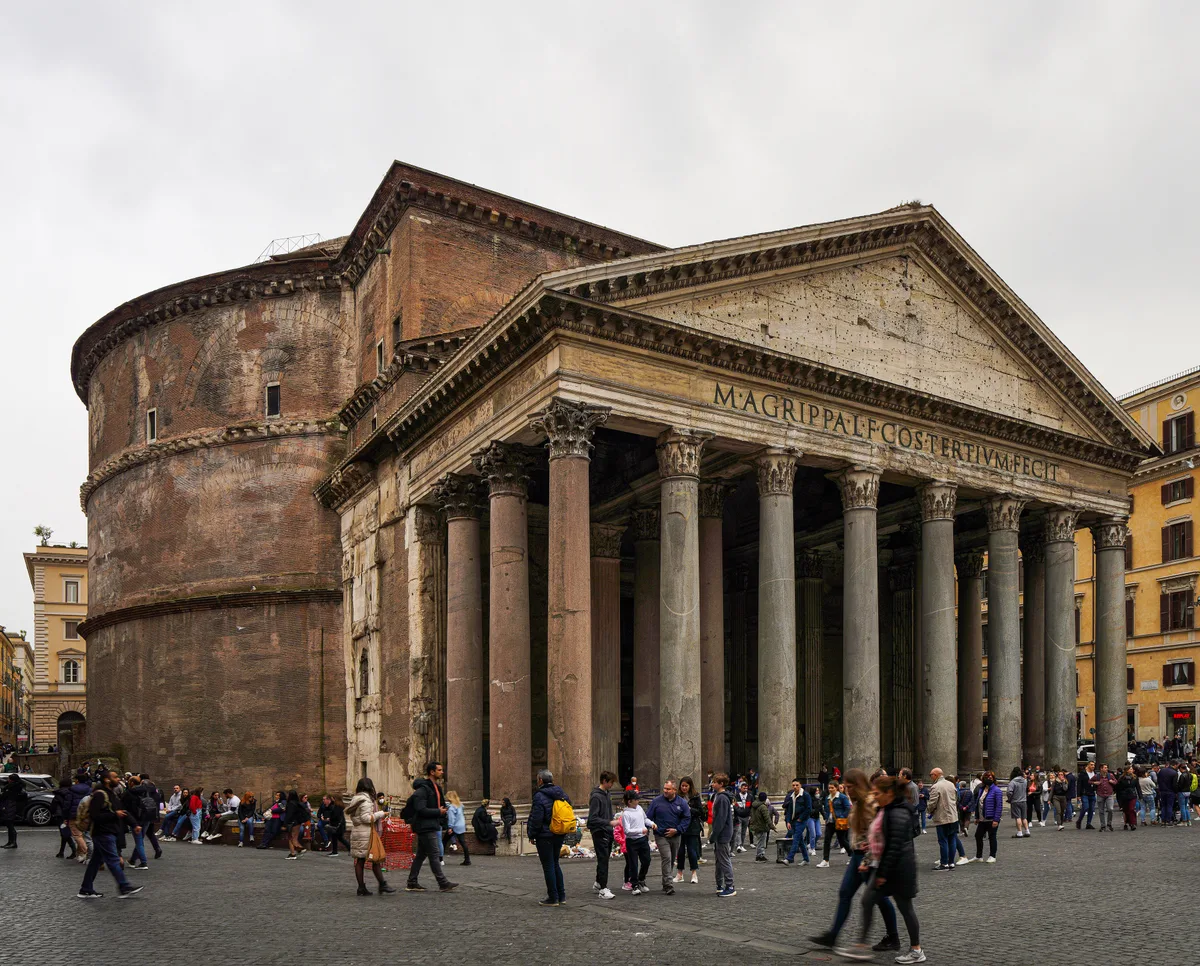
Photo: NikonZ7II / Wikimedia Commons (CC BY-SA 4.0)
At a Glance
- Period
- AD 118–125
- UNESCO
- Yes
- Notable structures
- Oculus, coffered dome, portico columns
- Best season
- Apr–Jun, Sep–Oct
- Visiting hours
- Daily (except major feast days)
- Recommended time
- 1–1.5 hours
- Entry
- Paid (modest fee)
Rome · Lazio
The Pantheon, the building whose dome the rain still crosses
The Pantheon, rebuilt by Hadrian around AD 118 to 125 on the site of an earlier temple of Agrippa, is the best-preserved monument of ancient Rome, surviving nearly intact because it became a church in the 7th century and never fell out of use. The inscription across the porch still names M. Agrippa, the first founder, a signature the emperor left in place.
The one dramatic gesture in the room is the dome: the largest unreinforced concrete vault ever built, 43 metres across, with an oculus of nine metres at its centre through which rain and sun fall on the marble floor. Stand under it when the rain comes down and you watch the water run off through the floor drains exactly as it did in Hadrian's day.
The painter Raphael is buried in an alcove to one side, and on an overcast day the measured light from the oculus is the quietest spectacle in Rome.
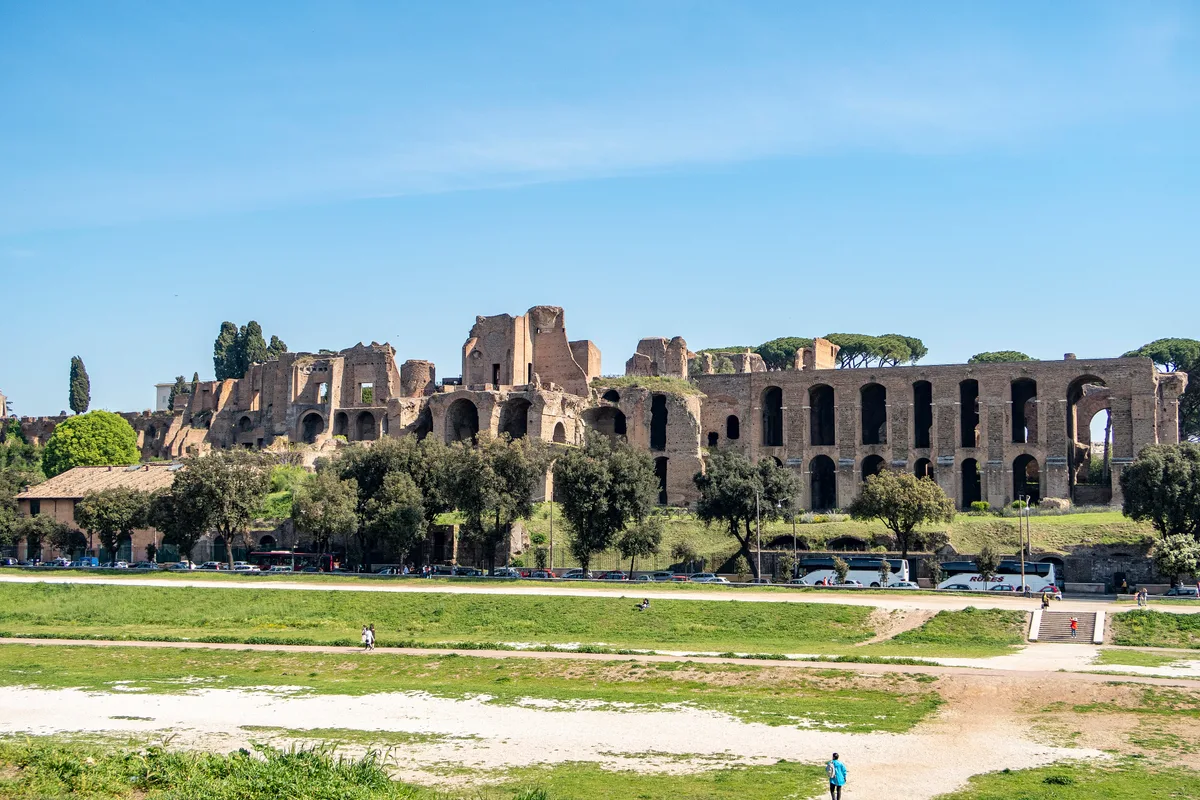
Photo: Lil Herodotus / Wikimedia Commons (CC BY-SA 4.0)
At a Glance
- Period
- 8th c. BC – imperial residences
- UNESCO
- Yes
- Notable structures
- Domus Flavia, Domus Augustana, Stadium
- Best season
- Apr–Jun, Sep–Oct
- Visiting hours
- Daily (seasonal)
- Recommended time
- 2–3 hours
- Entry
- Free with Colosseum pass
Rome · Lazio
Palatine Hill, where Rome began and the emperors moved in
The Palatine is the middle of Rome's seven hills and the one where the city is said to have begun, the slope where tradition placed the hut of Romulus and where the emperors later built their palaces, the Domus Flavia, Domus Augustana and the vast private wing that overlooks the Circus Maximus. Augustus, too young to rule the world and old enough to own this hill, was born here.
Take the upper walkway to the Stadium of Domitian, a sunken exercise ground with its curved end intact, then climb into the Farnese Gardens, raised over the ruins in the 16th century as one of the first botanical gardens in Europe. From the terrace the view drops straight onto the roofs of the Roman Forum, the finest roofless panorama in the city.
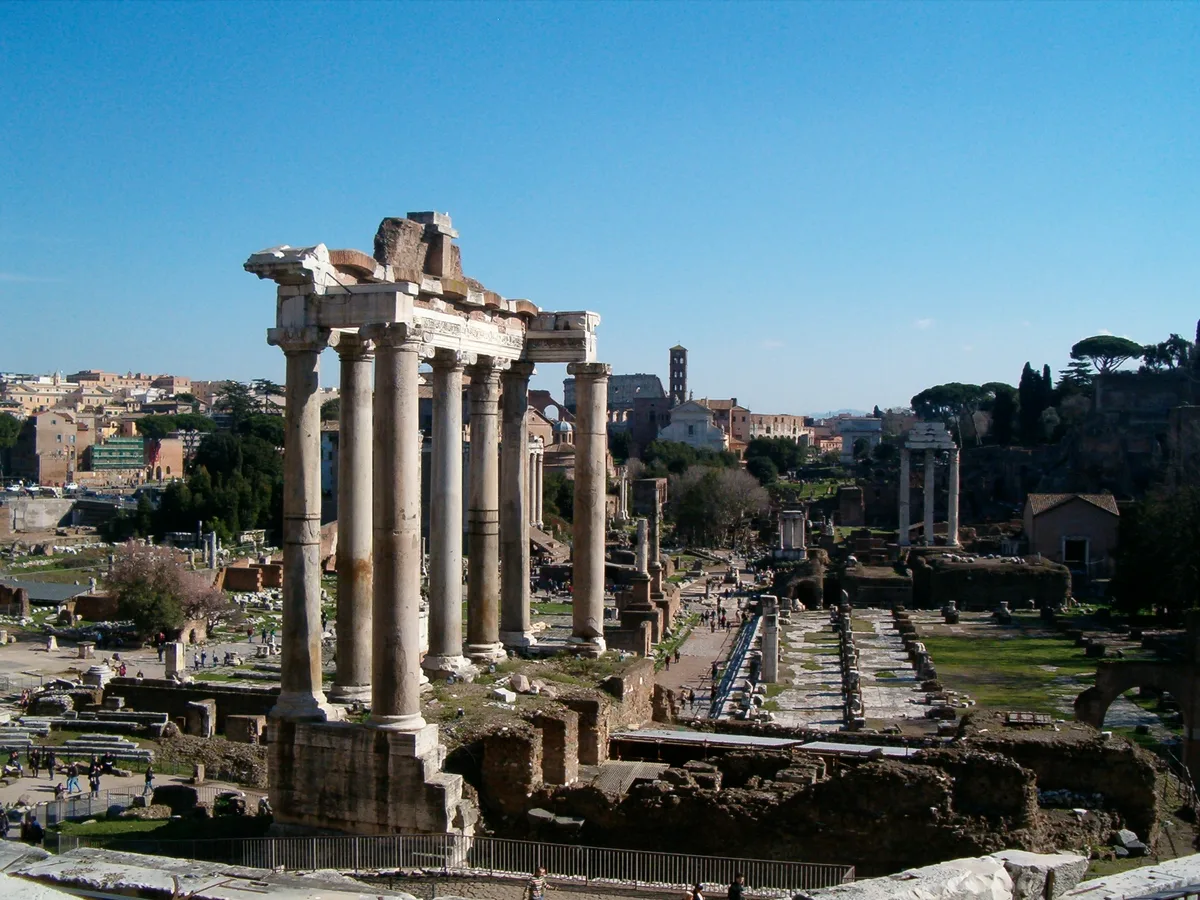
Photo: Marcok / Wikimedia Commons (CC BY-SA 3.0)
At a Glance
- Period
- Dedicated 497 BC; rebuilt 42 BC and in the 4th c. AD
- UNESCO
- Yes
- Notable structures
- Aerarium treasury, eight granite columns
- Best season
- Apr–Jun, Sep–Oct
- Visiting hours
- Visible from the Forum walkway
- Recommended time
- 20–30 minutes
- Entry
- Free (exterior view)
Rome · Lazio
The Temple of Saturn, the corner where Rome measured its empire
The Temple of Saturn is the grey ghost at the foot of the Roman Forum, eight granite and travertine columns holding a piece of entablature beneath the cliffs of the Capitoline Hill. The cult goes back to the earliest republic, with a first dedication in 497 BC, and the columns you see are a rebuild of 42 BC, raised by the returning general Munatius Plancus, repaired again in the 4th century AD. It is the only temple in the Forum whose Greek tradition of the golden age of Saturn sits next to the Latin state itself.
The reason the temple outlasted the city's other shrines sits under those columns. Beneath the podium the republic kept its treasury, the aerarium, the vault that held the gold, standards and accounts of the state, so this corner anchored Roman finances. From the golden milestone that Augustus later set up in the Forum beside it, all distances to the provinces were counted out. Stand in front and you are at the zero point of the empire's roads, the corner where Rome measured its empire.
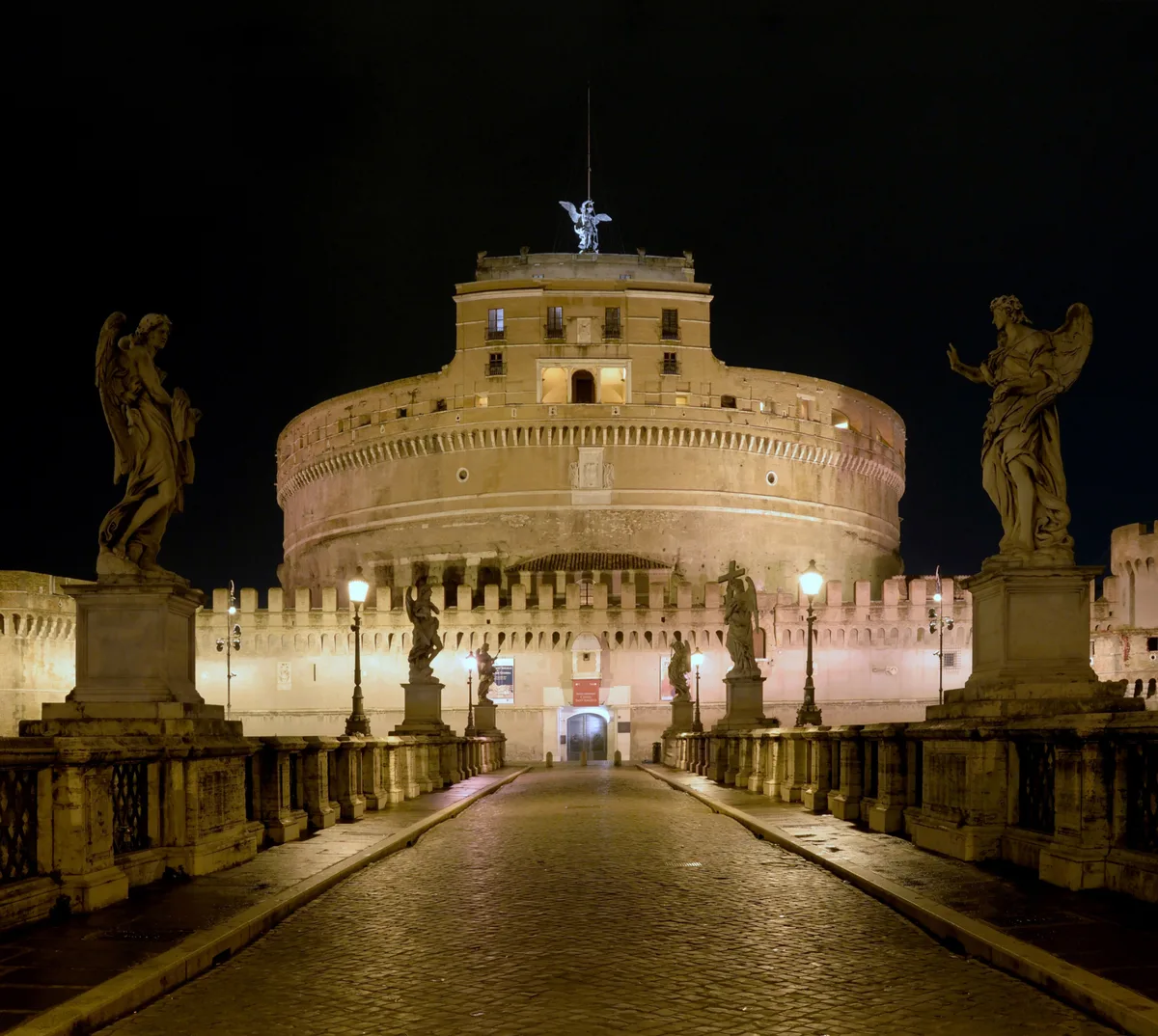
Photo: Livioandronico2013 / Wikimedia Commons (CC BY-SA 4.0)
At a Glance
- Period
- AD 123–139
- UNESCO
- Yes
- Notable structures
- Hadrian's rotunda, Passetto di Borgo, papal apartments
- Best season
- Apr–Jun, Sep–Oct
- Visiting hours
- Daily (seasonal)
- Recommended time
- 1.5–2 hours
- Entry
- Paid
Rome · Lazio
Castel Sant'Angelo, the emperor's tomb that became the pope's bolt-hole
Castel Sant'Angelo began as the mausoleum Hadrian built for himself across the Tiber in Rome, a drum of stone tall enough that later ages took it for a fortress and then a castle, ringed with walls and studded with papal apartments. From the Vatican a walled corridor still climbs to its upper floor, the escape route built in the 13th century for a pope who wanted a quiet road out.
The castle's real rarity is that corridor, the Passetto di Borgo, a vaulted route over the rooftops. When troops sacked Rome in 1527, Clement VII fled along it and shut the gates behind him, and it has remained the one place you can cross over the city without touching a street.
The roof terrace carries a bronze statue of the archangel Michael, the castle's namesake, said to have appeared above the building in 590 to sheathe his sword and end a plague; the statue on top today dates to 1753.
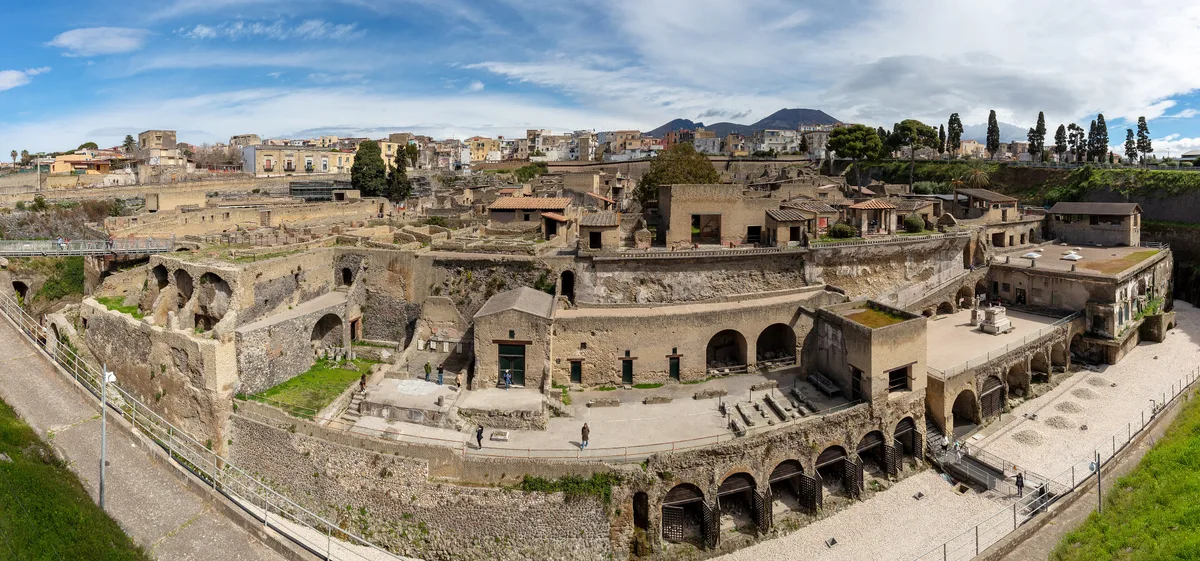
Photo: Diego Delso / Wikimedia Commons (CC BY-SA 4.0)
At a Glance
- Period
- 6th–5th c. BC; buried AD 79
- UNESCO
- Yes
- Notable structures
- House of the Wooden Partition, beach boat sheds, frescoes
- Best season
- Apr–Jun, Sep–Oct
- Visiting hours
- Daily (seasonal)
- Recommended time
- 2–3 hours
- Entry
- Paid
Naples · Campania
Herculaneum, the seaside town the volcano sealed with its top floors in place
Herculaneum, a smaller and wealthier seaside town between Naples and Pompeii, was buried by the same eruption of AD 79, but where Pompeii was smothered by ash, Herculaneum took the heat of the pyroclastic flows, which carbonized its timber and locked the upper storeys in place.
Because the building heights survived, Herculaneum is where a Roman street still reads as a street: two-storey houses with intact stairs, shuttered shop fronts, and beds and doors preserved as blackened wood, things that exist almost nowhere else in the Roman world. Down by the ancient beach, the vaulted boat sheds hold the skeletons of around 300 people who waited for boats that never came.
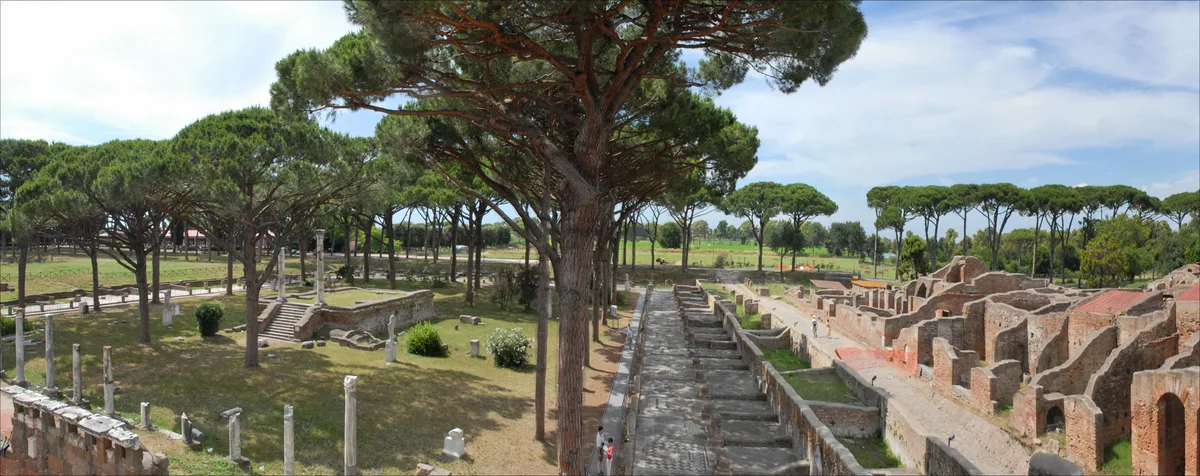
Photo: Jean-Pierre Dalbéra / Wikimedia Commons (CC BY 2.0)
At a Glance
- Period
- 4th c. BC – late Roman port
- UNESCO
- No
- Notable structures
- Theatre, Piazzale delle Corporazioni, Baths of Neptune
- Best season
- Apr–Jun, Sep–Oct
- Visiting hours
- Daily (seasonal)
- Recommended time
- 3–4 hours
- Entry
- Paid
Ostia Antica · Lazio
Ostia Antica, the port city where shops advertised in mosaic
Ostia, at the mouth of the Tiber, was Rome's port and, for centuries, its grain lifeline, a city that grew rich on trade and dense with some of the first true apartment blocks, walk-up flats of brick and concrete the Romans called insulae. Much of it survives because the changed harbour and the silted river let the town fall quiet rather than be demolished.
Step into the Piazzale delle Corporazioni, an arcaded square where shipping and trading offices advertised their trade in black-and-white mosaic signs, a grain ship, an elephant, a dolphin, the business district of an empire rendered in stone. From the square, follow the mosaic floor of the Baths of Neptune to the street of bars with their sunken jars still in the counters.
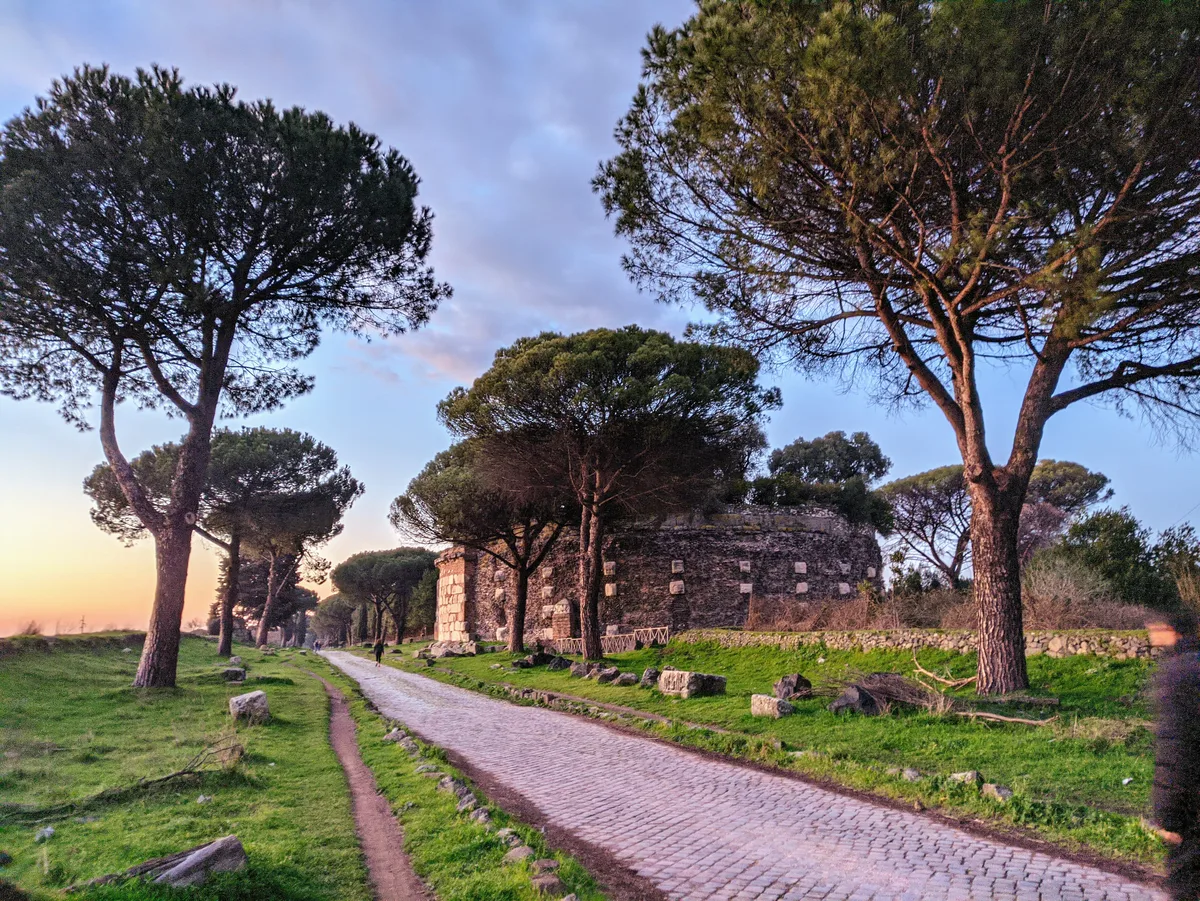
Photo: LuisaV72 / Wikimedia Commons (CC BY-SA 4.0)
At a Glance
- Period
- Begun 312 BC; extended through the 3rd c. BC
- UNESCO
- Yes
- Notable structures
- Basalt roadbed, tombs, catacombs, Cecilia Metella's mausoleum
- Best season
- Mar–Jun, Sep–Nov
- Visiting hours
- Park open daily; sites along it vary
- Recommended time
- Half a day
- Entry
- Free (park); some sites paid
Rome · Lazio
Via Appia, the queen of roads that still runs underfoot
In 312 BC the censor Appius Claudius Caecus drove a road out of Rome toward Capua, and his name still rides on it: the Via Appia, the regina viarum. It was the republic's first engineered highway, a straight stone rib laid over a packed bed, and its polygonal basalt blocks were cut on site to lock so tightly you can hardly trace the joints. Over the following century the road was pushed on to Benevento, Taranto and finally the Adriatic port of Brindisi, some 540 km in all, the doorway to Greece and Egypt.
The first stretch out of Rome, from the Aurelian Walls to the Alban Hills, is now the Appia Antica Regional Park, and it is where the road shows its true age. Tombs and broken mausoleums line the paving, among them the circular tower of Cecilia Metella and the church built over the Catacombs of San Callisto, and in the basalt surface the original wheel ruts are still scored where the carts wore two grooves into the stone. It is the oldest surviving route in Europe that still carries traffic, and bicycles and horses share it with the ghosts of the carriages.
In 2024 the whole corridor, together with its inland twin the Via Traiana and the ports and amphitheatres that fed it, was inscribed as a single UNESCO World Heritage property under its antique title, Via Appia. Regina Viarum, more than 800 km of roads, aqueducts and monuments counted as one site. Italy's sixtieth World Heritage inscription is also its first that you can simply start walking.
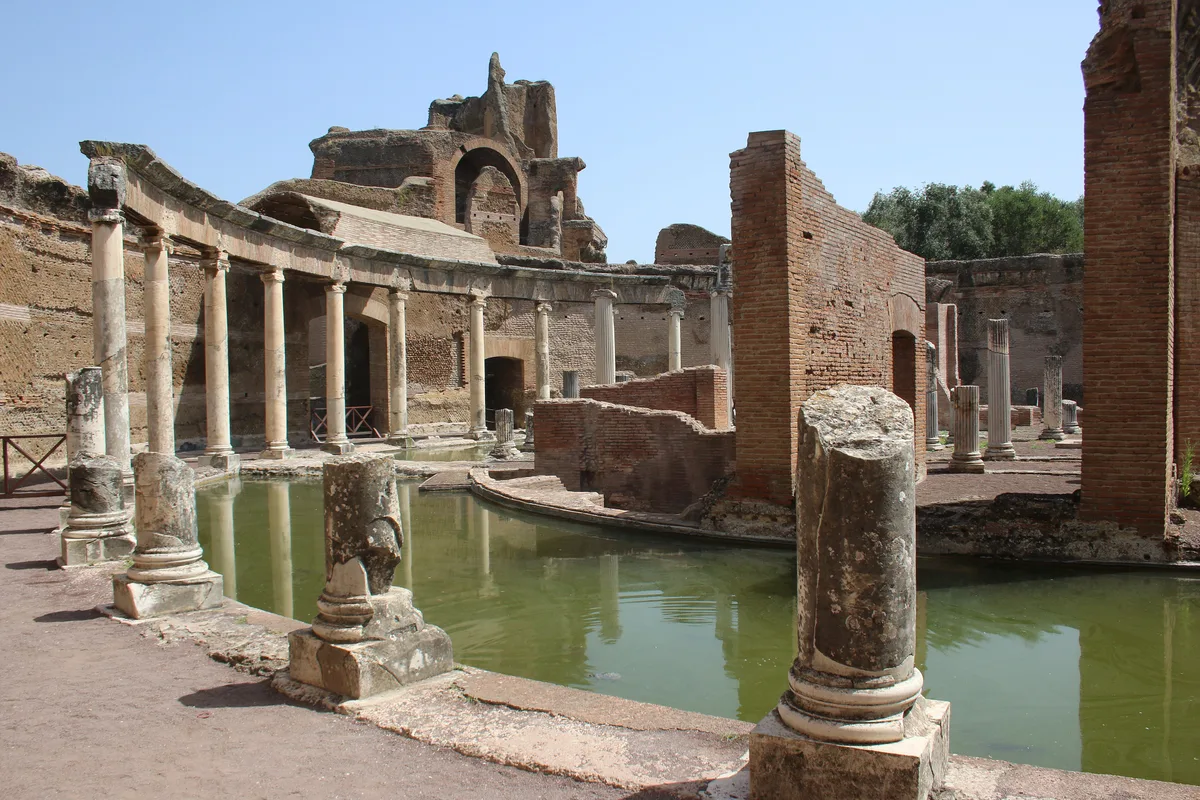
Photo: FrDr / Wikimedia Commons (CC BY-SA 4.0)
At a Glance
- Period
- AD 117–138
- UNESCO
- Yes
- Notable structures
- Maritime Theatre, Canopus, Poikile
- Best season
- Apr–Jun, Sep–Oct
- Visiting hours
- Daily (seasonal)
- Recommended time
- 3–4 hours
- Entry
- Paid
Tivoli · Lazio
Hadrian's Villa, the emperor's private empire of buildings
Hadrian's Villa, outside Tivoli east of Rome, is the countryside estate where the emperor retired to do what he most enjoyed, build: a compound of some thirty structures laid out between AD 117 and 138 and dotted with the names of places he had visited, including a canal called Canopus and a recreated Greek colonnade, the Poikile.
The strongest single room is the Maritime Theatre, a perfect circular pool ringed by a colonnade around a small domed villa on an island in the middle, a house within a house where the emperor could withdraw from his own court. UNESCO inscribed the villa in 1999 as the most complete and influential example of an ancient Roman imperial villa, its estates, baths, libraries and gardens-you-can-still-walk still readable as one plan.
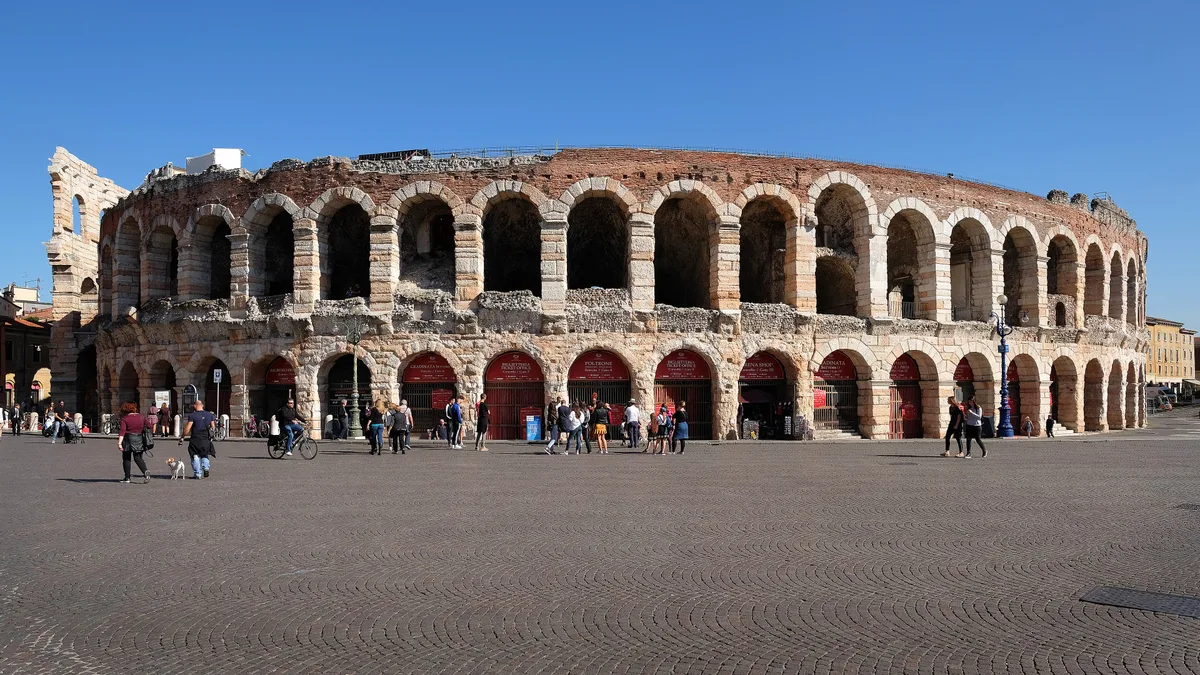
Photo: Claconvr / Wikimedia Commons (CC BY-SA 4.0)
At a Glance
- Period
- c. AD 30
- UNESCO
- Yes
- Notable structures
- Stone tiers, inner arena, opera stage
- Best season
- Apr–Sep
- NIGHT VISITS
- Opera nights, Jun–Sep
- Visiting hours
- Daily (seasonal)
- Recommended time
- 1–1.5 hours
- Entry
- Paid
Verona · Veneto
Verona Arena, the amphitheatre that still sells out its shows
Verona's Arena, built around AD 30, is the third largest Roman amphitheatre to survive, a shell of pink stone that an earthquake in 1117 stripped of its outer ring. Four tiers of the original 44 rows of stone seating remain, and you climb the same stones the crowds climbed two thousand seasons ago.
It is still used for what it was built for: since 1913 the Arena has staged a summer opera festival, now the largest open-air opera season in the world, drawing hundreds of thousands of spectators each year. To sit in the stone bowl at dusk, with the evening light on the tiers and the stage glowing below, is the closest the empire left a working theatre.
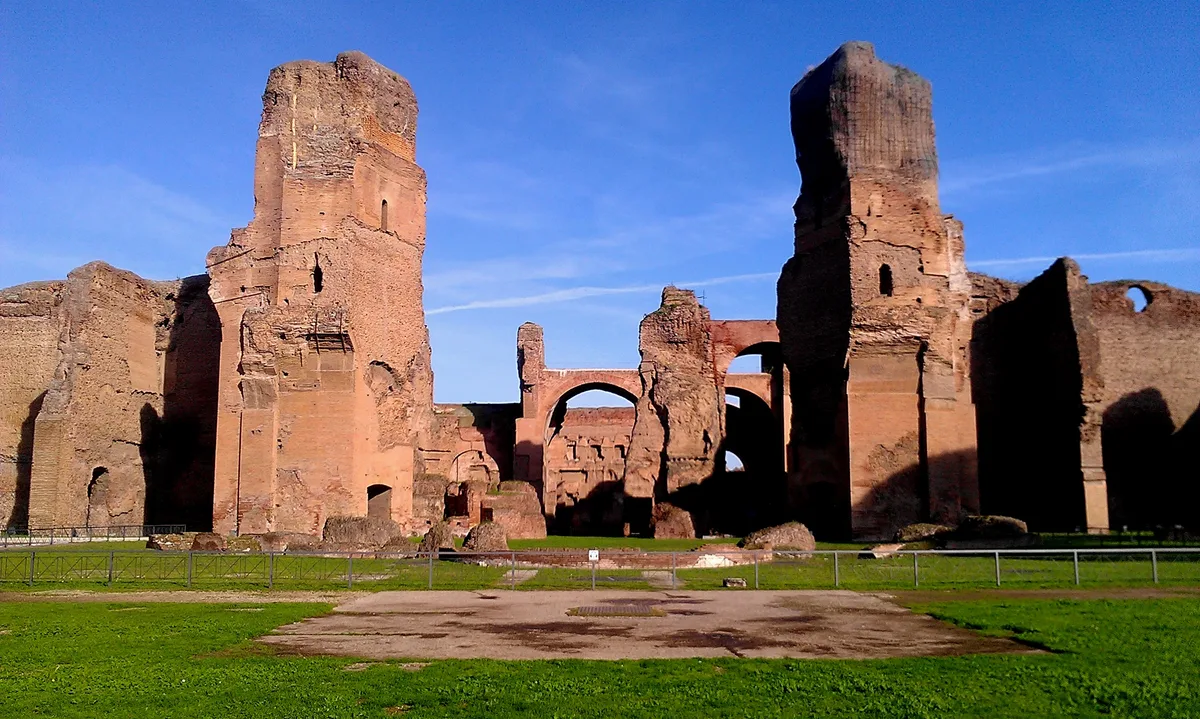
Photo: Ethan Doyle White / Wikimedia Commons (CC BY-SA 4.0)
At a Glance
- Period
- AD 212–217
- UNESCO
- Yes
- Notable structures
- Frigidarium, natatio, mosaic floors
- Best season
- Apr–Jun, Sep–Oct
- NIGHT VISITS
- Summer opera, Jul–Aug
- Visiting hours
- Daily (seasonal)
- Recommended time
- 1.5–2 hours
- Entry
- Paid
Rome · Lazio
Baths of Caracalla, the hall Rome never stopped using
The Baths of Caracalla, opened around AD 216, were the second largest bathing complex the empire ever built, a forest of vaulted halls that could take 1,600 bathers at once, with a daily capacity estimated at 6,000 to 8,000 people and an aqueduct branch built for the water alone. The great halls kept running into the 6th century, until wars broke the aqueducts.
The ruins stayed useful enough that Rome kept staging events in them: in 1960 the Olympic gymnastics competition was held inside the great hall, and a summer opera season has filled the shadow of the frigidarium since the 1930s. Climb the scale of the surviving vault walls and you feel the height of the room that once held a full band of Olympians.
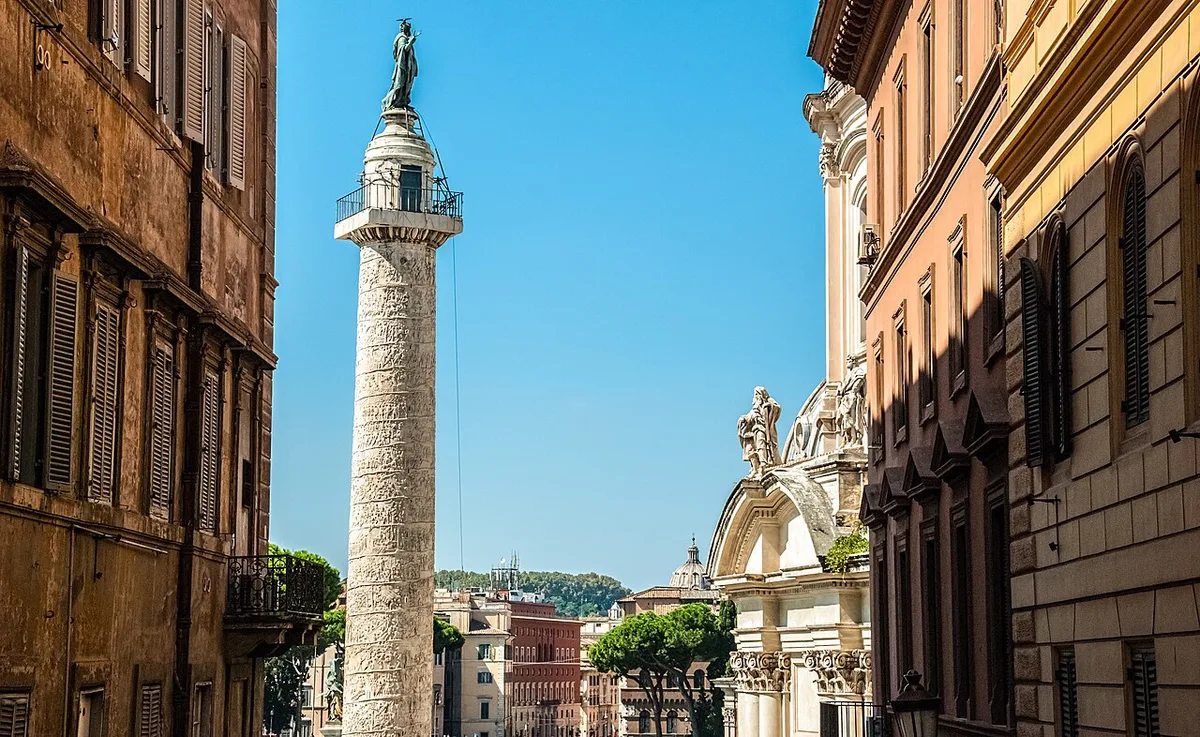
Photo: Gary Ullah / Wikimedia Commons (CC BY 2.0)
At a Glance
- Period
- Dedicated AD 113
- UNESCO
- Yes
- Notable structures
- Shaft, spiral frieze, base chamber
- Best season
- Year-round
- Visiting hours
- Always open (exterior)
- Recommended time
- 1 hour
- Entry
- Free (street view); forum museum paid
Rome · Lazio
Trajan's Column, the war documentary carved in marble
Trajan's Column, dedicated in AD 113 in the centre of Rome, commemorates the emperor's two wars against the Dacian kingdom, and does it as a narrative: a carved ribbon around 190 metres long spirals up the shaft in 23 turns, carrying some 2,600 figures through a story that reads as you move your eye, scene by scene, rather like a film.
Stand back and it becomes a construction feat too: the shaft is built from twenty drums of marble, each around three and a half metres across, with a spiral stair inside and small windows cut through the drum-to-drum joint. At the base, a small chamber held Trajan's own ashes, and the senate's inscription still names him from the pavement.
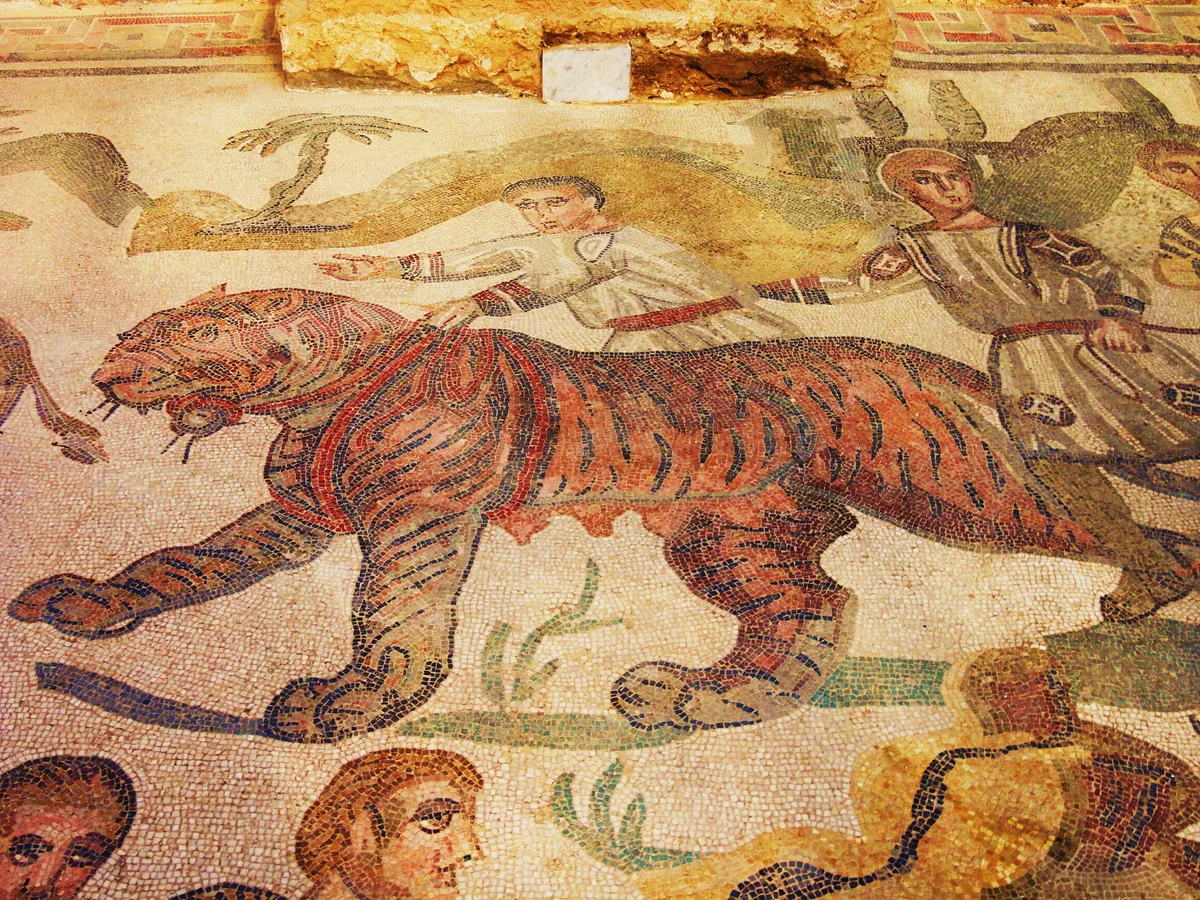
Photo: Robur.q / Wikimedia Commons (CC BY-SA 3.0)
At a Glance
- Period
- Early 4th c. AD
- UNESCO
- Yes
- Notable structures
- Great Hunt corridor, Bikini Girls mosaic, baths
- Best season
- Mar–May, Sep–Oct
- Visiting hours
- Daily (seasonal)
- Recommended time
- 2–3 hours
- Entry
- Paid
Piazza Armerina · Sicily
Villa Romana del Casale, the floor Sicily buried and kept
The Villa Romana del Casale, in the countryside near Piazza Armerina in central Sicily, was built early in the 4th century as the country seat of a wealthy Roman, and it survived because it disappeared: a mudslide near the end of the Middle Ages buried the whole estate, and under the silt the largest single collection of Roman mosaics in the world lay untouched.
The floors run to more than 3,500 square metres of mosaic, the richest late-Roman pavement assemblage left anywhere, and the standout spaces are the Great Hunt, a corridor around 60 metres long alive with beasts and hunters, and the room nicknamed for an aftergame, a mosaic of young women in two-piece costumes playing ball, lifting weights and racing for a victor's wreath. UNESCO inscribed the villa in 1997 for these floors, calling them the finest Roman mosaics still in place.
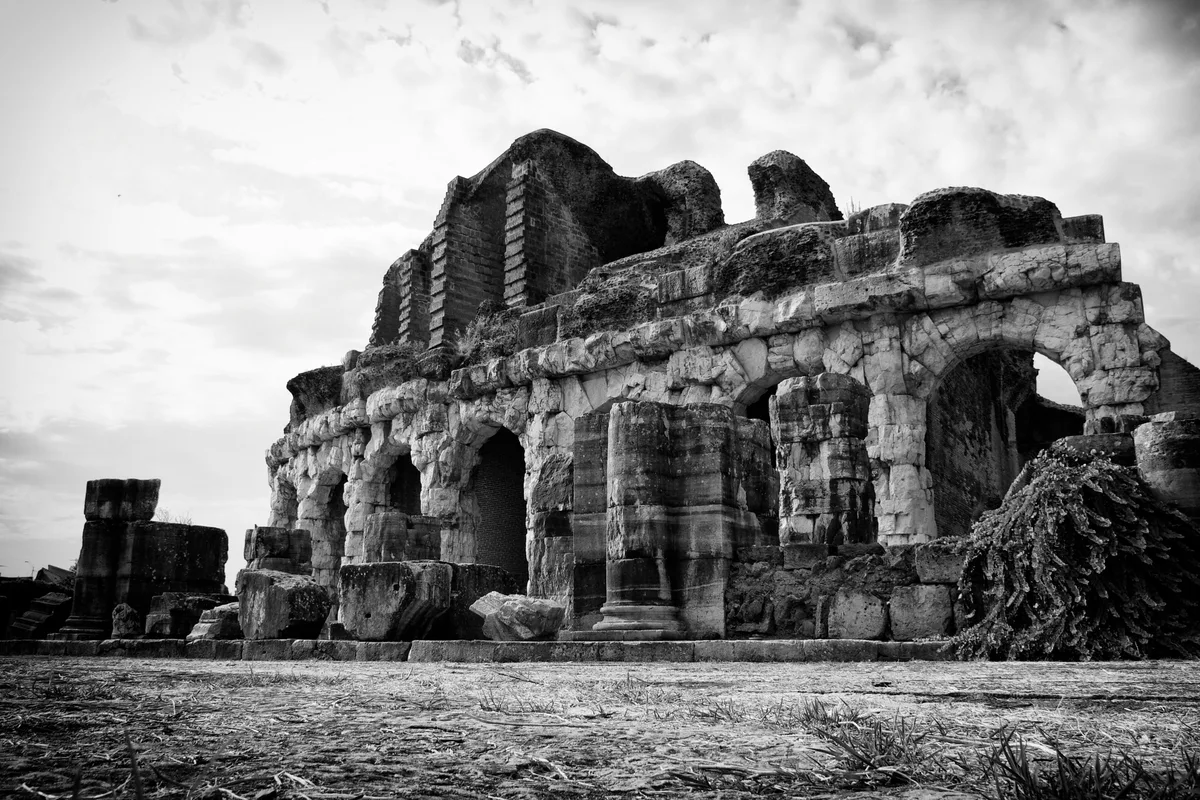
Photo: Nicola D'Orta / Wikimedia Commons (CC BY-SA 3.0)
At a Glance
- Period
- Late 1st to early 2nd c. AD
- UNESCO
- Yes
- Notable structures
- Underground galleries, busts of gods, gladiator-school site
- Best season
- Apr–Jun, Sep–Oct
- Visiting hours
- Tue–Sun (seasonal)
- Recommended time
- 1–2 hours
- Entry
- Paid
Capua · Campania
Amphitheatre of Capua, the arena where Spartacus walked out with a knife
Santa Maria Capua Vetere, on a plain above Naples, is ancient Capua, and its amphitheatre is a quiet rival to the one in Rome. Raised in the late 1st and early 2nd century AD, the building was the second largest amphitheatre in the Roman world, inscribed within a travertine oval 170 m on its long side, and its underground galleries for beasts and machinery survive in the densest remains of any arena outside the capital.
What gives the site its sharpest echo is the earlier building it replaced. The older arena on the same spot was home to the first and most famous gladiator school of the ancient world, the ludus, and from that school in 73 BC a Thracian captive named Spartacus escaped with about seventy followers, arming themselves with whatever kitchen tools came to hand. Two years later he had beaten several Roman armies before his war ended. Walk the underground corridor that survives and you are standing in the ground-level gallery those men ran through on the night they broke out.
On the surface, the west facade still rises to three storeys, and the busts of gods that once watched over the gates, among them the heads of Diana and Juno, are gathered in the adjoining museum. Since 2024 the amphitheatre is counted as a component of the Via Appia World Heritage property, tying the arena back to the road that once connected it to Rome.
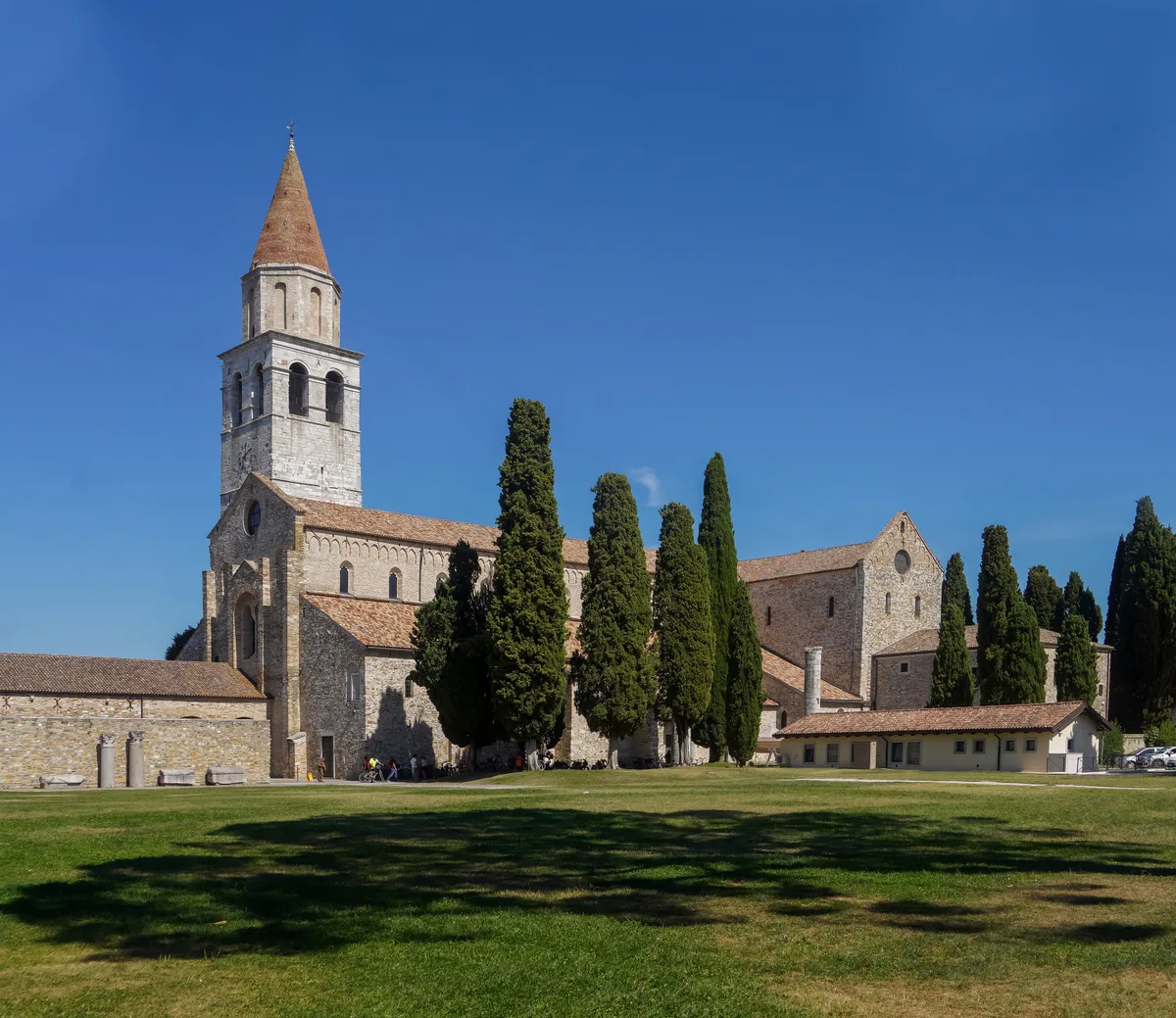
Photo: ThePhotografer / Wikimedia Commons (CC BY-SA 4.0)
At a Glance
- Period
- Founded 181 BC; destroyed AD 452
- UNESCO
- Yes
- Notable structures
- 760 m² mosaic floor, Basilica, port
- Best season
- May–Sep
- Visiting hours
- Basilica daily; excavations seasonal
- Recommended time
- 2–3 hours
- Entry
- Paid (Basilica and excavations)
Aquileia · Friuli Venezia Giulia
Aquileia, the Adriatic port that kept its floor hidden for a thousand years
Aquileia was founded in 181 BC by the Romans at the head of the Adriatic in what is now north-east Italy, a colony planted on the river Natissa to guard the eastern approaches to the plain. Within a few generations it grew into one of the largest and wealthiest cities of the early empire, a port where the goods of the Mediterranean and central Europe changed hands and where ships docked at the city's own river wharves. In AD 452 Attila destroyed it, and the survivors retreated to the marsh islands that later became Venice.
What visitors come for lies under the Basilica. In the early 4th century Bishop Theodorus laid a mosaic floor across a set of halls covering some 760 m², still the largest early Christian mosaic in the Western world, a wide field of pledges, birds and marine life threaded around the famous pair of a rooster and a tortoise, light daring darkness. For the whole Middle Ages the pavement stayed hidden beneath a later floor, and it only came back to light in modern excavation. The floor is enormous, the church small, and the contrast is the point.
Most of the Roman city, its forum, port, theatre and burial ground, still lies unploughed in the meadows around the Basilica, so fieldwork here keeps producing new rooms. UNESCO inscribed the site in 1998 as the greatest archaeological reserve of its kind, a city you can walk over and read at the same time.
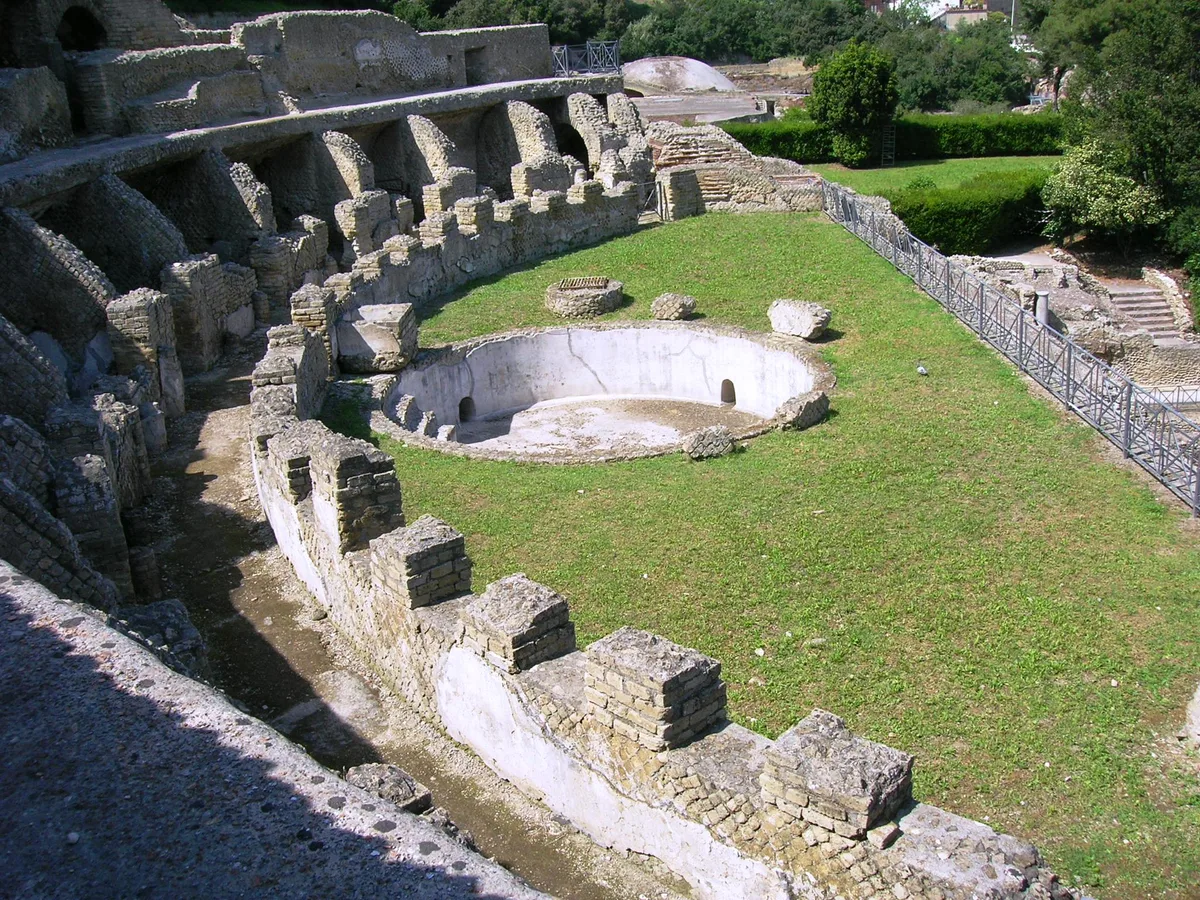
Photo: Mentnafunangann / Wikimedia Commons (CC BY-SA 3.0)
At a Glance
- Period
- 1st c. BC to 3rd c. AD
- UNESCO
- No
- Notable structures
- Sunken villas, mosaics, the "Temple of Mercury" dome
- Best season
- Apr–Oct
- Visiting hours
- Dive and boat tours run by the park
- Recommended time
- Half a day
- Entry
- Paid (boat and dive tours)
Baiae · Campania
Baiae, the Roman summer resort the sea took over
Baiae was the Roman world's most fashionable shoreside resort, a curve of hot springs on the Gulf of Naples where emperors kept villas, Julius Caesar owned property himself, and the wealthy came to be seen. Its shoreline ran with terraced villas, warmed pools and porticoes, and its devotees liked to call it the most beautiful bay in the world.
Then the ground sank. The same volcanic field that fed the hot springs began, after the empire, to let the sea in, pulled down by bradyseism, and half the town went under a few metres of water, where it still lies whole: rooms, mosaics, porticoes and piers, preserved by the sea that swallowed them. The area is protected as the Underwater Archaeological Park of Baiae, set up in 2002, and you can reach it by diving, from a glass-bottomed boat, or with just a mask at the surface, because the shallows keep the ruins close and clear.
Back on land, one building explains the town. The so-called Temple of Mercury is in fact a circular bathing hall, and its concrete dome, 21.5 m across, is the largest surviving of its age and the biggest known before the Pantheon was built in Rome. The technique Rome later sent across the empire was perfected in a seaside bathing hall. Half a town underwater and the finest dome of its day still standing: Baiae gives you both halves of a drowned resort.
Roman Sites in Italy
These places open up slowly, and only to the visitor who stops and looks twice. Vestigia is a field companion for that kind of travel, in your pocket with the context and detail most guides skip. Download the app before you go.
Common Questions
Which Roman sites in Italy should I visit?
Rome alone repays days: the Colosseum, the Pantheon, the imperial palaces of the Palatine, Castel Sant'Angelo and Trajan's Column. Then take the train south to Pompeii, sealed by Vesuvius in AD 79, a Roman town preserved as it actually ran. With more time, Hadrian's Villa spreads an emperor's private world across Tivoli, Verona's Arena remains the great amphitheatre still used for live performance, and Ostia Antica preserves the port where Roman trade moved daily.
What Roman ruins are there outside Rome?
The greatest lie around the Bay of Naples: Pompeii and Herculaneum, the cities buried by Vesuvius in AD 79, and the sunken resort of Baiae further round the coast. Close to the capital, Ostia Antica was Rome's own port, with warehouses and apartment blocks intact, and to the east Hadrian's Villa stretches across the plain at Tivoli. Further on, the Arena of Verona, the Amphitheatre of Capua, the trading city of Aquileia and Villa Romana del Casale in Sicily each show a different face of the empire beyond the capital.
Which amphitheatre was the second largest in the Roman world?
The Amphitheatre of Capua, at Santa Maria Capua Vetere on the plain above Naples, built inside a travertine oval some 170 m on its long side. Its underground galleries for beasts and machinery survive more densely than at any other arena outside the capital, and the earlier arena on the same ground housed the most famous gladiator school of the ancient world, from which Spartacus escaped with about seventy followers in 73 BC.