Ancient Cities in Turkey That Outlived Their Empires
Turkey sits on more layers of the past than almost anywhere on earth, Greek, Roman, Lycian (an ancient people of southwest Anatolia), Byzantine (the eastern Roman Empire centered on Constantinople), Seljuk (a medieval Turkish dynasty), Ottoman (the Turkish empire that ruled 1299–1922), and older still. This is a reader's guide to twenty ancient cities worth knowing, arranged from the most-visited to the more off-the-beaten-path, each paired with the single landmark that makes the trip worthwhile. In 2026, Christopher Nolan's film The Odyssey sent new travellers to Troy, the city where Homer's Trojan War began.
All 21 sites, plotted on the map below.
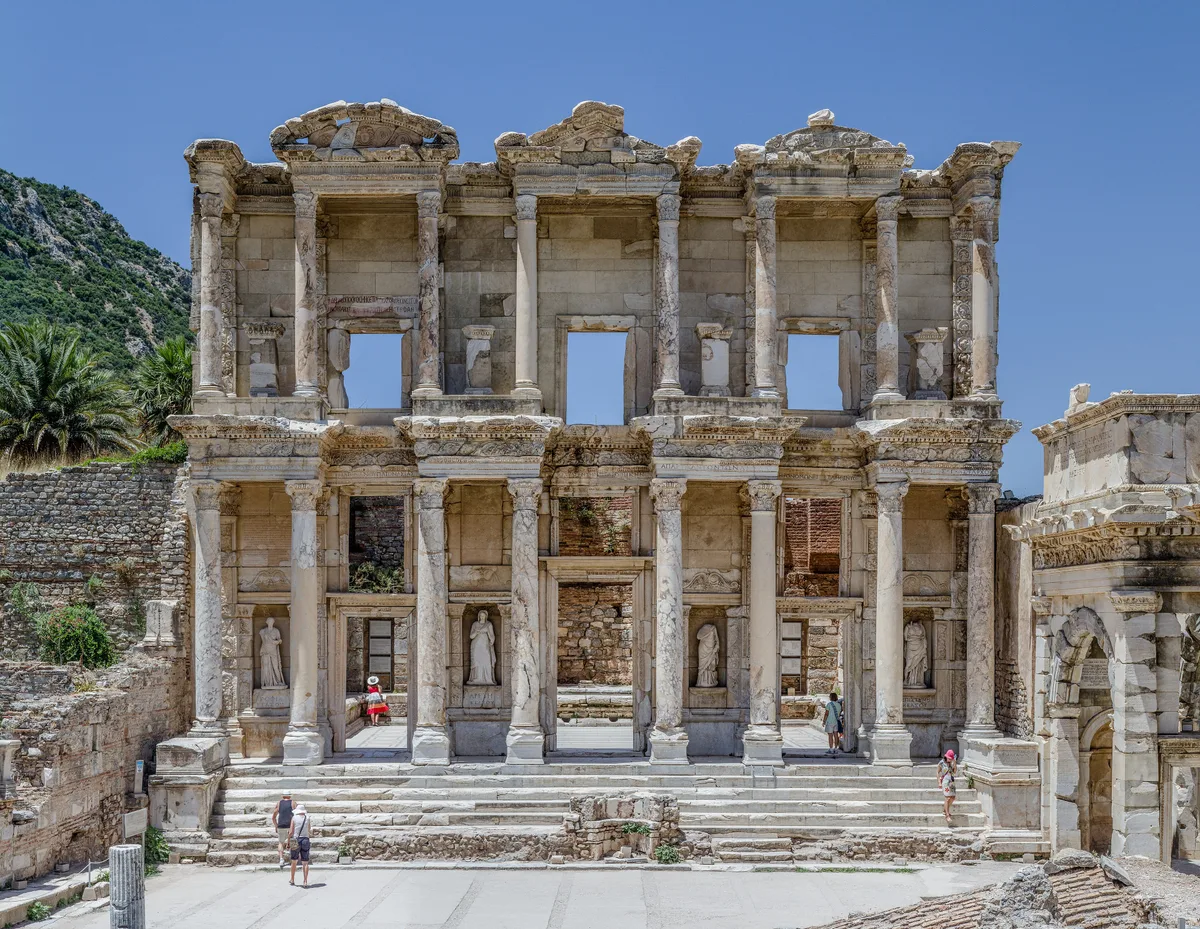
Photo: Benh LIEU SONG / Wikimedia Commons (CC BY-SA 3.0)
At a Glance
- Period
- Hellenistic–Roman (peak 1st c. BC)
- UNESCO
- Yes (2015)
- Notable structures
- Celsus Library, Great Theatre, Terrace Houses
- Best season
- Apr–Jun, Sep–Oct
- NIGHT VISITS
- Jun–Oct
- Visiting hours
- 08:00–19:00 (summer) · 08:00–17:00 (winter)
- Recommended time
- 3–4 hours
- Entry
- Paid
İzmir · Ionia
Ephesus, a harbour city that wrote its own library
Founded in the 10th century BC by Attic and Ionian (a branch of the ancient Greeks of the Aegean coast) colonists on the site of Apasa, capital of the Arzawa (a Bronze Age Anatolian kingdom) kingdom, Ephesus became a major Ionian port and, in 129 BC, the capital of the Roman province of Asia. Its great Artemision, counted among the Seven Wonders, drew pilgrims until Herostratus burned it in 356 BC. The Goths destroyed the city in AD 263, and as the Küçükmenderes delta advanced the harbour silted up, sealing its decline by the 15th century.
Its Great Theatre, cut into the hillside, held some 24,000 spectators and hosted both plays and gladiatorial games; its marble tiers looked down the Arcadiane, the colonnaded street to the harbour. Nearby, the Library of Celsus (AD 110s–130s) rose as a marble, east-facing façade; behind it lay the tomb of proconsul Tiberius Julius Celsus Polemaeanus and roughly 12,000 scrolls.
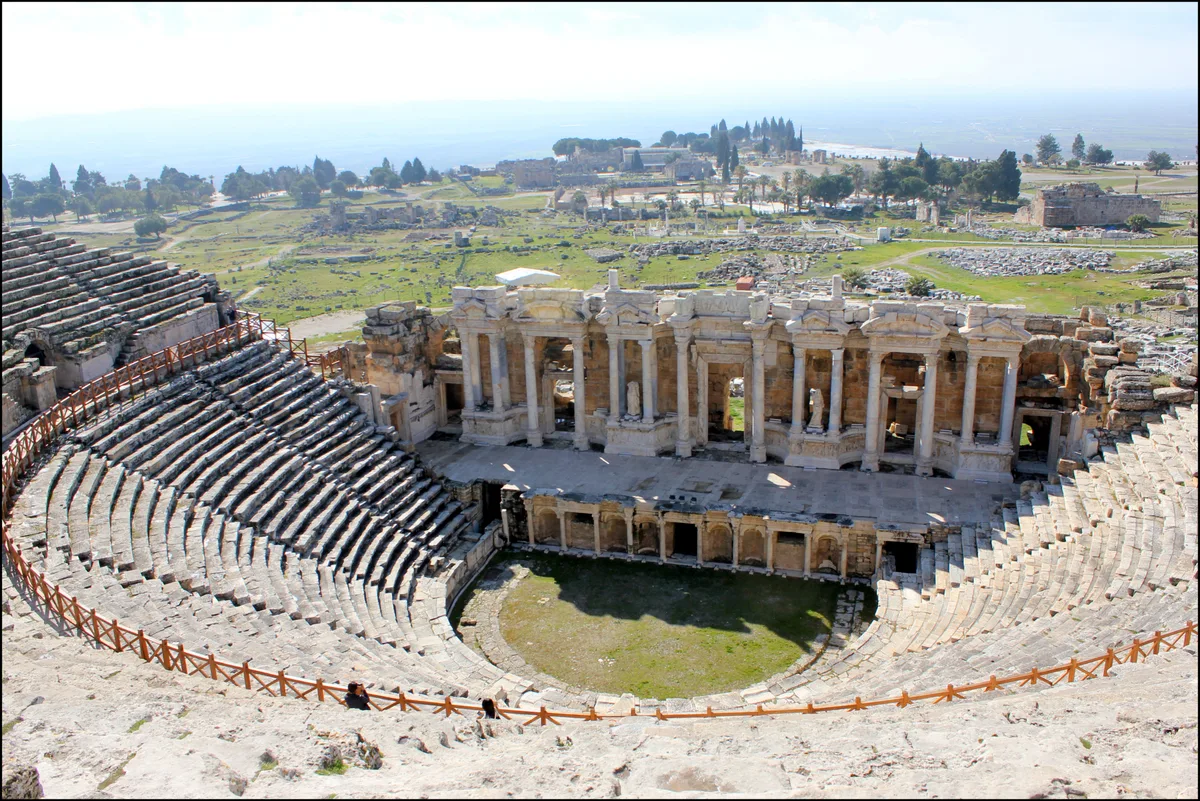
Photo: Daniel CULSAN / Wikimedia Commons (CC BY 4.0)
At a Glance
- Period
- Hellenistic–Roman (2nd c. BC)
- UNESCO
- Yes (1988)
- Notable structures
- Travertines, Roman Theatre, Necropolis
- Best season
- Apr–May, Sep–Oct
- NIGHT VISITS
- Jun–Oct
- Visiting hours
- 08:00–19:00 (summer) · 08:00–17:00 (winter)
- Recommended time
- 2–3 hours
- Entry
- Paid
Denizli · Phrygia
Hierapolis, a spa city built on living stone
Founded in the 3rd century BC by the Seleucid (a Hellenistic Greek dynasty of the Near East) kingdom and raised to a polis under Pergamon's Eumenes II (Attalid king who enlarged Pergamon, 2nd c. BC), Hierapolis sat atop Pamukkale's travertine terraces over a Phrygian (an ancient people of central Anatolia) Cybele cult centre. Its hot springs made it a Roman healing resort and wool-dyeing centre, and the Stoic Epictetus (a Stoic philosopher, c. AD 55–135) was born here. A devastating earthquake in AD 60 wrecked the city; a later 7th-century quake drove final abandonment by the late 14th century.
The Roman theatre, rebuilt after the AD 60 quake and dedicated under Hadrian in AD 129, still shows a 91 m-long marble scaenae frons. Its 50 rows, split into seven sections by eight stairways, seated about 15,000; the stage building was later reworked under Septimius Severus, and the lower city held a vast necropolis of limestone tombs.
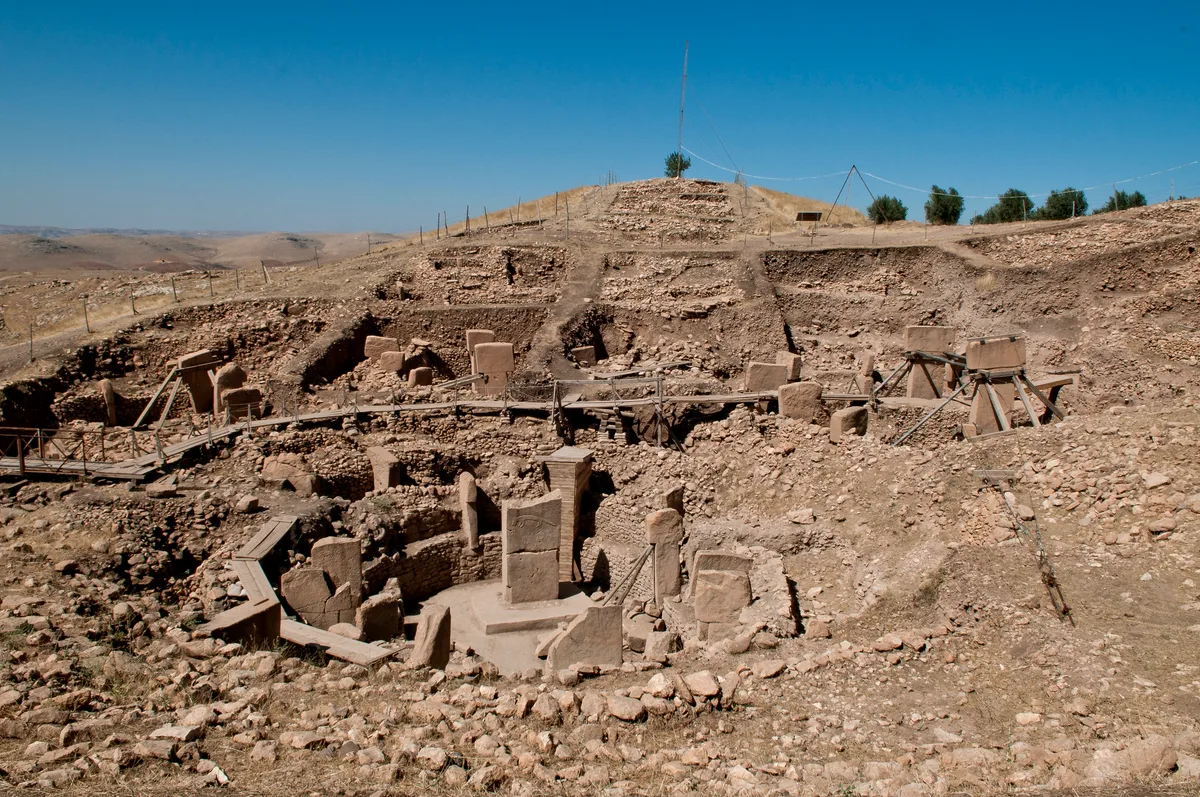
Photo: Teomancimit / Wikimedia Commons (CC BY-SA 3.0)
At a Glance
- Period
- Neolithic (c. 9600–8200 BC)
- UNESCO
- Yes (2018)
- Notable structures
- T-shaped pillars, circular enclosures
- Best season
- Mar–May, Sep–Nov
- Visiting hours
- 08:00–19:00 (summer) · 08:00–17:00 (winter)
- Recommended time
- 1.5–2 hours
- Entry
- Paid
Şanlıurfa · Mesopotamia
Göbekli Tepe, the hill that rewrote prehistory
Built around 9500 BCE by Neolithic (the late Stone Age, c. 10,000–3000 BC) hunter-gatherers, not a city but a cluster of monumental ritual enclosures, Göbekli Tepe predates pottery, agriculture, and writing. It was deliberately backfilled and abandoned near 8000 BCE, its meaning lost for millennia. Rediscovered by Klaus Schmidt in 1994, it was inscribed by UNESCO in 2018 as among the first expressions of human-made monumental architecture. Unlike later temples, the earliest enclosures sit on a hill with no village or houses around them, the site appears to have been a special-purpose ceremonial landscape visited by mobile groups rather than a settled community. The T-shaped pillars are widely read as stylized human figures, some with arms and hands carved at shoulder height, and their animal reliefs are thought to encode a lost hunter-gatherer cosmology. At roughly 6,000 years before Stonehenge, Göbekli Tepe forced archaeology to reconsider whether monumental religion came before, not after, the invention of farming.
Each circular enclosure, 10–30 m across, centres on two T-shaped limestone pillars up to 5.5 m tall, ringed by smaller stones carved with foxes, boars, and cranes. Geophysics suggests some 200 pillars across roughly 20 enclosures, all quarried about 100 m from the hilltop and dressed with flint tools rather than metal.
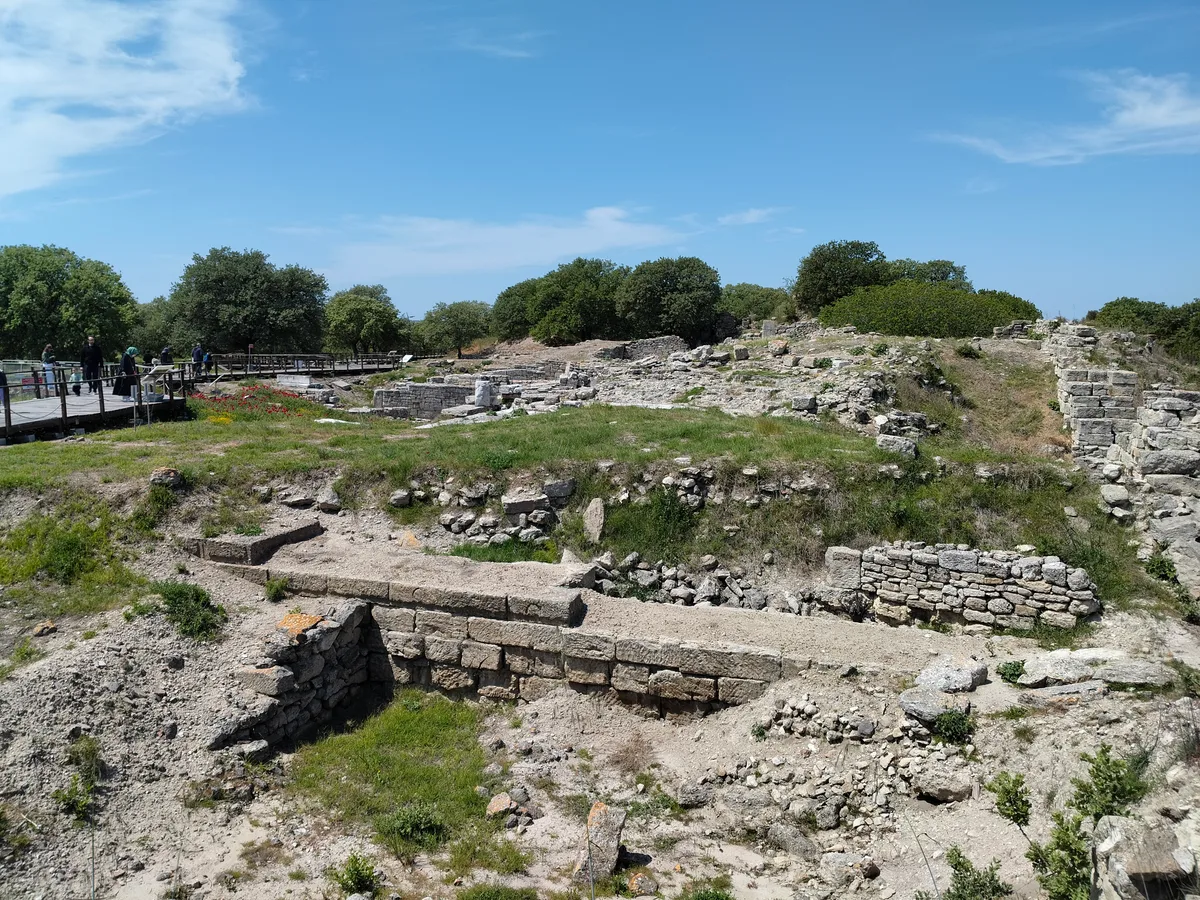
Photo: Barrowbob / Wikimedia Commons (CC BY-SA 4.0)
At a Glance
- Period
- Bronze Age–Hellenistic (from 3000 BC)
- UNESCO
- Yes (1998)
- Notable structures
- Hisarlık mound, fortifications, wooden horse replica
- Best season
- Apr–May, Sep–Oct
- Visiting hours
- 08:00–19:00 (summer) · 08:00–17:00 (winter)
- Recommended time
- 2–3 hours
- Entry
- Paid
Çanakkale · Troad · In the spotlight
Troy, where Homer meets the archaeologists
First settled around 3600 BC, Troy grew into a fortified citadel and, in the Late Bronze Age, the Hittite (an ancient Anatolian empire of the Bronze Age) vassal state of Wilusa, the setting of Homer's Iliad. Occupied continuously for some 4,000 years across nine stratified cities, it was destroyed at Troy VIIa around 1180 BC, its houses burned in the turmoil of the age. Heinrich Schliemann's excavations from 1870 finally proved a real city lay beneath the myth.
The surviving fortifications show 23 sections of defensive wall and 11 gates, with a paved ramp and five bastions built mainly in Troy II and VI. The Troy VI masonry, ashlar blocks fitted without mortar, is the citadel most often linked to the Homeric poem, its great south gate still standing among the ruins.
In 2026, Christopher Nolan's film The Odyssey (Universal, released 17 July 2026) returned Homer's epic to the global stage, following Odysseus home from the fall of Troy, the war that gave this mound its myth. Nolan had once been attached to direct the 2004 film Troy.
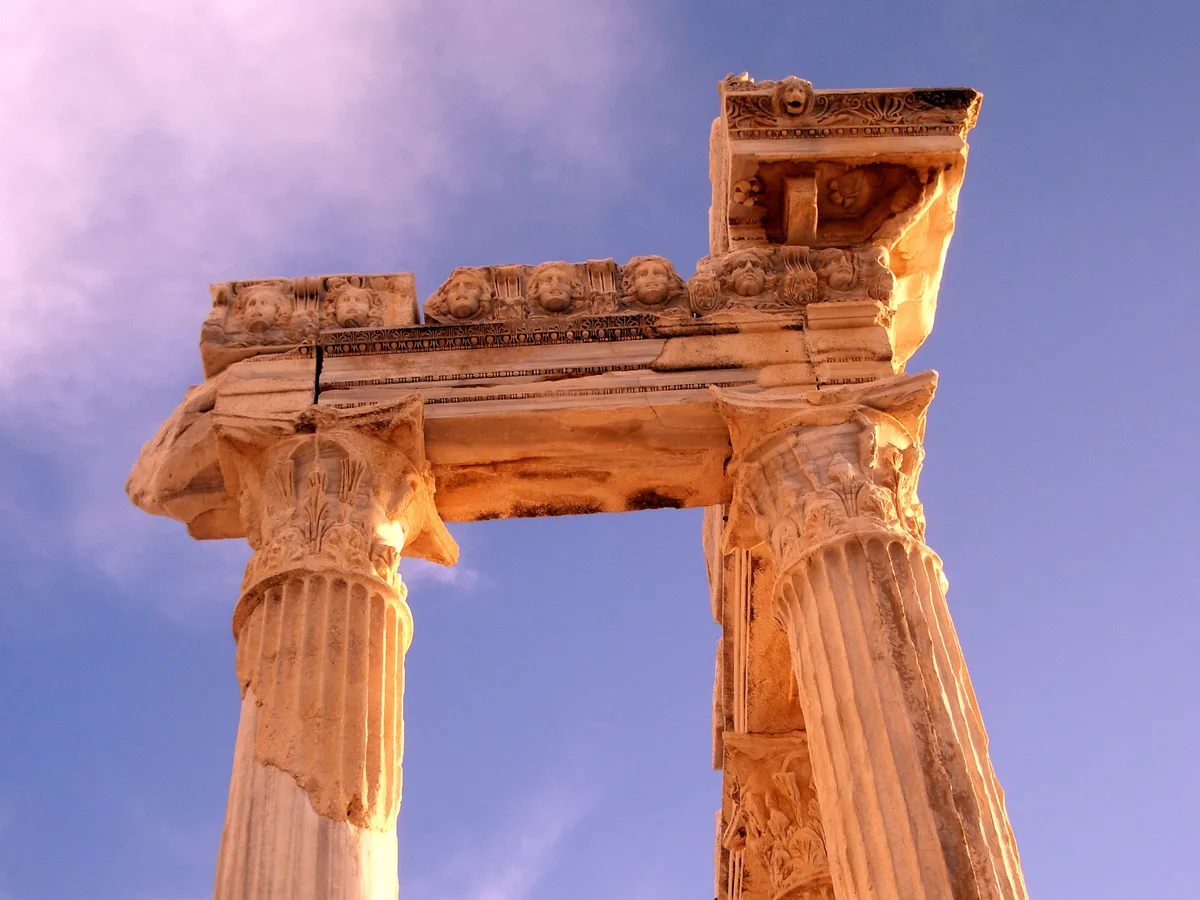
Photo: Exocetus / Wikimedia Commons (CC BY-SA 3.0)
At a Glance
- Period
- Hellenistic–Roman
- UNESCO
- No
- Notable structures
- Temple of Apollo, two harbours, ancient theatre
- Best season
- Apr–May, Sep–Oct
- NIGHT VISITS
- Jun–Oct
- Visiting hours
- 08:00–19:00 (summer) · 08:00–17:00 (winter)
- Recommended time
- 2–3 hours
- Entry
- Paid
Antalya · Pamphylia
Side, five columns that greet every ship
Founded in the 7th century BC by Greek settlers from Cyme (an ancient Greek city of Aeolis) in Aeolis (an ancient region of northwest Anatolia), Side became the chief port and naval base of Pamphylia (an ancient region of southern Anatolia), peaking under Rome with a population near 60,000. It served as the Cilician (from Cilicia, the coast of southeastern Anatolia) pirates' main harbour until Pompey cleared it in 67 BC, and minted its own coinage bearing the pomegranate that gave the city its name. Arab fleets raided and burned the city in the 7th century, and by the 10th century its citizens had moved to Attalia (the ancient name for Antalya).
The 2nd-century-AD theatre seated 15,000–20,000 and, uniquely, was later converted into a Byzantine open-air sanctuary with two chapels. Supplying the city was a 30 km Roman aqueduct of the 2nd century, carried on 22 bridges and 16 tunnels with only 36 m of fall along its entire length.
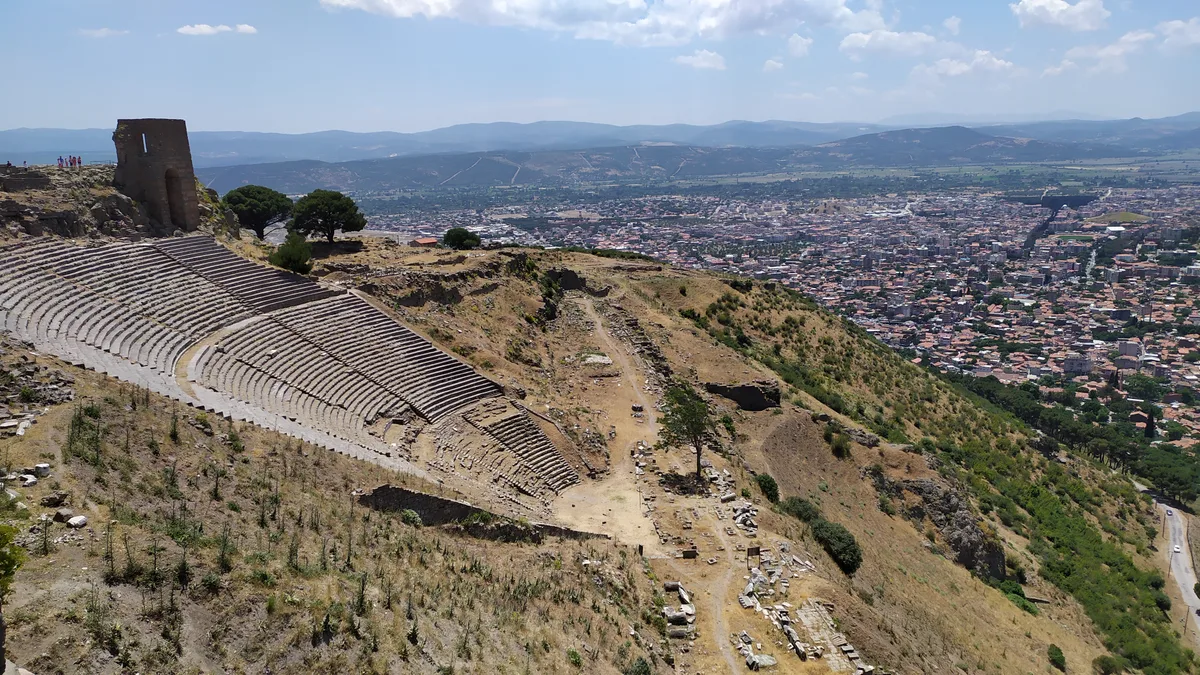
Photo: Mulazimoglu / Wikimedia Commons (Public domain)
At a Glance
- Period
- Hellenistic–Roman
- UNESCO
- Yes (2014)
- Notable structures
- Steep theatre, Asclepion, Altar of Zeus (original in Berlin)
- Best season
- Apr–Jun, Sep–Oct
- Visiting hours
- 08:00–19:00 (summer) · 08:00–17:00 (winter)
- Recommended time
- 3–4 hours
- Entry
- Paid
İzmir · Aeolis
Pergamon, a kingdom carved into a cliff
Pergamon began in 282 BC when Philetaerus (founder of the Attalid dynasty of Pergamon) seized the citadel and its treasury, becoming capital of the Attalid (the dynasty that ruled Pergamon, 282–133 BC) dynasty and later of the Roman province of Asia. In 133 BC Attalus III bequeathed the kingdom to Rome, and its library of some 200,000 scrolls was later shipped to Alexandria by Mark Antony. The physician Galen was born here in the 2nd century AD.
The Theatre of Pergamon is the steepest surviving ancient theatre: 78 rows climbing some 36 m down the hillside, with no permanent stone stage, a removable wooden platform left 64 post-holes. Below lay a 247 m by 17.4 m terrace, its vaults supporting the seats above the city's great altar of Zeus.
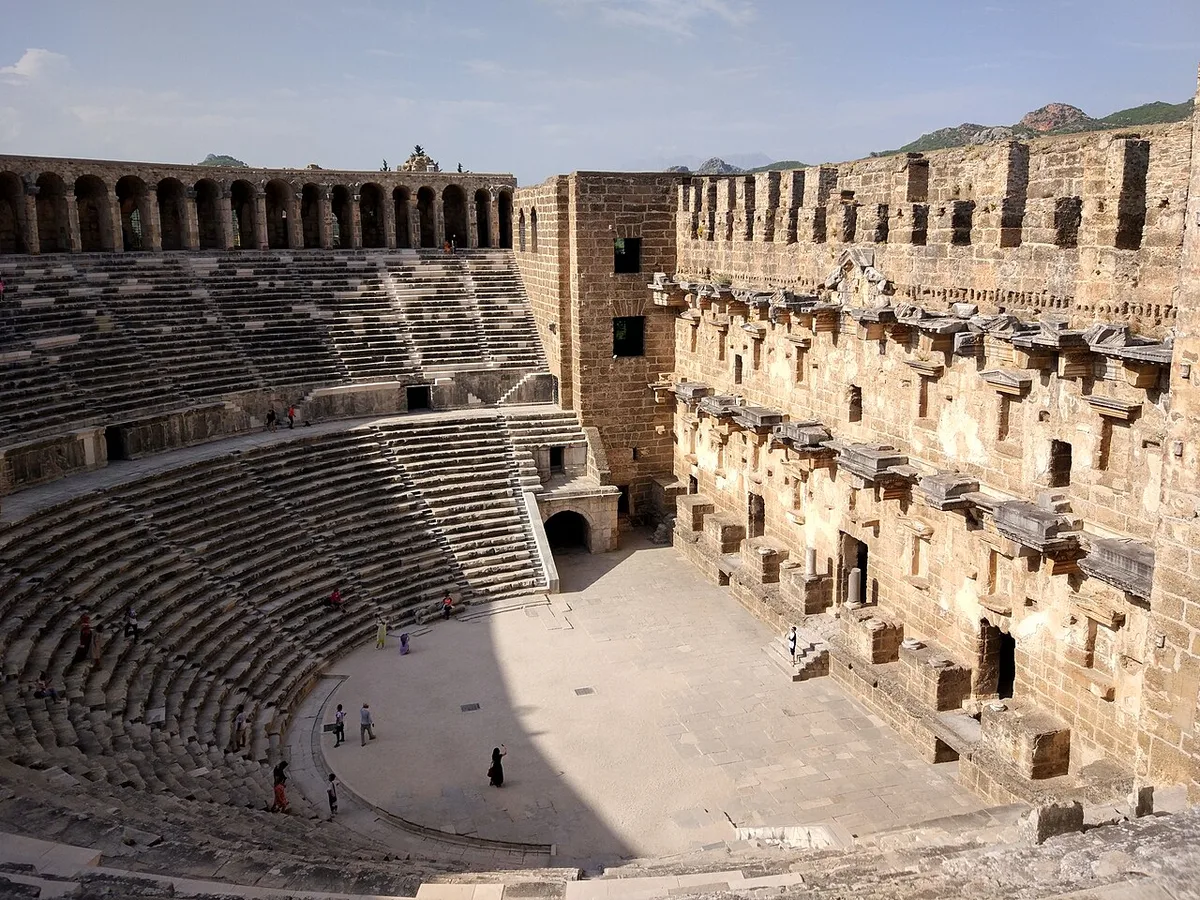
Photo: Dosseman / Wikimedia Commons (CC BY-SA 4.0)
At a Glance
- Period
- Roman
- UNESCO
- No
- Notable structures
- Aspendos Theatre, aqueducts, agora
- Best season
- Apr–May, Sep–Oct
- NIGHT VISITS
- Jun–Oct
- Visiting hours
- 08:00–19:00 (summer) · 08:00–17:00 (winter)
- Recommended time
- 1–2 hours
- Entry
- Paid
Antalya · Pamphylia
Aspendos, the Roman theatre that simply refused to fall
A Pamphylian city traditionally founded by Argive colonists, Aspendos prospered as a Roman trade centre and early coiner from around 500 BC. Its theatre survived because the Seljuk sultan Alaeddin Keykubat restored it in the 13th century as a palace and caravanserai, sparing it the dismantling other monuments suffered, and keeping it lived-in through Byzantine and Seljuk times.
The Roman theatre (AD 161–180), built under Marcus Aurelius and designed by the local architect Zenon, holds about 7,000 across 41 rows in a two-storey, ~22 m scaenae frons. Its acoustics are legendary: a whisper on stage carries to the top row. An aqueduct with ~30 m inverted siphons crossed a 1.7 km valley.
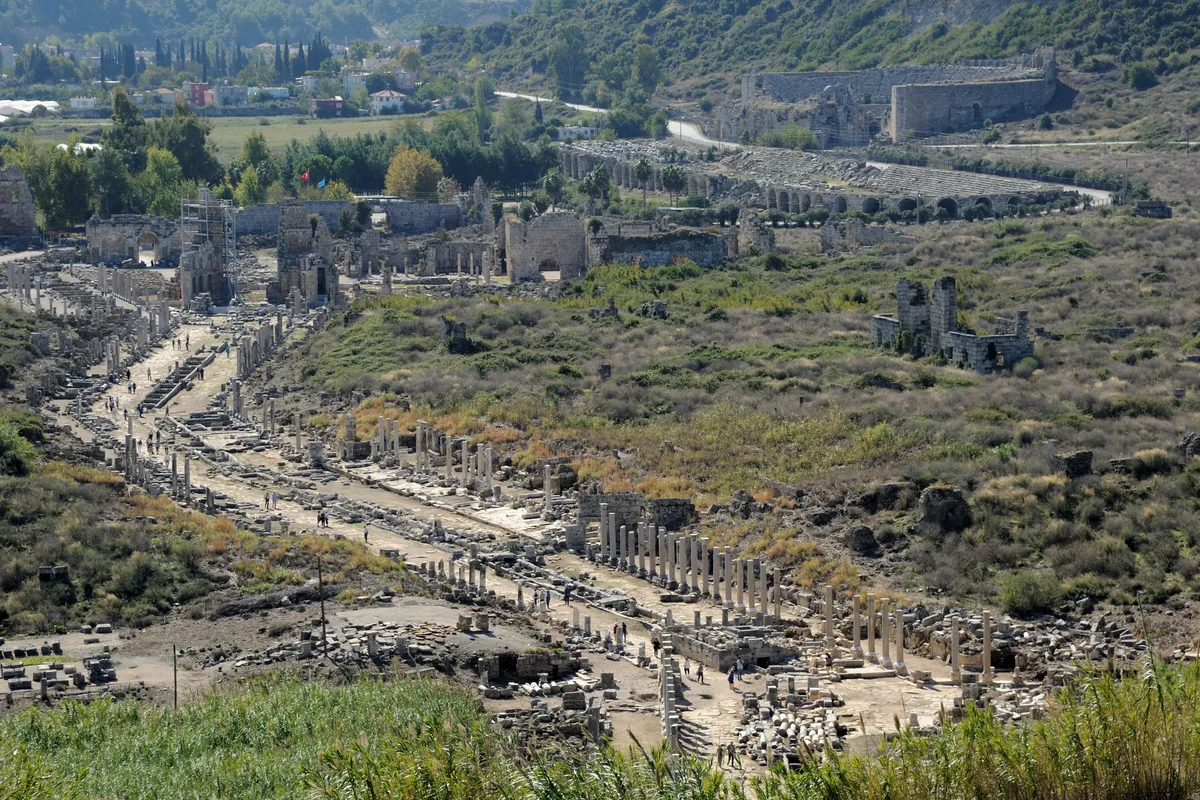
Photo: Dosseman / Wikimedia Commons (CC BY-SA 4.0)
At a Glance
- Period
- Hellenistic–Roman
- UNESCO
- No
- Notable structures
- Roman gate, stadium, colonnaded street
- Best season
- Apr–May, Sep–Oct
- Visiting hours
- 08:00–19:00 (summer) · 08:00–17:00 (winter)
- Recommended time
- 2–3 hours
- Entry
- Paid
Antalya · Pamphylia
Perge, the city that taught the world geometry
Perge was founded by Greek colonists led by Mopsos (a legendary seer said to have founded Perge) and Calchas (a legendary Greek seer of the Trojan War) after the Trojan War and became the capital of Pamphylia (an ancient region of southern Anatolia), passing from Lydia (an ancient kingdom of western Anatolia) and Persia to Alexander in 333 BC and Rome soon after. The apostle Paul preached here on his first journey, and its golden age came in the 2nd–3rd centuries AD, when the mathematician Apollonius of Perge lived and taught.
The stadium, about 270 m long with vaulted substructure and some 17 rows, seated roughly 12,000, among the best-preserved in the Mediterranean. The theatre, built against the hillside with a richly carved five-gated façade, held about 15,000 spectators and is still used for summer performances. A monumental gate of Plancia Magna, a wealthy priestess, and a long colonnaded street with a nymphaeum marked the city's civic heart.
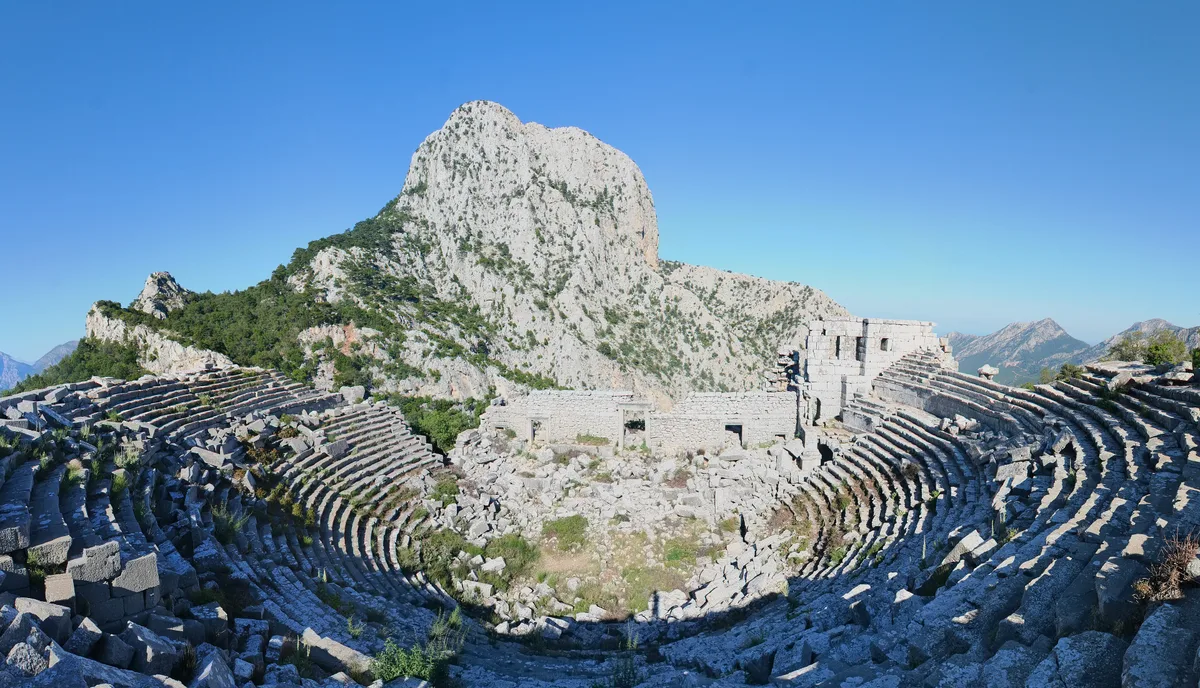
Photo: Ingo Mehling / Wikimedia Commons (CC BY-SA 3.0)
At a Glance
- Period
- Pisidian–Roman
- UNESCO
- No
- Notable structures
- Cliffside theatre, royal tombs, Corinthian gate
- Best season
- Apr–May, Oct
- Visiting hours
- 08:00–19:00 (summer) · 08:00–17:00 (winter)
- Recommended time
- 2–3 hours (involves walking)
- Entry
- Paid
Antalya · Pisidia
Termessos, the eagle's nest no army could take
A Pisidian (an ancient people of the mountainous interior of southern Anatolia) mountain city of the Solymi (a people of the Taurus mountains, in Greek myth allies of Troy), Termessos guarded the Taurus passes and kept its independence, allying with Rome in 71 BC. Alexander the Great besieged it in 333 BC and gave up, "an eagle's nest" he could not take, and the city later sheltered the Cilician (from Cilicia, the coast of southeastern Anatolia) way. After an earthquake destroyed its aqueduct, it was abandoned in the 5th century AD.
The theatre, set above 1,000 m on Mount Solymos, seated 4,000–5,000 across 16 tiers below a diazoma and 8 above, the cavea backed by the mountain itself. Nearby lies the heroon of Alcetas (a general of Alexander’s successors, killed at Termessos), the Macedonian (the Greek kingdom of Alexander the Great) general who died there in 319 BC, and a row of rock-cut house tombs.
Full guide: Termessos Theatre (Antalya) →
Also featured in: Rock-Cut Tombs in Turkey
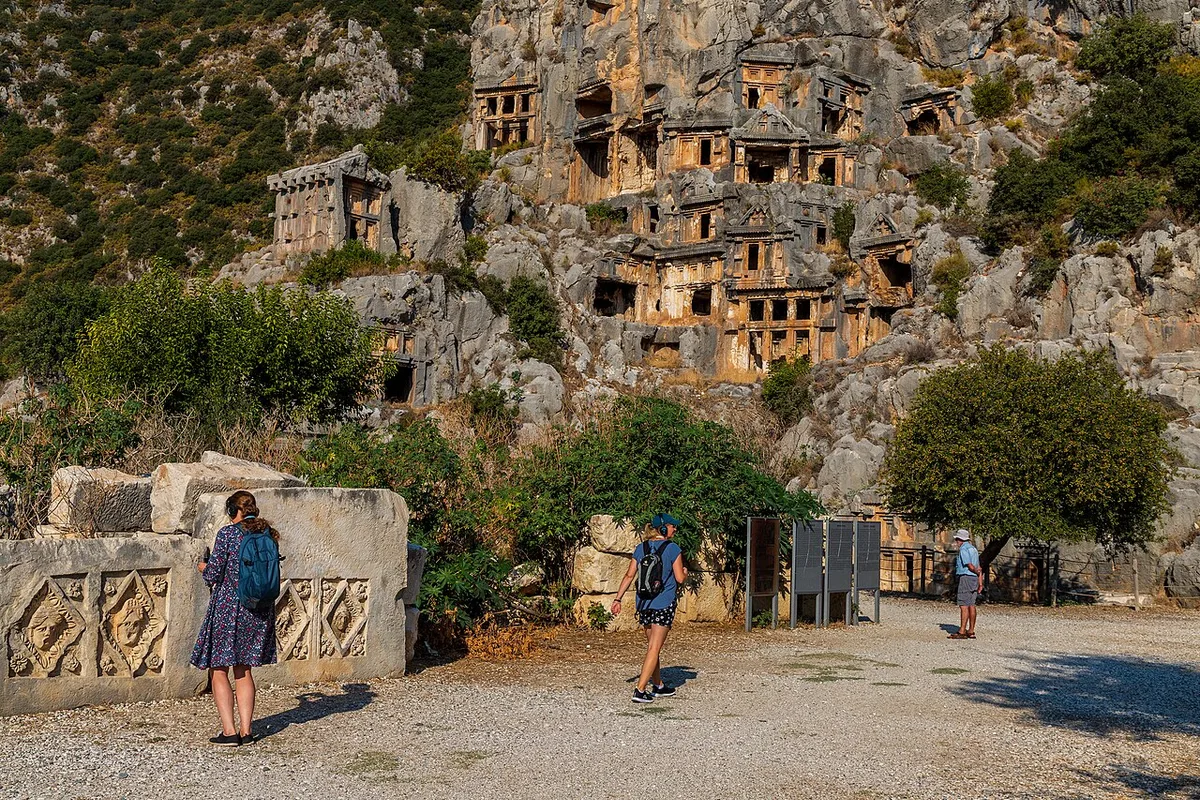
Photo: Mkrc85 / Wikimedia Commons (CC BY-SA 4.0)
At a Glance
- Period
- Lycian–Roman–Byzantine
- UNESCO
- No
- Notable structures
- Lycian rock-cut tombs, Church of St. Nicholas, theatre
- Best season
- Apr–May, Sep–Oct
- Visiting hours
- 08:00–19:00 (summer) · 08:00–17:00 (winter)
- Recommended time
- 1–2 hours
- Entry
- Paid
Antalya · Lycia
Myra, where the Lycians buried their dead in temple fronts
One of the six principal cities of the Lycian League (a federation of ancient city-states in southwest Anatolia), Myra held three votes and became the Byzantine capital of Lycia under Theodosius II in the 5th century AD. Earthquakes, the silting of its port at Andriake (the harbour of ancient Myra), and Arab raids from the 7th century reduced it; caliph Hārūn al-Rashīd took it in 808, though St. Nicholas (the 4th-century bishop who became Santa Claus) had already made the see famous.
Its Roman theatre is the largest in Lycia, seating 11,000–12,000, its cavea carved into the hillside. Above rise the rock-cut tombs, temple-front façades carved into the cliff, 104 documented, mostly 4th century BC, including the painted "Lion's Tomb" with its relief frieze. The city's bishops ranked among the highest in the Byzantine church, and the nearby port of Andriake (the harbour of ancient Myra) held a granary built under Hadrian.
Full guide: Myra Rock Tombs (Antalya) →
Also featured in: Rock-Cut Tombs in Turkey
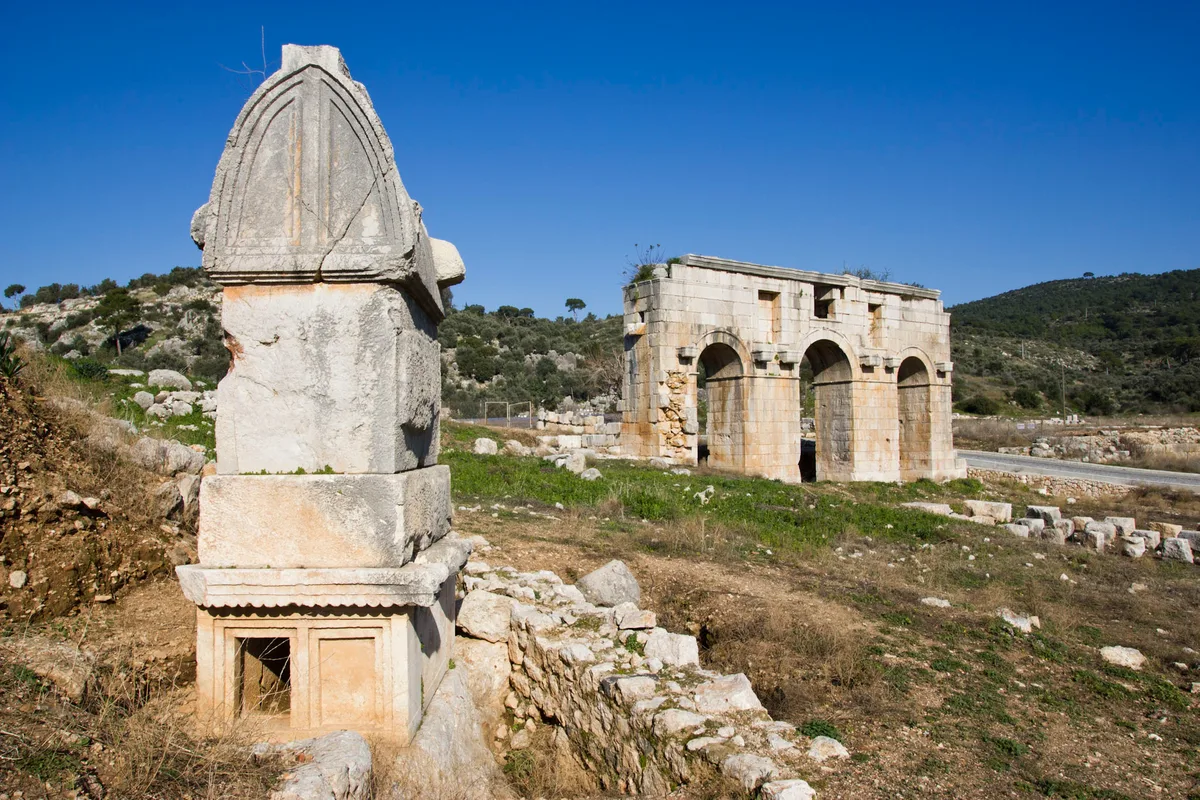
Photo: William Neuheisel / Wikimedia Commons (CC BY 2.0)
At a Glance
- Period
- Lycian–Roman–Byzantine
- UNESCO
- No
- Notable structures
- Bouleuterion (Assembly Hall), lighthouse, Hadrian's granary, theatre
- Best season
- Apr–May, Sep–Oct
- Visiting hours
- 08:00–19:00 (summer) · 08:00–17:00 (winter)
- Recommended time
- 1–2 hours
- Entry
- Paid
Antalya · Lycia
Patara, where the world's first democracy met the sea
Patara was the great harbour of ancient Lycia, a federation of city-states on Turkey's southern coast, and the sandy-mouthed port where St. Nicholas (the 4th-century bishop who became Santa Claus) was later born. Ships of the apostle Paul reportedly called here too, tying the site into the maritime world of the eastern Mediterranean. Patara also held a renowned oracle of Apollo: ancient writers say the god wintered here, ruling the world from its shrine while Delphi rested. Just inland, the sanctuary of Letoon served as the Lycian League's sacred centre, where the federation's delegates gathered for their annual rites.
What makes the ruins worth the trip is their civic scale. The Lycian League convened in a semicircular council hall, the bouleuterion, an early experiment in representative democracy that so impressed Montesquieu he called it a model republic. On the ground you can also walk a Roman lighthouse raised under Nero around AD 64–65, among the oldest anywhere, and a vast granary the emperor Hadrian built in AD 131 to stock the port's grain.
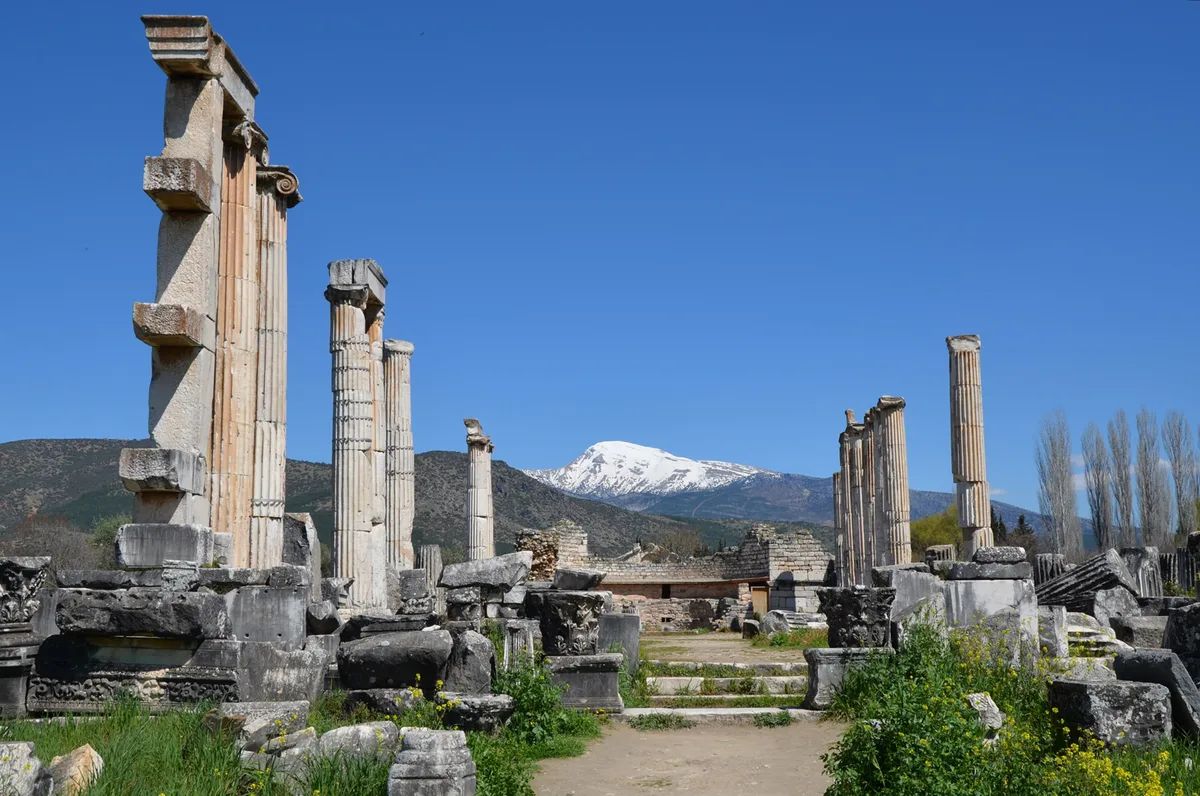
Photo: Carole Raddato / Wikimedia Commons (CC BY-SA 2.0)
At a Glance
- Period
- Hellenistic–Roman
- UNESCO
- Yes (2017)
- Notable structures
- Temple of Aphrodite, stadium, Sebasteion
- Best season
- Apr–Jun, Sep–Oct
- Visiting hours
- 08:00–19:00 (summer) · 08:00–17:00 (winter)
- Recommended time
- 2–3 hours
- Entry
- Paid
Aydın · Caria
Aphrodisias, the sculpture workshop of the Roman East
Named for Aphrodite, Aphrodisias was the metropolis of Roman Caria (an ancient region of southwest Anatolia) and famed for its marble sculptors' school, whose works adorned cities across the empire. The philosopher Alexander of Aphrodisias and the novelist Chariton both came from here. A 7th-century earthquake shattered the city; it never recovered, was refortified, and renamed Stauropolis to shed its pagan past. Aphrodisias enjoyed unusual imperial favour: declared a free city and exempt from certain taxes, it became the empire's premier address for imperial portraiture, its sculptors carving statues sent to forums from Rome to the Black Sea. Its great relief monument, the Sebasteion, lined the processional street with panels blending Greek myth and imperial propaganda.
The stadium, built in the 1st century AD, runs about 270 m by 60 m with 30 rows of seats and a track some 225 m long, holding up to 30,000, one of the largest in the ancient world. The bouleuterion seated about 1,750 beneath a colonnaded roof, and the Tetrapylon marked the sanctuary's processional way.
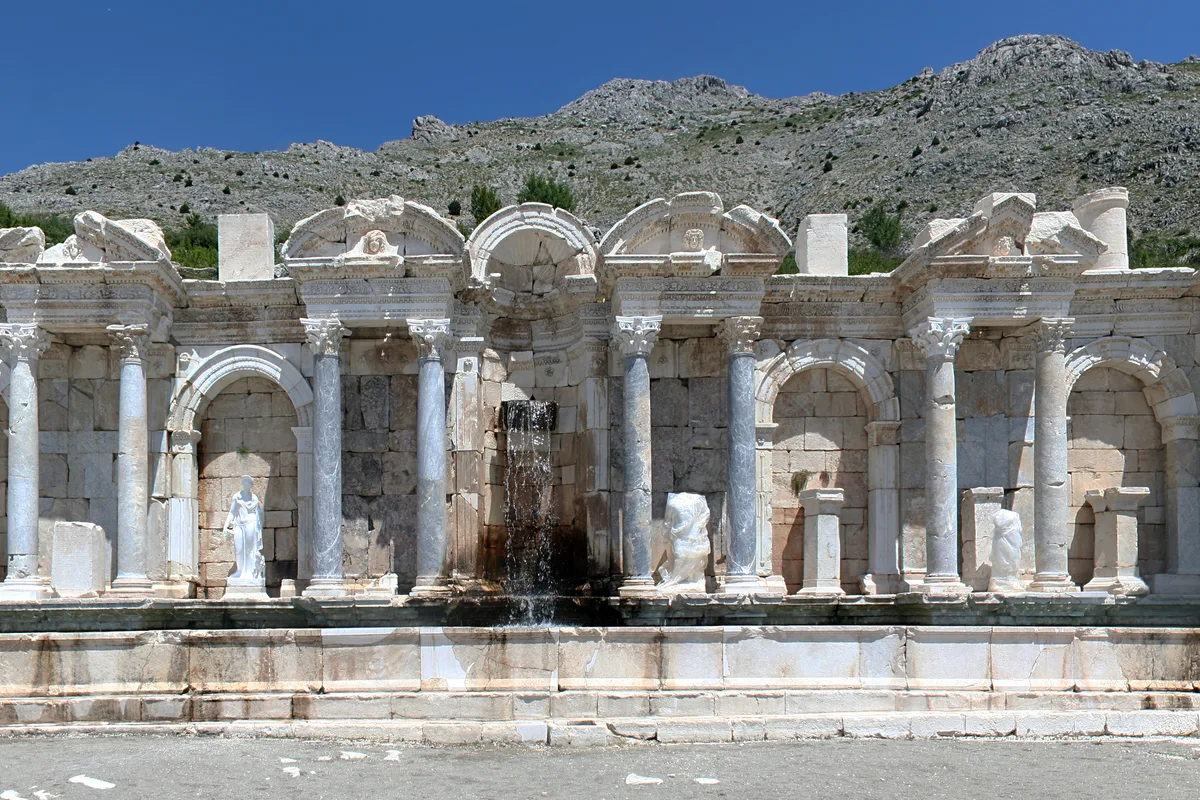
Photo: Ingo Mehling / Wikimedia Commons (CC BY-SA 3.0)
At a Glance
- Period
- Pisidian–Roman
- UNESCO
- No
- Notable structures
- Antonine Nymphaeum, upper agora, theatre
- Best season
- Apr–Jun, Sep–Nov
- Visiting hours
- 08:00–19:00 (summer) · 08:00–17:00 (winter)
- Recommended time
- 2–3 hours
- Entry
- Paid
Burdur · Pisidia
Sagalassos, the city that refused to leave the mountain
In the western Taurus at 1,400–1,600 m, Sagalassos was "the first city of Pisidia," favoured by Hadrian after Alexander the Great took it in 333 BC. Hittite texts knew the site as Salawassa (the Hittite name for the Sagalassos region) as early as the 14th century BC. A 518 earthquake, plague around 541–543, Arab raids, and a mid-7th-century quake forced its abandonment, leaving houses and tools preserved in debris. Sagalassos's height made it a natural fortress: Alexander had to storm it in 333 BC, and Rome later turned that defiance into prestige, raising it to colonial status and lavishing imperial patronage on its fountains and baths. As the "first city of Pisidia" it anchored the Pisidian League, a federation of highland communities that long held the interior against outside rule.
The Roman theatre terraces the slope at city height; a colossal statue of Hadrian, found in the baths in 2007, stands about 4–5 m tall, carved in sections joined with marble tenons. The agora, fountain houses, and a reconstructed hydraulic system show the city's imperial wealth. Lower town workshops produced the famous Sagalassos red slipware, a fine tableware exported across the Roman east.
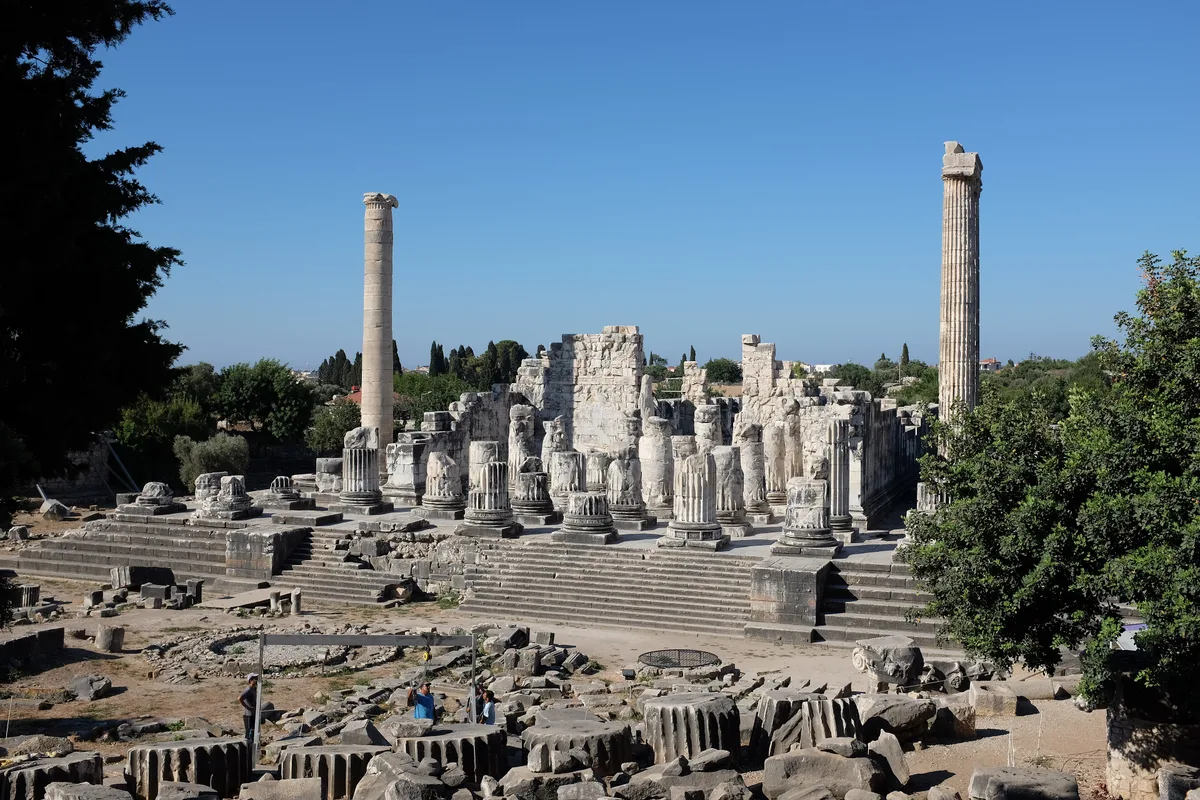
Photo: AlexanderVanLoon / Wikimedia Commons (CC BY-SA 4.0)
At a Glance
- Period
- Greek–Roman
- UNESCO
- No
- Notable structures
- Temple of Apollo Didymaion, Medusa head, sacred spring
- Best season
- Apr–Jun, Sep–Oct
- NIGHT VISITS
- Jun–Oct
- Visiting hours
- 08:00–19:00 (summer) · 08:00–17:00 (winter)
- Recommended time
- 1–2 hours
- Entry
- Paid
Aydın · Ionia
Didyma, the oracle that stood in the open air
Didyma was the oracle sanctuary of Apollo beside Miletus, settled by Ionian Greeks around 1000 BC. The Persians sacked it in 494 BC and silenced the oracle; after Alexander liberated Miletus in 334 BC it was rebuilt and consulted for centuries, Hadrian even served as its prophet in AD 129, and the Branchidae priests guarded the cult. Didyma ranked among the foremost oracles of the Greek world, rivaling Delphi, and pilgrims walked the 17 km Sacred Way from Miletus to consult it. Its answers came not from a temple cell but from a priestess by a sacred spring in the open court, and the hereditary Branchidae priests served the cult until the Persians carried them off after sacking the shrine in 494 BC.
The Temple of Apollo (Didymaion) was among the largest Greek temples ever planned: a 51 × 109 m stylobate, a double file of Ionic columns 19.7 m high, and a sekos wall rising ~25 m, pierced by a ~14 m door. A sacred spring lay within the unroofed court; the temple was never finished.
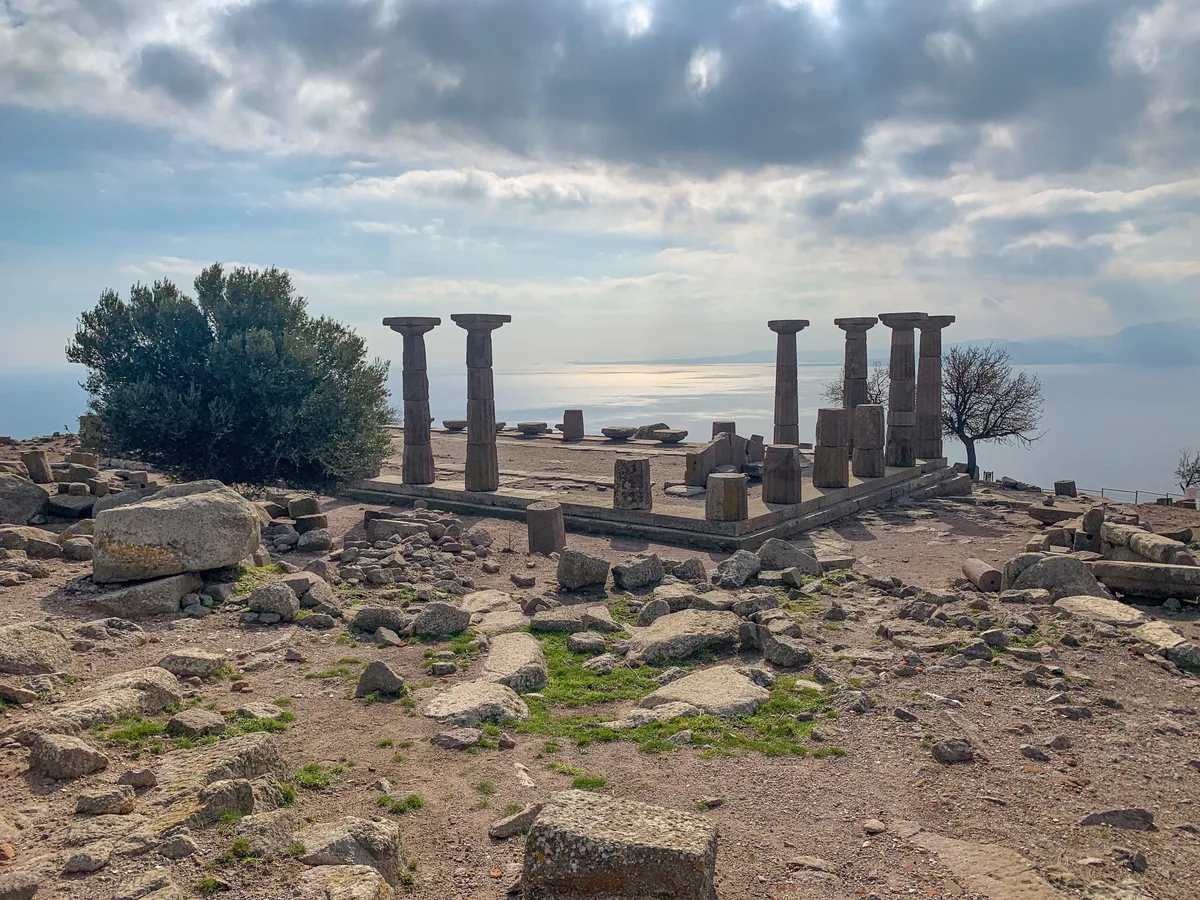
Photo: Sonnyhill / Wikimedia Commons (CC BY-SA 4.0)
At a Glance
- Period
- Ancient Greek–Roman–Byzantine
- UNESCO
- No
- Notable structures
- Temple of Athena, amphitheatre, agora
- Best season
- Apr–May, Sep–Oct
- Visiting hours
- 08:00–19:00 (summer) · 08:00–17:00 (winter)
- Recommended time
- 1–2 hours
- Entry
- Paid
Çanakkale · Troad
Assos, where philosophy came down to the sea
Founded 1000–900 BC by Aeolian colonists from Lesbos, Assos commanded the only good harbour along 80 km of Troad coast and quarried its own andesite stone. Aristotle lived here from 348 BC, ran an academy, and studied zoology until Persia's Hermias (a ruler of Assos under Persian overlordship) was tortured to death and he fled to Macedon. Aristotle's circle made Assos a brief intellectual capital: his pupil Theophrastus taught here, and the philosopher later tutored the young Alexander of Macedon before he took the throne. Centuries later a Neoplatonic school kept Assos on the philosophical map.
The Temple of Athena (c. 530 BC) is the only Doric-order temple in Asia Minor, on the acropolis 238 m above the sea; of 38 original columns, 6 remain, overlooking the Aegean. The 4th-century-BC walls carry 14 m-high towers, and a theatre below held 5,000 spectators. The philosopher Cleanthes (a Stoic philosopher, 3rd century BC), a Stoic, was also born here, and the acropolis terraces still show the agora and a bouleuterion.
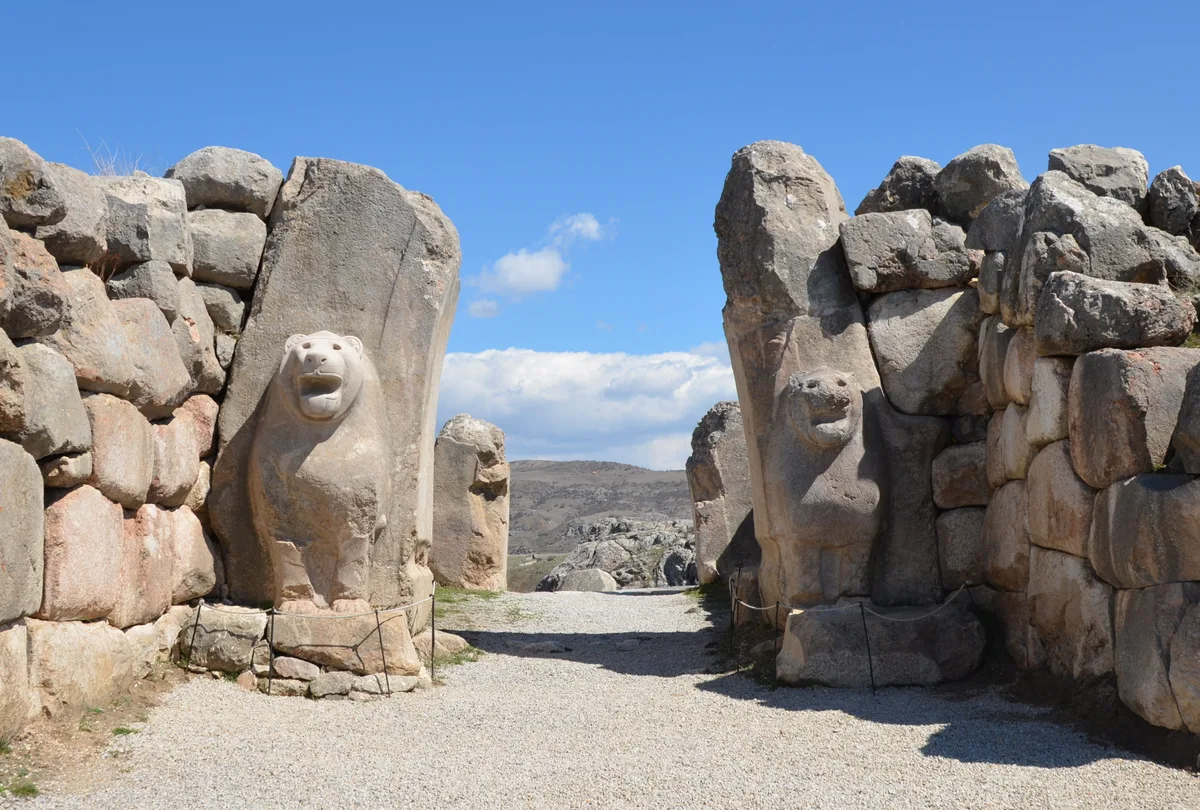
Photo: Carole Raddato / Wikimedia Commons (CC BY-SA 2.0)
At a Glance
- Period
- Hittite (17th–12th c. BC)
- UNESCO
- Yes (1986)
- Notable structures
- Great Temple, Lion Gate, fortifications
- Best season
- Apr–Jun, Sep–Oct
- Visiting hours
- 08:00–19:00 (summer) · 08:00–17:00 (winter)
- Recommended time
- 2–3 hours
- Entry
- Paid
Çorum · Hittite Anatolia
Hattusa, the capital that guarded the Storm God
Hattusa became the Hittite capital around 1650 BC under Hattusili I (a Hittite king of the 17th century BC) and ruled an empire stretching from Anatolia to Syria. Around 1200 BC, during the Late Bronze Age collapse, the city was destroyed and slowly abandoned as drought and fire ended Hittite power. The Kadesh (a Syrian city, site of a famous Hittite–Egyptian treaty) treaty with Ramesses II (1259 BC), engraved on tablets, was archived in its temples. Hattusa's temples preserved some 30,000 cuneiform tablets, the largest Bronze Age archive known, recording the world's earliest written peace treaty, the Kadesh accord with Egypt, alongside Hurrian myths and diplomatic letters in several languages. The Hittite tongue preserved there is among the oldest attested Indo-European languages, and the city lay abandoned for millennia until excavations brought it back to light in the early 1900s.
Over 6 km of walls, inner and outer courses ~3 m thick with a ~2 m gap, totaling ~8 m, were raised under Suppiluliuma I (a Hittite king of the 14th century BC). The Great Temple stood in the inner city beside granaries; the Lion Gate and Sphinx Gate, with their carved stone beasts, guarded the south approach.
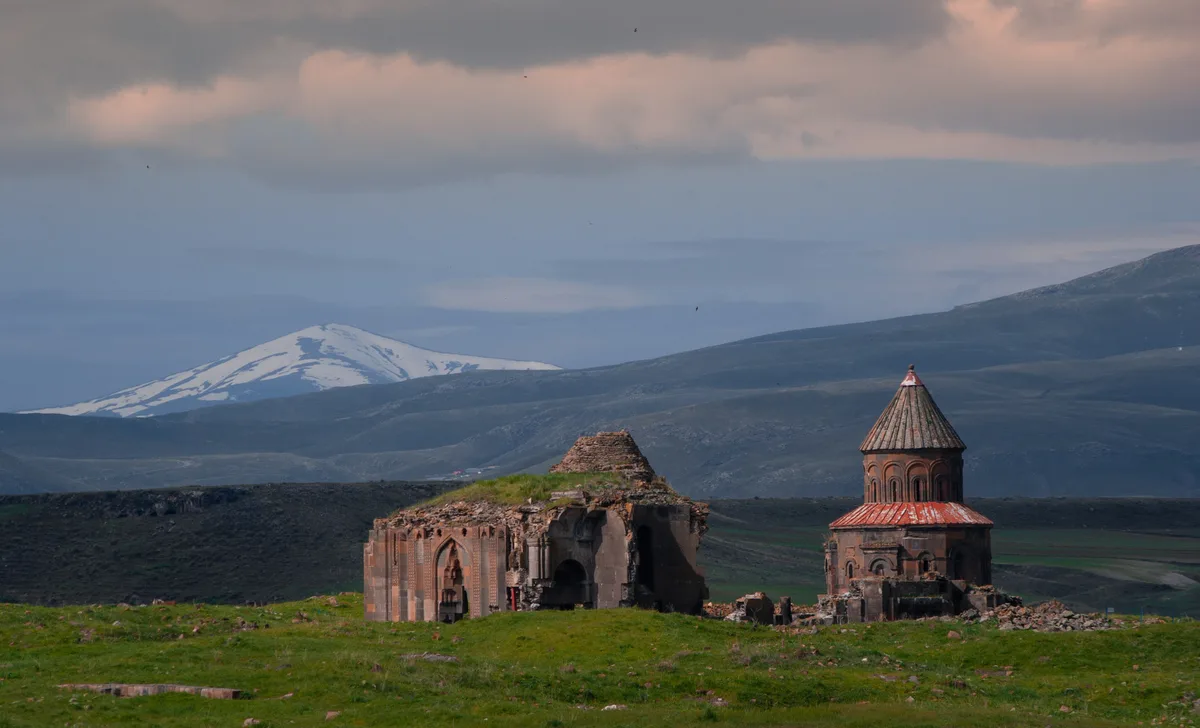
Photo: Engin Tavlı / Wikimedia Commons (CC BY-SA 4.0)
At a Glance
- Period
- Medieval (10th–11th c.)
- UNESCO
- Yes (2016)
- Notable structures
- Cathedrals, fortifications, bridge
- Best season
- May–Oct
- Visiting hours
- 08:00–19:00 (summer) · 08:00–17:00 (winter)
- Recommended time
- 2–3 hours
- Entry
- Paid
Kars · Medieval Anatolia
Ani, the city of a thousand and one churches
Ani rose as a medieval capital in the 10th century when King Ashot III moved his seat there in 961, a Silk Road hub of over 100,000 people whose churches traded with Byzantium and Persia. Seljuk forces under Alp Arslan took it in 1064 after a 25-day siege; a Mongol sack in 1236 and the 1319 earthquake that dropped the cathedral dome preceded its abandonment by the 17th century.
The Cathedral of Ani, begun by architect Trdat in 989 and completed by 1001, is a domed basilica of red and black tuff, 34.3 m long and 21.9 m wide, originally ~38 m to its dome. The 11th-century city walls still enclose dozens of churches, palaces, a caravanserai, and a bridge over the Akhurian.
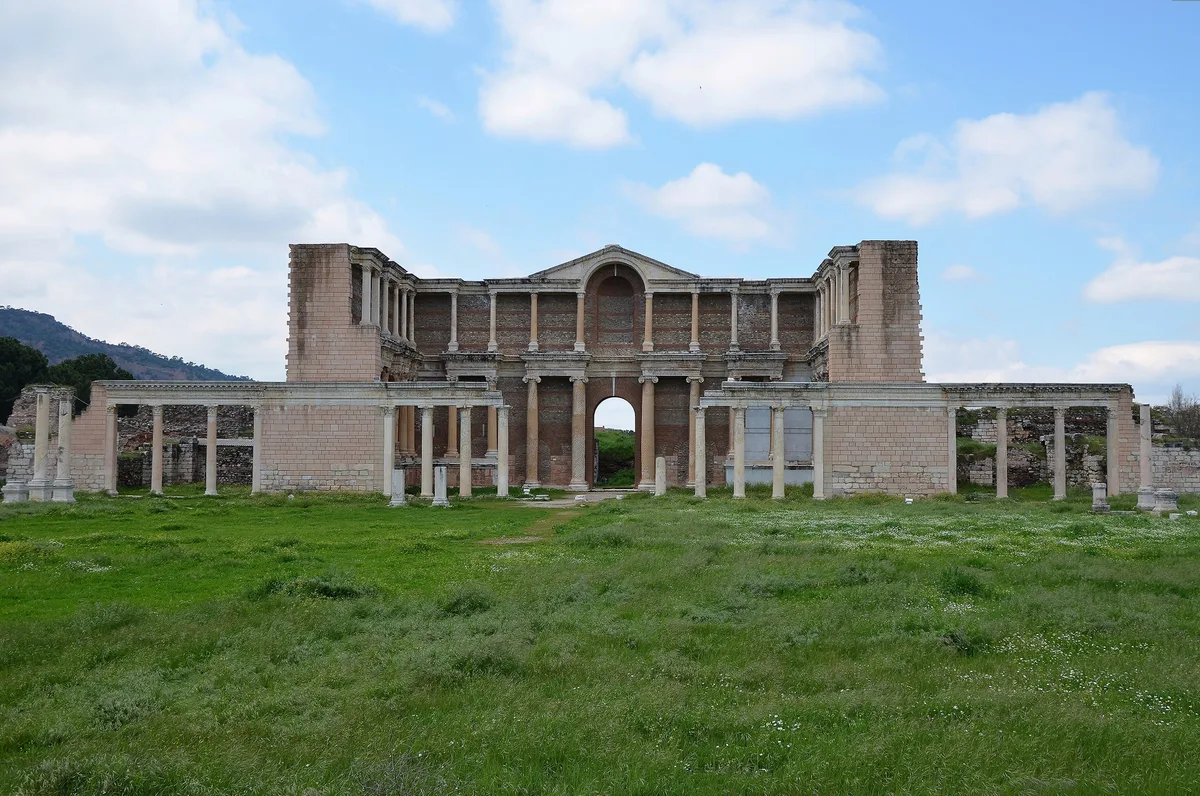
Photo: Carole Raddato / Wikimedia Commons (CC BY-SA 2.0)
At a Glance
- Period
- Lydian–Persian–Roman
- UNESCO
- Yes (2025)
- Notable structures
- Temple of Artemis, synagogue, gymnasium
- Best season
- Apr–Jun, Sep–Oct
- Visiting hours
- 08:00–19:00 (summer) · 08:00–17:00 (winter)
- Recommended time
- 1.5–2 hours
- Entry
- Paid
Manisa · Lydia
Sardis, the city that invented money
Sardis was the capital of Lydia (an ancient kingdom of western Anatolia), founded by the Mermnad (the dynasty that ruled Lydia, c. 680–546 BC) dynasty under Gyges (founder of Lydia’s Mermnad dynasty, c. 680 BC) around 680 BC and richest under Croesus (r. 560–546 BC), who minted the first gold coins. Cyrus the Great captured it in 547/546 BC, making it the western end of the Persian Royal Road. A devastating AD 17 earthquake brought Tiberius's funds to rebuild. Sardis later ranked among the Seven Churches of Asia named in the Book of Revelation, and the nearby Pactolus river, whose gold-bearing gravel had financed Lydia's first coins, kept the city wealthy long after Croesus. Rome made it a provincial assize centre where the governors of that same province heard cases from across western Anatolia.
The Temple of Artemis, begun in the 3rd century BC and never finished, was planned as a pseudodipteros of about 64 Ionic columns ~17.7 m tall on a ~100 × 45 m platform; two still stand to full height. Beside it, the bath-gymnasium complex covers ~23,000 m², its walls up to 13 m, enclosing a 60 m-long synagogue.
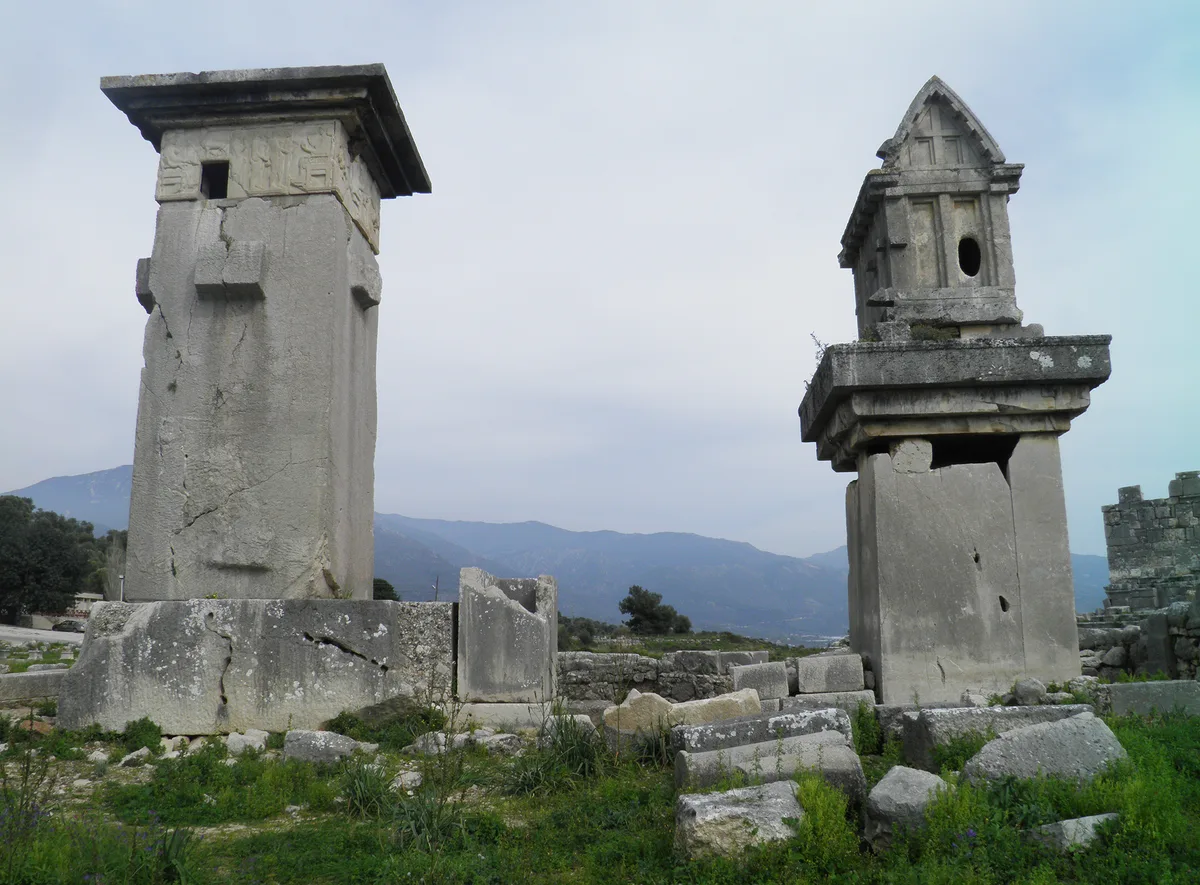
Photo: Carole Raddato / Wikimedia Commons (CC BY-SA 2.0)
At a Glance
- Period
- Lycian–Roman
- UNESCO
- Yes (1988)
- Notable structures
- Harpy Tomb, Payava Sarcophagus, Letoon
- Best season
- Apr–May, Sep–Oct
- Visiting hours
- 08:00–19:00 (summer) · 08:00–17:00 (winter)
- Recommended time
- 1.5–2 hours
- Entry
- Paid
Antalya · Lycia
Xanthos, the heart of Lycia, twice burned for freedom
Capital of ancient Lycia and named in Homer's Iliad, Xanthos was a defiant city: around 540 BC, facing Persia's Harpagus (the Persian general who subdued Lycia, c. 540 BC), its people burned the city and chose mass death over surrender, only ~80 families surviving. Brutus destroyed it again in 42 BC, leaving ~150 men; Arab raids ended it in the 7th century AD.
Its Lycian pillar tombs are unique: the Harpy Tomb, dated 480–470 BC, is a monolithic column over 5 m on a two-step podium with a chamber atop, ~8.9 m overall. The Nereid Monument (c. 390 BC), tomb of dynast Arbinas (a Lycian dynast of Xanthos, builder of the Nereid Monument), stood ~13.5 m high and later inspired British Museum sculpture galleries. The Roman theatre, rebuilt in the 2nd century AD, originally held some 2,200 spectators, and the Letoon (a Lycian sanctuary dedicated to Leto) sanctuary lay a few kilometres to the south.
Also featured in: Rock-Cut Tombs in Turkey
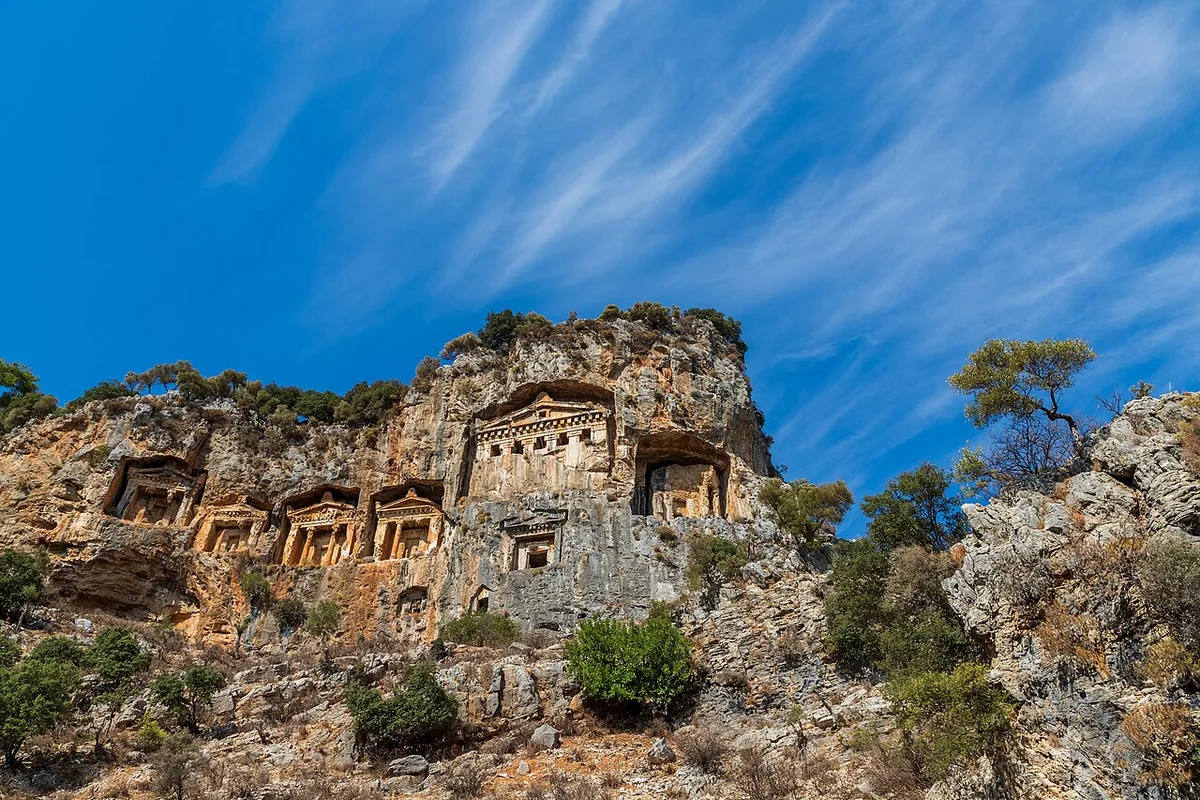
Photo: HALUK COMERTEL / Wikimedia Commons (CC BY 3.0)
At a Glance
- Period
- Carian–Roman
- UNESCO
- No
- Notable structures
- Rock-cut tombs, theatre, harbour
- Best season
- Apr–May, Sep–Oct
- Visiting hours
- 08:00–19:00 (summer) · 08:00–17:00 (winter)
- Recommended time
- 1.5–2 hours
- Entry
- Paid
Muğla · Lycia–Caria
Kaunos, the frontier town that the sea abandoned
A Carian (an ancient people of southwest Anatolia) city on the border between Caria (an ancient region of southwest Anatolia) and Lycia, Kaunos was a busy trading port and salt-producer, founded around the 9th century BC and ruled in turn by Caria, Lycia, and Persia. Its harbour silted up over the centuries as the Çalış delta advanced, and the city was finally abandoned around 1500 AD. Herodotus noted the Kaunians as distinct from their Carian neighbours. Strabo (the Greek geographer of the 1st century AD) noted Kaunos's temple of Apollo was built in an Egyptian style unusual for the Greek world, and the city's salt pans and fish-sauce works made it a noted producer long before the harbour choked with silt. Its people, Herodotus wrote, kept their own language and customs even while bordering Caria and Lycia.
The theatre, 75 m in diameter with 33 seating rows and a 22.8 m orchestra, held about 5,000; its Hellenistic (the period after Alexander the Great) core was reworked in Roman times. Above loom the Kaunosian rock-cut temple tombs of the 4th century BC, Ionic façades carved into the cliff, the largest left unfinished when the stone was abandoned.
Also featured in: Rock-Cut Tombs in Turkey
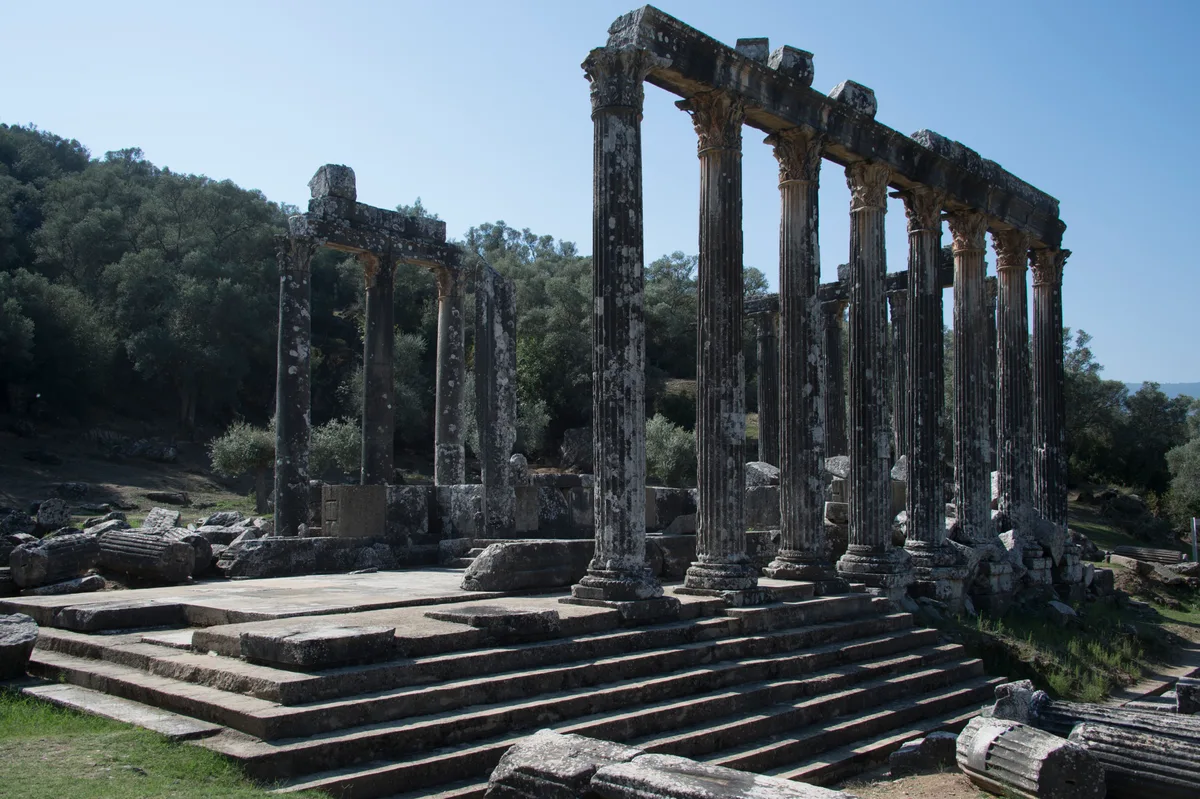
Photo: Dosseman / Wikimedia Commons (CC BY-SA 4.0)
At a Glance
- Period
- Carian–Roman
- UNESCO
- No
- Notable structures
- Temple of Zeus Lepsynos, theatre, agora, walls
- Best season
- Apr–Jun, Sep–Oct
- Visiting hours
- 08:00–19:00 (summer) · 08:00–17:00 (winter)
- Recommended time
- 1–1.5 hours
- Entry
- Paid
Muğla · Caria
Euromos, the Carian city that kept its Zeus
A Carian (an ancient people of southwest Anatolia) city on the plain below Mount Grium, Euromos, earlier Kyromos or Hyromos, appears in the Athenian tribute lists of the 5th century BC and later entered a short-lived sympoliteia with Mylasa (an ancient Carian city, modern Milas). Though never large, it minted its own coins and survived as a settled community into the Roman era, when its most ambitious building rose just outside the city wall.
That building is the Temple of Zeus Lepsynos, a Corinthian structure of the 2nd century AD begun under Hadrian and never fully completed: of a planned peristyle of 11 by 6 columns, 16 still stand, some fluted, some left smooth, several inscribed with the names of the citizens who funded them. A relief of a double-headed labrys flanked by two ears on the south wall marks the Carian Zeus who carried the axe and heard the prayers carved before him.
Ancient Sites Across Anatolia
These places open up slowly, and only to the visitor who stops and looks twice. Vestigia is a field companion for that kind of travel, in your pocket with the context and detail most guides skip. Download the app before you go.
Which ancient cities in Turkey should I visit?
Start with the names nearly every itinerary leans on. Troy, the city of the Homeric epics; Ephesus, the great harbour city whose Library of Celsus still stands; Aphrodisias, named for the goddess Aphrodite and the sculpture workshop of the Roman East; and Aspendos, whose theatre survives as one of the best-preserved ancient auditoriums anywhere. For the wilder side, climb to Termessos, the mountaintop stronghold no army could take, and end at Ani, the medieval Silk Road capital stranded near Turkey's eastern border.
What is the best preserved ancient theatre in Turkey?
Aspendos. Its stage building survives to full height and the auditorium keeps rows of seating for roughly 12,000 spectators, which scholars rank among the best-preserved ancient theatres in the world.
What was the Lycian League?
A federation of ancient city-states in southwest Anatolia, and an early experiment in representative democracy. Its leading cities met in a semicircular council house at Patara, the bouleuterion, in an assembly that so impressed the political thinker Montesquieu that he called it a model republic. The federation also kept its sacred centre at the sanctuary of Letoon, a little inland from Patara.