Where Anatolia Carved Its Dead From Stone
Long before they built for the living, the peoples of Anatolia cut their dead into the rock. This is a reader's guide to the most extraordinary rock-cut tombs in Turkey, Lycian (an ancient people of southwest Anatolia) temple fronts above the sea, a honeycomb cliff of hundreds of chambers, Carian (an ancient people of southwest Anatolia) sarcophagi cut into the bedrock, and a Phrygian (an ancient people of central Anatolia) monument cut straight from the living rock. Each is paired with the single monument that makes the scramble worthwhile.
All 11 sites, plotted on the map below.
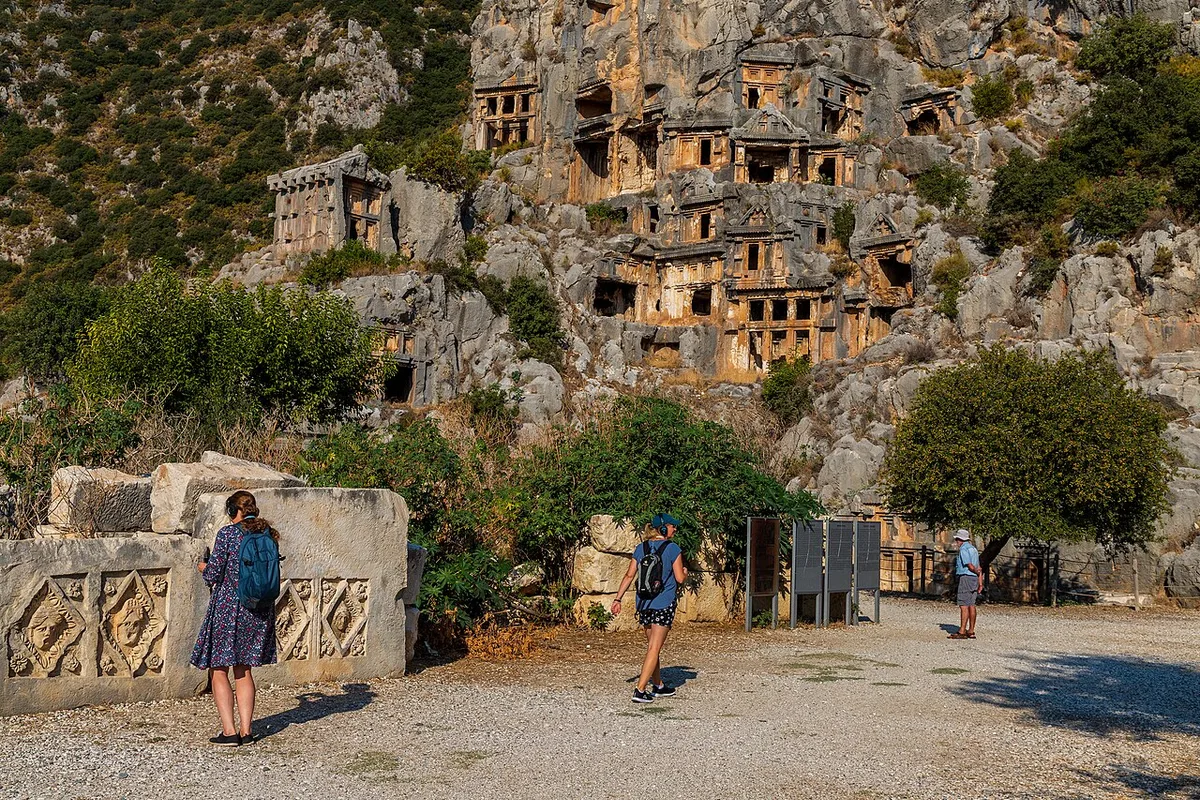
Photo: Mkrc85 / Wikimedia Commons (CC BY-SA 4.0)
At a Glance
- Period
- Lycian–Roman (4th c. BC)
- UNESCO
- No (Lycian Civilization, tentative)
- Notable structures
- 104 rock-cut tombs, Lion's Tomb, house- & temple-type façades
- Best season
- Apr–May, Sep–Oct
- Visiting hours
- 08:00–19:00 (summer) · 08:00–17:00 (winter)
- Recommended time
- 1–2 hours
- Entry
- Paid
Antalya · Lycia
Myra, a cliff stacked with a hundred temple doors
Among the six leading cities of the Lycian League (a federation of ancient city-states in southwest Anatolia), Myra is remembered less for its agora than for the necropolis cut straight into the limestone cliff above the modern town of Demre. Lycian funerary belief placed the dead high on the rock face, where winged beings could carry the soul upward, so the tomb façades were the most visible architecture a city raised.
The cliff at Myra is a catalogue of two Lycian tomb types. The house-tombs copy the gabled, beam-ended wooden houses the living once built, the dead were meant to keep a household on the rock. The temple-tombs set Ionic columns, triangular pediments and toothed friezes above the door, granting the deceased the honours of a shrine. The most famous, the "Lion's Tomb," keeps a painted relief frieze, a lion seizing a bull, its colour surviving two millennia in the sheltered rock; the chambers behind held family burials on carved stone benches.
Full guide: Myra Rock Tombs (Antalya) →
Also featured in: Ancient Cities in Turkey
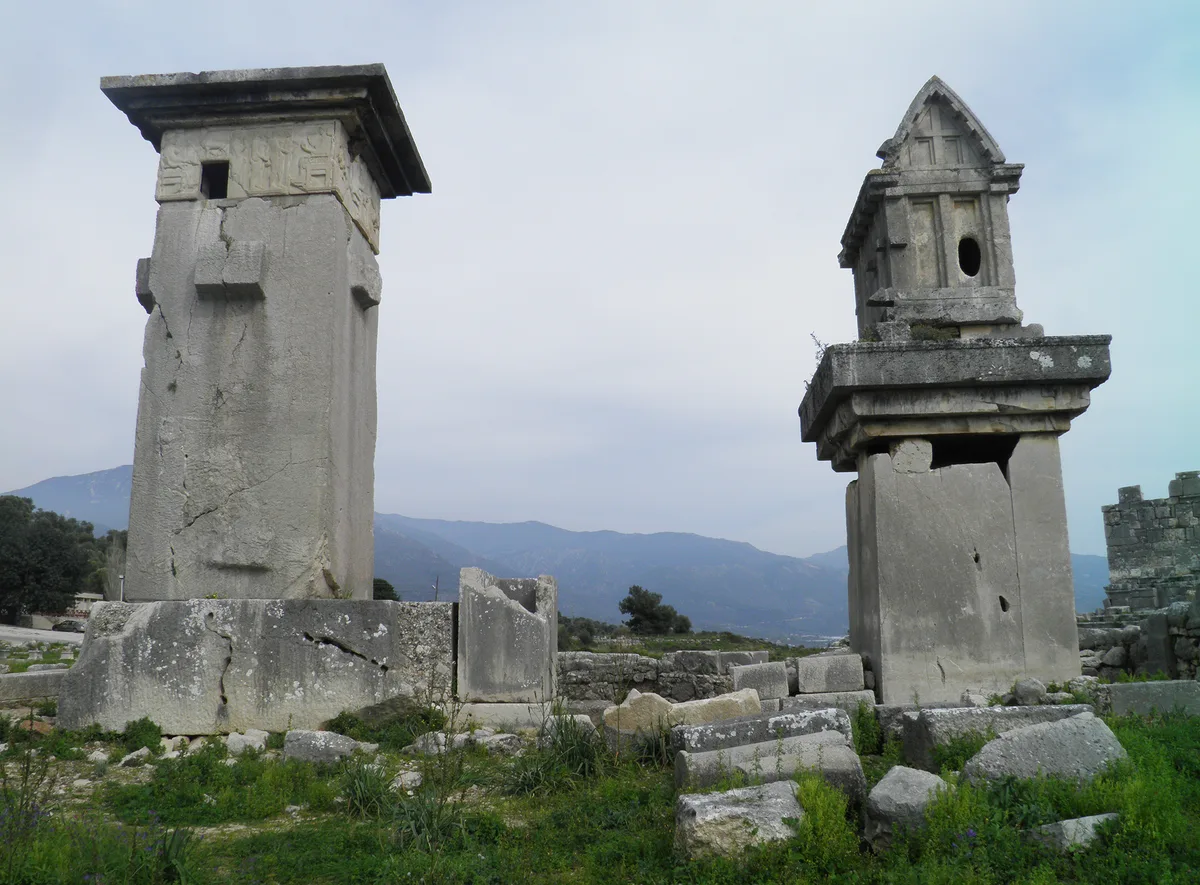
Photo: Jona Lendering / Wikimedia Commons (CC0)
At a Glance
- Period
- Lycian–Roman (from 6th c. BC)
- UNESCO
- Yes (1988)
- Notable structures
- Harpy Tomb, Payava Tomb, Xanthian Obelisk
- Best season
- Apr–May, Sep–Oct
- Visiting hours
- 08:00–19:00 (summer) · 08:00–17:00 (winter)
- Recommended time
- 2–3 hours
- Entry
- Paid
Antalya · Lycia
Xanthos, the pillar tombs of a city that burned twice
At Xanthos the dead were given the high ground. Across the acropolis cliff and the slopes below, the Lycians cut chamber tombs into the living rock and raised free-standing pillar tombs that lift the burial chamber high above the city, here the necropolis, not the theatre or the agora, is what has drawn travellers for two centuries.
The pillar tomb is a form found almost nowhere but Lycia: a stone shaft on a podium with the burial chamber hollowed into its top, set so the soul, in Lycian belief, carried off by winged beings, could rise. The Harpy Tomb (c. 480 BC) opens the series, its carved chamber now in the British Museum with casts left on site. Beside it, the Payava (a Lycian dynast of Xanthos, 4th century BC) Tomb shows the later Ionic dress and a relief where Greek and Persian costume meet, while the Xanthian Obelisk, a trilingual stele, carries the longest inscription in the Lycian language yet found, keeping the dead's names in three scripts.
Also featured in: Ancient Cities in Turkey
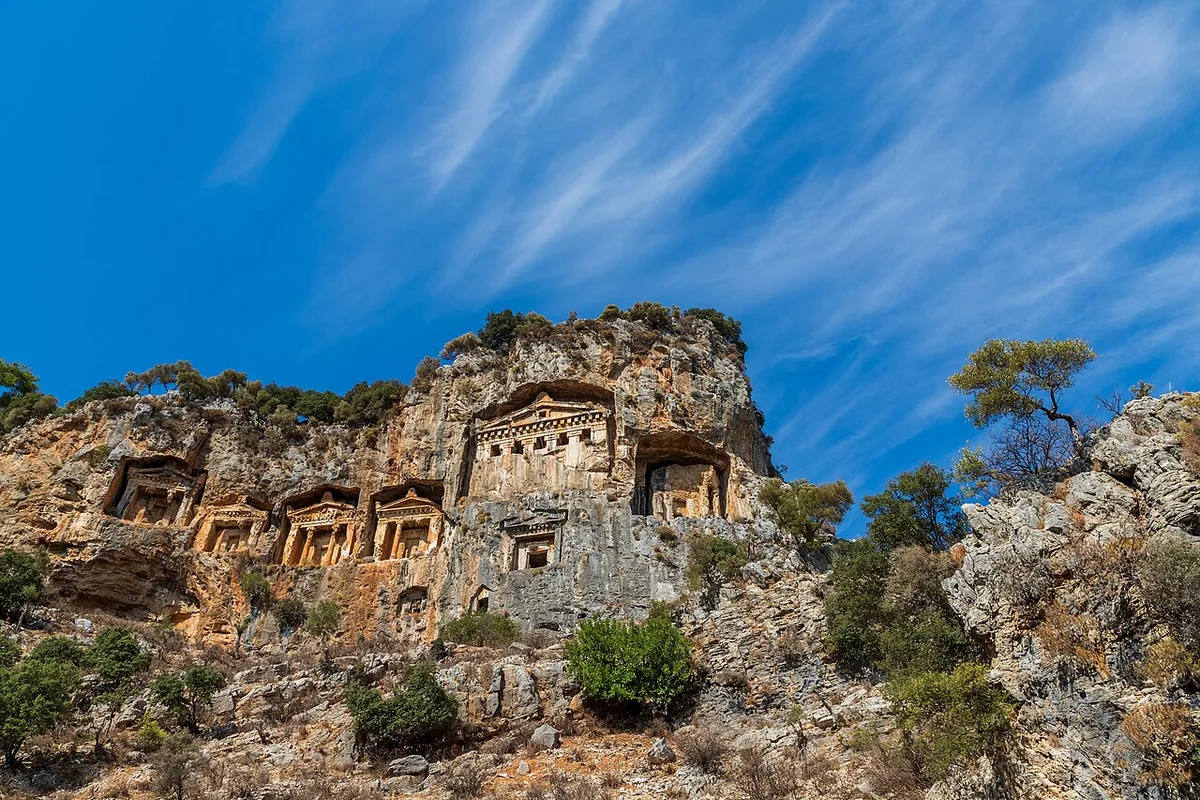
Photo: Mkrc85 / Wikimedia Commons (CC BY-SA 4.0)
At a Glance
- Period
- Carian–Lycian (mid-4th c. BC)
- UNESCO
- Tentative
- Notable structures
- 167 rock-cut tombs, "Kaunosian" temple façades
- Best season
- Apr–Jun, Sep–Oct
- NIGHT VISITS
- Yes (lit at dusk)
- Visiting hours
- 08:30–18:30 (summer) · 08:30–17:00 (winter)
- Recommended time
- 1.5–2 hours
- Entry
- Paid
Muğla · Caria–Lycia
Kaunos, a cliff of temple-fronted tombs above the river
A Carian (an ancient people of southwest Anatolia) city on the border between Caria (an ancient region of southwest Anatolia) and Lycia, Kaunos kept its own language well into antiquity, but it is remembered above all for the cliff of temple-fronted tombs its people cut above the Dalyan river, the most elaborate funerary façades anywhere on this coast.
The limestone face of Balıklar Mountain holds 167 rock-cut tombs grouped in seven clusters, dating from the mid-4th century BC. The finest are "Kaunosian Style" temple tombs, miniature Ionic temples with two columns, pediments and palm-leaf acroteria, cut into the cliff above the river; about twenty of the 167 are of this temple type. The chambers behind held family burials on carved stone benches. At dusk the tombs are lit, and their façades glow above the water.
Also featured in: Ancient Cities in Turkey
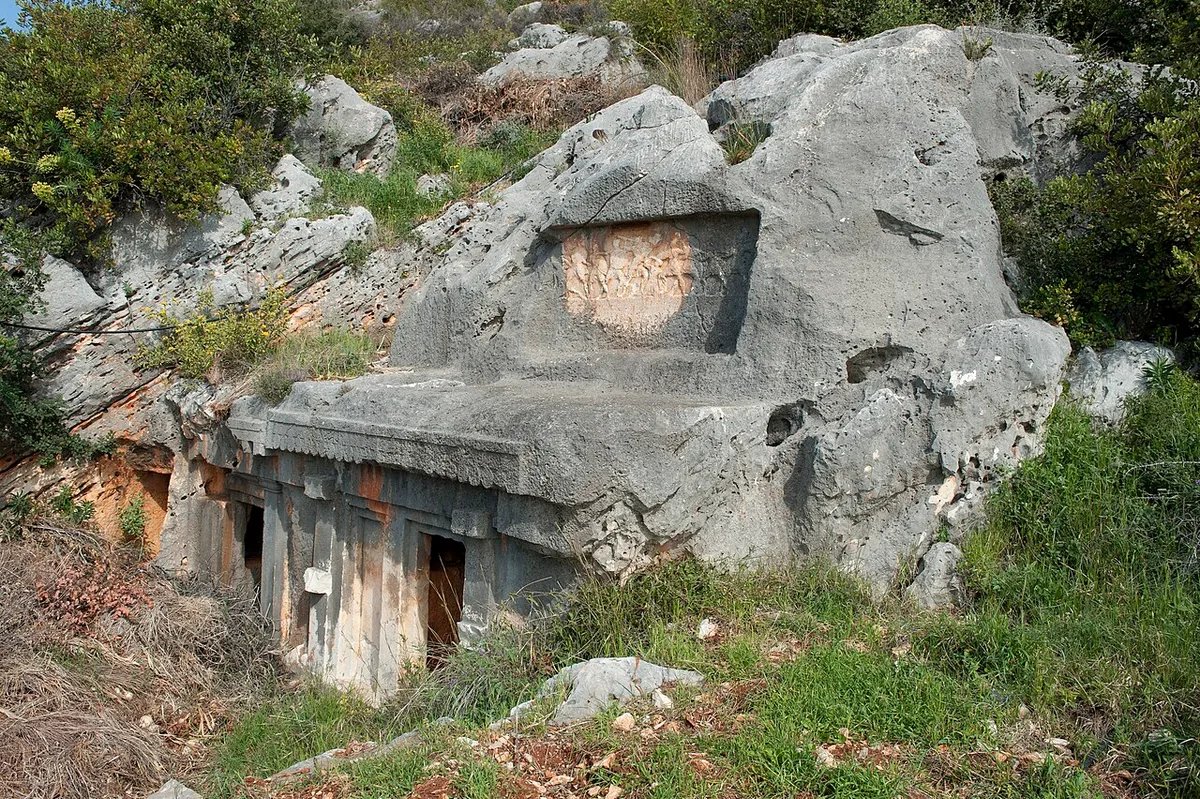
Photo: Dosseman / Wikimedia Commons (CC BY-SA 4.0)
At a Glance
- Period
- Lycian (5th–4th c. BC)
- UNESCO
- No (Lycian Civilization, tentative)
- Notable structures
- 400+ rock-cut tombs, Tebursseli Tomb, Heroon of Pericles
- Best season
- Apr–May, Sep–Oct
- Visiting hours
- 08:00–19:00 (summer) · 08:00–17:00 (winter)
- Recommended time
- 1.5–2 hours
- Entry
- Paid
Antalya · Lycia
Limyra, the cliff city with more rock-cut tombs than anywhere in Lycia
At the foot of Toçak Mountain near Finike, Limyra rose to prominence under the dynast Perikle (a dynast of Limyra in the 4th century BC) in the 4th century BC and became the Lycian city with the largest body of tombs anywhere in the region, over four hundred rock-cut graves scattered through five necropoleis on the slopes and cliffs above the plain.
The finest lie carved straight into the rock: house-type tombs with gabled, beam-ended façades that copy Lycian wooden houses, and chamber tombs whose reliefs still carry Lycian inscriptions naming the dead. The Tebursseli Tomb, cut into the cliff in Necropolis II, keeps a battle relief with a Lycian inscription (TL 103–104) recording a dynastic war. Set apart from these rock-cut graves stands the Heroon of Pericles, a temple-shaped monument on a high podium, its roof carried by eight caryatid statues instead of columns; a free-standing built tomb, not cut from the rock, and its caryatids now in the Antalya Museum. Here the necropolis, not the heroon, is what makes Limyra extraordinary.
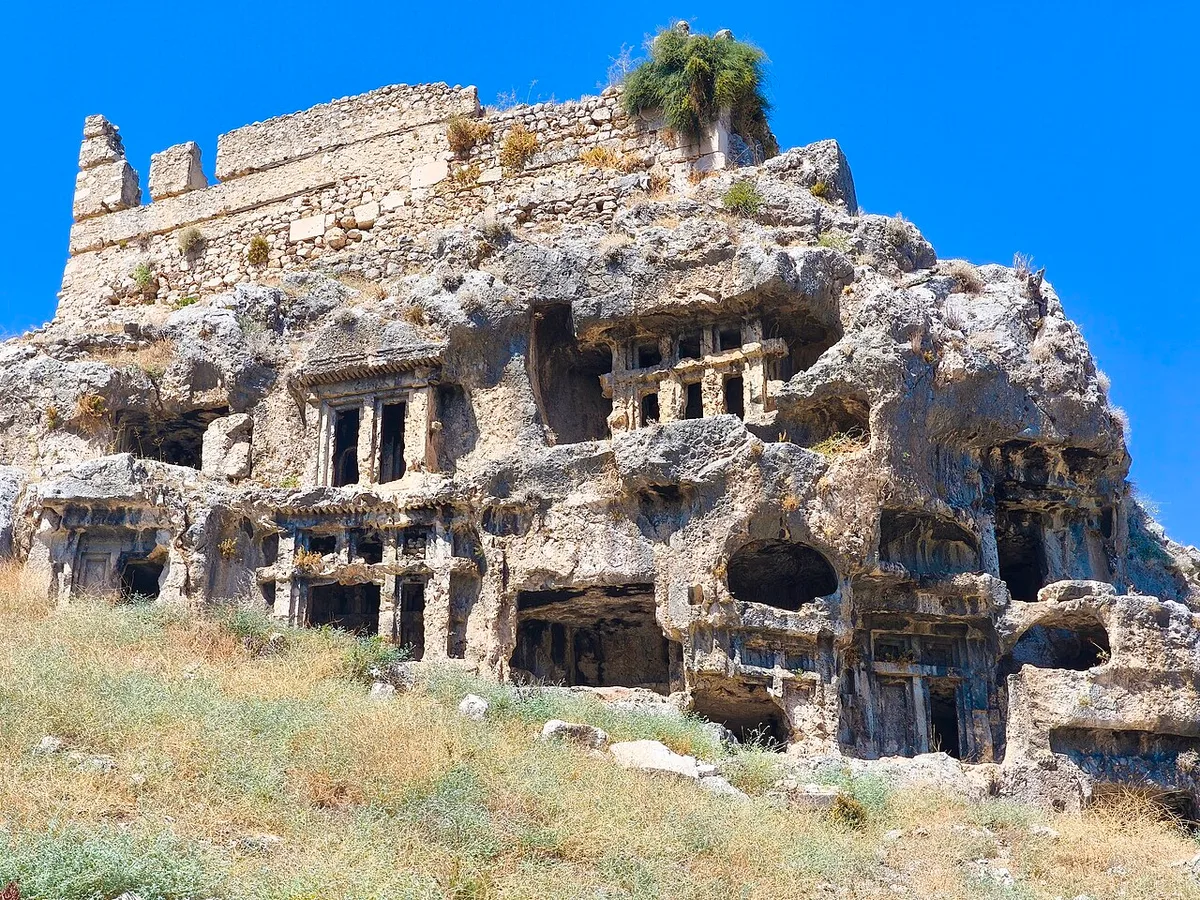
Photo: Kevser Tunç / Wikimedia Commons (CC BY-SA 4.0)
At a Glance
- Period
- Lycian–Roman
- UNESCO
- No (Lycian Civilization, tentative)
- Notable structures
- Bellerophon Tomb, house- & temple-type tombs, sarcophagi
- Best season
- Apr–May, Sep–Oct
- Visiting hours
- 08:00–19:00 (summer) · 08:00–17:00 (winter)
- Recommended time
- 2–3 hours
- Entry
- Paid
Antalya · Lycia
Tlos, the Bellerophon tomb and a city of sarcophagi
The largest and most important of the Lycian cities, Tlos was inhabited almost without break into the Ottoman (the Turkish empire that ruled 1299–1922) period, its acropolis fortress crowning a hill above the Xanthos valley. Below the castle, the cliff and slopes are thick with the dead. Tlos was one of the six great cities of the Lycian League, each entitled to three votes in the federal assembly that managed Lycia's foreign affairs, and its acropolis was later reused as a Byzantine (the eastern Roman Empire centered on Constantinople) and Ottoman fortress, so the ancient tombs lie beneath a medieval castle.
Tlos is the richest in rock-cut tombs of any Lycian site. The most striking is the Bellerophon Tomb, carved high on the acropolis with a relief of Bellerophon riding Pegasus; other house-type and temple-type tombs speckle the cliff, alongside dozens of Lycian sarcophagi, stone chest-tombs with pitched lids, set into the rock. The tombs show both the gabled "house" form and the later Ionic façades the Lycians adopted from the Hellenic world.
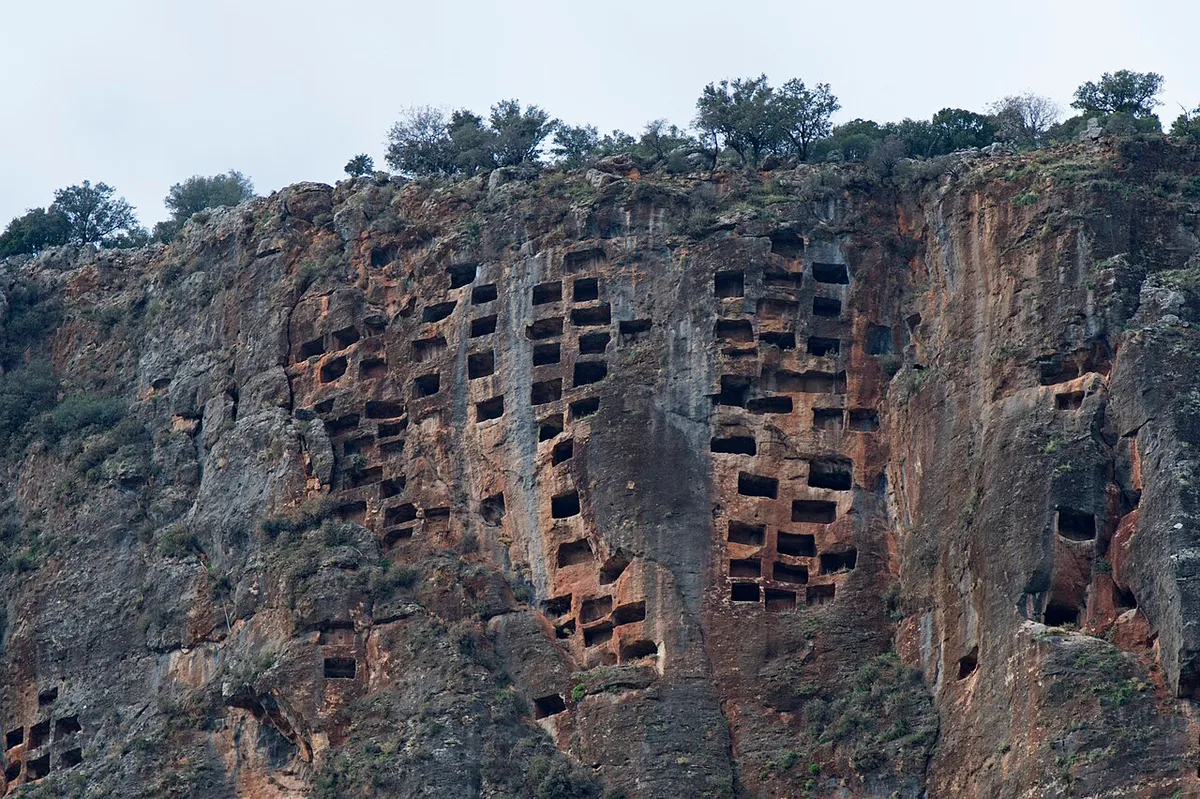
Photo: Dosseman / Wikimedia Commons (CC BY-SA 4.0)
At a Glance
- Period
- Lycian (4th c. BC)
- UNESCO
- No (Lycian Civilization, tentative)
- Notable structures
- Honeycomb "pigeon-hole" cliff, Royal Tomb
- Best season
- Apr–May, Sep–Oct
- Visiting hours
- 08:00–19:00 (summer) · 08:00–17:00 (winter)
- Recommended time
- 2–3 hours
- Entry
- Paid
Muğla · Lycia
Pinara, a cliff honeycombed with the dead
One of the six leading cities of the Lycian League, with three votes in its assembly, Pinara takes its name from the round rocky hill, the pinara of the Lycians, that rises above the ruins. Most of the city lies unexcavated; the tombs are the spectacle that has drawn travellers for two centuries.
The upper acropolis is a vertical drum of stone, and on its face the Lycians cut hundreds of tombs in tight rows, the "pigeon-hole" cliff, visible from far away, each small chamber holding a single body. Higher up, the "Royal Tomb" is a house-type tomb with reliefs of walled Lycian cities. Height was deliberate: Lycian belief held that winged beings carried the dead upward, so tombs were placed as high as the cliff allowed, some unreachable without rope.
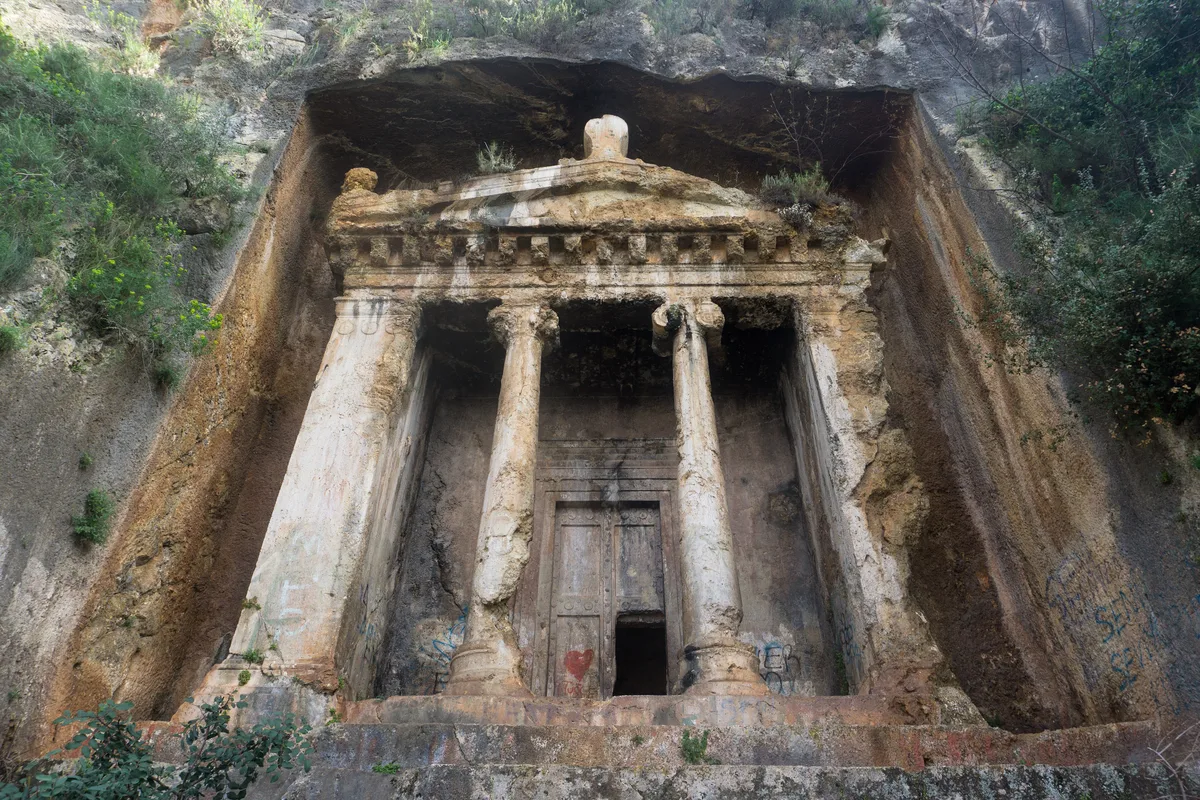
Photo: Alexey Komarov / Wikimedia Commons (CC BY-SA 4.0)
At a Glance
- Period
- Lycian–Hellenistic (350 BC)
- UNESCO
- No
- Notable structures
- Tomb of Amyntas, Ionic temple façade, 100+ cliff tombs
- Best season
- Apr–May, Sep–Oct
- Visiting hours
- 08:00–19:00 (summer) · 08:00–17:00 (winter)
- Recommended time
- 1–2 hours
- Entry
- Paid
Muğla · Lycia (Telmessos)
Amyntas, a temple door cut for one man
Ancient Telmessos (an ancient Lycian city, modern Fethiye), the "City of Oracles" beneath modern Fethiye, faces a south limestone cliff cut with over a hundred rock tombs. Most are plain chamber tombs; a few wear full temple façades that announce the wealth of those buried within.
The Tomb of Amyntas (350 BC) is the masterpiece: an Ionic temple front 11 × 13 m, its two columns and pediment carved from the living rock some 50 m above the town, reached by a rock-cut stair. An inscription names "Amyntas, son of Hermapias." Behind the façade, a single chamber with stone benches (klinai) imitates a Lycian house in stone, all the artistry spent on the exterior that the living would see.
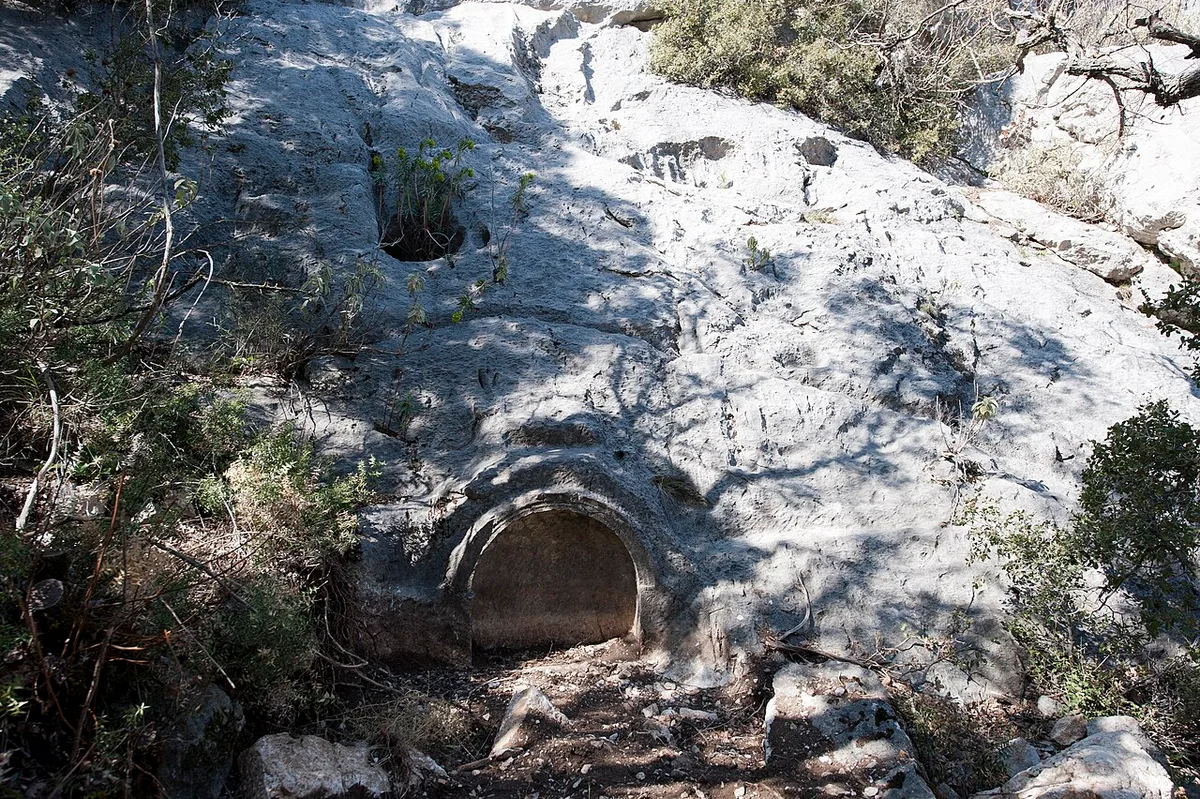
Photo: Zythème / Wikimedia Commons (CC BY-SA 3.0)
At a Glance
- Period
- Pisidian–Roman
- UNESCO
- No (tentative)
- Notable structures
- Cliffside rock-cut house tombs, heroon of Alcetas
- Best season
- Apr–May, Oct
- Visiting hours
- 08:00–19:00 (summer) · 08:00–17:00 (winter)
- Recommended time
- 2–3 hours (involves walking)
- Entry
- Paid
Antalya · Pisidia
Termessos, the eagle's nest and its cliff tombs
A Pisidian (an ancient people of the mountainous interior of southern Anatolia) mountain city that Alexander "could not take," Termessos clings to Mount Solymos above Antalya. Its theatre and walls are famous, but the necropolis is cut into the same cliffs the living defended, the dead placed where they could look down over the pass.
At Termessos the same impregnable cliff served the living and the dead. The necropolis is cut straight into the living limestone below the theatre, each house-tomb a gabled chamber hollowed from the rock rather than built, a Lycian habit the highland city kept after the coastal cities had moved on. The heroon of Alcetas (a general of Alexander’s successors, killed at Termessos), the Macedonian (the Greek kingdom of Alexander the Great) general who fell here in 319 BC, is carved as a shrine into that same face, the city's last defence and its memorial occupying one stretch of stone.
Full guide: Termessos (Antalya) →
Also featured in: Ancient Cities in Turkey
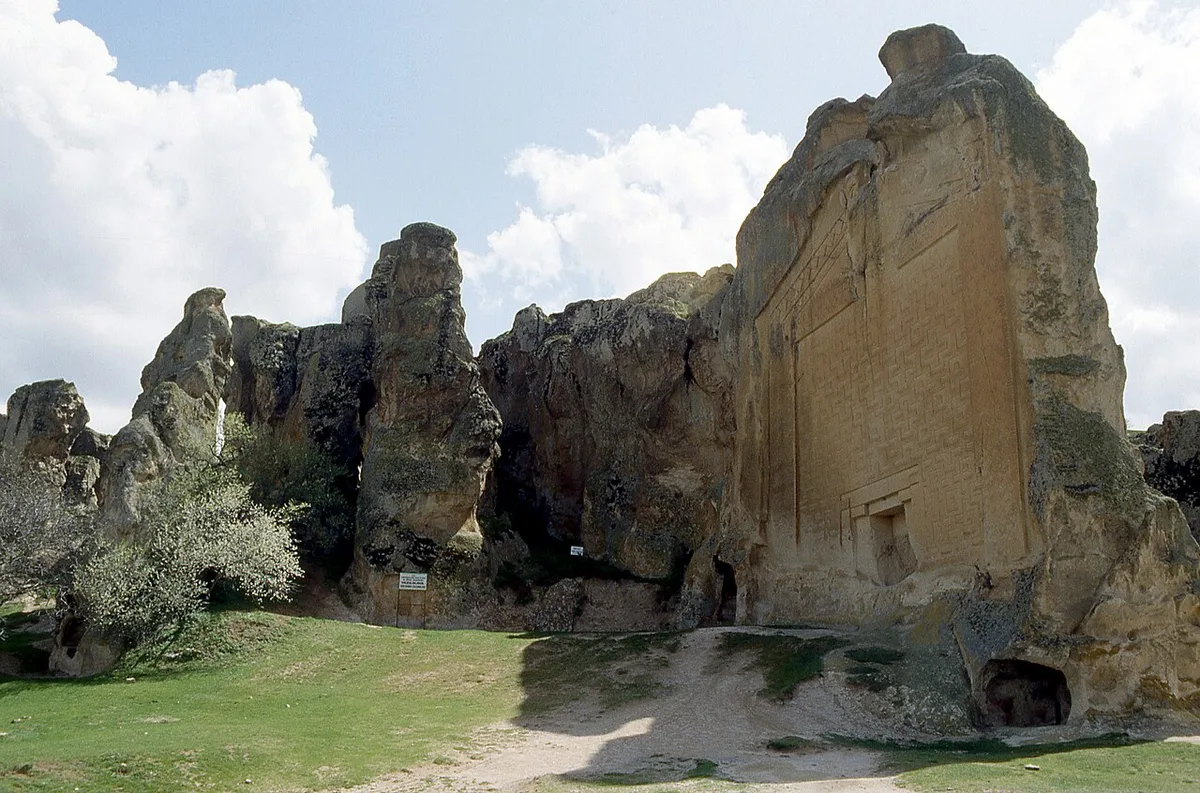
Photo: Mark Landon / Wikimedia Commons (CC BY 4.0)
At a Glance
- Period
- Phrygian (7th–6th c. BC)
- UNESCO
- No (Phrygian Highlands, tentative)
- Notable structures
- Midas Monument, rock-cut chamber tombs, klinai
- Best season
- May–Oct
- Visiting hours
- 08:00–19:00 (summer) · 08:00–17:00 (winter)
- Recommended time
- 2–3 hours
- Entry
- Paid
Eskişehir · Phrygia
Midas City, the Phrygians who cut their gods and dead in rock
In the volcanic tuff of the Phrygian (an ancient people of central Anatolia) highlands near Yazılıkaya (the Inscribed Rock, a Phrygian sanctuary near Midas City), Midas City was less a capital than a cult centre. Ramsay named it for the inscribed word "Mida", a title of the goddess Cybele, not the legendary king, above its great façade, and the site is thick with monuments the Phrygians raised from the living rock.
The Midas Monument is a rock-cut façade 17 m high and 16.5 m wide, an imitation of a Phrygian megaron with geometric relief, crowned by a volute akroterion; its central niche once held a statue of the goddess Matar (the Phrygian mother goddess). Around the plateau, the Phrygians cut chamber tombs with pitched, beam-ended roofs and stone benches (klinai) for the dead, megaron-planned, like the houses they knew in life.
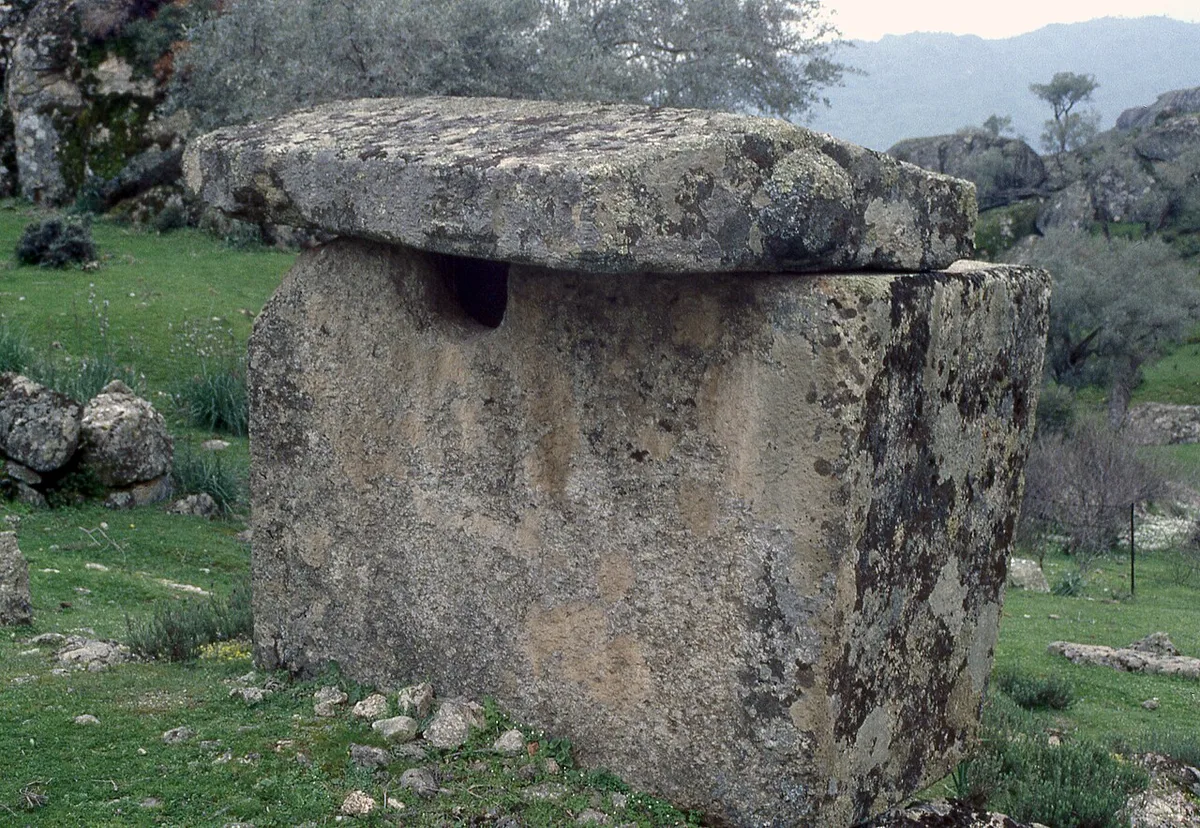
Photo: Mark Landon / Wikimedia Commons (CC BY 4.0)
At a Glance
- Period
- Carian–Roman
- UNESCO
- No
- Notable structures
- Rock-cut sarcophagi, chamber tombs, heroon, necropolis by the aqueduct
- Best season
- Apr–May, Sep–Oct
- Visiting hours
- Open site; daylight hours
- Recommended time
- 1–2 hours
- Entry
- Free
Aydın · Caria
Alinda, Carian sarcophagi cut into the living rock
Above the plain near modern Karpuzlu, the Carian (an ancient people of southwest Anatolia) city of Alinda keeps its dead on the slopes. Across four necropolises, north, south, north-east, and by the aqueduct to the west, the tombs were cut straight into the bedrock: sarcophagi hollowed from the living stone, and chamber graves opened into the cliff. A heroon stands in the north-east group, among the most monumental of them.
Alinda is where Caria passed, almost without a fight, into Alexander's hands. In 334 BC the queen Ada (queen of Caria and ally of Alexander the Great), driven from Halicarnassus, received Alexander here and named him her son and heir, handing him the fortress and its treasury; he restored her as ruler of Caria. The rock-cut tombs are the city's best-preserved ruins, and still its clearest record of how the Carians buried their dead.
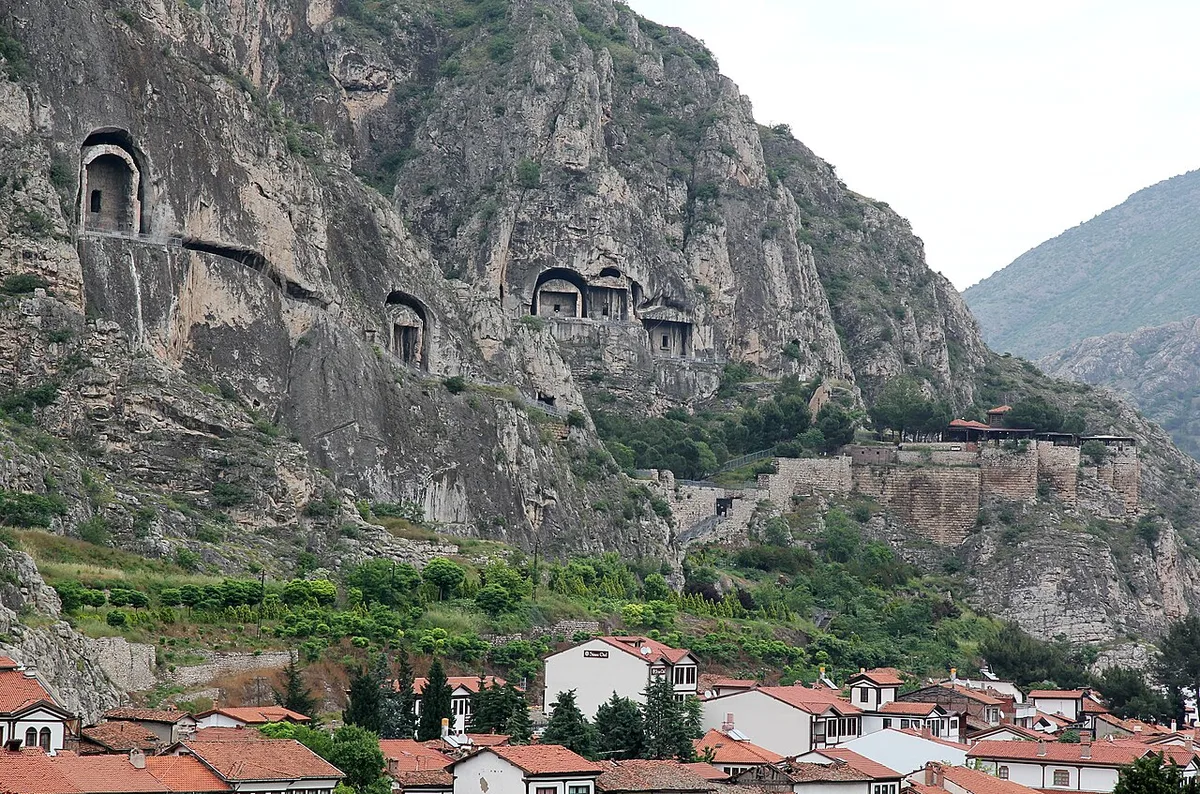
Photo: Ingeborg Simon / Wikimedia Commons (CC BY-SA 3.0)
At a Glance
- Period
- Hellenistic (Pontic)
- UNESCO
- Tentative (Mount Harşena and the Pontic tombs, 2014)
- Notable structures
- 5 royal rock-cut tombs (A–E), 21 tombs, Mount Harşena
- Best season
- May–Oct
- Visiting hours
- Daylight; site open
- Recommended time
- 1–2 hours
- Entry
- Paid
Amasya · Pontus
Amasya, where Pontus carved its kings into the cliff
On the southern flank of Mount Harşena, above the Yeşilırmak river, the kings of Pontus (an ancient Black Sea kingdom) cut their dead into the limestone. Twenty-one rock tombs ring the city; five are royal, their facades framed by Ionic columns or rounded tops, the grave chambers reached only by ladder through door-high openings. Rock-cut staircases and a tunnel climb from tomb to tomb up the cliff.
Amasya holds the only royal necropolis of its kind in the world, and its story runs backwards. Elsewhere in Anatolia Greek forms slowly replaced local ones; here the Greek temple façade gives way, in the tomb of Pharnakes I (a king of Pontus, 2nd century BC), to a deliberately un-Greek Pontic style, the tradition ending when the capital moved to Sinope (an ancient Black Sea port, early capital of Pontus). Among Anatolia's rock-cut tombs, none follows this path.
Where the Tombs Were Cut
These places open up slowly, and only to the visitor who stops and looks twice. Vestigia is a field companion for that kind of travel, in your pocket with the context and detail most guides skip. Download the app before you go.
Where are the Lycian rock tombs in Turkey?
Concentrated along the Lycian coast of south-west Turkey, where temple fronts were cut into the cliffs above the sea. Myra is the showpiece, a cliff face stacked with a catalogue of tomb facades; Limyra scatters over four hundred rock-cut graves through its hills; and the Tomb of Amyntas rises above Fethiye as a single Ionic masterpiece cut for one man. Kaunos, Xanthos, Tlos and Pinara complete the circuit through Lycia.
How were Lycian rock-cut tombs carved?
Masons carved straight into the living cliff, working the facade first as the home of the dead, then the chambers behind it. At Myra two types stand side by side: house-tombs that copy the gabled wooden houses the living built, and temple-tombs that set Ionic columns, pediments and toothed friezes above the door. The chambers held family burials on carved stone benches, and the most famous, the Lion's Tomb, keeps a painted relief, a lion seizing a bull, whose colour has survived two millennia in the sheltered rock.
Are there rock-cut tombs in Turkey outside Lycia?
Yes. In the Phrygian (an ancient people of central Anatolia) highlands, Midas City is a rock-cut cult centre crowned by a monument facade 17 m high and 16.5 m wide, with chamber tombs nearby cut with pitched, beam-ended roofs and stone benches. On the Black Sea, Amasya is where the kingdom of Pontus carved its kings into the cliff above the river below.