Macau Historical Landmarks
1. Ruins of St. Paul's
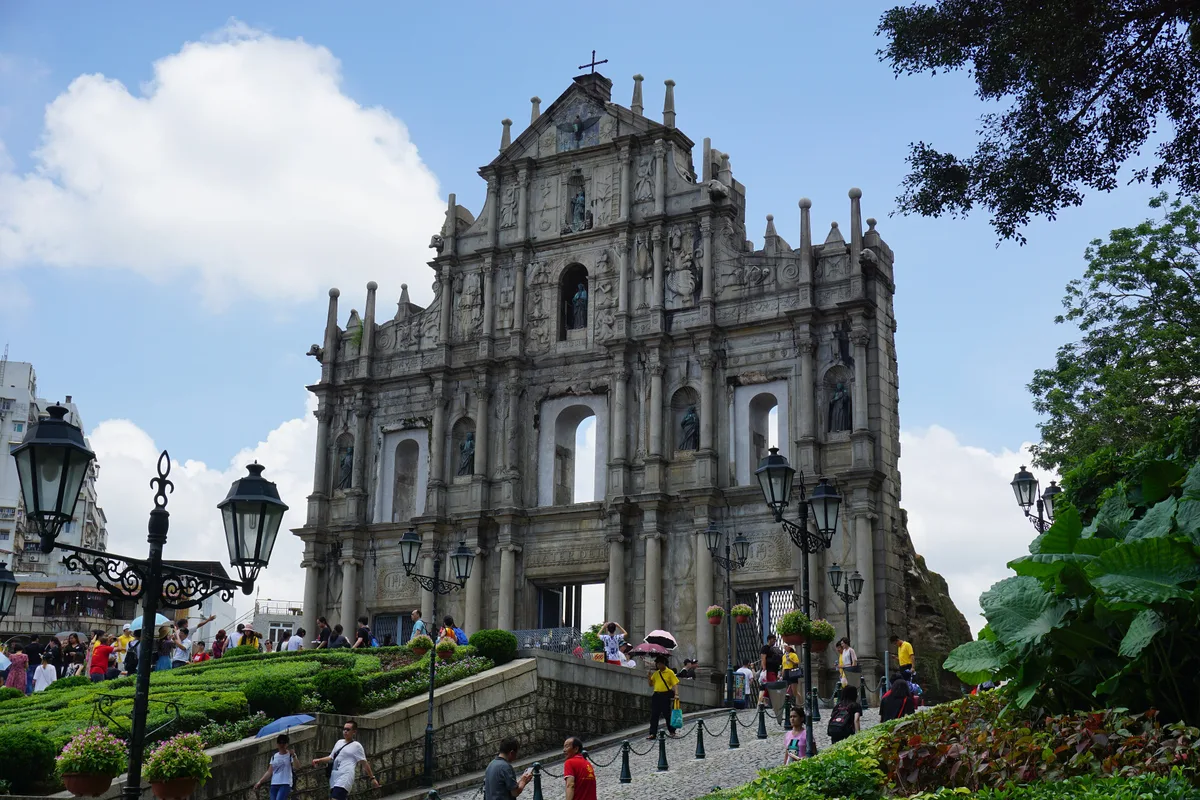
Photo: GG001213 / CC0
What Your Eye SeesA grand stone church facade rising alone against the sky, carved with elaborate Christian and Chinese symbolism, its four tiers of columns and niches framing statues of saints, angels, and a dragon.
ContextBuilt between 1602 and 1640 by Jesuit priests, St. Paul's College and Church was the largest Catholic church in East Asia at the time. Its stone facade was designed by the Italian Jesuit Carlo Spinola and carved by Japanese Christian exiles and local craftsmen. In 1835 a typhoon-driven fire destroyed the complex except the granite facade and the college's basement vault. The facade alone survives as Macau's most iconic landmark.
Source: UNESCO (Historic Centre of Macau); Wikipedia (Ruins of St. Paul's)
 Did
DidYou
Know
The facade is a 'sermon in stone', its tiers weave Christian and Asian symbols into a single wall: a Chinese dragon, a Japanese chrysanthemum, a Portuguese sailing ship, and the Virgin Mary trampling a seven-headed dragon, the scene captioned in Chinese characters. Nowhere else in Asia was a Christian catechism carved so openly in local imagery.
ShareA Name Carved In Latin
On the facade's first tier, above the middle entrance, the stone carries the Latin inscription MATER DEI, "Mother of God", the name of the church that once stood behind this wall. The Jesuit emblem IHS appears beside it, a monogram you can trace in the carved granite from the foot of the staircase.
The Dove Above The Pediment
At the very top of the facade, inside the triangular pediment, a dove rendered in copper spreads its wings, the emblem of the Holy Spirit. Around it are stone carvings of the sun, the moon and stars, a sky-scape that visitors rarely look up far enough to see.
A Tomb Beneath The Ruins
Behind the facade, a crypt and the college's foundations were uncovered during excavations carried out by the Macau government from 1990 to 1996. In the centre lies the remains of a tomb that may have belonged to the college's founder, Alessandro Valignano, who died in Macau in 1606. Relics of Japanese and Vietnamese martyrs line the side walls, and both are now displayed in the Museum of Sacred Art.
Sources: Wikipedia (Ruins of Saint Paul's); UNESCO (Historic Centre of Macao); Cultural Heritage Bureau (Macao); Macao Museum
 Euro Heritage
 Baroque Master
 Time Traveler
2. A-Ma Temple
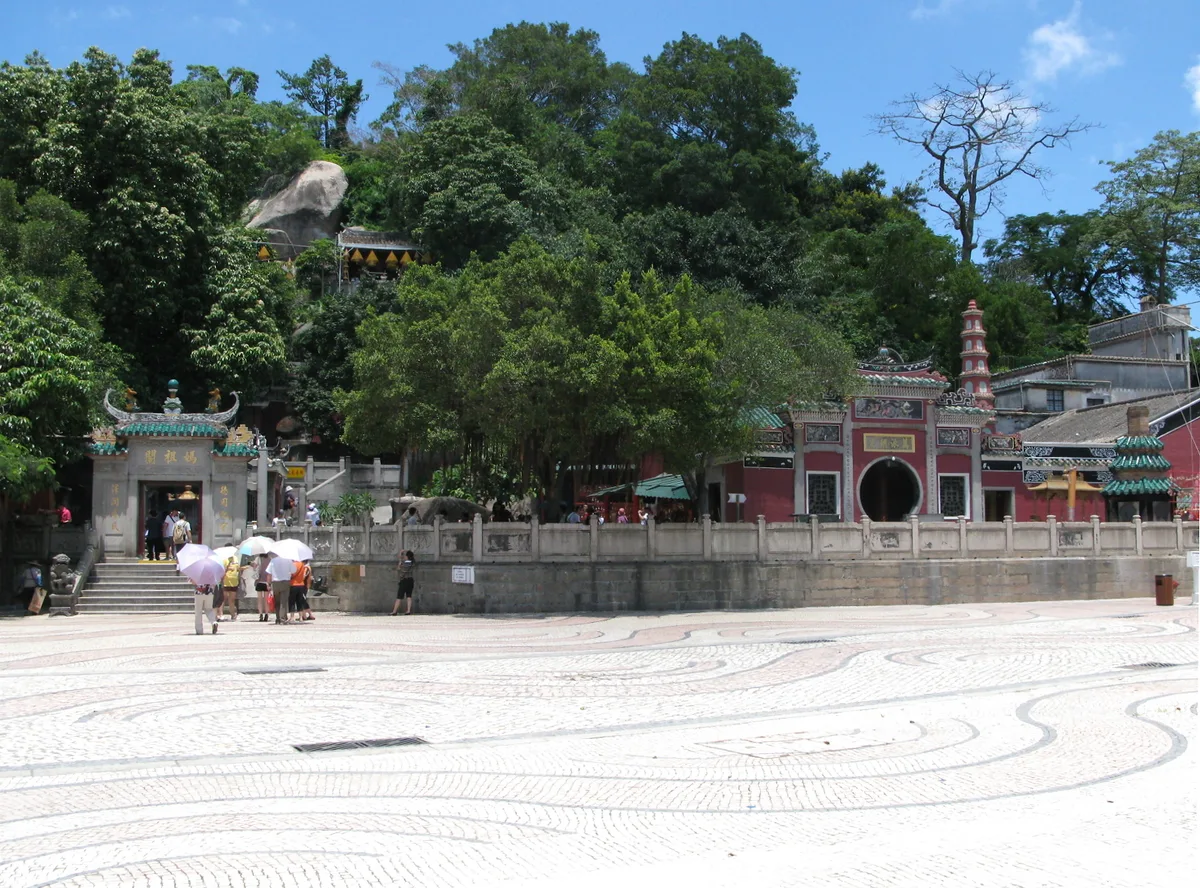
Photo: WiNG / CC BY 3.0
What Your Eye SeesA sprawling complex of granite pavilions climbing a hillside, with curling incense smoke rising from bronze censers, red-and-gold altars, and weathered stone lions guarding each gate.
ContextBuilt around 1488 during the Ming Dynasty, A-Ma Temple predates Portuguese settlement and is the oldest surviving temple in Macau. It is dedicated to Mazu (A-Ma), the goddess of seafarers. According to legend, Portuguese sailors landing in 1553 asked the name of the place and locals replied 'A-Ma', the Portuguese transcribed it as 'Macau,' giving the territory its name.
Source: UNESCO (Historic Centre of Macau); Wikipedia (A-Ma Temple)
DidYou
Know
A-Ma Temple honours Mazu, who began life as a mortal girl named Lin Moniang, according to legend, a fisher's daughter who could walk on waves and calm typhoons before she was deified as the goddess of seafarers. For 500 years Macau's boatmen left offerings here before every voyage.
Share→ The Archway With The Temple's Name
The entrance is marked by the Memorial Arch, a stone archway whose lintel bears the temple's name carved in Chinese characters, flanked by a couplet in calligraphy on each side. Above it the roof is covered in green glazed tiles, and along the grey ridge sits a pair of dragon-fish holding a pearl between them.
→ Ships Carved In Stone
Two stones at the temple carry carvings of sailing ships. According to legend, during the Wanli period of the Ming dynasty, a Fujian merchant vessel was caught in a hurricane near the temple when A-Ma appeared by the mountainside and calmed the sea; the grateful crew had a ship carved into the stone with the inscription "Li She Da Chuan" (Smooth sailing on the sea). Around 24 cliff carvings left by Qing-era officials and scholars dot the surrounding rock.
→ The Lions Of The Gate
The entrance to A-Ma Temple is the Gate Pavilion, a granite structure about 4.5 metres wide, guarded by a pair of stone lions (shishi), a male and a female with a cub, placed there to protect the house of prayer from evil spirits. Behind them, the complex's pavilions climb Barra Hill, each built in a different period and reaching their present scale by 1828.
Sources: Wikipedia (A-Ma Temple); UNESCO (Historic Centre of Macao); Cultural Heritage Bureau (Macao); Travel China Guide
 Eastern Spirit
 Spiritual Seeker
3. Monte Fort (Fortaleza do Monte)
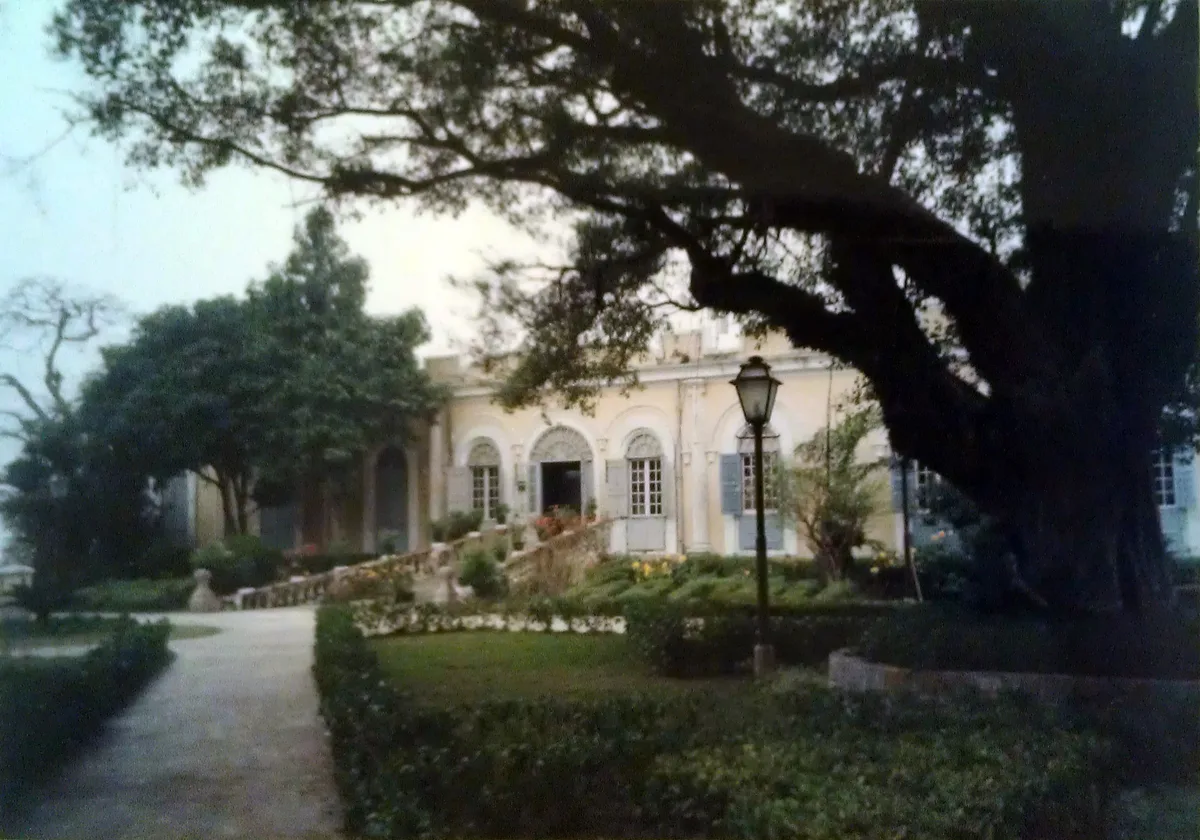
Photo: Holly Cheng / CC BY-SA 3.0
What Your Eye SeesA massive stone fortress atop a hill with thick bastion walls, 32 iron cannons still aimed at the harbor, and a central courtyard now housing the Museum of Macau.
ContextBuilt by Jesuit priests between 1617 and 1626, Monte Fort is the only fortress in the world designed and constructed by clergymen. It played a decisive role in repelling the Dutch invasion of 1622, the only military attack on Macau by a European power. The fort served as the residence of Macau's governors until 1746 and is now the site of the Museum of Macau.
Source: UNESCO (Historic Centre of Macau); Wikipedia (Fortaleza do Monte)
DidYou
Know
Monte Fort's gunners were not soldiers but Jesuit mathematicians and astronomers, among them Adam Schall, who would later become the imperial astronomer in Beijing. They computed the cannon fire that drove off an invading fleet, one lucky shot reportedly hitting a powder cart and killing the assault's commander.
Share→ Walls Built To Outlast Their Purpose
Walk the fort's perimeter and you'll see the quadrilateral ramparts rising about nine metres to corner bastions, with bases more than two and a half metres thick. The granite was set in a mortar of sand, lime and rice straw, a traditional recipe that has held these walls together since the fort was raised.
→ The Bell Cast By A Cannon-Maker
Beside the old weather-observatory building on the fort hangs an ancient bronze bell, cast, unusually, by a cannon-maker rather than a church bell-founder. It is a small relic of the same foundry craft that produced the cannons which once lined these walls.
→ Embrasures Still Filled
The parapets of the bastions are pierced by deep, splayed gun embrasures, and in many of them the original iron cannon barrels still sit, muzzles angled out over the city's rooftops, the metal weathered and pitted. The fortress's guns were never hauled away; they stand where they were mounted.
Sources: Wikipedia (Fortaleza do Monte); UNESCO (Historic Centre of Macao); Macao Museum; China Highlights
Spiritual Seeker
4. Senado Square & Leal Senado
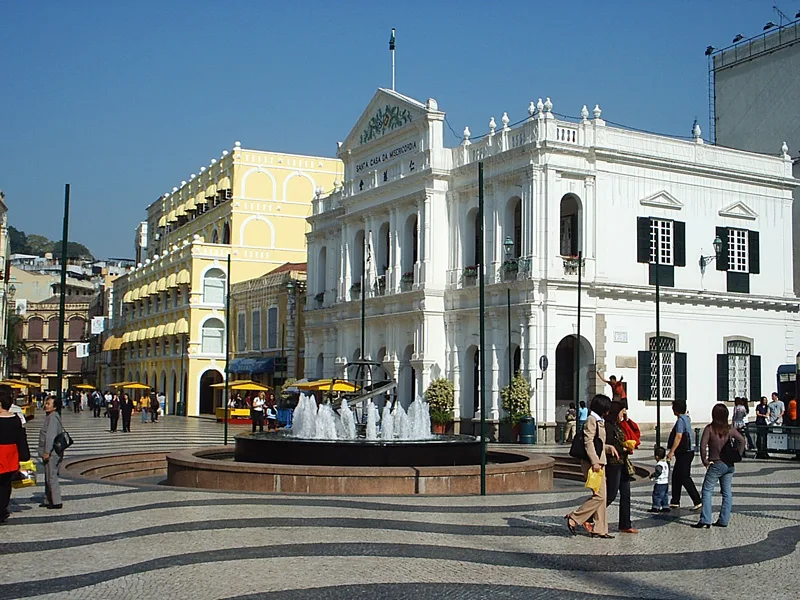
Photo: Андрей Суриков / Andrey Surikov. Original uploader was Сура at ru.wikipedia / CC BY 2.5
What Your Eye SeesA broad public square paved in wave-patterned black-and-white mosaic stones, flanked by pastel-colored neo-classical buildings with arched colonnades, ending at the elegant Leal Senado building.
ContextSenado Square has been Macau's civic heart since the 16th century. The Leal Senado (Loyal Senate) building, completed in 1784, was the first Western-style municipal building in China. It was granted the title 'Leal' (Loyal) by King John IV in 1654 for Macau's refusal to recognize Spanish rule during the 60-year Spanish annexation of Portugal.
Source: UNESCO (Historic Centre of Macau); Wikipedia (Senado Square)
DidYou
Know
The square's distinctive black-and-white wave mosaic is surprisingly recent, laid only in the early 1990s, when Macau's Portuguese administration brought in craftsmen from Portugal to install the calçada portuguesa, the same hand-set stone pavement of Lisbon. For most of its history the square had no such pattern.
Share→ Azulejos In The Courtyard
Step through the main doorway of the Leal Senado and you'll find an inner courtyard whose walls are clad in blue-and-white azulejo tiles, panels of classical scenes framed by geometric border patterns in the Portuguese tradition. The tiling climbs around the stairway, a detail most visitors rush past on their way through.
→ A Library Modeled On Mafra
Inside the building, a public library opened in 1929 is styled after the famous library of the Mafra Convent in Portugal. It holds about 18,500 books, including Macau's municipal records and official gazettes dating back to the 17th century, written in Portuguese, Latin and Classical Chinese, a working archive of the city's colonial years.
Sources: Wikipedia (Senado Square); UNESCO (Historic Centre of Macao); Cultural Heritage Bureau (Macao)
 Ancient Roots
 Renaissance
5. St. Dominic's Church
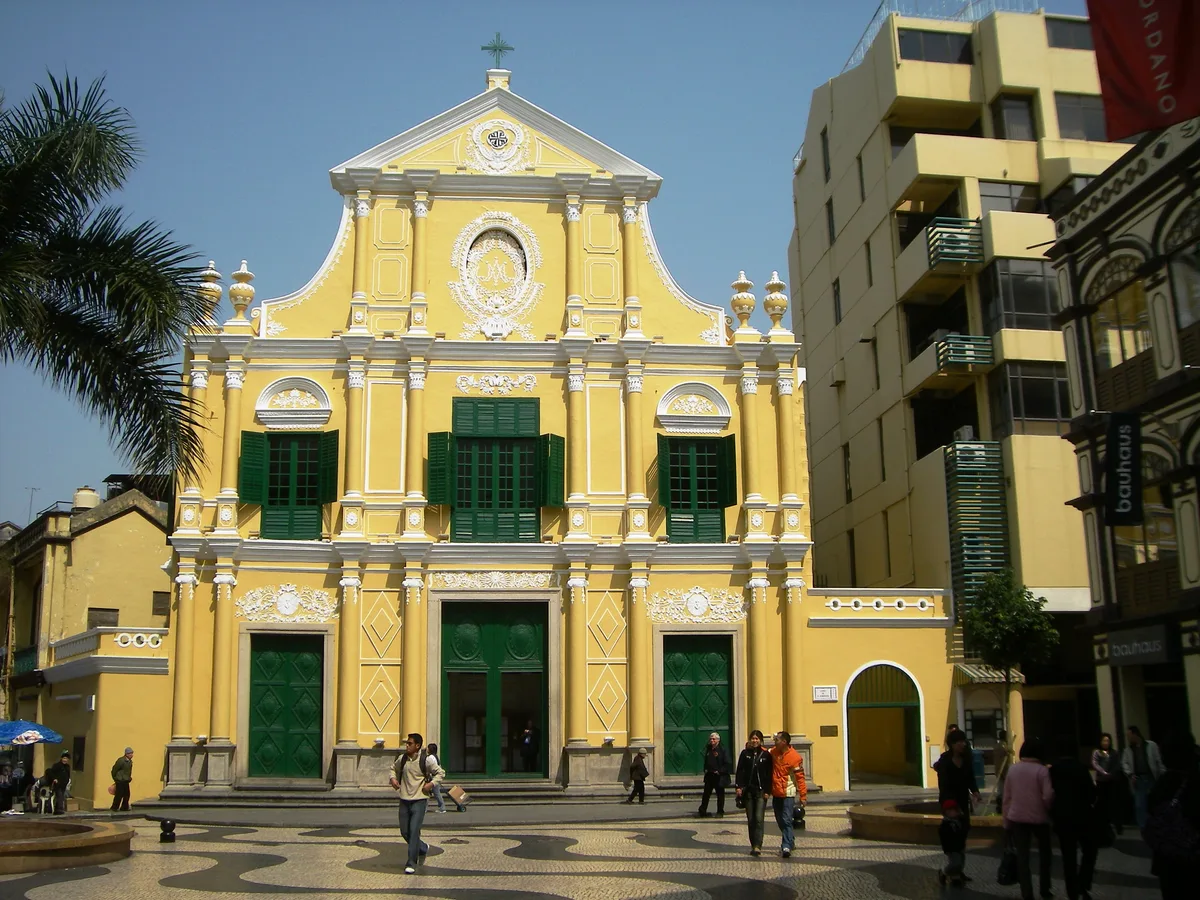
Photo: Whhalbert / CC BY-SA 4.0
What Your Eye SeesA canary-yellow baroque church with white-trimmed arched windows, a bell tower with a green dome, and an ornate altar with gold-leaf carvings and a silver processional cross.
ContextFounded in 1587 by Spanish Dominican priests, St. Dominic's Church was the first church in China to hold masses in both Portuguese and Cantonese, a radical move that provoked conflict with the conservative Jesuit order. The attached Museum of Sacred Art houses over 300 pieces of religious art spanning four centuries of Chinese-Portuguese Catholic history.
Source: UNESCO (Historic Centre of Macau); Wikipedia (St. Dominic's Church, Macau)
DidYou
Know
In 1822 this unassuming Macau chapel became the birthplace of China's first Portuguese-language newspaper. The priests printed A Abelha da China ('The China Bee') from St. Dominic's, turning a 200-year-old church into the unlikely cradle of the Lusophone press in China.
Share→ The Madonna On The High Altar
At the centre of the high altar stands a statue of the Madonna holding the infant Christ, the image that greets every visitor through the doors. It is framed by white plaster reliefs and corkscrew columns, the hallmarks of the interior's baroque decoration.
→ A Crown Painted On The Ceiling
Look up above the main altar and you'll find the decorative patterns of the ceiling centred on a painted crown. The motif sits directly over the altar, marking the spot as the heart of the church in the building's painted plaster.
→ An Arch Of Solid Brick
Inside, the church is divided into three halls, and the opening that leads from one to the next is spanned by a solid brick arch rather than a wooden beam. Stand beneath it and you'll see how the whole interior is structured around masonry, not timber.
Sources: Wikipedia (St. Dominic's Church, Macau); Cultural Heritage Bureau (Macao); UNESCO; Macao Government Tourism Office
Euro Heritage
Baroque Master
Spiritual Seeker
Renaissance
6. Guia Fortress, Chapel & Lighthouse
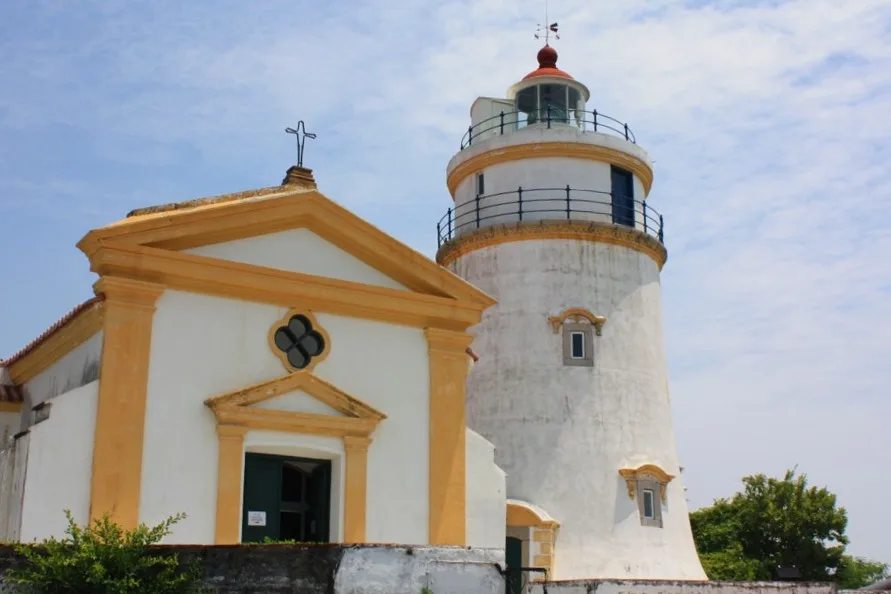
Photo: J. Patrick Fischer / CC BY-SA 3.0
What Your Eye SeesA hilltop fortress with stone bastion walls, a small whitewashed chapel with 17th-century frescoes inside, and a 15-meter lighthouse painted in red and white bands, the oldest on the Chinese coast.
ContextBuilt in 1638, Guia Fortress was Macau's primary coastal defense overlooking the Pearl River Delta. The chapel inside was painted with Sino-Christian frescoes, the only surviving examples of this hybrid art form, uncovered during 1990s restoration. The Guia Lighthouse, first lit on 24 September 1865, was the first modern lighthouse on the Chinese coast and was designed by the Macanese Carlos Vicente da Rocha.
Source: UNESCO (Historic Centre of Macau); Wikipedia (Guia Fortress)
DidYou
Know
Guia's lighthouse was knocked out by a typhoon in 1874 and stayed dark for 35 years, an unusually long blackout for a major coastal light, before being rebuilt and re-lit in 1910, after its lamp was electrified.
Share→ A Working Lighthouse You Can't Enter
The white tower beside the chapel is still a functioning lighthouse, yet its interior is closed to the public. From the fort's open ground you can walk right up to its base, count the tower's three levels and see the lantern room at the top, its large spotlight still in place behind the glass.
→ The Bell That Raised The Alarm
On the fortress stands a bronze bell that was rung to alert the people of Macau whenever ships were sighted approaching the harbour, the fort's early-warning system in the days before radio. The bell remains in place on the hilltop, a working relic of the fortress's watchkeeping past.
→ A Fort Opened To The City
The Guia Fortress remained a restricted military area until 1976, when Portugal withdrew its forces from Macau and the fort was opened to the public. Beneath the hill, wartime air-raid shelters were later preserved and restored, from 2003 they became the Guia Hill Air-Raid Shelter Exhibition Gallery, open to visitors inside the old defensive tunnels.
Sources: Wikipedia (Guia Fortress); UNESCO (Historic Centre of Macao); Cultural Heritage Bureau (Macao); Trip.com
Spiritual Seeker
7. Mandarin's House
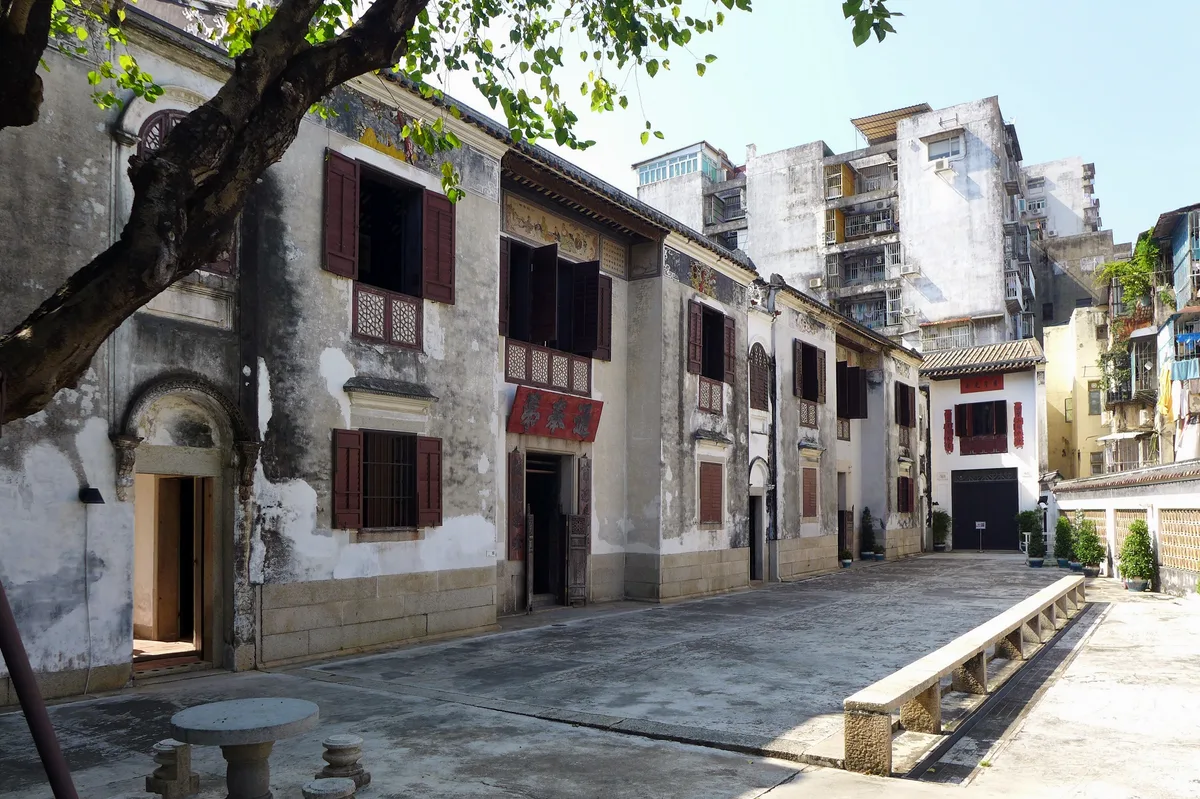
Photo: Bahnfrend / CC BY-SA 4.0
What Your Eye SeesA grand Chinese courtyard mansion with grey-brick walls, moon gates, lattice windows, and Portuguese-style verandahs, a physical fusion of East and West in every architectural detail.
ContextBuilt in 1869 by his father Zheng Wenrui and later expanded by Zheng Guanying, Mandarin's House was the residence of the Qing-era scholar, merchant, and reformist writer. His 1892 book 'Words of Warning in a Prosperous Age' influenced both Sun Yat-sen's republican revolution and Deng Xiaoping's economic reforms. After the family moved out in the mid-20th century, the 4,000-square-metre mansion was subdivided into some 85 dwellings and only restored after 2001.
Source: UNESCO (Historic Centre of Macau); Wikipedia (Mandarin's House)
DidYou
Know
Mandarin's House is one of the largest Qing-era Chinese residences to have survived in Macau, a rare survivor of the grand scholarly households that once lined the city's old Chinese quarter, and a stark contrast to the tiny colonial buildings the Portuguese raised nearby.
Share→ Plaques Of A Ranked Family
Hanging beneath the porch eaves of the gatehouse is a large wooden plaque inscribed Rong Lu Di, "Hall of Ronglu", the honorific title the family earned through disaster-relief work under the Qing dynasty. A companion plaque, Chong De Hou Shi, displayed in the inner corridor, was written by the late-Qing official Zeng Guoquan. Both were hung for every visitor to read as they entered.
→ The Shrine With 18 Coats Of Paint
At the gatehouse, a small shrine of the Earth God sits in its niche, so unassuming that it is easy to walk straight past. Yet when restorers worked on it they counted 18 layers of paint, meaning the family had repainted the shrine at least 17 times over the years as an act of devotion.
→ The East-West Architecture
The house's front section follows the strict symmetry of Qing-dynasty courtyard architecture, grey-brick walls, moon gates, and timber sliding doors, while the interior and upper floors show unmistakable Western influence: arched doorways, columns and balconies, decorative window lintels and rendered exterior plaster. It stands as one of Macau's finest examples of Chinese and Portuguese styles blended in a single residence.
Sources: Wikipedia (Mandarin's House); UNESCO (Historic Centre of Macao); Cultural Heritage Bureau (Macao); Macao World Heritage
Eastern Spirit
What are the famous landmarks in Macau?
Macau’s famous landmarks blend Portuguese colonial and Chinese heritage. The Ruins of St. Paul’s, the iconic façade of a 17th-century cathedral, is the city’s symbol, fronted by Senado Square and the St. Dominic’s Church in the UNESCO-listed historic centre. The A-Ma Temple, dedicated to the sea goddess Mazu and the origin of the name “Macau”, sits by the harbour, while Monte Fort, Guia Fortress with its lighthouse, and the Mandarin’s House show the city’s layered defences and merchant history.
Why is only a facade left of St Paul's in Macau?
In 1835 a typhoon-driven fire destroyed the whole complex of St Paul's College and Church, leaving only the stone facade and the college's basement vault. The church was built between 1602 and 1640 by Jesuit priests and was the largest Catholic church in East Asia at the time, its facade designed by the Italian Jesuit Carlo Spinola and carved by Japanese Christian exiles and local craftsmen. The facade is a sermon in stone: it weaves Christian and Asian symbols into a single wall, including a Chinese dragon, a Japanese chrysanthemum and the Virgin Mary trampling a seven-headed dragon.
How did Macau get its name?
According to legend, Portuguese sailors landing in 1553 asked the name of the place, and locals replied A-Ma, the name of the goddess of seafarers honoured at A-Ma Temple. The Portuguese transcribed it as Macau. The temple itself was built around 1488 during the Ming Dynasty, making it the oldest surviving temple in Macau and predating Portuguese settlement by decades.
These landmarks reward close attention. Vestigia is a field companion for people who look longer, with curated context, architectural detail, and the stories most visitors walk past. Free on the App Store and Google Play.