Samarkand Historical Landmarks
1. Registan Square
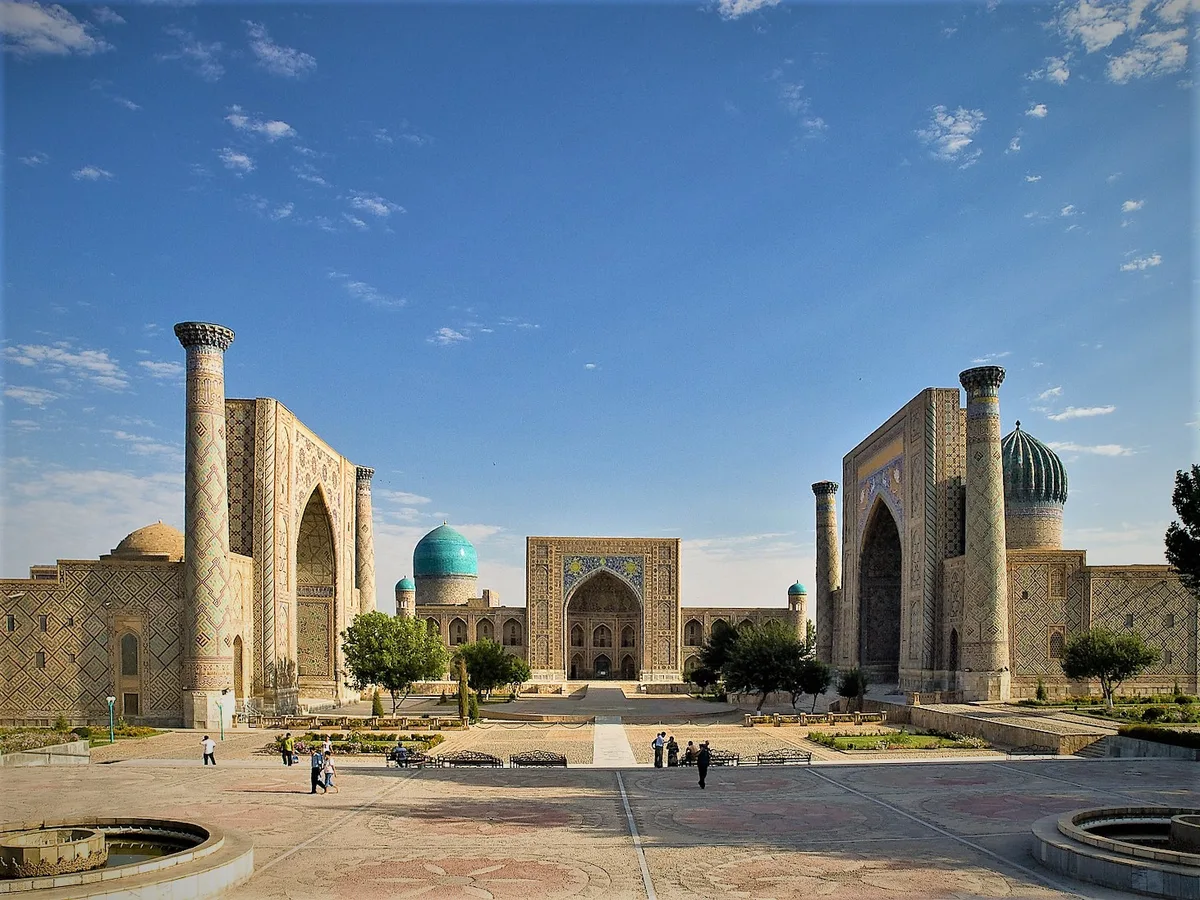
Photo: Registan_-_Gusjer.jpg: Gustavo Jeronimo from Aranjuez, Spain derivative work: MrPanyGoff / CC BY 2.0
What Your Eye SeesThree monumental madrasas face one another across a vast plaza of cream paving: the Ulugh Beg, the Sher-Dor and the Tilya-Kori. Their facades are clad in turquoise, cobalt and gold tilework, each crowned with a ribbed dome, and in the centre of the square an old stone well shaft marks the meeting point.
ContextThe Registan - Persian for 'sandy place' - was Samarkand's medieval public square. The three madrasas were built in separate centuries: the Ulugh Beg Madrasa was commissioned by the astronomer-king in 1417-1420, the Sher-Dor followed in 1619-1636, and the Tilya-Kori - the youngest, part madrasa and part mosque - in 1646-1660. Together they made the square one of the great ceremonial stages of Central Asia.
Source: UNESCO (Samarkand – Crossroads of Cultures); Wikipedia (Registan)
 Did
DidYou
Know
What visitors see today is largely a 20th-century restoration: after centuries of earthquakes and neglect the three madrasas were rebuilt and re-tiled under Soviet conservators, so the dazzling facades are as much modern craft as Timurid original.
ShareThe Swaggering Tiger
Above the iwan of the Sher-Dor Madrasa, two golden tigers with sun-rays rising from their backs chase white deer across the tiles - a rare depiction of living creatures in Islamic art, added despite the traditional ban on figurative imagery.
→ The Bazaar Beneath The Square
Until the 15th century the Registan was an open bazaar; its former shops' foundations lie under the paving you walk on today, a market that predated the three madrasas.
Sources: Wikipedia (Registan Square); Wikipedia (Registan); Advantour (Registan)
 Silk Road Legacy
 Ancient Roots
 Time Traveler
2. Gur-e-Amir Mausoleum
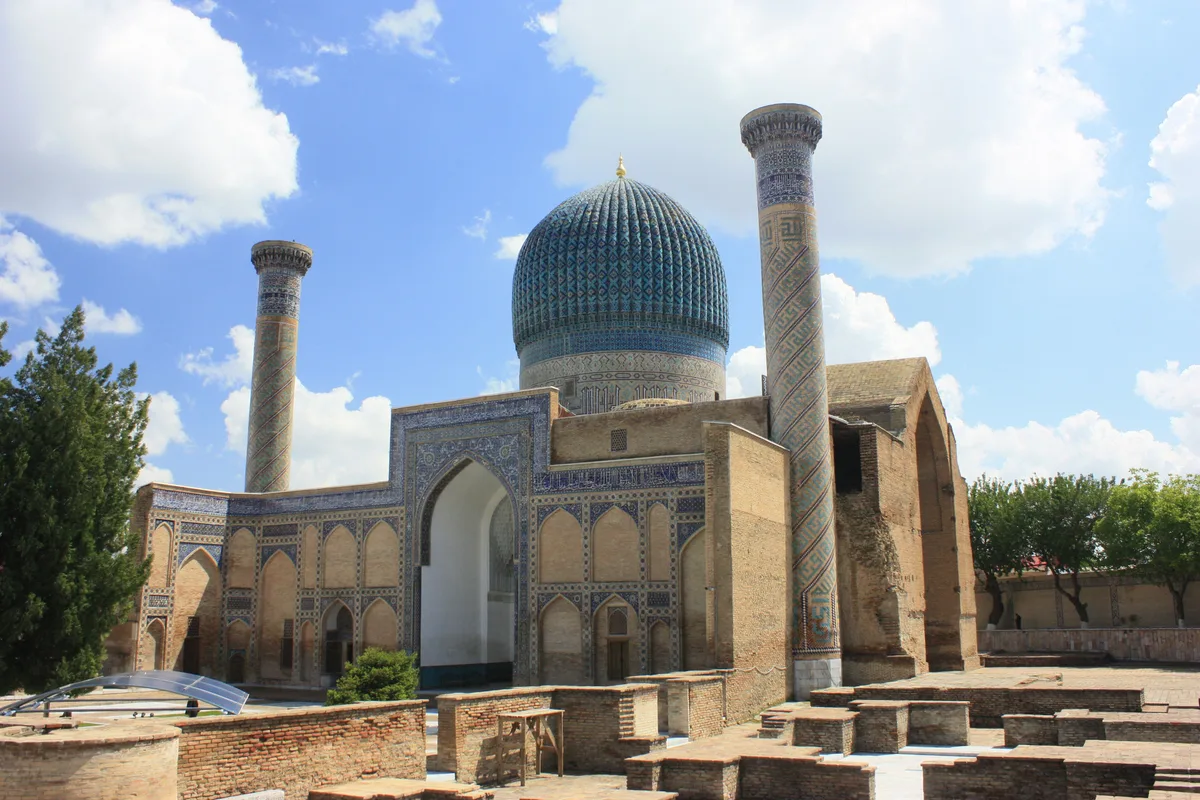
Photo: Willard84 / CC BY-SA 4.0
What Your Eye SeesA ribbed, melon-shaped dome of turquoise tiles crowns a tall drum; below it, a portal of mosaic and Kufic inscriptions opens into a single chamber. Inside, ornate carved headstones stand on a floor of dark marble, and the walls below are lined with panels of painted onyx.
ContextGur-e-Amir - Persian for 'Tomb of the King' - was built in 1403-1404 for Timur's grandson and heir Muhammad Sultan, who died in 1403. When Timur himself died in February 1405 on a campaign towards China, the snowed-in passes to his planned tomb at Shahrisabz forced his burial here instead. The mausoleum then became the family tomb of the Timurid dynasty, including the astronomer-ruler Ulugh Beg.
Source: UNESCO (Samarkand – Crossroads of Cultures); Wikipedia (Gur-e-Amir)
DidYou
Know
In 1941 Soviet archaeologists opened Timur's tomb and removed his remains for study - an act, legend says, followed within days by the German invasion of June 1941, prompting a hasty reburial before the war's end.
ShareThe Fluted Dome's 64 Ribs
The signature dome is not smooth but fluted with heavy ribbing - a melon-shaped cupola whose repetitive ribs give the silhouette its famous rippled outline in sunlight.
Dark Green Jade
Timur's headstone is a single block of dark green nephrite jade - once carried off to Persia by Nadir Shah in 1740, broken in two, and later returned; the repaired joins are still part of the stone today.
Sources: Wikipedia (Gur-e-Amir Mausoleum); Lonely Planet
Silk Road Legacy
 Spiritual Seeker
Time Traveler
Spiritual Seeker
Time Traveler
3. Bibi-Khanym Mosque
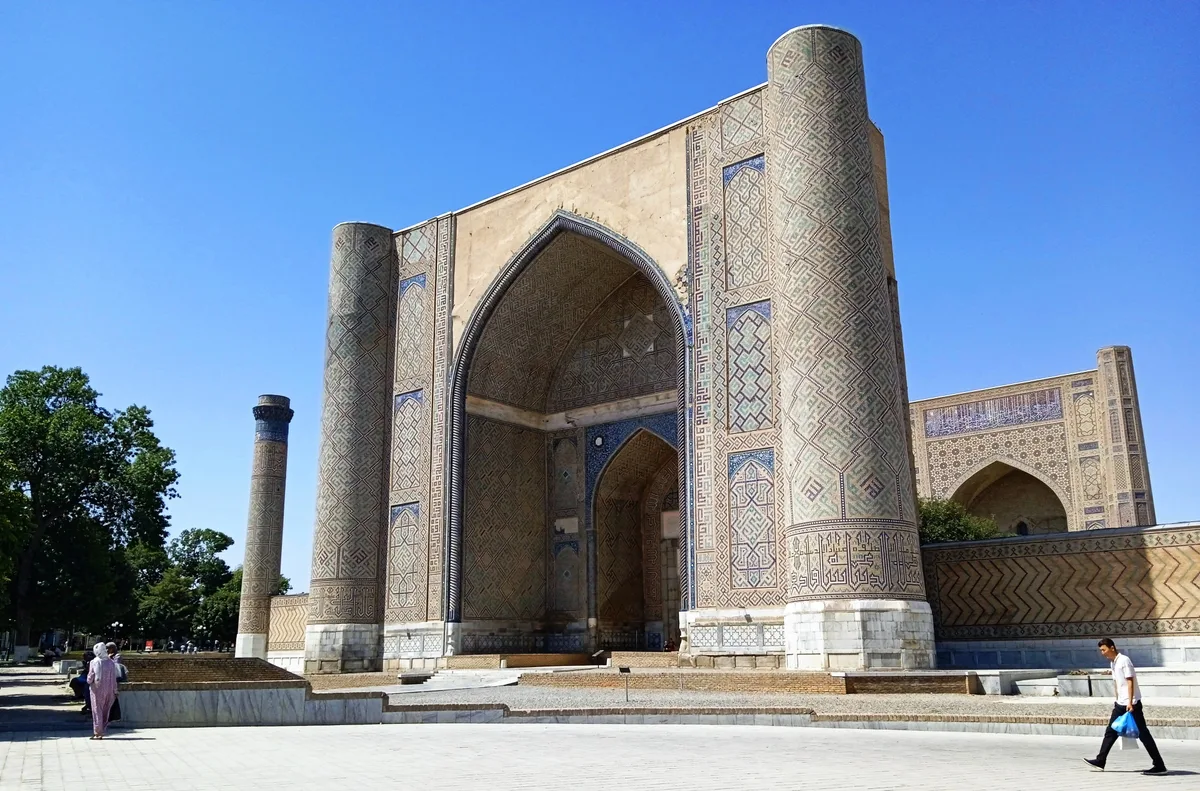
Photo: Шухрат Саъдиев / CC BY-SA 4.0
What Your Eye SeesA colossal blue-domed mosque stands at the edge of a vast courtyard: a towering entrance portal, a great central dome and walls of glazed tile, with broken and rebuilt marble columns scattered around the open space where a market now crowds the square outside.
ContextBibi-Khanym Mosque was commissioned by Timur after his 1398-1399 campaign in India and built 1399-1404. At its completion it was one of the largest mosques in the Islamic world, its dome rising to roughly 40 metres. Columns of marble were hauled from India - according to tradition with the help of 95 elephants - and the courtyard could hold thousands of worshippers for Friday prayer.
Source: UNESCO (Samarkand – Crossroads of Cultures); Wikipedia (Bibi-Khanym Mosque)
DidYou
Know
Bibi-Khanym was so vast and hastily raised that its great dome began to crack almost at once, and the mosque was already in ruins by the 17th century - what stands today is a 20th-century reconstruction of Timur's ambition.
ShareThe Broken Arch
Huge marble blocks and toppled column drums still lie at the foot of the entrance arch - remnants of the 1897 earthquake that destroyed the columns, which were never fully rebuilt.
→ The Marble Quran Stand
In the courtyard centre stands the 2.3m marble lectern placed by Ulugh Beg, once holding the Osman Quran, a single block you can see at the heart of the mosque.
Sources: Wikipedia (Bibi-Khanym Mosque); UNESCO (Samarkand – Crossroads of Cultures)
Silk Road Legacy
Ancient Roots
4. Shah-i-Zinda Necropolis
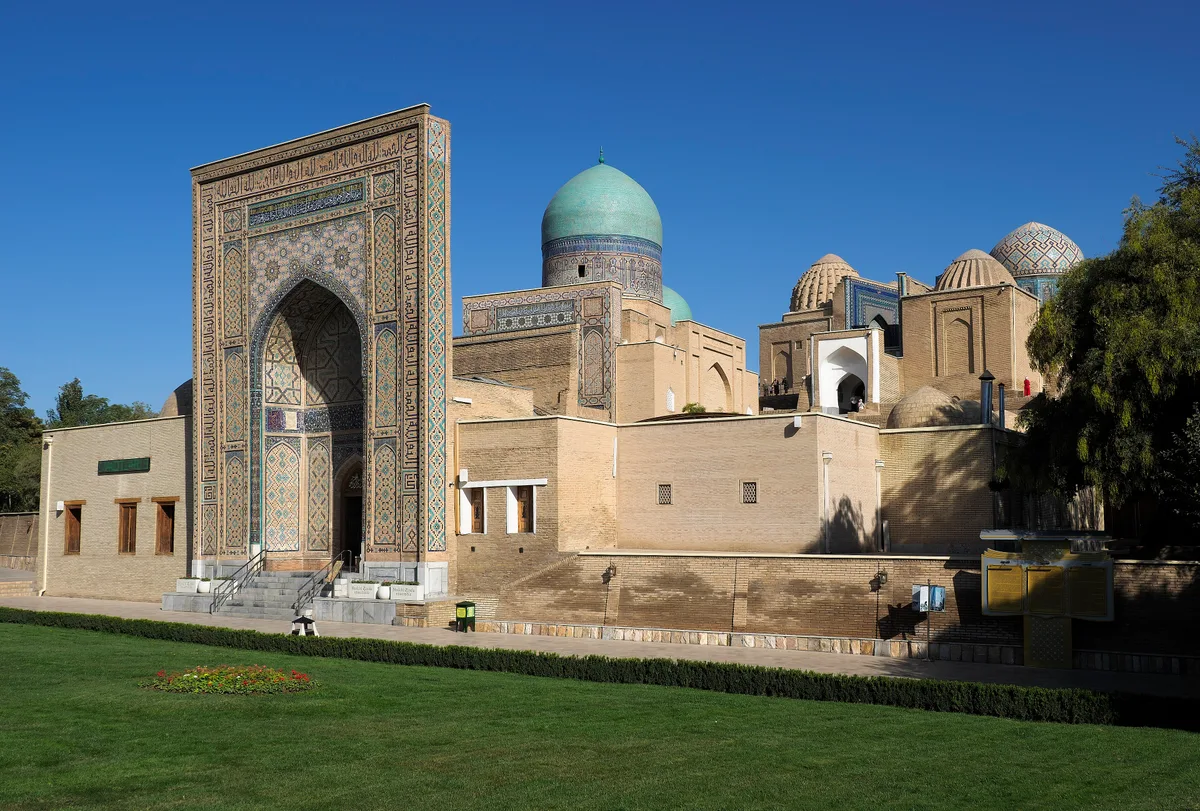
Photo: Petar Milošević / CC BY-SA 4.0
What Your Eye SeesA steep stairway climbs a hillside to a narrow lane lined with more than twenty mausoleums, their facades a shimmering collage of turquoise, cobalt and majolica tile. Domes cluster above the path, and the whole ensemble feels like a street built for the dead.
ContextShah-i-Zinda - Persian for 'The Living King' - is a necropolis built around the supposed tomb of Qusam ibn Abbas, a cousin of the Prophet Muhammad who legend says was beheaded but walked alive into a well. The earliest structures date to the 11th century, but most of the mausoleums were built in the 14th and 15th centuries under the Timurids, including tombs for Timur's family, wives and generals.
Source: UNESCO (Samarkand – Crossroads of Cultures); Wikipedia (Shah-i-Zinda)
DidYou
Know
Shah-i-Zinda is still an active pilgrimage site, and its tiled mausoleums, stacked up a narrow stairway, form one of the most densely decorated corridors in all of Islamic architecture, each facade a different scheme of turquoise and cobalt glaze.
ShareA Lane Of Forty Steps
The entrance climbs a flight of roughly forty steps, and the mausoleums line a single narrow axis beyond - a processional street whose oldest surviving shrine, the Kusam ibn Abbas mausoleum, dates to the 11th century.
A Family Of Tombstones
Look for Shadi Mulk Aga (1371, niece of Timur) and Shirin Bika Aga (1385, sister of Timur), the most lavishly tiled mausoleums, their turquoise and gold tilework still vivid.
Sources: Wikipedia (Shah-i-Zinda); Advantour (Shah-i-Zinda); Oriental Architecture (Shah-i-Zinda)
Silk Road Legacy
Spiritual Seeker
Time Traveler
5. Ulugh Beg Observatory
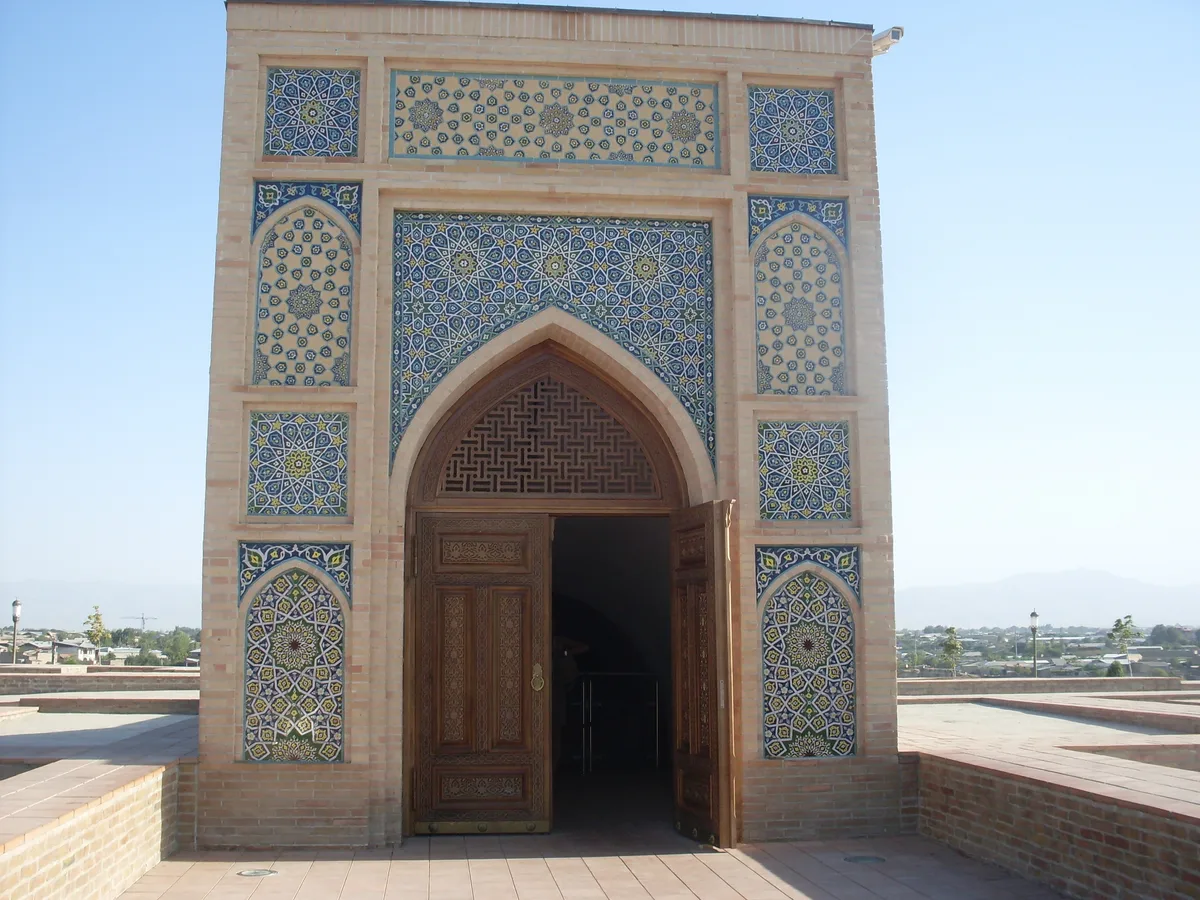
Photo: Bobyrr / CC BY-SA 4.0
What Your Eye SeesOn a low hill at the edge of the city, a circular brick platform marks the footprint of a vanished building, and a doorway leads down into a deep stone trench. At the bottom, a curved arc of polished marble - a huge partial circle - sweeps across the floor.
ContextThe observatory was built in the 1420s by Ulugh Beg, the Timurid ruler and astronomer, and completed around 1429. Its main instrument was the Fakhri sextant, a massive marble meridian arc with a radius of about 40 metres - the largest astronomical instrument of its time. Ulugh Beg's astronomers used it to compile the Zij-i Sultani star catalogue of 1437, listing more than 1,000 stars with remarkable precision. The observatory was destroyed after Ulugh Beg's assassination in 1449 and only rediscovered in 1908 by the Russian archaeologist V.L. Vyatkin.
Source: UNESCO (Samarkand – Crossroads of Cultures); Wikipedia (Ulugh Beg Observatory)
DidYou
Know
Its star catalogue, the Zij-i Sultani of 1437, remained the most accurate until Tycho Brahe's observations in 1598.
ShareThe Buried Arc
What survives is only the lower section of the great marble quadrant, still visible in the trench - its walls were once lined with polished marble and marked with a scale that measured the height of stars crossing the meridian.
→ The Buried Arc
Trace the two parallel marble rails of the 40.04m arc still set in the 2-metre-wide meridian trench, the sextant's scale you can walk beside today.
Sources: Wikipedia (Ulugh Beg Observatory); Orexca (Ulugh Beg Observatory)
Silk Road Legacy
Time Traveler
6. Afrasiab Museum
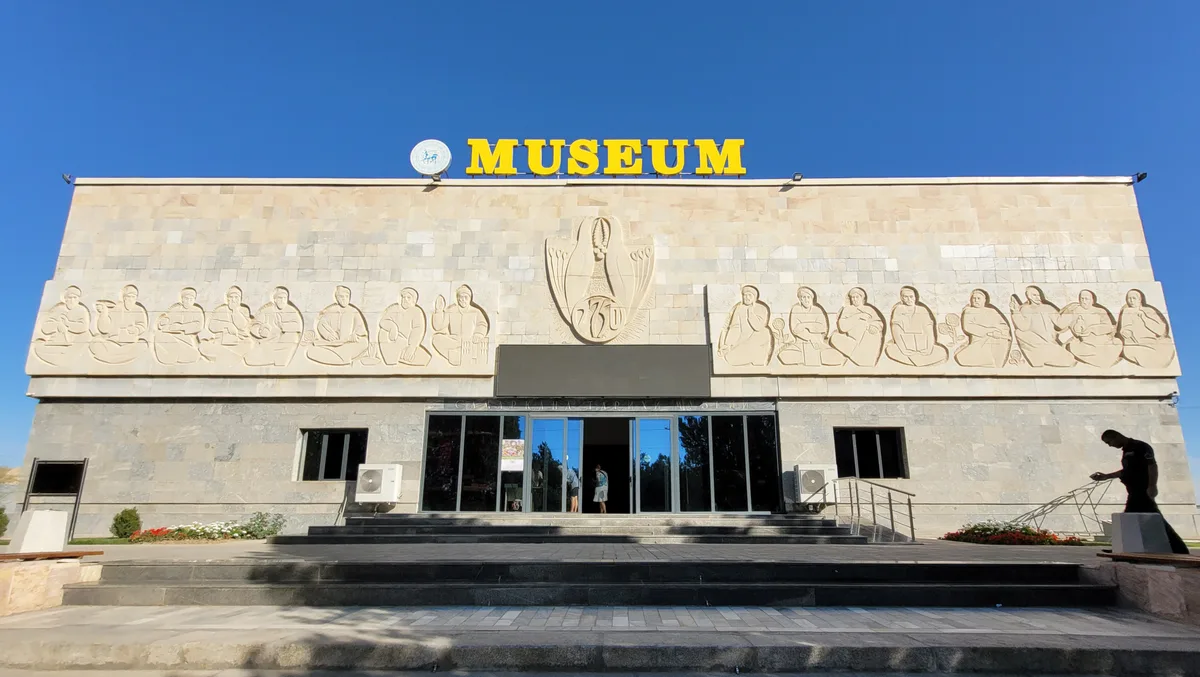
Photo: Bgag / CC0
What Your Eye SeesA two-storey modern building rises at the foot of a vast, bare archaeological mound of sun-baked earth. Inside, dark rooms display ceramics, coins and ossuaries, and a central hall is dominated by vivid fragmentary wall paintings of robed figures, horses and ambassadors.
ContextThe museum sits against the mound of Afrasiab, the ancient site of Samarkand, settled no later than the 7th century BC. It was opened in 1970 and built around the site's most famous treasure: the Afrasiab murals, discovered in 1965 during road construction. These 7th-century Sogdian wall paintings once decorated the reception hall of King Varkhuman and show ambassadors arriving from China, Korea, Tibet and Central Asian states - a rare visual record of Silk Road diplomacy.
Source: UNESCO (Samarkand – Crossroads of Cultures); Wikipedia (Afrasiyab)
DidYou
Know
The Afrasiab murals are the only known Sogdian wall paintings of a royal reception to survive anywhere - and their fragments are displayed in a darkened, climate-controlled hall built to preserve pigments that had lain buried for more than 1,300 years.
ShareThe Mound's 11 Layers
Outside the museum, the bare hillside of Afrasiab is a huge archaeological mound - more than 200 hectares of settlement layers, several metres thick, spanning the city's history from its 7th-century BC founding to its destruction in the 13th century.
Ossuaries Of The Sogdians
In the display cases, clay ossuaries - small lidded vessels for the bones of the dead - reveal a Zoroastrian custom in which bodies were exposed to birds before the cleaned bones were gathered.
Sources: Orexca; Wikipedia (Afrasiab Museum)
Ancient Roots
Silk Road Legacy
7. Hazrat Khizr Mosque
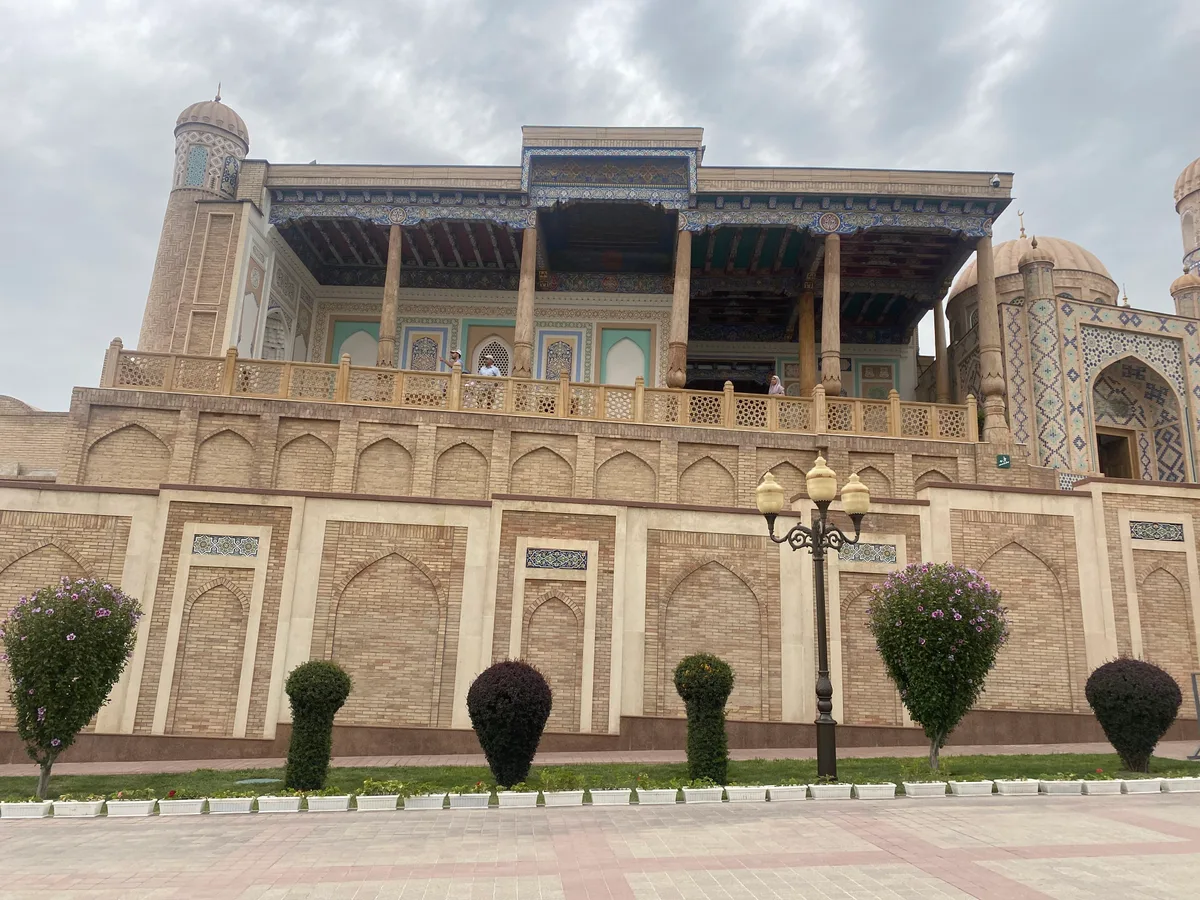
Photo: Visola Tangirova / CC BY-SA 4.0
What Your Eye SeesOn a low hill opposite the Shah-i-Zinda, a one-domed mosque with a slender minaret and carved brick portico looks out across the old city. A new white mausoleum with a blue dome stands within the same walled compound.
ContextThe site is associated with the legendary prophet Khizr and, according to tradition, with a mosque built after the Arab conquest of Sogd around 712, later destroyed by the Mongols in 1220. The present building was constructed in 1854 on the ancient foundation, with the minaret and portal added in the 1890s. Since 2018 the compound has also held the mausoleum of Islam Karimov, Uzbekistan's first president.
Source: UNESCO (Samarkand – Crossroads of Cultures); Wikipedia (Hazrat Khizr Mosque)
DidYou
Know
The mosque honours Khizr, the 'Green Prophet' of Islamic lore who is said to have drunk from the water of life - and local tradition ties him to Samarkand through a legend of a white bird that broke a dam to turn back an invading army, the miracle that first drew a shrine to this hill.
ShareA Hill Over The Dead
The mosque stands on a ridge directly opposite the Shah-i-Zinda necropolis, and from its terrace the whole sweep of blue-tiled tombs rises on the far side of the valley - one of the best overlooks in the old city.
A President's Tomb
Within the compound, a marble and blue-domed mausoleum built in 2018 holds the remains of Islam Karimov - making the modern and the medieval share the same sacred hilltop.
Sources: Wikipedia (Hazrat Khizr Mosque)
Spiritual Seeker
Ancient Roots
8. Khodja Abdu-Darun Mausoleum
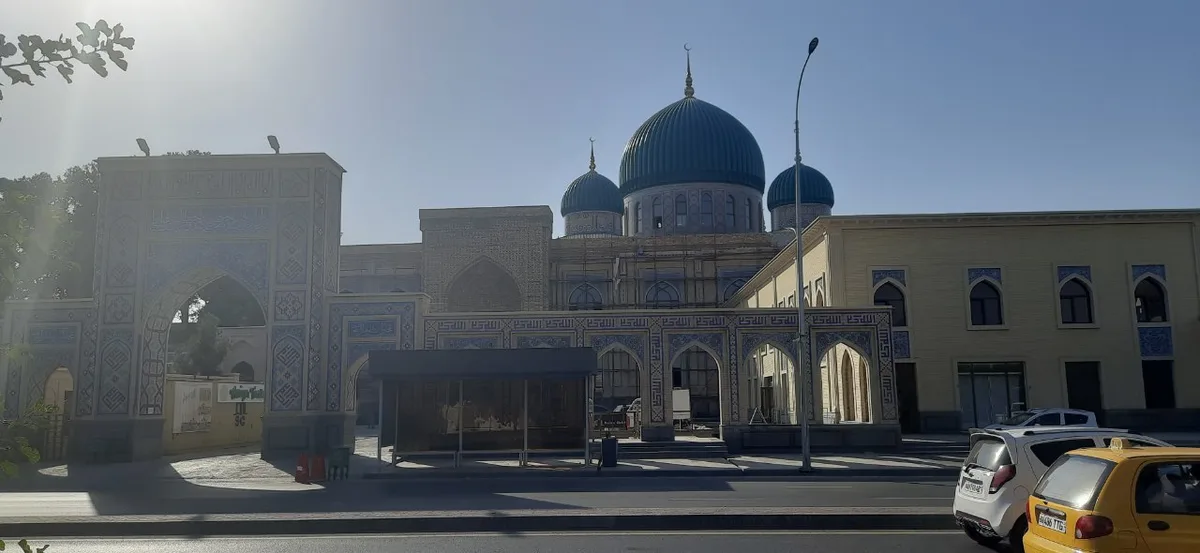
Photo: ShHamrayev / CC BY-SA 4.0
What Your Eye SeesA peaceful walled complex at the edge of an old cemetery: a small octagonal mausoleum with a tent-shaped dome, a tiled khanaka, a mosque, a minaret and a still reflecting pool shaded by towering plane trees. Worshippers come and go among the graves.
ContextThe complex honours Abd al-Maziddin, a respected Islamic judge who died in Samarkand around 861 and was buried in the garden of his own estate. In the first half of the 12th century a small mausoleum was built over his tomb by order of Sultan Sanjar, and in the 15th century a khanaka - a Sufi retreat - was added. 'Darun' means 'inside', marking its place within the medieval city walls.
Source: UNESCO (Samarkand – Crossroads of Cultures); Wikipedia (Khodja Abdu-Darun)
DidYou
Know
Unlike Samarkand's grand tiled monuments, Abdu Darun is a place of quiet devotion - the garden tomb of a 9th-century judge remembered as a Hanafi judge, remembered as one of Samarkand's most respected qadis, later enclosed by a Sufi khanaka where dervishes gathered, a calm counterpoint to the city's showpiece mausoleums.
ShareThe Healing Pool
In the courtyard, a pond fed by a spring keeps the same level in summer and winter, and local tradition has long regarded its water as healing - pilgrims still gather around it under the plane trees.
→ The Khanaka Courtyard
Look around the 15th-century khanaka courtyard with 19th-century wooden aivan, hujras and the hauz (stone pool) on its spring, the living Sufi centre you can walk through.
Sources: Wikipedia (Khodja Abdu-Darun Mausoleum); Orexca; Wikipedia (Abdidarun Complex); Orexca (Abdidarun)
Spiritual Seeker
Silk Road Legacy
9. St. John the Baptist Church
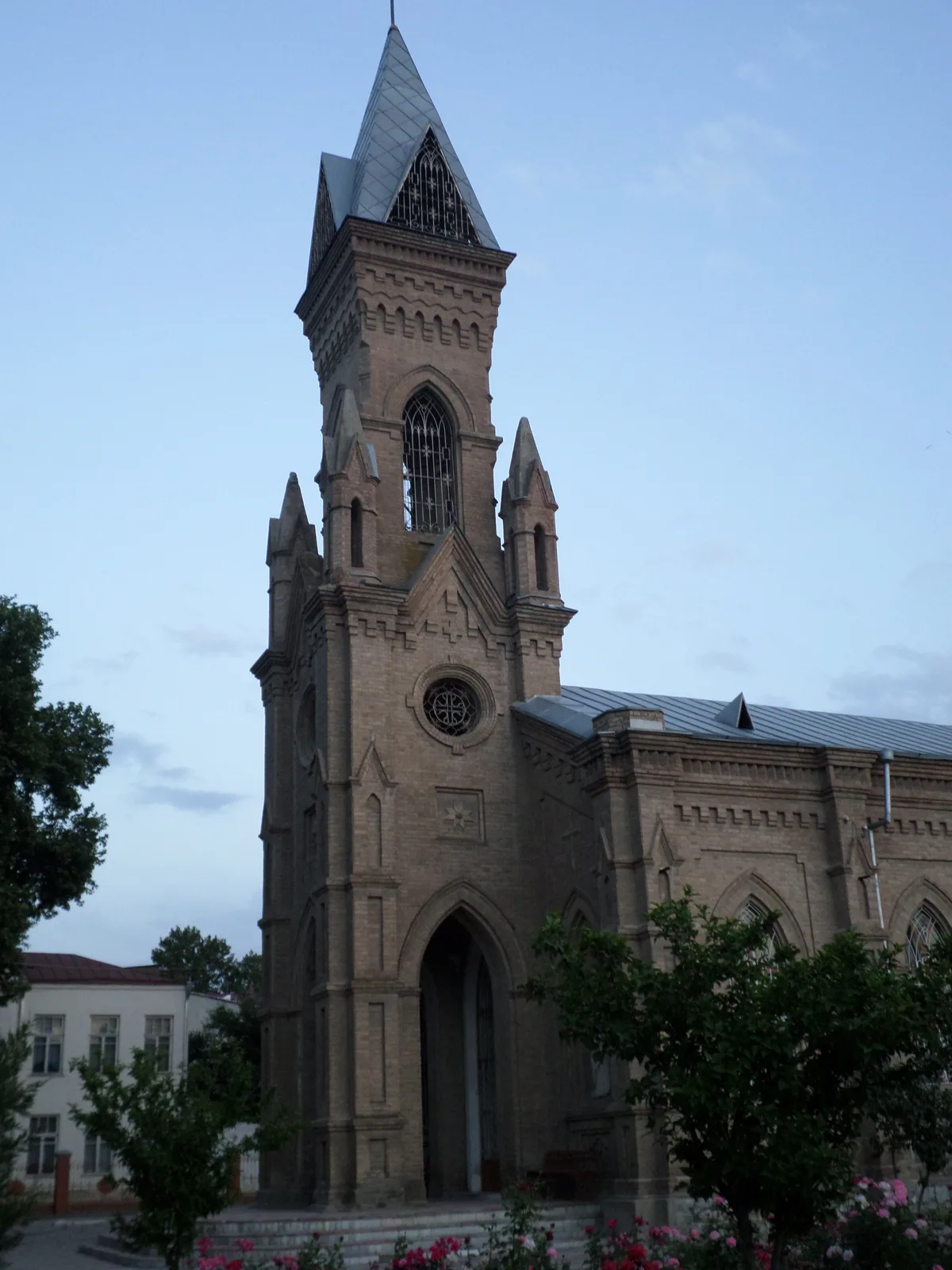
Photo: Bobyrr / CC BY-SA 4.0
What Your Eye SeesA modest brick church with pointed neo-Gothic arches and a small bell tower stands in a quiet street of the old Russian district. Inside, a single nave leads to an altar, and stained-glass windows cast colour across the wooden pews.
ContextThis is the only Catholic church in Samarkand. It was built in 1915-1916 for the city's Polish and German Catholic community, swelled by prisoners of war arriving in 1915, and based on a design by the architect E. Nelle. Closed during the Soviet period, it was reopened in 1997 and today serves the Apostolic Administration of Uzbekistan.
Source: UNESCO (Samarkand – Crossroads of Cultures); Wikipedia (Church of St. John the Baptist, Samarkand)
DidYou
Know
Its architect, E. Nelle, gave Samarkand a rare Gothic Revival church - a pointed-arch brick silhouette that stands out sharply against the blue domes of the Islamic city, a small monument to the European prisoners and settlers who passed through Central Asia in the First World War.
ShareThe Missing Spire
Look closely at the roofline and you will see the bell tower carries no spire - the original one was stripped away during the Soviet years, when the building spent over 70 years as a sports hall, its pointed arches hidden behind a gym's whitewash until the parish got it back in 1997.
Relics In The Chapel
A side chapel displays relics including a fragment said to be of the Holy Cross and a stone from Golgotha - an unexpected treasure inside an unassuming Central Asian church.
Sources: Wikipedia (St. John the Baptist Church, Samarkand); Catholics in Samarkand (official parish site)
Spiritual Seeker
Time Traveler
What are the must-see monuments in Samarkand?
Our guide covers nine of Samarkand’s monuments: Registan Square, Gur-e-Amir Mausoleum, Bibi-Khanym Mosque, Shah-i-Zinda Necropolis, Ulugh Beg Observatory, the Afrasiab Museum, Hazrat Khizr Mosque, Khodja Abdu-Darun Mausoleum, and St. John the Baptist Church.
Is it Samarkand or Samarqand?
Both spellings refer to the same city in Uzbekistan. “Samarqand” is a common transliteration from the Uzbek and Russian, while “Samarkand” is the most widely used English spelling.
Is the Registan under renovation?
The square remains open, but the facade of the Sher-Dor Madrasah, built in the 17th century, is in a phased conservation project funded by the U.S. Ambassadors Fund for Cultural Preservation. Its mosaics, majolica and Kufic inscriptions are being stabilised, and the first phase was completed in June 2026. A companion project, Eternal Registan, will add virtual-reality tours of the ensemble.
These landmarks reward close attention. Vestigia is a field companion for people who look longer, with curated context, architectural detail, and the stories most visitors walk past. Free on the App Store and Google Play.