Istanbul Historical Landmarks
1. Hagia Sophia (Ayasofya)
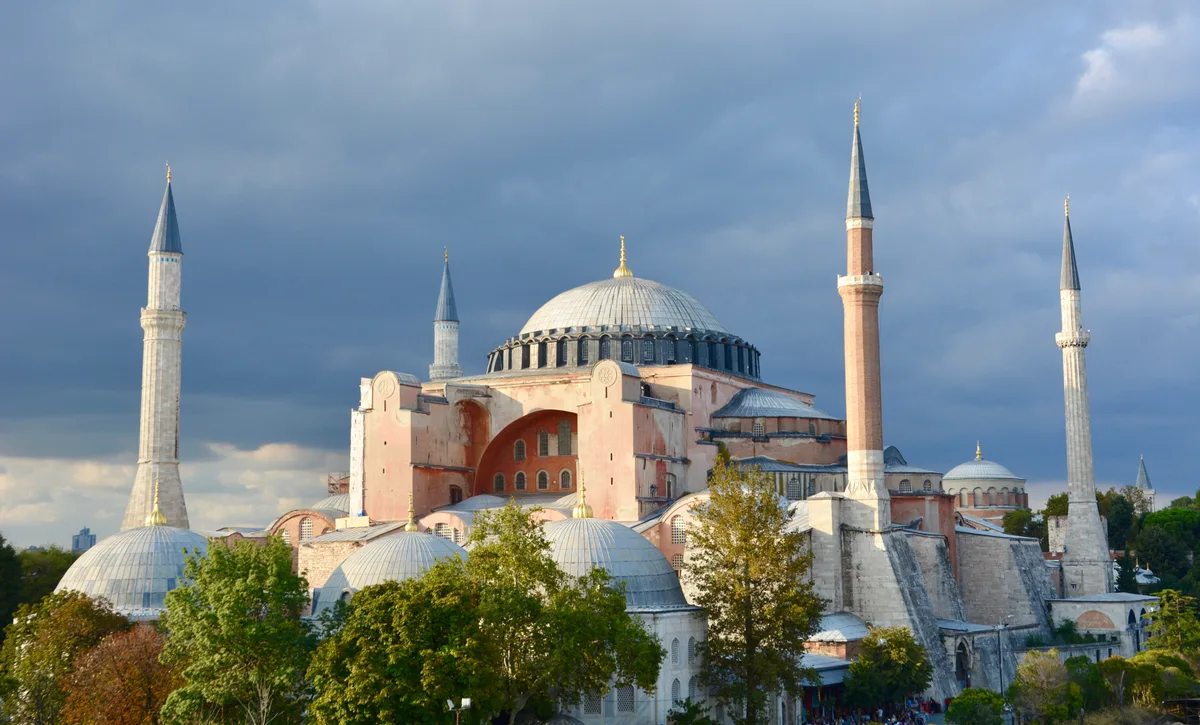
Photo: Adli Wahid / CC BY-SA 3.0
What Your Eye SeesA massive terracotta-colored structure defined by its towering dome, flanked by four soaring Ottoman minarets overlooking the Bosporus.
ContextCommissioned by Emperor Justinian I in 537 AD, Hagia Sophia was the largest cathedral in the world for close to a thousand years. It served as the spiritual heart of the Byzantine Empire until 1453, when Mehmed II converted it into a mosque. In 1934, it became a museum, and in 2020 it became a functioning mosque, a building that has reflected the political identity of its rulers for 1,500 years.
Justinian's builders also raised the Basilica Cistern beside it and, far to the south, rebuilt St Nicholas Church at Myra.
On ScreenHagia Sophia appears in the James Bond film From Russia with Love (1963) and Dan Brown's Inferno (2016).
Source: UNESCO (Historic Areas of Istanbul); Kültür ve Turizm Bakanlığı; Wikipedia (Hagia Sophia); Wikipedia (From Russia with Love); Wikipedia (Inferno); production notes
 Did
DidYou
Know
Look closely at the marble balustrades of the upper southern gallery. Here, 9th-century Viking guards protecting Byzantine emperors carved runes saying "Halfdan was here", an ancient piece of graffiti remaining intact in a building that transitioned from cathedral to mosque.
Share→ The Crown Of Windows
Around the base of the great dome run about 40 windows, letting a band of daylight spill into the interior. In Hagia Sophia's original design this ring of light makes the immense dome seem to float above the waiting space below.
→ The Off-Centre Prayer Niche (Mihrab)
Look down the nave toward the apse: the prayer niche (mihrab) is not centred but sits noticeably off the building's axis, shifted to point toward Mecca, which lies to the southeast rather than due east. Step back and you can see how the pulpit (minbar)'s staircase and the sultan's loge all follow this rotated line against the church's original orientation.
→ The Weeping Column
Look for the bronze-clad column in the north aisle: a small hole at thumb height. Legend promises that if you insert your thumb and turn it fully, your wish will come true, and countless visitors over the centuries have worn the polish into the metal.
Sources: Wikipedia (Hagia Sophia); Smarthistory; Atlas Obscura
 Silk Road Legacy
2. Blue Mosque (Sultan Ahmet Camii)
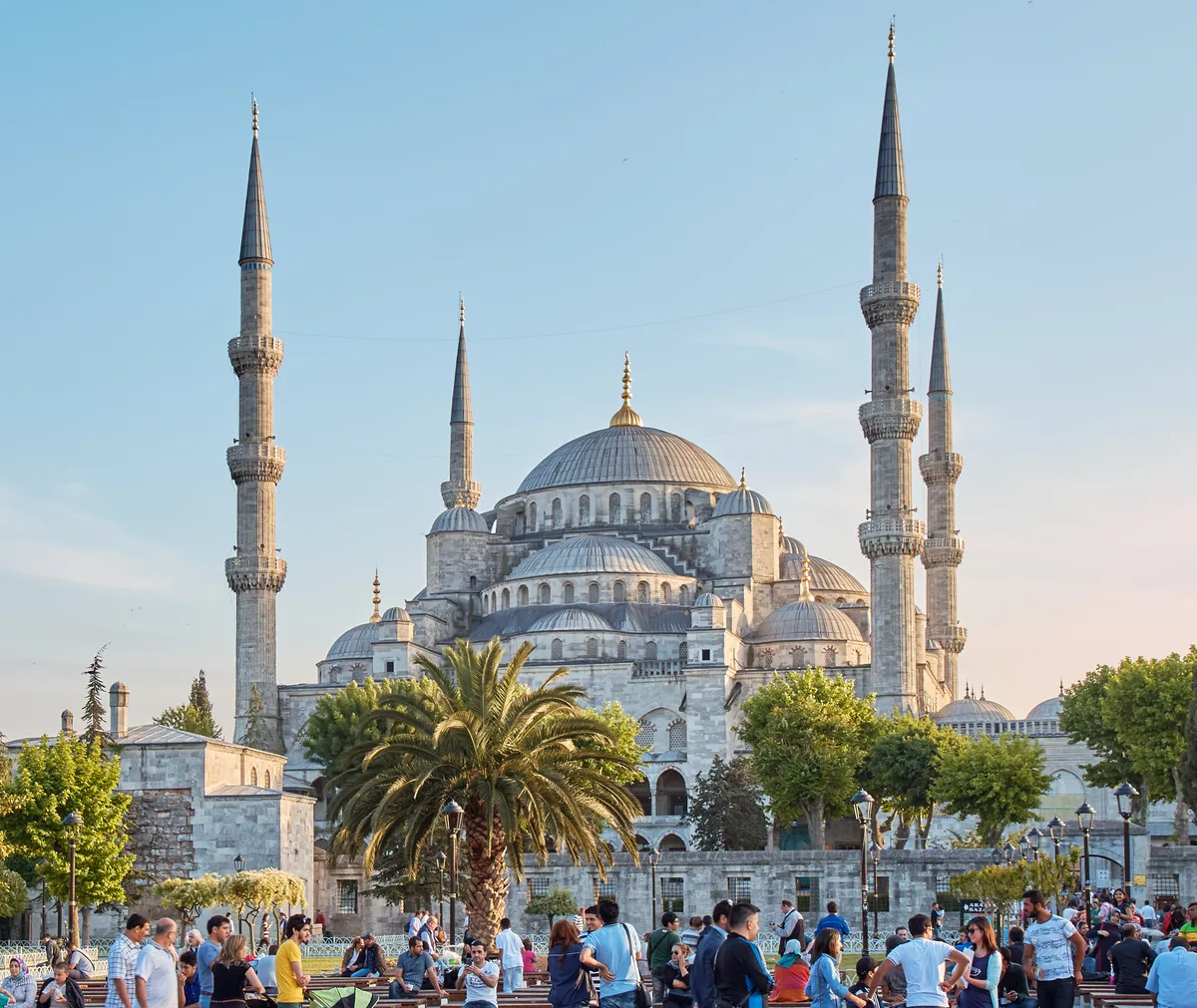
Photo: Pedro Szekely from Los Angeles, USA / CC BY-SA 2.0
What Your Eye SeesA cascading series of domes and semi-domes, framed uniquely by six slender minarets directly facing the Hagia Sophia.
ContextBuilt between 1609 and 1616 by Sultan Ahmed I and designed by his chief imperial architect Sedefkâr Mehmed Ağa, the last great pupil of Mimar Sinan, this was the first imperial mosque built in almost 40 years and the last great classical Ottoman mosque. Positioned directly opposite Hagia Sophia, it rivals, and surpasses, Justinian's architectural legacy. A bold statement of Ottoman imperial confidence.
Its silhouette is defined by six minarets, and by an interior sheathed in some 20,000 handmade İznik tiles in shades of blue, from which the mosque takes its familiar name. The complex also encloses the tomb of Ahmed I.
On ScreenThe Blue Mosque served as a Bond location in From Russia with Love (1963) and appears in the game Assassin's Creed: Revelations (2011).
Source: UNESCO (Historic Areas of Istanbul); Kültür ve Turizm Bakanlığı; Wikipedia (Blue Mosque); Wikipedia (Blue Mosque); From Russia with Love production notes; Assassin's Creed: Revelations
DidYou
Know
When completed in 1616, the six minarets caused a major diplomatic crisis with Mecca, which had the only other six-minaret mosque. The Sultan resolved this controversy by funding a seventh minaret for the Grand Mosque in Mecca to maintain its religious supremacy.
Share→ The Sultan's Loge (Hünkâr Mahfili)
In the south-east corner of the prayer hall an raised box of gilded wood rests on ten marble columns: the sultan's private loge, or hünkâr mahfili. It carries its own small prayer niche (mihrab) and was linked to the royal kiosk outside, so the ruler could enter without passing through the public door.
→ The 21,000 Tiles
Ahmed I ordered tiles for the mosque from the entire Iznik industry. Inside are some 21,000 hand-painted Iznik tiles showing more than fifty different designs, tulips, carnations, cypresses and more, in cobalt blue, turquoise and a particular red that gives the interior its glow.
Sources: Wikipedia (Blue Mosque, Istanbul); Britannica
 Ancient Roots
Silk Road Legacy
Ancient Roots
Silk Road Legacy
 Spiritual Seeker
3. Topkapi Palace (Topkapı Sarayı)
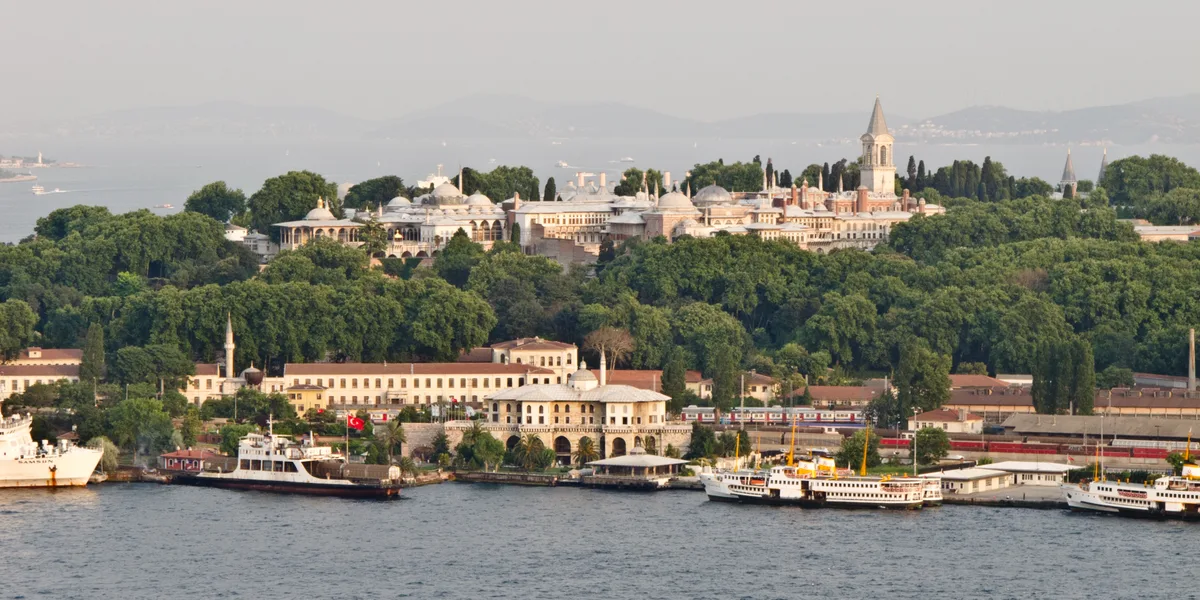
Photo: Carlos Delgado / CC BY-SA 3.0
What Your Eye SeesA sprawling, low-profile palace complex consisting of four main courtyards nestled between the Bosporus and the Golden Horn.
ContextConstructed between 1460 and 1478 under Mehmed II, Topkapi served as the primary residence of Ottoman sultans for centuries. Its location on the Seraglio Point offers commanding views of both the Bosphorus and the Golden Horn, a strategic choice by the Conqueror who understood that controlling the waterways meant controlling the city.
More than a residence, it was the empire's administrative and ceremonial heart for nearly four centuries, until the court moved to Dolmabahçe Palace in 1856. Within its four courtyards sat the Imperial Council, where the Grand Vizier governed, the sultan's private apartments and the vast Harem, and the Treasury that held the Ottomans' most prized relics and jewels.
On ScreenTopkapi Palace lent its name to the heist classic Topkapi (1964) and appears in From Russia with Love (1963) and the game Assassin's Creed: Revelations (2011).
Source: UNESCO (Historic Areas of Istanbul); Kültür ve Turizm Bakanlığı; Wikipedia (Topkapı Palace); Wikipedia (Topkapi Palace); Topkapi (1964) production notes; Assassin's Creed: Revelations
DidYou
Know
The palace kitchens were a city within a city: hundreds of cooks fed up to 4,000 people daily across rows of separate domed ovens. Each group, sultan, harem, viziers, Janissaries, received meals of different quality, the sultan's kitchen marked by taller, more ornate chimney stacks.
Share→ The Baghdad Kiosk
This pavilion was built to commemorate the Ottoman conquest of Baghdad, and its interior glitters with mother-of-pearl and tortoiseshell inlay set into its walls and cupboards. Each piece was fitted by hand, so no two sections are identical.
→ The Harem Maze
The Harem grew into a labyrinthine warren of some 400 rooms connected by deliberately irregular corridors. Black eunuchs guarded the thresholds between the sultan's world and the women's quarters, the architecture itself, as much as the gates, enforced the palace's strict hierarchy.
Sources: Wikipedia (Topkapı Palace); Ministry of Culture and Tourism (Turkey)
Silk Road Legacy
 Euro Heritage
 Baroque Master
4. Basilica Cistern (Yerebatan Sarnıcı)
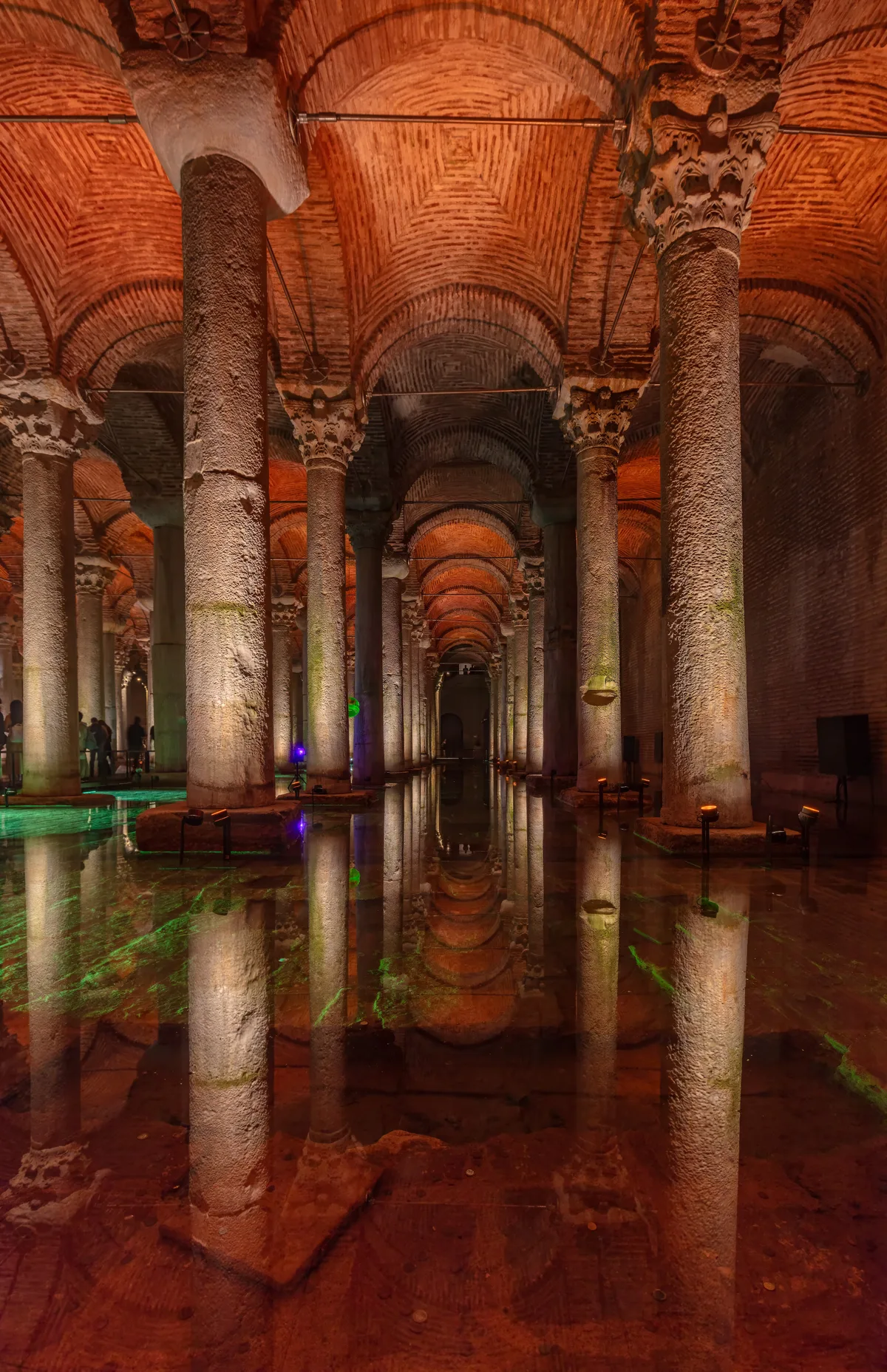
Photo: Diego Delso / CC BY-SA 4.0
What Your Eye SeesA damp, subterranean forest of 336 marble columns standing in shallow water, illuminated by a warm orange glow.
ContextEmperor Justinian I built this underground water storage system in 532 AD to guarantee Constantinople's water supply during sieges. The cistern could hold up to 80,000 cubic metres of water, delivered by the Valens Aqueduct system. After the Ottoman conquest, the cistern's existence was forgotten by the public until the French scholar Petrus Gyllius rediscovered it in 1545.
The vast chamber is carried by 336 marble columns, each about 9 metres tall, recycled from older buildings across the empire. Its most famous sight is in the northwest corner, where two columns rise from blocks carved with the face of Medusa, one turned on its side, the other upside down, their placement a puzzle that archaeologists still debate.
Justinian's other works frame this cistern, Hagia Sophia above and St Nicholas Church at Myra, which he also rebuilt.
On ScreenThe Basilica Cistern was used as a filming location for the James Bond film From Russia with Love (1963) and features in Dan Brown's Inferno (2016).
Source: UNESCO (Historic Areas of Istanbul); Kültür ve Turizm Bakanlığı; Wikipedia (Basilica Cistern); Wikipedia (From Russia with Love); Wikipedia (Inferno); production notes
DidYou
Know
Until the 20th century, houses stood directly over the cistern and their residents lowered buckets through the floor to draw drinking water from the columns below, the great 'sunken palace' quietly served as a neighbourhood well for centuries.
Share→ The Medusa Heads
Look down in the northwest corner of the cistern: two Medusa heads support columns, one set on its side, one upside down. They are believed to have been placed this way deliberately, to neutralize the petrifying power of the Gorgon's gaze.
→ The Tears Column
Look for the column carved with patterns like falling tears. It is remembered as the 'Weeping Column', linked by tradition to the enslaved labourers said to have died while the cistern was being built, though the true intention behind the carving is unknown.
Sources: Wikipedia (Basilica Cistern); Basilica Cistern Guide; Smithsonian Magazine
Ancient Roots
Silk Road Legacy
Spiritual Seeker
5. Galata Tower (Galata Kulesi)
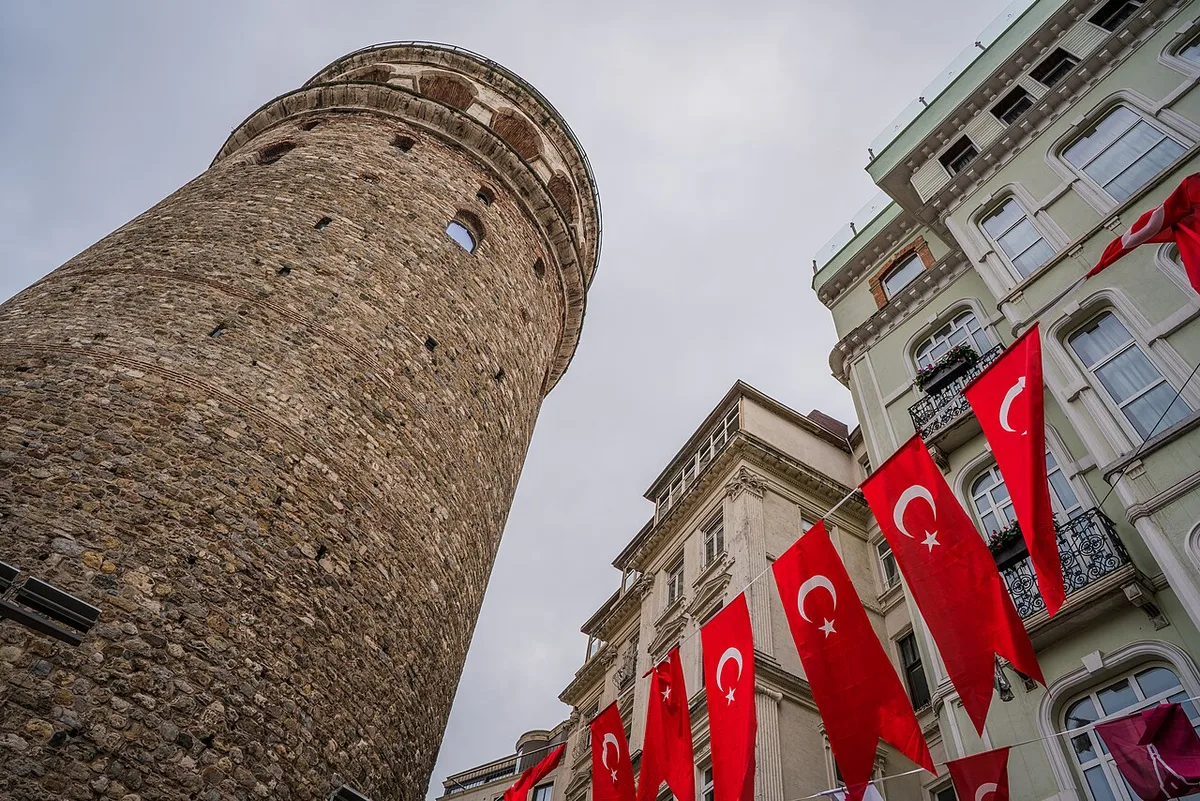
Photo: Nan Palmero from San Antonio, TX, USA / CC BY 2.0
What Your Eye SeesA stone cylindrical tower rising above the historic Galata neighborhood, topped by a conical roof.
ContextBuilt by the Genoese colony in 1348 as part of their fortified trading quarter, the tower was originally called the Tower of Christ. It formed the northern anchor of the massive chain that stretched across the Golden Horn during Byzantine times. After the Ottoman conquest, the tower served as a fire observation post and later a prison.
At about 67 metres, it was for centuries the tallest structure in the city, and its hilltop perch still gives one of the finest panoramas over the Golden Horn and the Bosphorus.
On ScreenGalata Tower is recreated as a climbable landmark in the game Assassin's Creed: Revelations (2011).
Source: Kültür ve Turizm Bakanlığı; Wikipedia (Galata Tower); Wikipedia (Galata Tower); Assassin's Creed: Revelations production notes
DidYou
Know
Built by Genoese merchants as a defensive watchtower, it became the site of early human flight. In the 17th century, Hezarfen Ahmed Celebi strapped artificial wings to his arms and glided across the Bosporus from this very tower.
Share→ The Lead-Capped Cone
Look up at the lead-capped cone: the tower is crowned by a steep conical roof covered in lead. Today's cone is a 1965-67 reconstruction, the original was blown off by a storm in 1875, and for nine decades the tower stood roofless before the landmark silhouette was rebuilt.
→ The 3.75-Metre Walls
From the square below, note the thickness of the tower's base: the walls measure about 3.75 metres thick, brick-and-ashlar masonry rising in a cylinder that tapers slightly toward the top. This is the defensive bulk of a medieval watchtower, and the darker stone of the lower courses predates the later restorations.
Sources: Wikipedia (Galata Tower); Galata Tower (official); City of Istanbul
Euro Heritage
 Gothic Soul
6. Dolmabahce Palace (Dolmabahçe Sarayı)
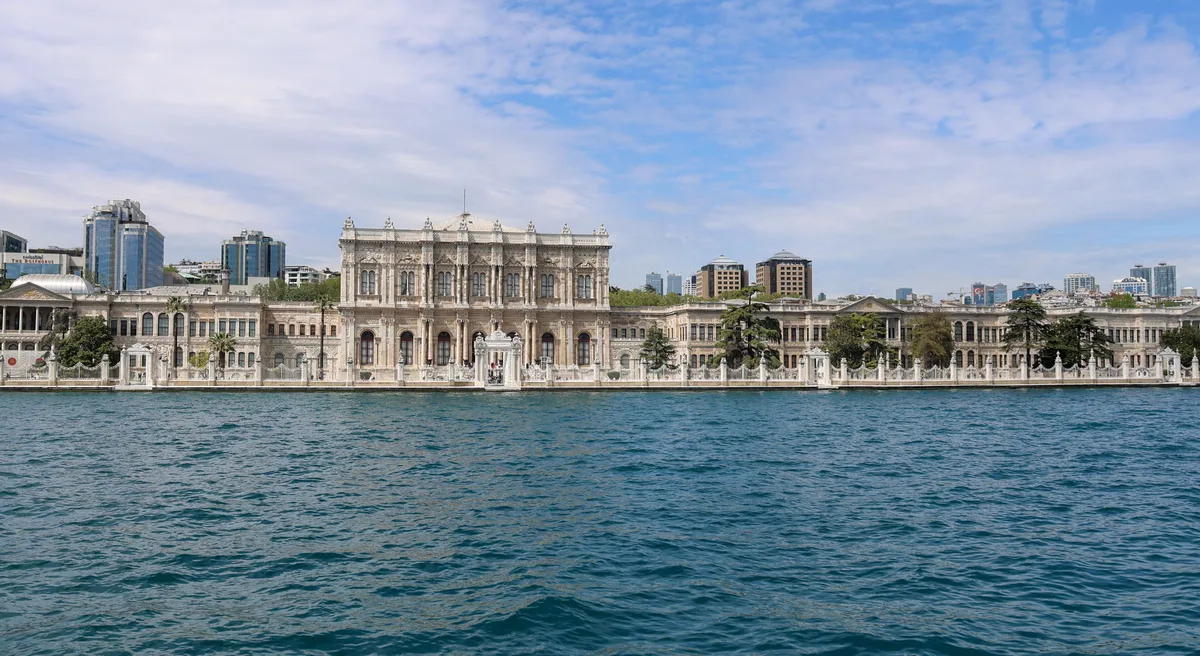
Photo: flowcomm / CC BY 2.0
What Your Eye SeesA monumental, gleaming white marble facade stretching along the waters of the Bosporus Strait.
ContextCommissioned by Sultan Abdülmecid I and completed in 1856, Dolmabahçe replaced Topkapi as the main administrative centre of the Ottoman Empire. Its construction reflected a deliberate shift toward European-style governance, the sultan wanted a palace that looked like the palaces of Paris and London, signalling that the empire was modernising. Its European neobaroque silhouette was the work of the Armenian architect Garabet Balyan and his son Nigoğayos Balyan.
What makes it unforgettable is scale and spectacle: the Ceremonial Hall hangs a 4.5-tonne Bohemian crystal chandelier, said to be a gift from Queen Victoria, beneath a 36-metre dome, and every clock in the palace is stopped at 9:05, the moment Mustafa Kemal Atatürk died here on 10 November 1938.
On ScreenDolmabahçe Palace hosted the James Bond films The World Is Not Enough (1999) and Skyfall (2012).
Source: Milli Saraylar (National Palaces); Wikipedia (Dolmabahçe Palace); Wikipedia (Dolmabahçe Palace); The World Is Not Enough production notes; Skyfall production notes
DidYou
Know
Built to project modern European power, the palace's construction cost 35 tons of gold, pushing the Ottoman Empire into bankruptcy. Ironically, this lavish attempt to look strong only accelerated the state's decline.
Share→ The 4.5-Tonne Chandelier
Hung over the Ceremonial Hall is a vast Bohemian crystal chandelier weighing about 4.5 tonnes. Its hundreds of lamps were once lit by gas, and traces of that original gas piping are still visible above the crystal work.
→ The Stopped Clocks
Atatürk died in this palace at 9:05 on the morning of 10 November 1938. Every clock in the building was stopped at that moment, and they have never been restarted, a frozen tribute that survives to this day.
Sources: Wikipedia (Dolmabahçe Palace); Dolmabahçe Palace (official)
Euro Heritage
Baroque Master
7. Süleymaniye Mosque (Süleymaniye Camii)
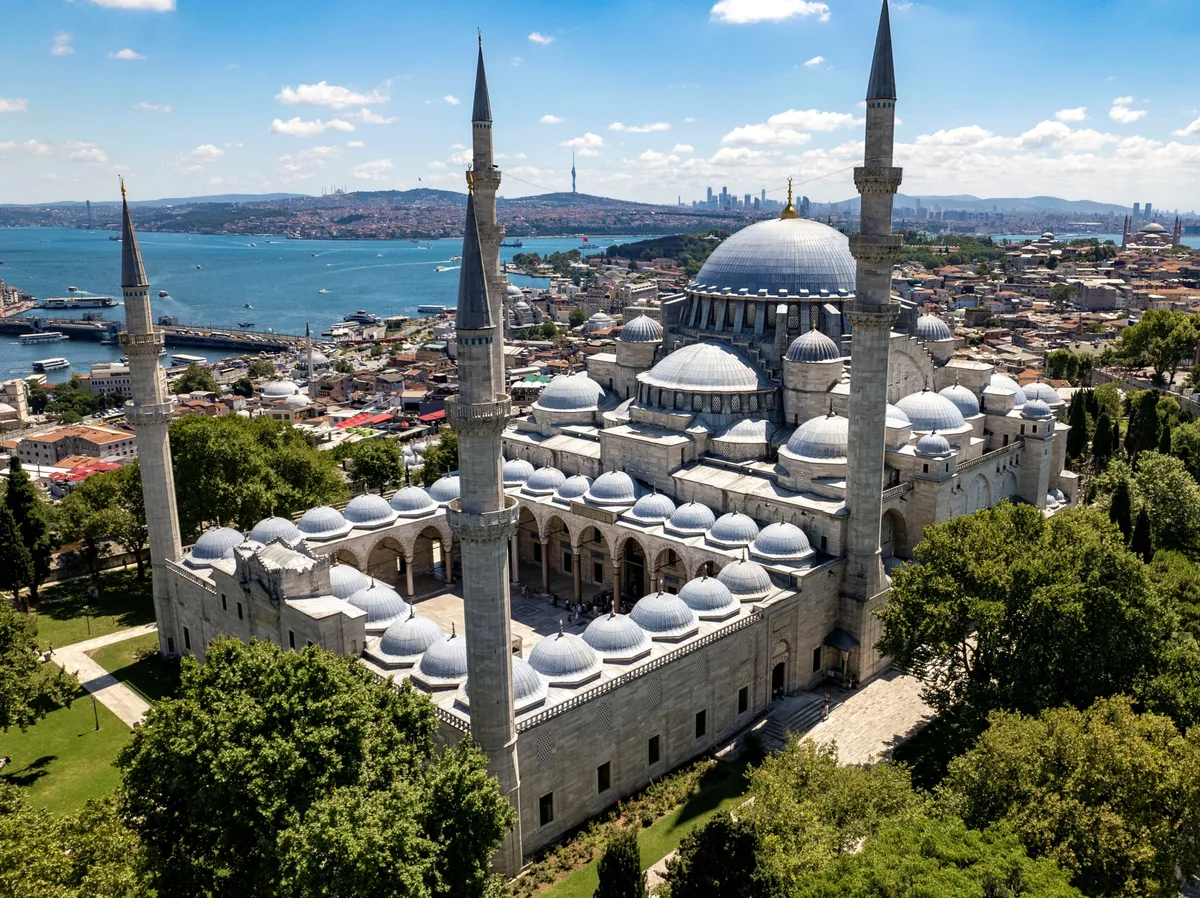
Photo: Hunanuk / CC0
What Your Eye SeesA massive hilltop mosque with a central dome flanked by four towering minarets, dominating the Golden Horn skyline.
ContextBuilt under Süleyman the Magnificent and designed by his master architect Mimar Sinan, this mosque rose as the Ottoman Empire reached its zenith, stretching from Budapest to Mecca. It was conceived more than as a place of worship but as a social complex (külliye) with hospitals, schools, a public kitchen, and a caravanserai (a roadside inn for merchants), employing over 2,000 people in the 16th century. Sinan built it between 1550 and 1557 and ranked it among his finest works. Behind the mosque lie the ornate tombs of Süleyman and his wife Hürrem Sultan.
The sultan who commissioned this complex was, like Mehmed before him, no ordinary conqueror. To his own people he was Kanuni, 'the Lawgiver', who codified the Ottoman legal code, fusing sultanic and Islamic law into a system that outlasted the empire by centuries. He was a poet, too, writing in Persian and Turkish under the pen name Muhibbi ('the Lover'); some of his verses passed into everyday proverbs, and his most famous were love poems addressed to Hürrem, the former slave from Ruthenia who became his wife and the great love of his life. He broke with Ottoman tradition to free and marry her, remaining devoted to her alone, a union that opened the era known as the 'Sultanate of Women.' As a young prince he had trained as a goldsmith in Trabzon, and he filled the palace workshops with hundreds of artisans, painters, bookbinders and jewelers among them. His 46-year reign was the longest in Ottoman history, and under it the empire reached its greatest extent, from Hungary, whose conquest carried Ottoman armies to the gates of Vienna in 1529, to Iraq and most of North Africa. The golden age of Ottoman art that Sinan's mosques crowned was, in the end, Süleyman's own making.
On ScreenThe Süleymaniye Mosque appears in the James Bond films Skyfall (2012) and From Russia with Love (1963).
Source: Wikipedia (Suleiman the Magnificent; Hürrem Sultan); Britannica; The Metropolitan Museum of Art; Wikipedia (Süleymaniye Mosque); Skyfall production notes; From Russia with Love production notes
DidYou
Know
The four minarets symbolize Kanuni Sultan Süleyman as the fourth Ottoman sultan after the conquest of Istanbul, and the ten balcony balustrades (şerefe) signify his place as the tenth sultan. Mimar Sinan called this his "apprenticeship work."
Share→ Sinan's Own Tomb
In the garden behind the mosque stands the modest stone tomb (türbe) of Mimar Sinan, the architect who designed this mosque. He prepared his own tomb here and was buried in it after his death in 1588, a plain resting place in the shadow of the imperial complex he built for Süleyman.
→ The Acoustic Jars
Look up into the dome to spot some sixty ceramic jars Sinan embedded within it and its corners, their openings turned inward. They act as resonance chambers that control the echo, letting a voice carry clearly across the great hall, a trick he reused from earlier Byzantine practice.
Sources: Wikipedia (Süleymaniye Mosque); Turkish Cultural Foundation; Archnet
Ancient Roots
Silk Road Legacy
Spiritual Seeker
8. Chora Church (Kariye)
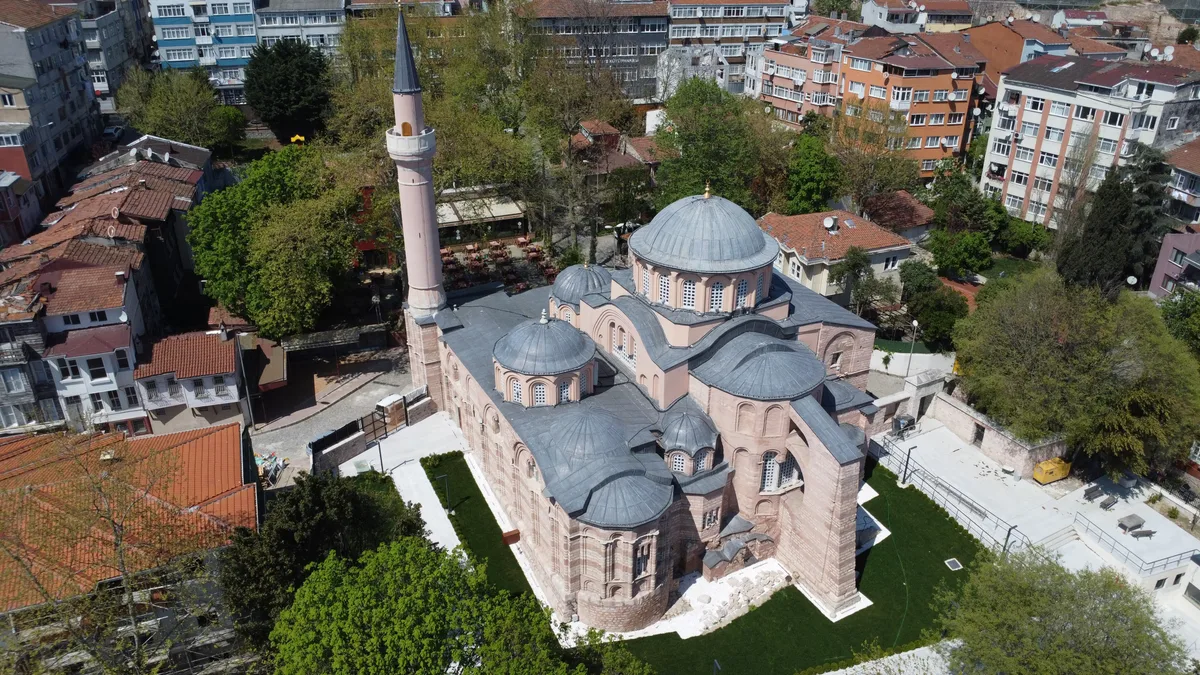
Photo: Tadam / CC0
What Your Eye SeesA modest stone church with brick courses, a large central dome, and multiple smaller domes, tucked behind high walls in the Edirnekapı neighborhood.
ContextOriginally built outside the city walls, "Chora" means "countryside" in Greek, the church was part of a monastery complex. During the Palaeologian Renaissance of the 14th century, the Byzantine court official Theodore Metochites funded a complete refurbishment, covering the interior with remarkably preserved mosaics and frescoes that narrate the story of salvation.
Source: UNESCO (Historic Areas of Istanbul); Kültür ve Turizm Bakanlığı; Wikipedia (Chora Church)
DidYou
Know
Its 14th-century mosaics and frescoes, uncovered in the 20th century, lay hidden beneath layers of plaster after the Ottoman conversion to a mosque, preserved for 500 years in near-perfect condition.
Share→ The Genealogy In The Dome
Look up into the south dome of the inner narthex: Christ Pantocrator is ringed by the ancestors of Christ, the kings and patriarchs from Adam down through Jacob, running in bands of mosaic between the dome's ribs.
→ The Parecclesion Fresco
Step into the side chapel to see the famous Anastasis fresco, in which a resolute Christ tears Adam and Eve from their tombs, bursting open the gates of Hell at his feet. It is counted among the most powerful compositions of late Byzantine art.
Sources: Wikipedia (Chora Church); Byzantine Legacy; UNESCO (Historic Areas of Istanbul)
Silk Road Legacy
Spiritual Seeker
9. Rumeli Fortress (Rumeli Hisarı)
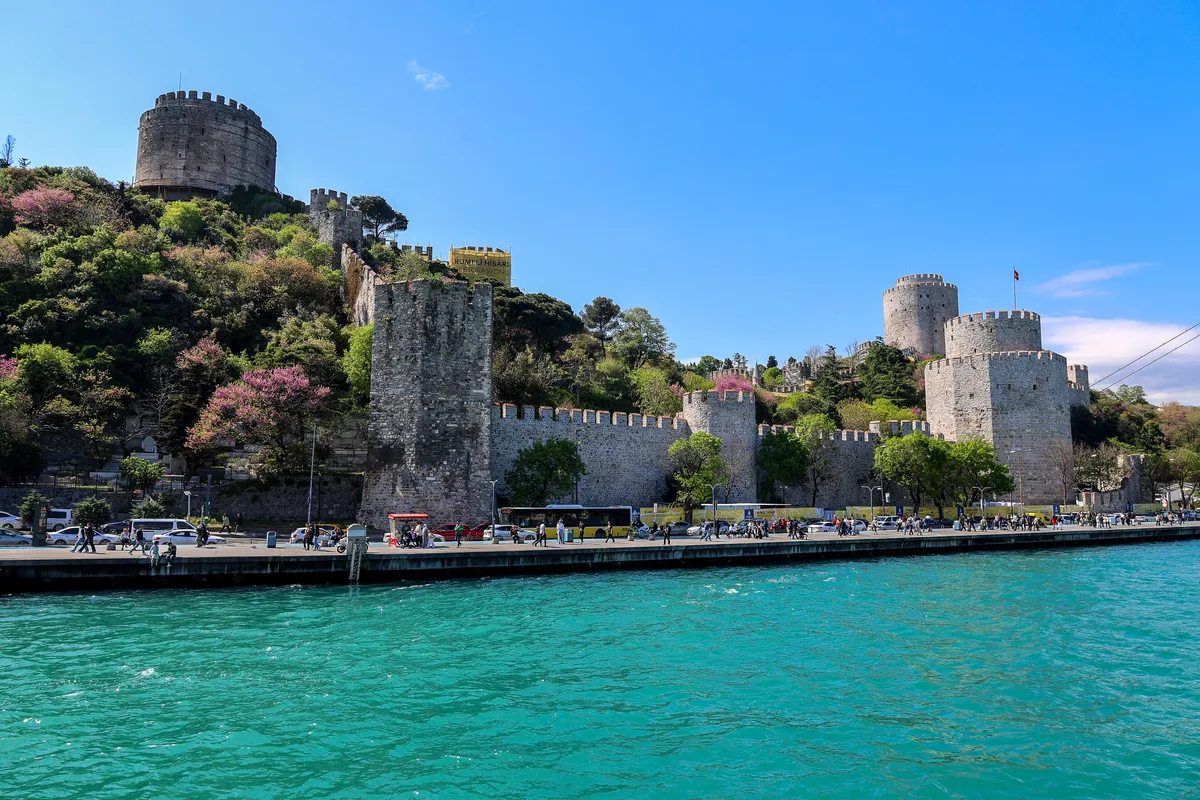
Photo: flowcomm / CC BY 2.0
What Your Eye SeesAn immense stone fortress with three main towers connected by massive curtain walls, stretching along the Bosphorus shore.
ContextMehmed II ordered this fortress constructed as part of a coordinated two-pronged strategy to isolate Constantinople. Simultaneously, an older fortress on the Asian shore (Anadolu Hisarı, built by his grandfather) blocked the Bosphorus from the other side. Together, they cut the city's maritime supply lines entirely.
Mehmed II raised it in just over four months in 1452, a pace that stunned contemporaries, and nicknamed it Boğazkesen, 'Strait-cutter', for the way its cannon could choke traffic on the Bosphorus. Each of its three great towers was built by, and named after, one of the sultan's viziers, turning a fortress into a contest of prestige.
Source: Kültür ve Turizm Bakanlığı; Wikipedia (Rumeli Hisarı)
DidYou
Know
Mehmed II's fortress was built to choke the Bosphorus so tightly that Byzantine grain shipments from the Black Sea could no longer reach Constantinople, starving the city by sea months before he ever marched on its walls.
Share→ The Three Pashas
The fortress's three great towers are named after the pashas who supervised their construction, Saruca Pasha, Halil Pasha and Zağanos Pasha. Rival crews raced to finish their sections, and the varying stonework between the towers still hints at where one mason's work ended and another's began.
Sources: Wikipedia (Rumeli Fortress); Ministry of Culture and Tourism (Turkey)
Silk Road Legacy
10. Valens Aqueduct (Bozdoğan Kemeri)
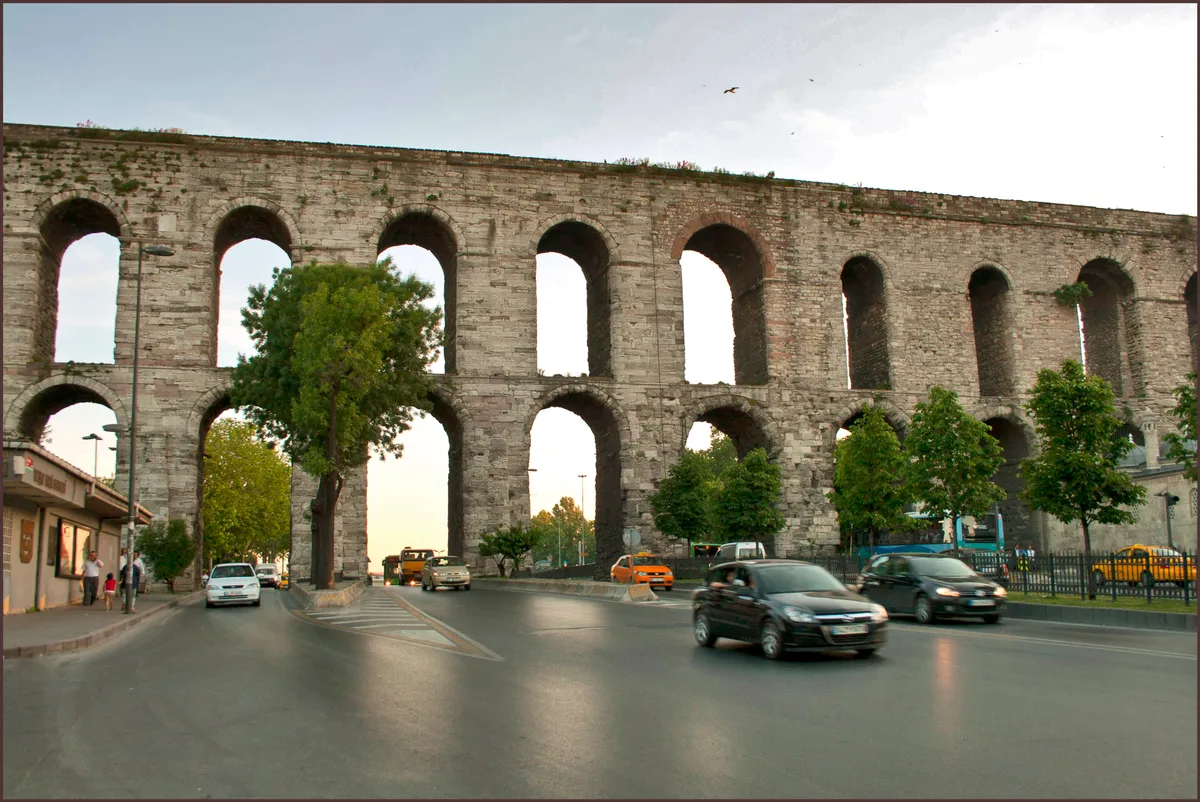
Photo: Laima Gūtmane (simka… / CC BY-SA 3.0
What Your Eye SeesA monumental double-tiered Roman aqueduct spanning nearly a kilometre across the valley between the third and fourth hills of Istanbul.
ContextEmperor Valens completed this aqueduct around 368 AD to carry water from springs many kilometres to the west of the city into a growing Constantinople. Repaired by Byzantine emperors and later restored by Ottoman sultans after 1453, it stayed a functioning part of the capital's water system for well over a millennium.
Justinian's wider rebuilding of Constantinople also produced Hagia Sophia and the Basilica Cistern, and reached St Nicholas Church at Myra.
Source: UNESCO (Historic Areas of Istanbul); Kültür ve Turizm Bakanlığı; Wikipedia (Valens Aqueduct)
DidYou
Know
After the Nika riots of 532 levelled much of Constantinople, Justinian rebuilt this aqueduct as part of his reconstruction of the city, so the arches you see carry the repair work of an emperor better known for Hagia Sophia.
Share→ Traffic Beneath The Arches
From street level, look up: the aqueduct strides across the valley on two stacked tiers of arches, and the traffic of Atatürk Boulevard now runs straight through the arcade. Buses and cars pass beneath the same piers that carried Constantinople's water supply, the water itself flowed in a covered channel along the top, far above the road.
Sources: Wikipedia (Valens Aqueduct); UNESCO (Historic Areas of Istanbul)
Ancient Roots
11. Ortaköy Mosque (Büyük Mecidiye Camii)
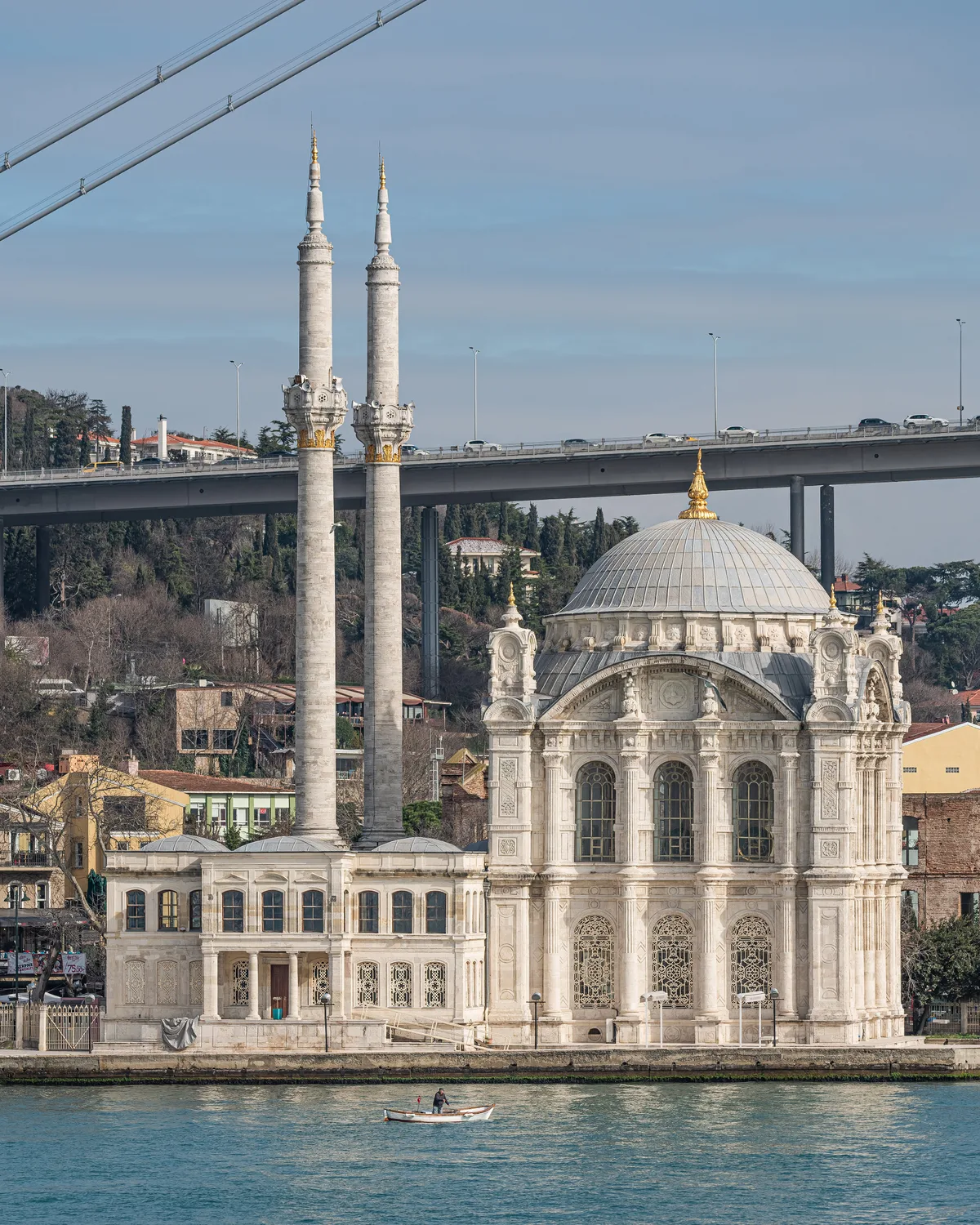
Photo: A.Savin / FAL
What Your Eye SeesAn elegant white neo-baroque mosque with two slender minarets and wide arched windows, set directly on the Bosphorus waterfront.
ContextSultan Abdülmecid I built this mosque, designed by his court architect Garabet Balyan, as part of the Tanzimat reforms, a 19th-century wave of Western-inspired modernization. Its neo-baroque style was a deliberate visual declaration: the Ottoman Empire could adopt European aesthetics without losing its Islamic identity.
It reads best from the water because it was built to be seen from it: the same Balyan hands, the Armenian court architects behind Dolmabahçe, gave the empire its most European mosque, all Neo-Baroque curves and colossal windows. When the Bosphorus Bridge rose directly behind it in 1973, it accidentally composed Istanbul's most-photographed old-meets-new image: 1850s lace against 1970s steel.
Abdülmecid's neo-Baroque mosque had a foreshadowing across the Mediterranean: Muhammad Ali's Mosque in Cairo, built in the 1830s–40s, had already borrowed the Ottoman Baroque vocabulary of Istanbul's great mosques.
Source: Kültür ve Turizm Bakanlığı; Wikipedia (Ortaköy Mosque)
DidYou
Know
Look at the slim minarets: their original shafts were fluted, grooved like a column. After the devastating 1894 Istanbul earthquake they were rebuilt in the plainer style you see today, an early photograph is the only record of the originals.
Share→ The Carved Stone Reliefs
Run your eyes over the facades: they are lined with engaged columns and covered in richly carved stone reliefs. Unlike the smooth classical surfaces of most Ottoman Baroque mosques, Ortaköy's stonework is picked out in sculpted ornament, giving the little mosque its restless, dynamic appearance.
Sources: Wikipedia (Ortaköy Mosque); Ministry of Culture and Tourism (Turkey)
Euro Heritage
Baroque Master
Spiritual Seeker
12. New Mosque (Yeni Cami)
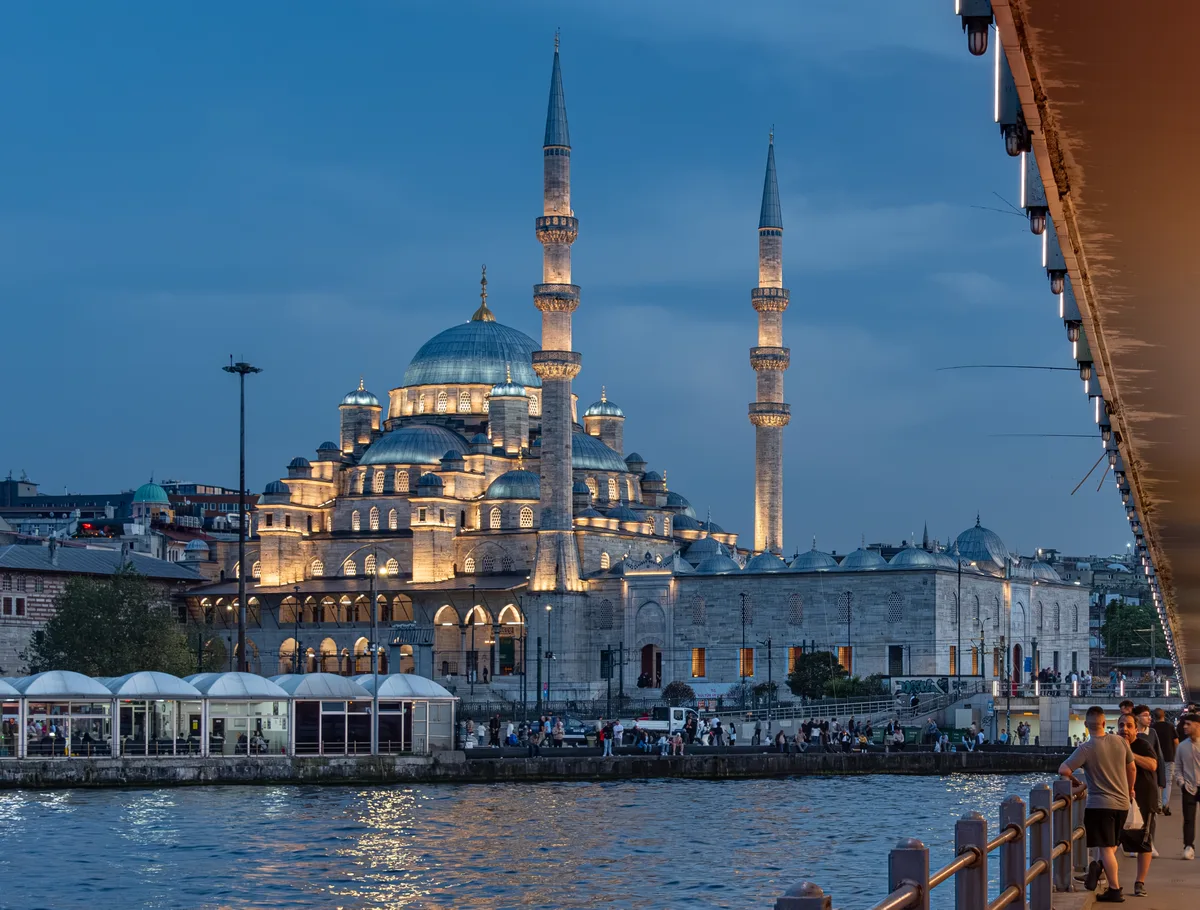
Photo: Jorge Franganillo / CC BY 2.0
What Your Eye SeesA large courtyard mosque with two tall minarets and cascading domes, located at the foot of the Galata Bridge in Eminönü.
ContextThe mosque's construction history mirrors the political turbulence of the 17th-century Ottoman court. Commissioned by Safiye Sultan, mother of Mehmed III, the project stalled for decades after her son's death and her subsequent exile. The unfinished shell stood as an urban embarrassment until Turhan Hatice Sultan completed it in 1665. The mosque was designed by the court architect Davud Ağa.
Its construction, from 1597 to 1665, is the longest of any Ottoman imperial mosque. While the shell stood abandoned for two generations, Sultan Ahmed I made a telling choice: he raised a monument in his own name instead, the Blue Mosque, rather than finish the Valide Sultan's project. The 'New' Mosque was therefore completed only after the Blue Mosque that rose nearby during its long silence.
On ScreenThe New Mosque features in the James Bond film Skyfall (2012).
Source: Kültür ve Turizm Bakanlığı; Wikipedia (New Mosque); Wikipedia (New Mosque); Skyfall production notes
DidYou
Know
The New Mosque took 68 years to complete, begun by one queen mother, Safiye Sultan, and finished by another, Turhan Hatice, while the young Ahmed I spent the middle decades raising his own Blue Mosque and left Safiye's Golden Horn shell stranded.
Share→ The Sundials On The Wall
Look at the southwestern face of the courtyard wall for three marble sundials set into the stone; the oldest is dated 1663-64, carved in the final years of the mosque's six-decade-long construction. For centuries their shadows told time for the Eminönü bazaar district.
Sources: Wikipedia (New Mosque, Istanbul); Ministry of Culture and Tourism (Turkey)
Ancient Roots
Silk Road Legacy
Spiritual Seeker
13. Eyüp Sultan Mosque (Eyüp Sultan Camii)
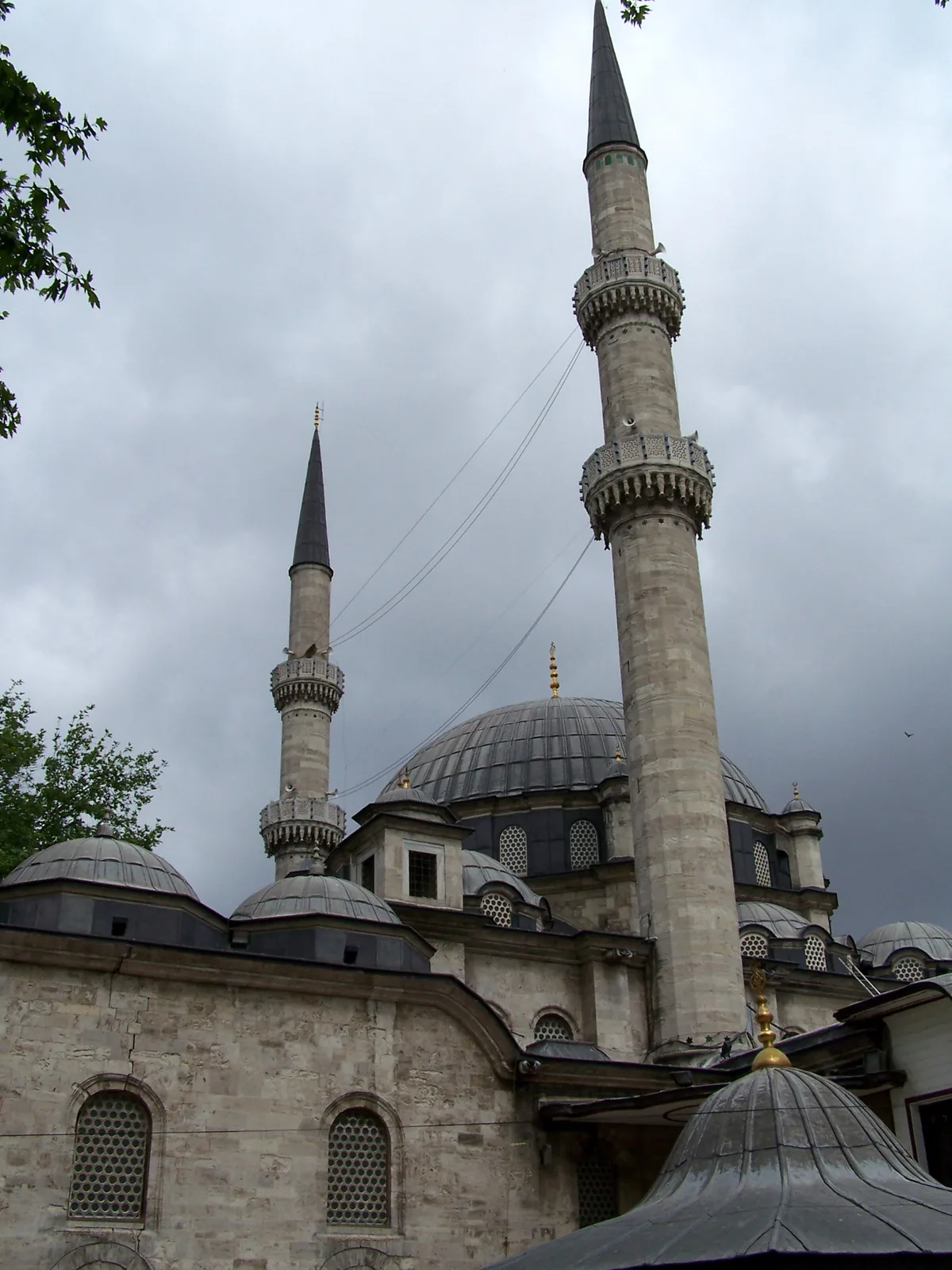
Photo: User:Darwinek / CC BY-SA 3.0
What Your Eye SeesA religious complex with two minarets, a large central dome, and a wide courtyard, located outside the city walls along the Golden Horn.
ContextThis area has been a pilgrimage destination since 1453, when Mehmed II discovered the tomb of Abu Ayyub al-Ansari shortly after conquering Constantinople. The discovery established an unbroken tradition: for 500 years, every Ottoman sultan came to Eyüp to be girt with the Sword of Osman, the dynasty's founding blade, brought here in procession from the Topkapı treasury, at his accession ceremony.
Source: Kültür ve Turizm Bakanlığı; Wikipedia (Eyüp Sultan Mosque)
DidYou
Know
The mosque complex houses the tomb of Abu Ayyub al-Ansari (Eyüp Sultan), the Prophet Muhammad's standard-bearer who died during the first Arab siege of Constantinople in 674. It remains one of the most sacred pilgrimage sites in Istanbul.
Share→ The Courtyard Ablution Fountain (Şadırvan)
In the outer courtyard, look for the ablution fountain (şadırvan), the marble fountain with its ring of taps and carved basin where worshippers washed before prayer. It is a piece of the old complex that survived the rebuilding of the mosque itself.
→ The Plane Tree Parterre
In the middle of the inner courtyard an old plane tree stands on a raised rectangular platform, with Baroque marble fountains set at its corners. This shaded parterre among the courtyard's colonnades is one of the calmest corners of the whole complex.
Sources: Wikipedia (Eyüp Sultan Mosque); TDV İslâm Ansiklopedisi; Ministry of Culture and Tourism (Turkey)
Silk Road Legacy
Spiritual Seeker
14. Fatih Mosque (Fatih Camii)
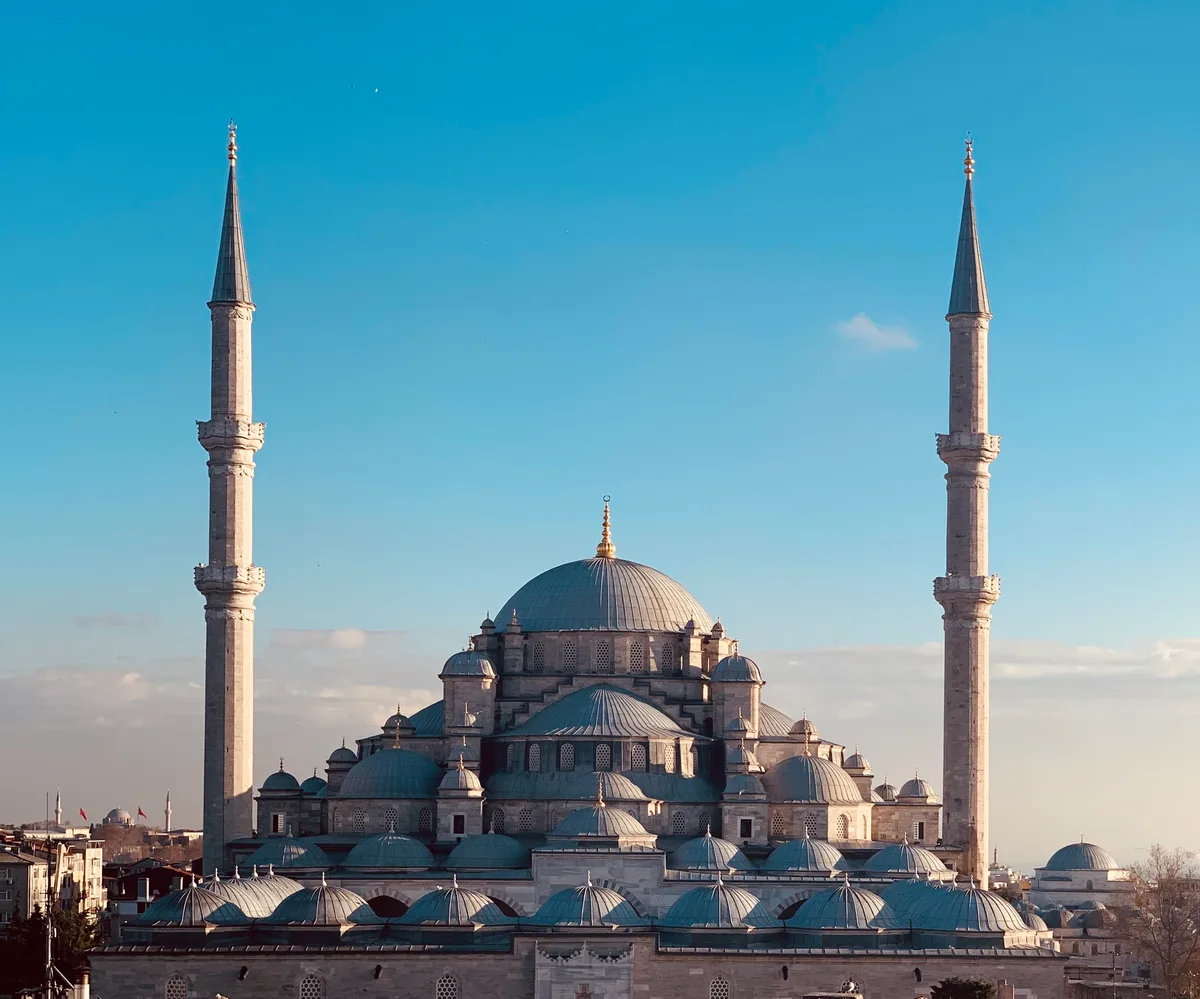
Photo: Ezzeldin.Elbaksawy / CC BY-SA 4.0
What Your Eye SeesAn imposing mosque with a large central dome surrounded by four semi-domes and two minarets, on a hill overlooking the Golden Horn.
ContextNamed "Fatih" (Conqueror) after Mehmed II, this mosque was built on the ruins of the Church of the Holy Apostles, one of Constantinople’s most important Byzantine churches. The original mosque was designed by the Greek architect Atik Sinan and stood as the most ambitious post-conquest architectural statement in the city.
The man who ordered this complex took Constantinople at twenty-one, the sultan who hauled his fleet overland on greased runners to bypass the great chain and seize the Golden Horn. Victory fed an imperial imagination: he styled himself "Kayser-i Rûm" (Caesar of the Romans), heir to the Byzantine emperors he had unseated. Yet he was no mere warrior-prince. Reputed fluent in six languages, Turkish, Arabic, Persian, Greek, Latin and Serbian, he gathered Italian humanists, Greek scholars and astronomers at his court, summoned the Venetian painter Gentile Bellini to Constantinople in 1479 for his portrait, and amassed a library of Greek, Persian and Latin manuscripts. He was himself a poet, too, under the pen name Avnî he compiled a divan (a collected book of poems) in Turkish and Persian, in the classical tradition of the Persian poets Sa’di and Hafiz. The complex he raised here, its mosque ringed by eight colleges, was the outward face of that same ambition: to patronize learning across the cultures of his empire. His ambition reached west to Italy itself: in 1480 his commander Gedik Ahmed Pasha seized Otranto, the first Ottoman foothold on Italian soil.
Source: Wikipedia (Fatih Mosque; Mehmed II); Britannica; FSMVÜ; Kültür ve Turizm Bakanlığı
DidYou
Know
The original mosque, built by Mehmed II immediately after the conquest, completely collapsed in the 1766 earthquake. What stands today is an 18th-century replacement in Ottoman baroque style, a rebuild rising from the ruins of Mehmed's original.
Share→ The Conqueror's Tomb
Behind the mosque stands the tomb of Mehmed II, 'the Conqueror', who built the original mosque and was himself buried here after his death in 1481. The surrounding complex was once a vast religious complex (külliye) with eight colleges, the famed Sahn-ı Seman ('the Eight Colleges'), a hospital, a library and public baths.
→ The Original Tile Panels
Look up in the inner courtyard at two tile panels above window lintels, rare survivors from Mehmed II's original 1470 mosque. One bears the Basmala, the other a passage from the Throne Verse; both use a yellow tone found only in 15th-century Ottoman tiles.
Sources: Wikipedia (Fatih Mosque); TDV İslâm Ansiklopedisi; Britannica
Silk Road Legacy
Euro Heritage
Baroque Master
Spiritual Seeker
15. Beylerbeyi Palace (Beylerbeyi Sarayı)
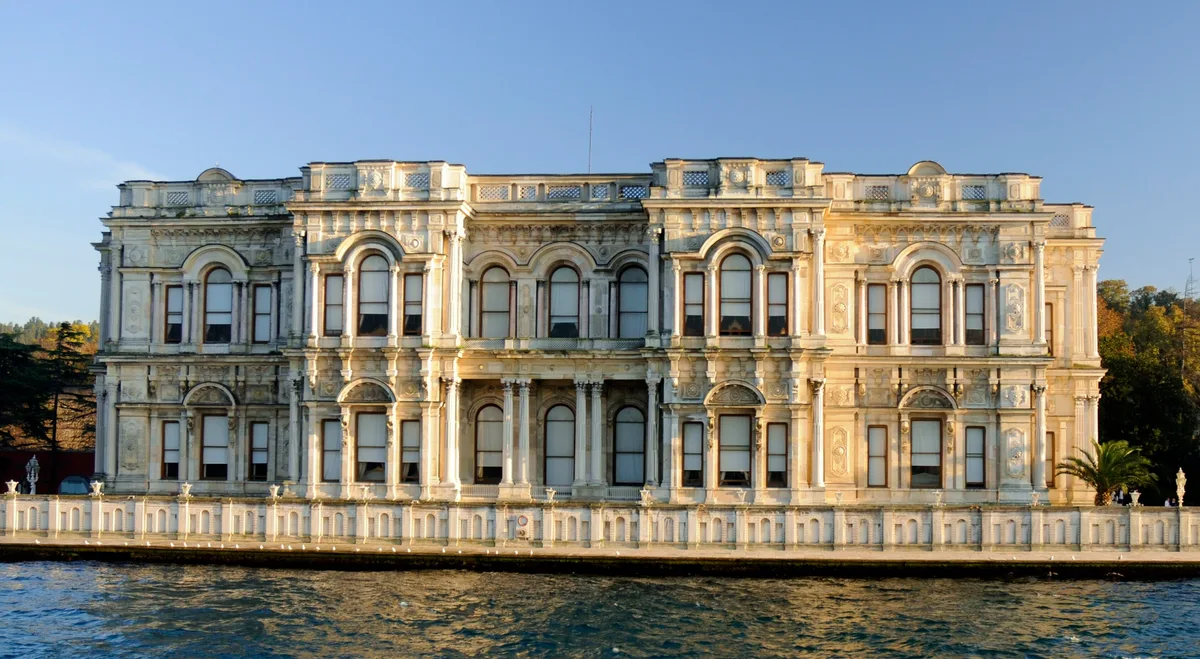
Photo: mayanming / CC BY-SA 3.0
What Your Eye SeesA gleaming white marble neo-baroque palace with symmetrical facades, set on the Asian shore of the Bosphorus.
ContextCommissioned in 1861 by Sultan Abdülaziz as a summer residence and guest palace for visiting foreign dignitaries, Beylerbeyi hosted royalty from across Europe, including Empress Eugénie of France and Emperor Franz Joseph of Austria. Unlike the opulent Dolmabahçe, this palace was designed for warmer months, with cross-ventilation and shaded gardens.
Abdülaziz was the empire's most travelled sultan, he had toured Paris, London and Vienna in 1867, and he wanted a European retreat to match. The result charmed even Empress Eugénie of France, who on her 1869 visit was so taken with her guest-room window that she had a copy made for the Tuileries; two marble bathing pavilions still step straight into the Bosphorus, one for the harem and one for the selamlık (the men's quarters).
Source: Milli Saraylar (National Palaces); Wikipedia (Beylerbeyi Palace)
DidYou
Know
After his 1909 deposition, the last great Sultan Abdülhamid II was brought back to Beylerbeyi Palace, where he lived under guard and died in 1918, the same waterfront retreat that had once hosted Europe's royalty as a guest palace.
Share→ The Twin Bathing Pavilions
On either side of the palace's shore front two small bathing pavilions project toward the water, one for the harem, one for the selamlik, and are best seen from a passing boat. Their pale marble and arched windows are a distinctive feature of the waterfront elevation.
Sources: Wikipedia (Beylerbeyi Palace); National Palaces (Turkey)
Euro Heritage
Baroque Master
16. Çırağan Palace (Çırağan Sarayı)
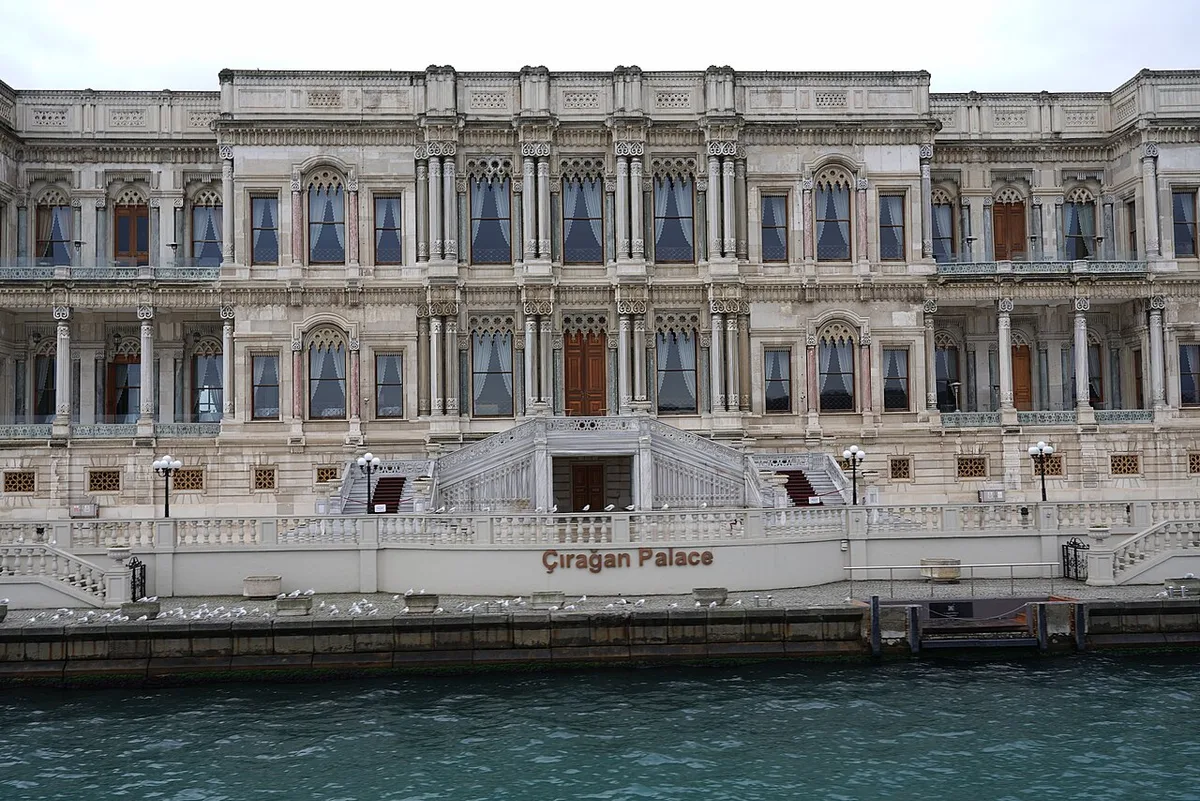
Photo: Ray Swi-hymn from Sijhih-Taipei, Taiwan / CC BY-SA 2.0
What Your Eye SeesAn ornate white marble palace with a distinctive arched colonnade running along the Bosphorus waterfront.
ContextCommissioned by Sultan Abdülaziz, who was deeply influenced by European architecture during his visit to Paris, London, and Vienna in 1867. The palace was built on the site of an earlier garden complex filled with "çırağan" (lantern-lit festivals), giving the palace its name. Abdülaziz was found dead inside in 1876, shortly after his deposition, under mysterious circumstances. It was designed by the Balyan family of Ottoman Armenian architects, Sarkis, Agop, and Nigoğayos Balyan.
Source: Milli Saraylar (National Palaces); Wikipedia (Çırağan Palace)
DidYou
Know
After a devastating fire in 1910, the palace stood as a burned shell for eight decades before being meticulously reconstructed and reopened as a luxury hotel in 1992, preserving 19th-century Ottoman grandeur in modern form.
Share→ The Waterfront Marble
Seen from the water, the palace reads as one long marble facade running along the Bosphorus shore, its rows of arched windows and balconies facing the strait. The white stone reflects in the current that once carried the sultan's caïques.
Sources: Wikipedia (Çırağan Palace); National Palaces (Turkey)
Silk Road Legacy
Euro Heritage
Baroque Master
17. Maiden's Tower (Kız Kulesi)
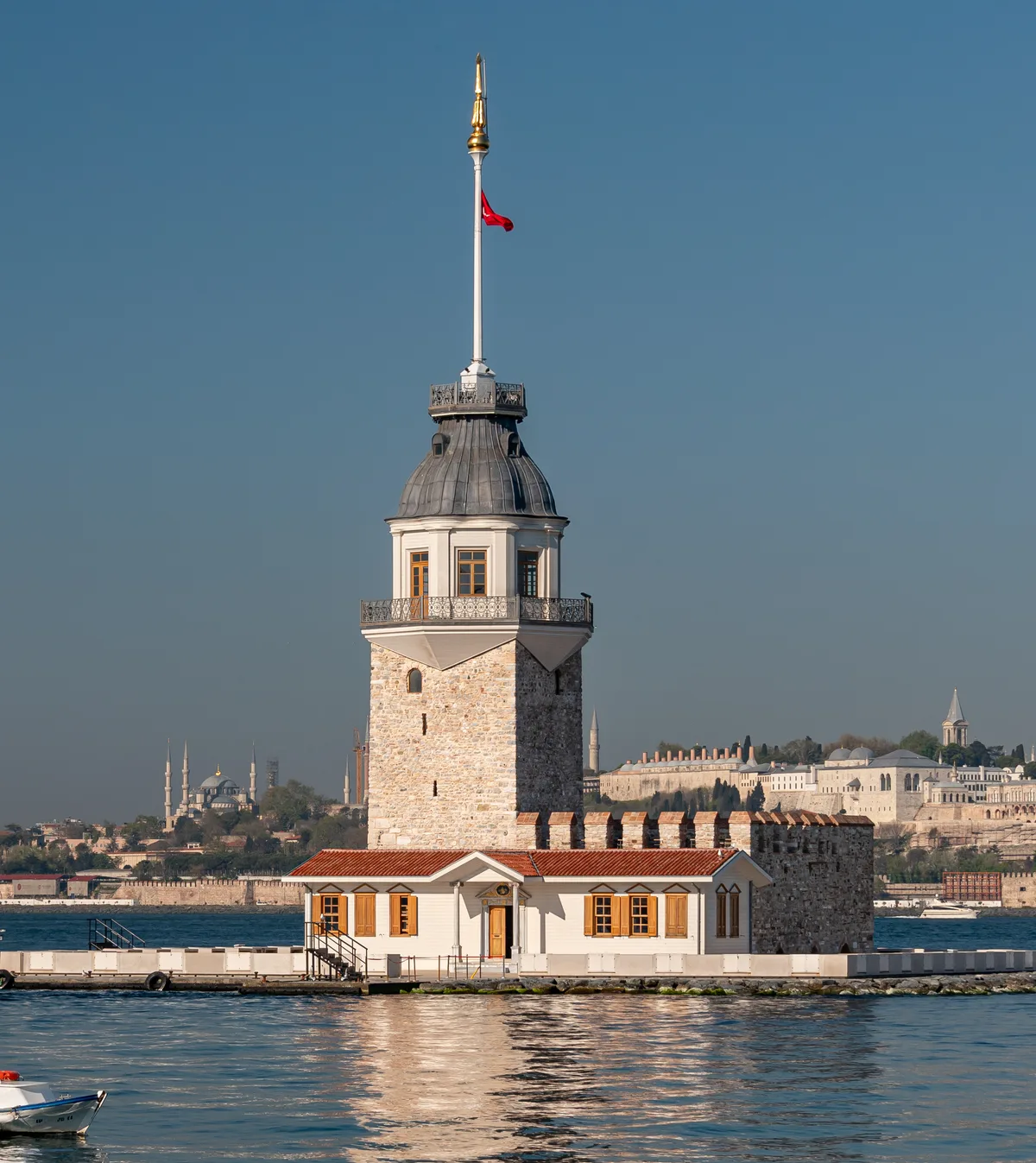
Photo: Jorge Franganillo / CC BY 2.0
What Your Eye SeesA small stone tower standing alone on a tiny rocky island in the Bosphorus, accessible only by boat.
ContextOne of Istanbul's oldest surviving structures, the tower's foundation dates back to a 5th-century BC Athenian customs station. Over the centuries, it has been rebuilt by Roman, Byzantine, and Ottoman rulers, each leaving their architectural mark. During the Byzantine era, a massive chain stretched from the tower to the European shore, blocking enemy ships from entering the Golden Horn.
It stands alone on a small islet at the southern mouth of the Bosphorus, and over the centuries served as a customs post, a lighthouse, and a quarantine station.
On ScreenThe James Bond film The World Is Not Enough (1999) used Maiden's Tower as a filming location.
Source: Kültür ve Turizm Bakanlığı; Wikipedia (Maiden's Tower); Wikipedia (The World Is Not Enough); production notes
DidYou
Know
Legend says a sultan imprisoned his daughter here after a prophecy foretold death by snakebite on her 18th birthday. The snake reached her concealed in a fruit basket, and the prophecy fulfilled itself.
Share→ The Stone On The Rock
Stand on the Salacak shore and look across: the tower rises from a bare rock outcrop, its lower storey of stone masonry tapering up to white-painted upper floors and a dome. The tiny islet and slender body make it look impossibly balanced in mid-strait.
→ The Balcony In The Sky
Look up just below the summit to the ringed balcony projecting from the stone body of the tower, giving it its distinctive waisted silhouette. From this deck the whole Bosphorus, the Golden Horn, Topkapı and the Asian shore, swings into view.
Sources: Wikipedia (Maiden's Tower); Ministry of Culture and Tourism (Turkey); UNESCO
Silk Road Legacy
18. Grand Bazaar (Kapalıçarşı)
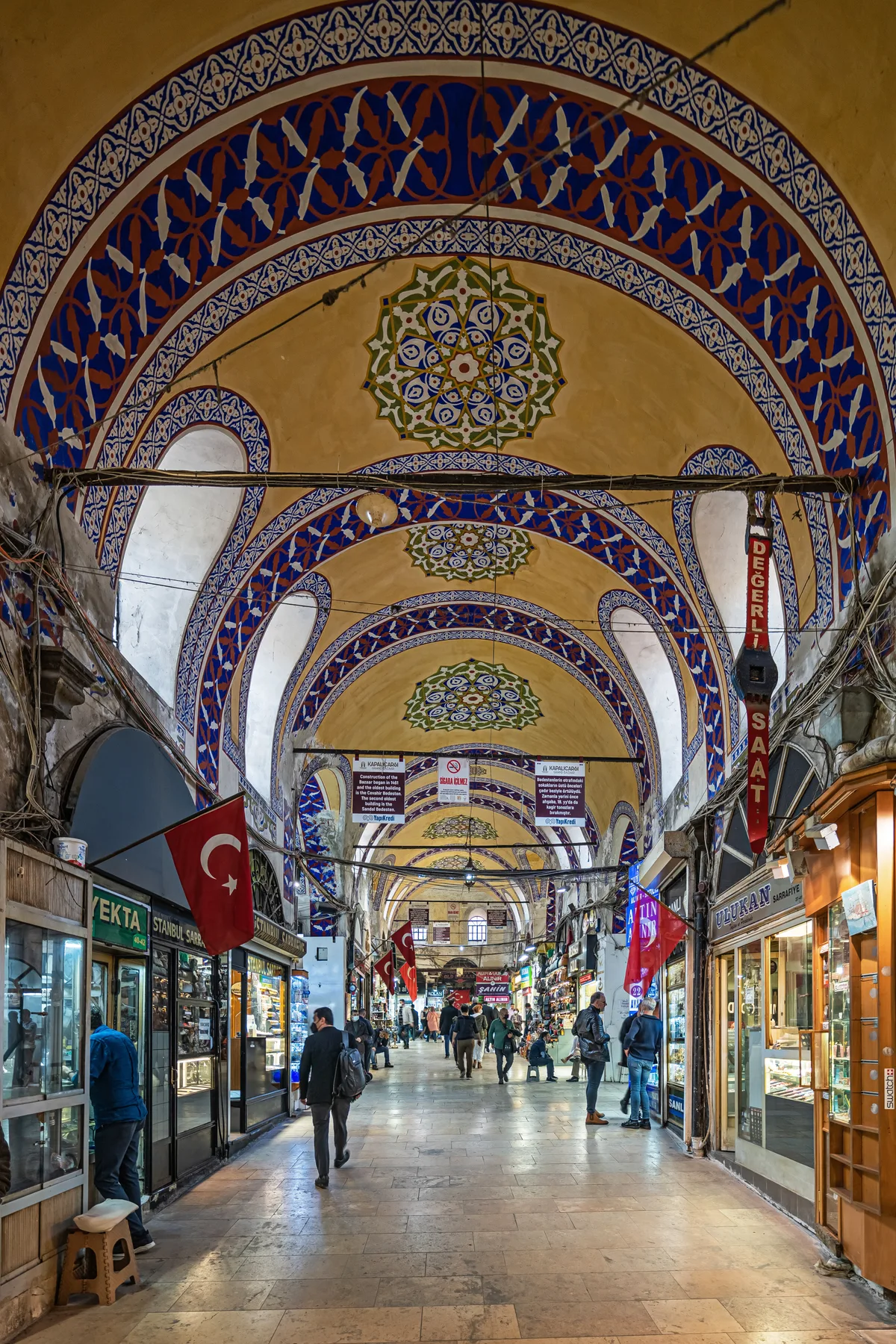
Photo: A.Savin / FAL
What Your Eye SeesA walled quarter of vaulted, covered streets packed with shops and arcades near the old city's heart, entered through arched stone gates.
ContextBegun by Sultan Mehmed II in 1461 around the domed Eski Bedesten, the bazaar’s oldest covered market, the Grand Bazaar grew into one of the largest and oldest covered markets in the world. Its 61 covered streets and some 4,000 shops fill a walled quarter near the heart of the old city, entered through arched gates that once locked at night, and it is still visited by hundreds of thousands of people every day.
On ScreenThe Grand Bazaar appears in From Russia with Love (1963), Taken 2 (2012), Skyfall (2012) and Dan Brown's Inferno (2016).
Source: UNESCO (Historic Areas of Istanbul); Kültür ve Turizm Bakanlığı; Wikipedia (Grand Bazaar); Wikipedia (From Russia with Love); Wikipedia (Taken 2); Wikipedia (Skyfall); Wikipedia (Inferno); production notes
DidYou
Know
At its heart stand the bazaar's two oldest, most heavily guarded structures: the bedestens (covered markets), vaulted medieval trade halls where luxury goods were locked away each night. The maze only received its official street names in 1927, and five centuries on, its lanes still trace a medieval guild system.
Share→ The Gates That Once Locked
Look for the around 18 arched gates piercing the bazaar's walls, in earlier centuries they were shut and bolted every night, closing the market like a fortress.
→ The Domed Hall At The Core
Step into the core of the complex to the Eski Bedesten, a domed stone hall raised before most of the surrounding streets were covered. Its heavy doors once closed on gold, antiques and carpets, which changed hands at daily auctions beneath the dome.
Sources: Wikipedia (Grand Bazaar, Istanbul); Ministry of Culture and Tourism (Turkey); UNESCO (Historic Areas of Istanbul)
Silk Road Legacy
 Time Traveler
19. Obelisk of Theodosius (Dikilitaş)
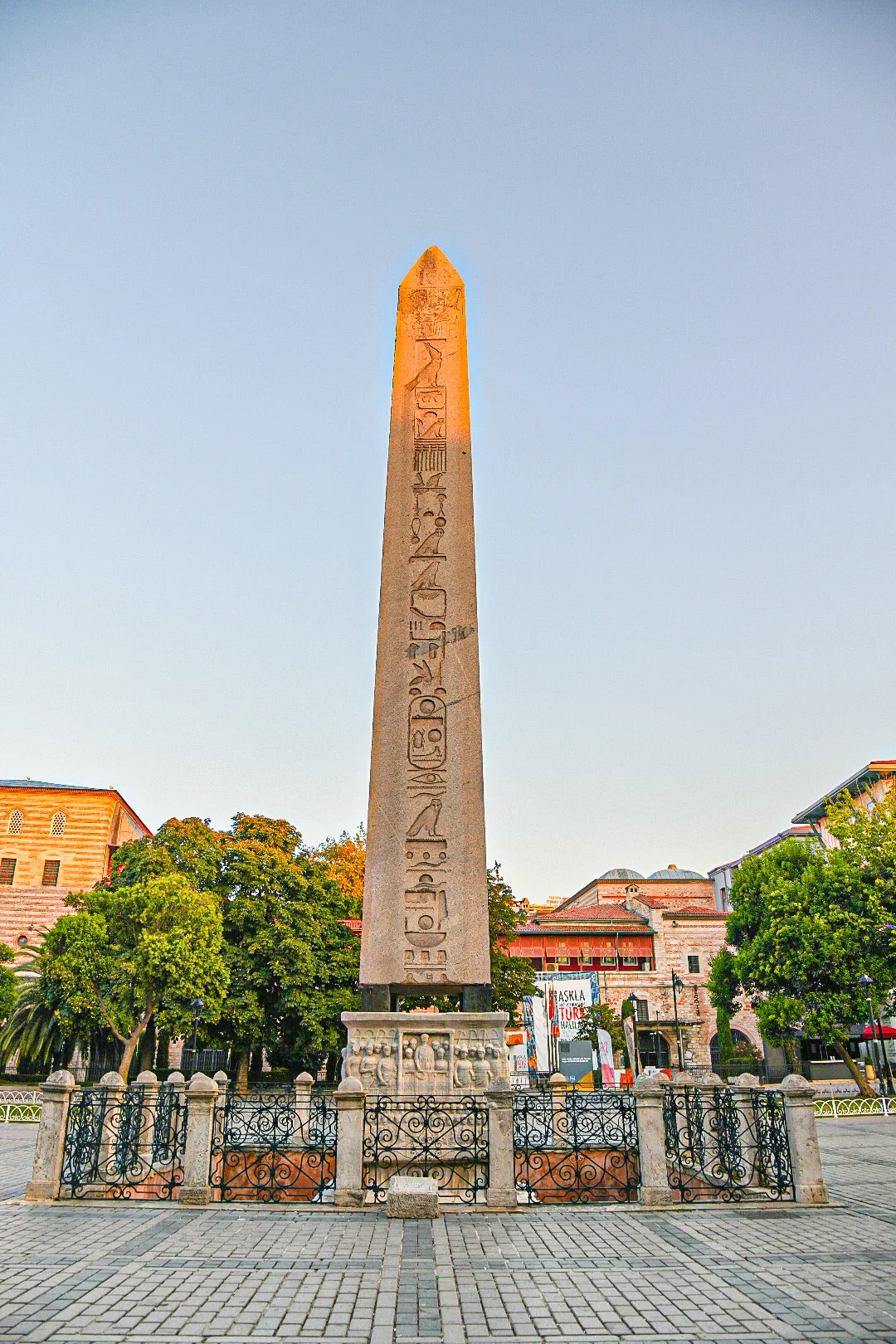
Photo: Apaleutos25 / CC BY-SA 4.0
What Your Eye SeesA tall rose-granite obelisk carved with hieroglyphs, standing on a carved marble base in the open ground of the old Hippodrome.
ContextCarved in Egypt from red Aswan granite for Pharaoh Thutmose III in the 15th century BC, the obelisk stood about 30 metres tall at Karnak before its lower third was lost. Constantius II moved it to Alexandria in 357; Theodosius I re-erected it on the Hippodrome's spina in AD 390, where its 18.5-metre shaft (25.6 m with the pedestal) still stands, the oldest ancient object in Istanbul.
Source: UNESCO (Historic Areas of Istanbul); Kültür ve Turizm Bakanlığı; Wikipedia (Obelisk of Theodosius)
DidYou
Know
When Theodosius re-erected the obelisk in AD 390, four bronze cubes were left at its corners to brace it upright, the only hardware of the ancient lifting operation still in place, while the pharaoh's shaft lost its lower third somewhere in antiquity.
Share→ Hieroglyphs For A Pharaoh
Look up at the carved hieroglyphs: the column's faces still tell of Thutmose III's campaigns across Syria, cut in Egypt long before Rome or Constantinople existed.
→ The Reliefs On The Base
Look at the marble pedestal below the obelisk for reliefs showing Theodosius and his family watching chariot races from the imperial box, a scene of the very ground the obelisk still stands on.
Sources: Wikipedia (Obelisk of Theodosius); UNESCO (Historic Areas of Istanbul); Ministry of Culture and Tourism (Turkey)
Ancient Roots
Time Traveler
20. Serpentine Column (Yılanlı Sütun)
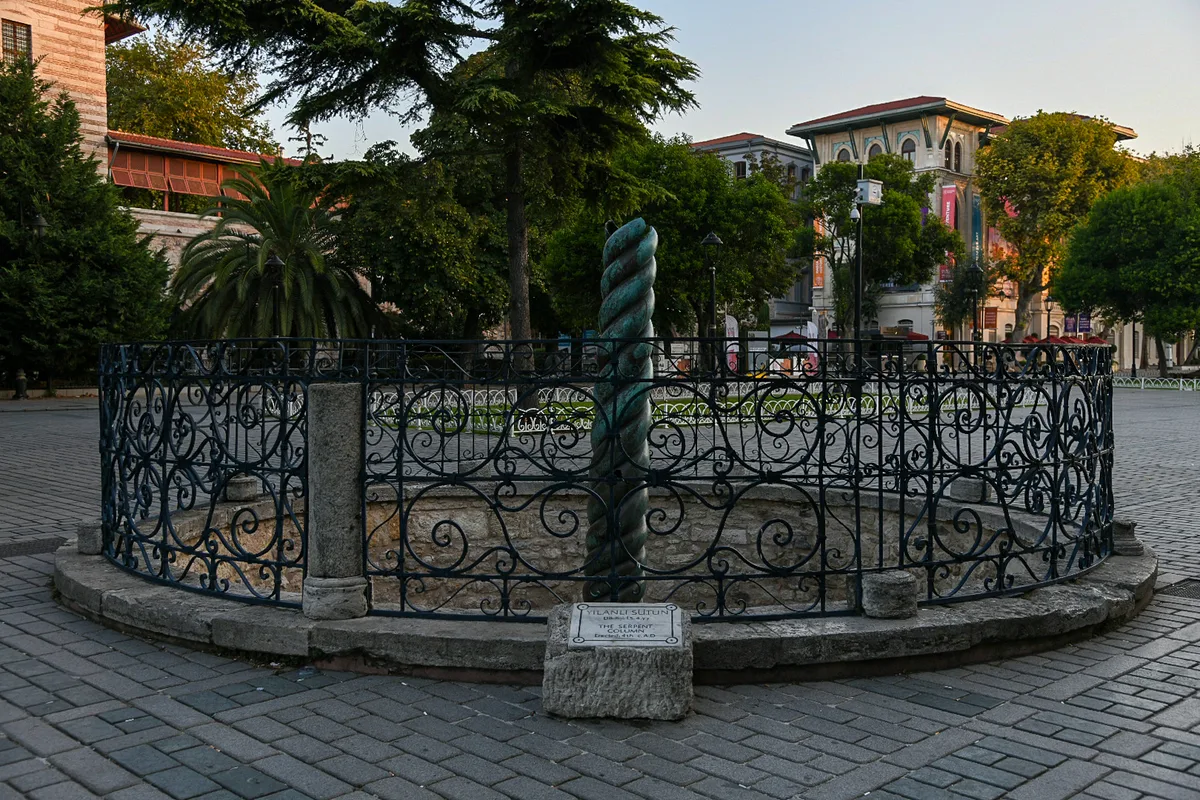
Photo: Apaleutos25 / CC BY-SA 4.0
What Your Eye SeesA dark twisted bronze column of three entwined snakes rising from a low stone base in the open ground of the old Hippodrome.
ContextCast at Delphi around 479 BC to celebrate the Greek victory over Persia at Plataea, the Serpentine Column was crowned by a golden tripod dedicated to Apollo. Constantine the Great moved it to Constantinople, where its three entwined bronze serpents still rise in the Hippodrome. The names of 31 Greek city-states are engraved on its coils; its serpent heads were lost in 1700.
Source: UNESCO (Historic Areas of Istanbul); Kültür ve Turizm Bakanlığı; Wikipedia (Serpentine Column)
DidYou
Know
According to the historian Herodotus, the Greeks forged this column from the melted-down bronze of Persian weapons stripped from the battlefield, an entire war machine recast as a victory memorial.
Share→ The Missing Heads
Look for where the three serpent heads once crowned the column, they are long gone, though one surviving head sits in the Istanbul Archaeology Museums, a short walk from the Hippodrome.
→ Built To Hold A Tripod
Look at the top of the column where a golden tripod once stood, the bowl-and-stand that the Greek city-states dedicated together at Delphi.
Sources: Wikipedia (Serpent Column); UNESCO (Historic Areas of Istanbul); Ministry of Culture and Tourism (Turkey)
Ancient Roots
Time Traveler
21. Walled Obelisk (Örme Dikilitaş)
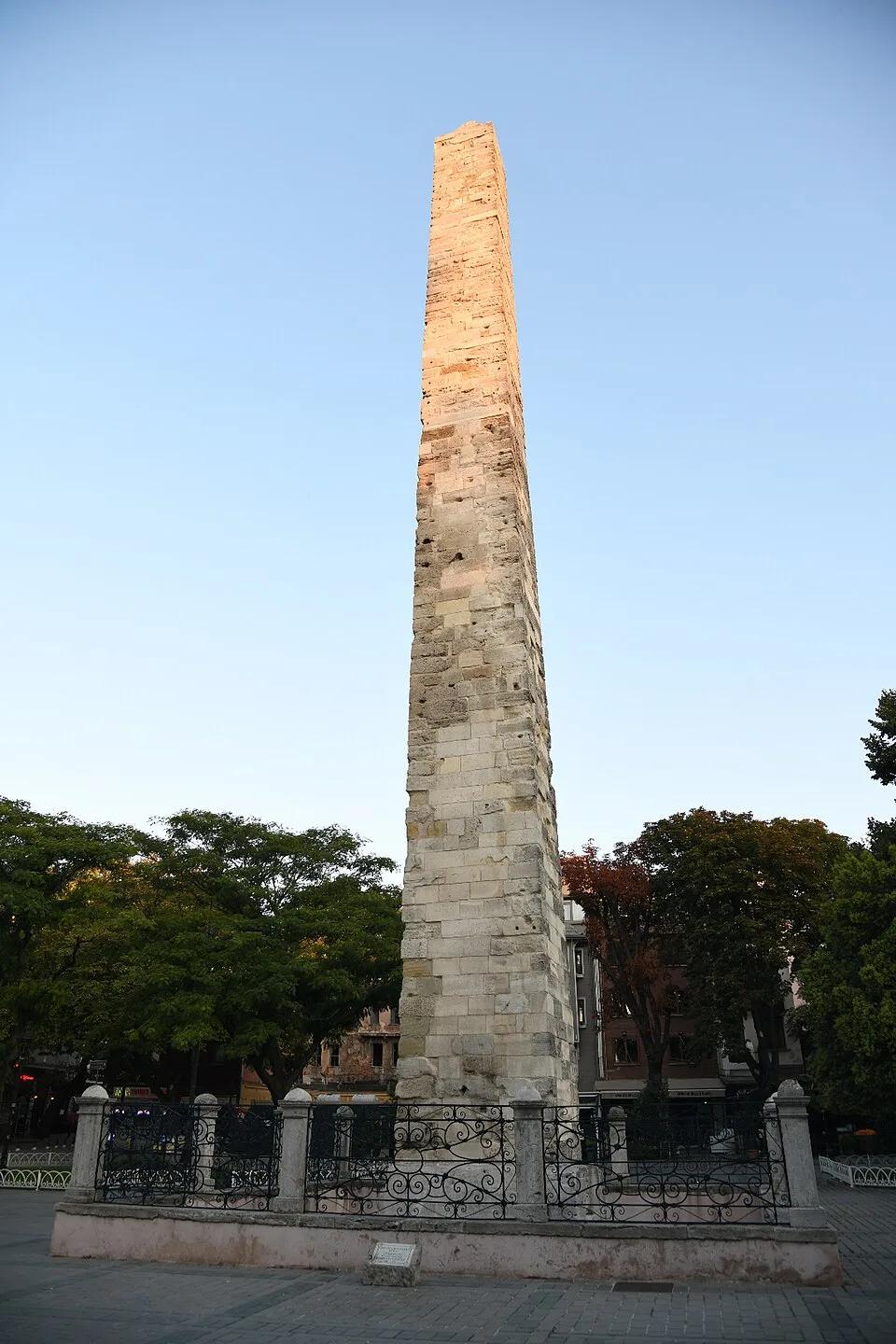
Photo: Apaleutos25 / CC BY-SA 4.0
What Your Eye SeesA tapering masonry tower of brick and stone on the old Hippodrome, its rough patchwork surface a silent clue to a lost bronze casing.
ContextRestored by the Byzantine emperor Constantine VII in the 10th century and once sheathed in gilded bronze plaques, the masonry obelisk lost its metal casing when Crusaders sacked the city in 1204. Built of rough limestone blocks, it rises about 32 metres as the southern counterpart to the Obelisk of Theodosius on the Hippodrome's spina.
On ScreenThe Walled Obelisk of the Hippodrome appears as a landmark in the Constantinople district of the game Assassin's Creed: Revelations (2011).
Source: UNESCO (Historic Areas of Istanbul); Kültür ve Turizm Bakanlığı; Wikipedia (Walled Obelisk); Assassin’s Creed Wiki (Ubisoft)
DidYou
Know
Despite its name, 'Constantine's Obelisk' owes its title to a repairman, not a builder: the 10th-century emperor Constantine VII restored the monument, whose original constructor is unrecorded. Scholars suspect it was raised in late antiquity to mirror the neighbouring Obelisk of Theodosius, a matched pair, like the two obelisks on Rome's Circus Maximus racetrack.
Share→ The Brick Core
Up close the smooth silhouette dissolves into brick and stone courses, the tell-tale skeleton of a monument that once wore a bronze skin.
→ The Restorer's Inscription
A Greek inscription on the base records Constantine VII's restoration, naming the emperor who gave the monument its present form.
Sources: Wikipedia (Walled Obelisk); UNESCO (Historic Areas of Istanbul); Ministry of Culture and Tourism (Turkey)
Ancient Roots
Time Traveler
22. Haydarpaşa Railway Station (Haydarpaşa Garı)
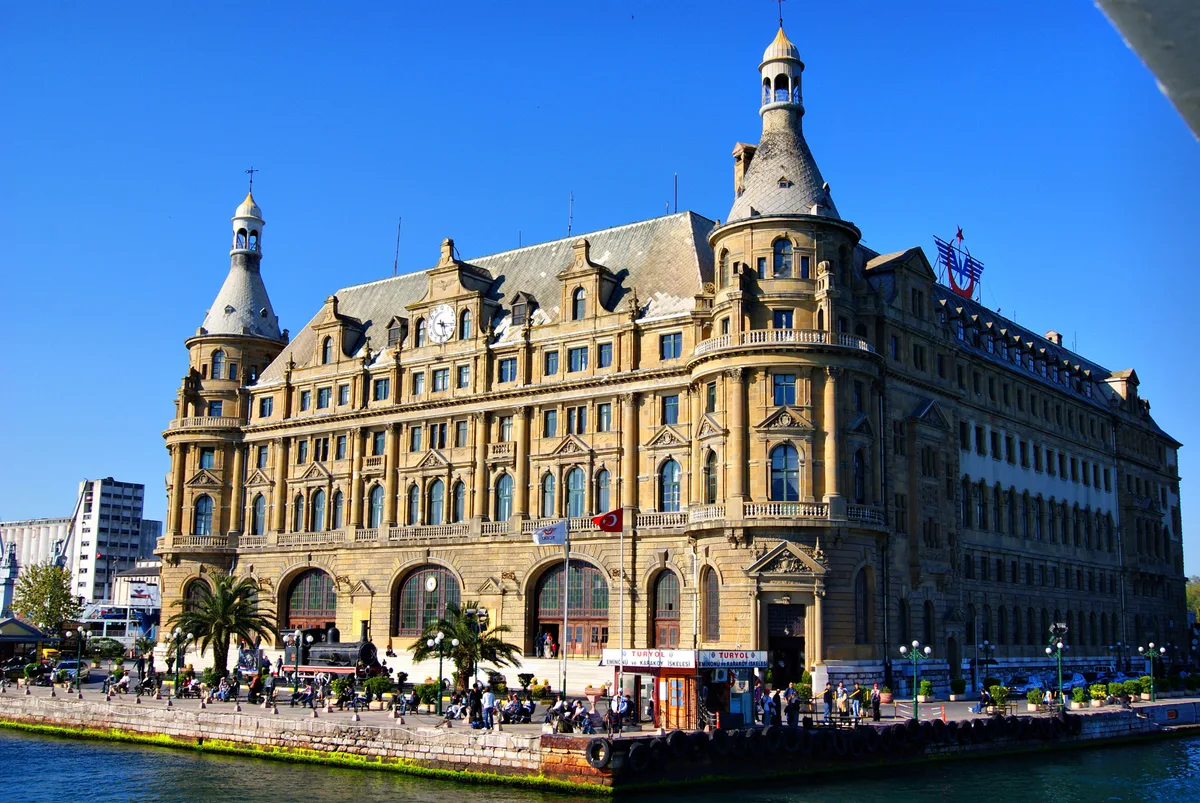
Photo: A.Cihan CÖMERTEL / CC BY-SA 3.0
What Your Eye SeesA grand stone station with corner towers and a gabled roofline rising directly above the Bosphorus waterfront on the Asian shore.
ContextOpened in 1908 as the Asian terminus of the Anatolian and Baghdad railways, the German-built, German-financed line championed under Sultan Abdülhamid II, Haydarpaşa Railway Station is a grand Neoclassical building on the shore of the Bosphorus, crowned with turrets and gables.
On ScreenHaydarpaşa Station was a filming location for Taken 2 (2012).
Source: TCDD; Wikipedia (Haydarpaşa railway station); Wikipedia (Haydarpaşa Station); Taken 2 production notes
DidYou
Know
Its designers, the German architects Otto Ritter and Helmut Cuno, raised the station in a European style rare on this shore, a deliberate message of modernity as the empire pushed its railways east.
Share→ The Tracks Meet The Water
The lines end in a gentle curve at the Bosphorus shore, Haydarpaşa was built as a railway-and-port complex, where trains and ferries exchanged passengers and freight at the water's edge.
→ The Empire's Last Grand Station
Raised as the Ottoman Empire entered its final decades, Haydarpaşa was the imperial government's last great railway monument, a display of the modern lines it was building across Anatolia.
Sources: Wikipedia (Haydarpaşa railway station); TCDD; Ministry of Culture and Tourism (Turkey)
Euro Heritage
Time Traveler
23. Yıldız Palace (Yıldız Sarayı)
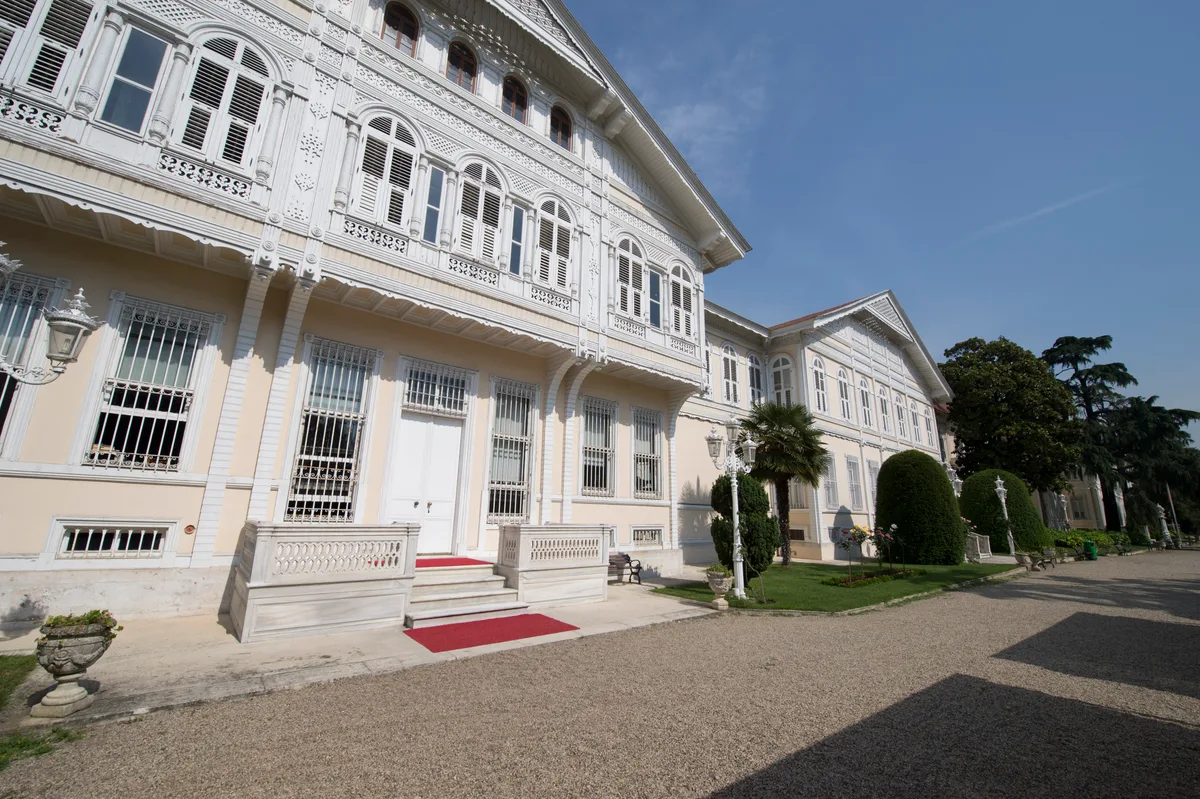
Photo: Dosseman / CC BY-SA 4.0
What Your Eye SeesA sprawling complex of pavilions, kiosks and gardens on a wooded hill above the Bosphorus, with no single grand facade.
ContextYıldız Palace was the imperial residence of Sultan Abdülhamid II from 1877 until his deposition in 1909, a wooded hilltop complex of pavilions, kiosks and gardens rather than one building. Spread across 500,000 square metres above the Bosphorus, it was the last great seat of Ottoman government, with its own theatre, library, porcelain factory and barracks.
Source: Milli Saraylar (National Palaces); Wikipedia (Yıldız Palace)
DidYou
Know
After his uncle Sultan Abdulaziz was deposed in 1876, the new sultan kept his court hidden on a sealed-off hilltop, Yıldız, where Abdülhamid II ruled in seclusion for over thirty years.
Share→ The Pavilions And The Park
Wander between the Büyük Mabeyn, the Şale and the terraced gardens and the 'palace' reveals itself as a district of rooms and kiosks, no single building to photograph, only a chain of ornate ones.
→ The Sultan's Private World
Behind the walls lay everything a ruler might need without leaving the grounds, a mosque, a theatre, a porcelain factory and rooms kept for the sultan's private collections.
Sources: Wikipedia (Yıldız Palace); National Palaces (Turkey); Ministry of Culture and Tourism (Turkey)
Time Traveler
Euro Heritage
24. Spice Bazaar (Mısır Çarşısı)
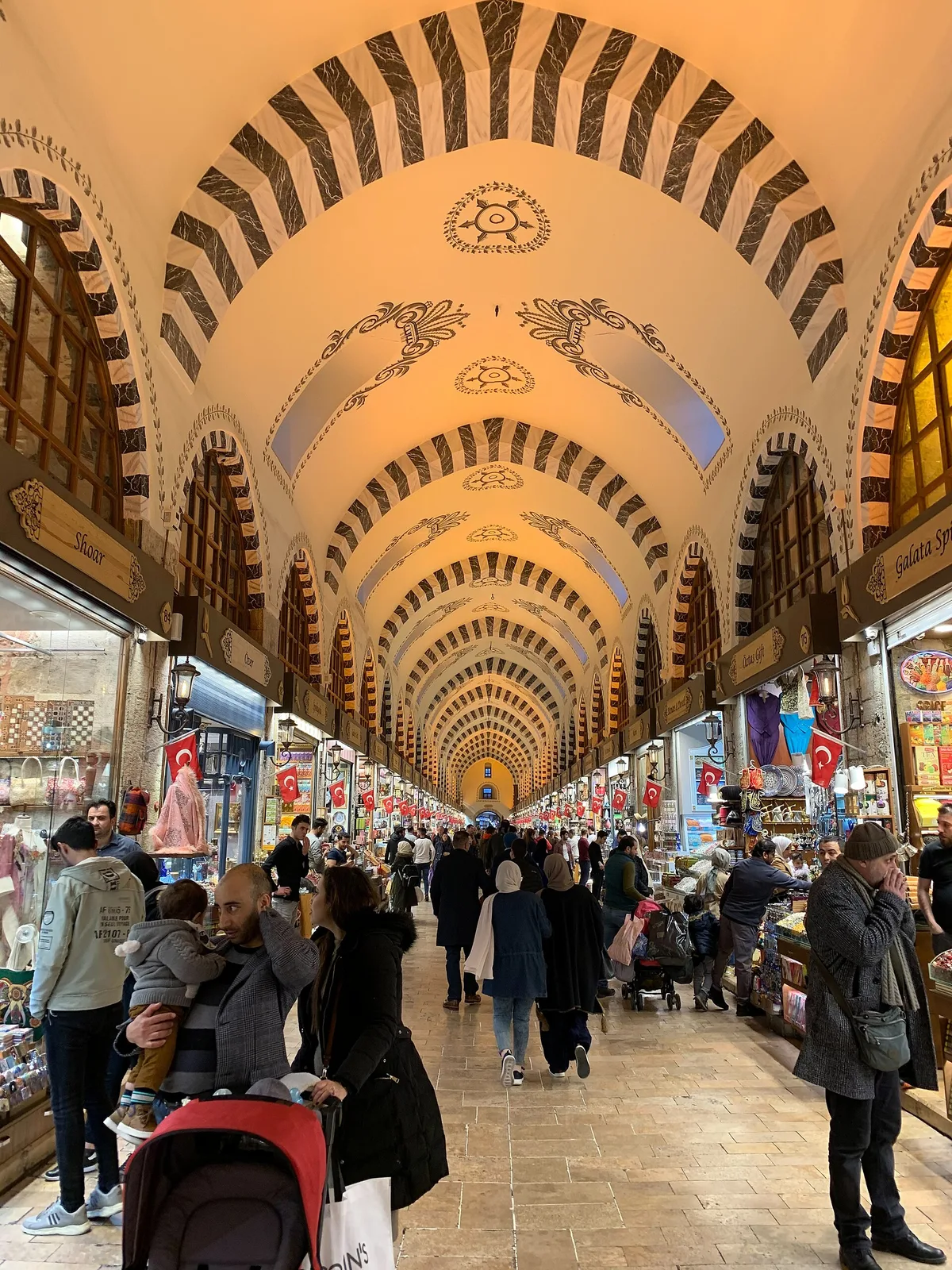
Photo: Robot8A / CC BY-SA 4.0
What Your Eye SeesAn L-shaped covered market of stone and brick beside the New Mosque, its vaulted walkways lined with shops heaped with spices and sweets near the Golden Horn.
ContextBuilt in 1660 as part of the New Mosque complex in Eminönü, the Spice Bazaar is one of the largest covered markets in the city, an L-shaped hall of some 85 shops trading spices, lokum, and dried fruit beside the Golden Horn. It was designed by the chief architect Koca Kasım Ağa as part of the New Mosque endowment.
On ScreenThe Spice Bazaar appears in the James Bond film Skyfall (2012) and Taken 2 (2012).
Source: Kültür ve Turizm Bakanlığı; Wikipedia (Spice Bazaar); Wikipedia (Skyfall); Wikipedia (Taken 2); production notes
DidYou
Know
When it opened in 1660 the bazaar was the Ottoman answer to a pharmacy: its vaulted shops were given over to spices, herbs and drugs, and physicians mixed remedies under the same domes where shoppers now haggle over lokum, the New Mosque's endowment leasing every stall.
Share→ Begun In A Fire's Wake
Construction began in the last months of 1660, just after the Great Fire of 1660 burned through the city for about 49 hours and destroyed whole neighbourhoods, this market rose as part of Eminönü's great rebuilding.
→ Arched Recesses On Every Side
Each shop opens onto the walkway through a wide, vaulted arch, and rows of these arched recesses line both arms of the L, look up and the hall is roofed in a chain of brick vaults and small domes.
Sources: Wikipedia (Spice Bazaar); Ministry of Culture and Tourism (Turkey); UNESCO (Historic Areas of Istanbul)
Silk Road Legacy
Time Traveler
25. Rüstem Paşa Mosque (Rüstem Paşa Camii)
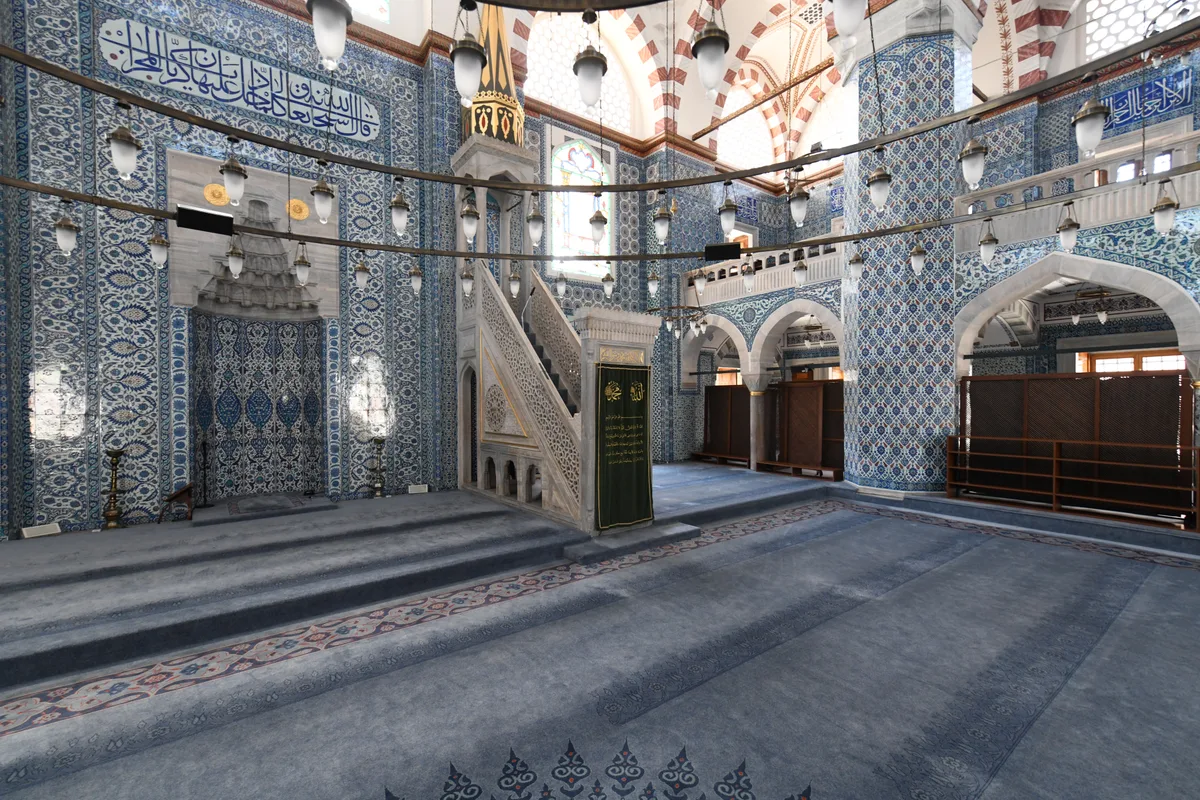
Photo: Dosseman / CC BY-SA 4.0
What Your Eye SeesA compact mosque with a single dome and one minaret raised on a stone terrace above a row of market shops, near the Spice Bazaar.
ContextDesigned by Mimar Sinan for Grand Vizier Rüstem Pasha and completed around 1563, this compact mosque rises on a stone terrace above a row of vaulted shops near the Spice Bazaar, their rents helping to fund the complex.
Rüstem Pasha was one of Süleyman the Magnificent's grand viziers, and the husband of Mihrimah Sultan, a daughter of the sultan. His fortune paid for what is, on the inside, the city's finest surviving İznik tilework: deep cobalt and turquoise panels climb the walls, the mihrab arch and the minbar alike, so densely that the decoration, not the small prayer hall, is the building's true subject.
Source: Kültür ve Turizm Bakanlığı; Wikipedia (Rüstem Pasha Mosque)
DidYou
Know
Inside, almost every vertical surface is sheathed in some 2,300 Iznik tiles in about 80 different patterns, including a tomato-red glaze, fired from Armenian bole, that would become the hallmark of the finest Ottoman ceramics.
Share→ Stairs In The Corners
Narrow, twisting stone staircases tucked into the corners of the building climb from street level to the courtyard, you mount the mosque like a small fortress, leaving the market below.
→ Washing At Street Level
Look down at street level, where the ablution fountain stands: the terrace was too tight for it, so worshippers wash outside before climbing the stairs to pray.
Sources: Wikipedia (Rüstem Pasha Mosque); Ministry of Culture and Tourism (Turkey); Turkish Cultural Foundation
Spiritual Seeker
 Renaissance
26. Pera Palace Hotel (Pera Palas)
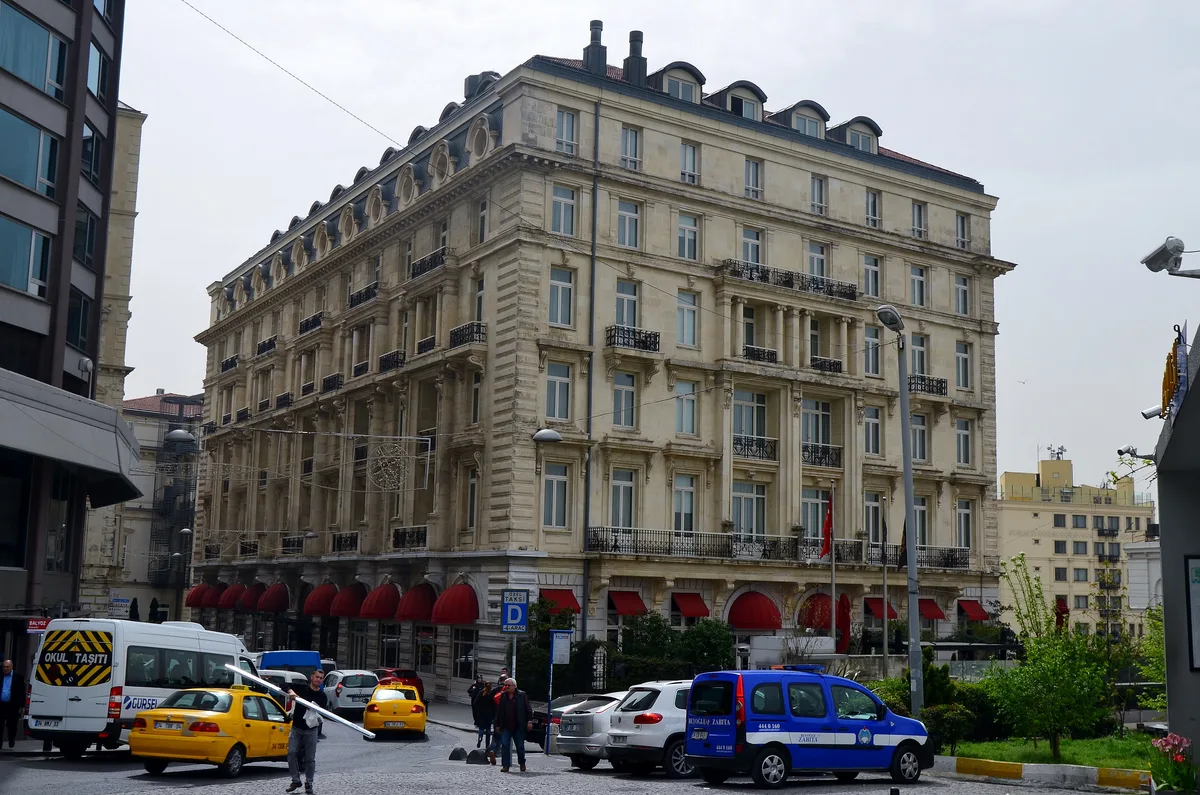
Photo: CeeGee / CC BY-SA 4.0
What Your Eye SeesA grand fin-de-siècle hotel with a neoclassical facade rising above Tepebaşı, its ornate gables and windows looking toward the Golden Horn.
ContextBuilt between 1892 and 1895 by the Compagnie Internationale des Wagons-Lits, the company behind the Orient Express, to lodge passengers arriving at the Sirkeci terminus, the Pera Palace was designed by the French-Ottoman architect Alexandre Vallaury in a blend of neoclassical, art nouveau and oriental styles, and was the first building in Istanbul, outside the imperial palaces, to have electricity, hot running water and an electric lift. Its guest book reads like a century of history: Ernest Hemingway drank at the bar while reporting the wars of the early 1920s, Greta Garbo, Alfred Hitchcock and Jacqueline Kennedy Onassis stayed between the wars, and Mustafa Kemal Atatürk kept room 101, now a museum, on his visits. It survived the fall of the empire and two world wars, in 1941 a bomb in its luggage room targeted British diplomats evacuated from Sofia, and, after closing in 2006, reopened fully restored in 2010.
On ScreenThe Pera Palace Hotel is the real setting of the Netflix series Midnight at the Pera Palace (2022).
Source: Pera Palace Hotel (official); Wikipedia (Pera Palace Hotel); Wikipedia (Pera Palace Hotel); Midnight at the Pera Palace (Netflix); Agatha Christie (Murder on the Orient Express)
DidYou
Know
Crime writer Agatha Christie was a regular guest from 1926 to 1932, always in room 411, still named for her today, where she is said to have drafted Murder on the Orient Express, the story she set aboard the very trains that once carried her to Istanbul.
Share→ The Cage In The Stairwell
An ornate iron-and-glass cage elevator, an original art nouveau piece, still climbs the open stairwell at the heart of the hotel, one of the city's earliest passenger lifts.
→ Six Domes In The Lobby
Over the lower lounge, six small domes crown the atrium, a dash of the oriental style Vallaury folded into the neoclassical facade.
Sources: Wikipedia (Pera Palace Hotel); Pera Palace Hotel (official); Ministry of Culture and Tourism (Turkey)
Euro Heritage
Time Traveler
27. Little Hagia Sophia (Küçük Ayasofya)
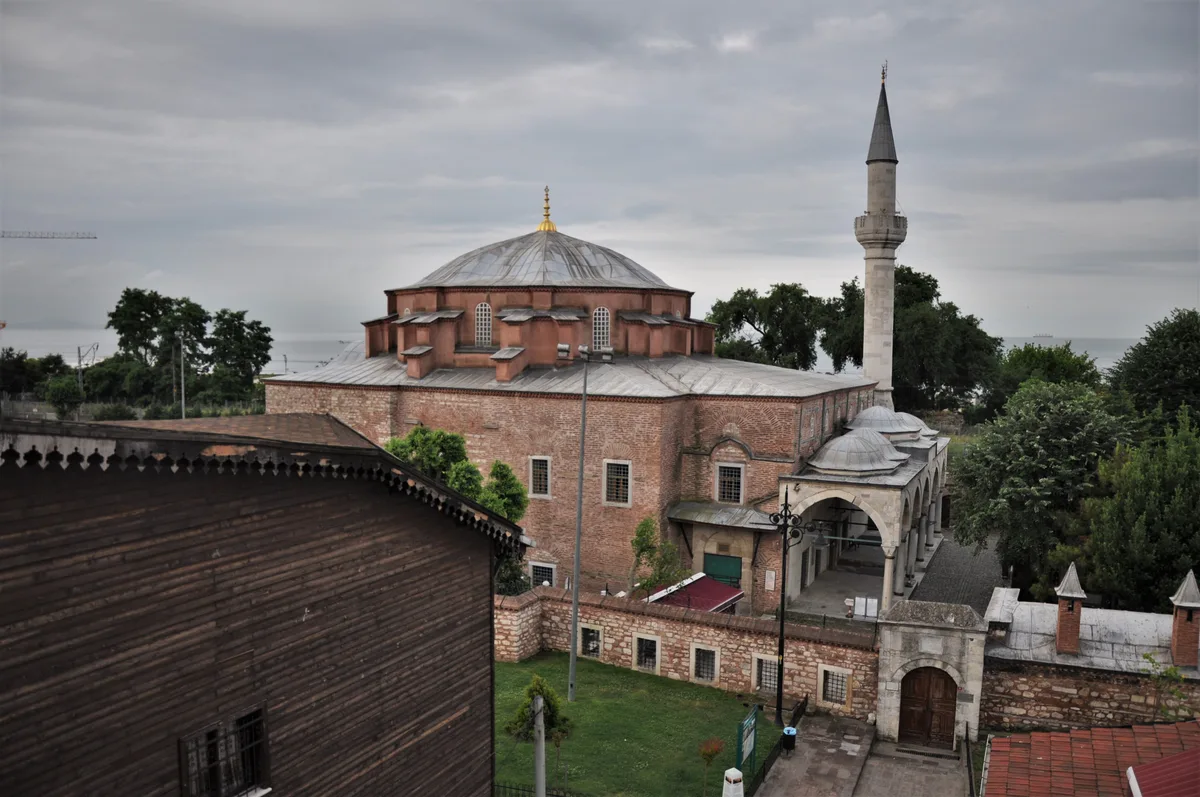
Photo: fusion-of-horizons / CC BY 2.0
What Your Eye SeesA small brick church-turned-mosque with a low, ribbed dome, its octagonal body set in a leafy courtyard south of the Hippodrome.
ContextBuilt by Emperor Justinian between 527 and 536 as the Church of Saints Sergius and Bacchus, this is one of Istanbul's oldest surviving churches, a brick octagon that became a mosque in the early 1500s and is now known as Little Hagia Sophia. Justinian raised it on the grounds of the Hormisdas Palace, his residence before he took the throne, and it sheltered a community holding that Christ had a single nature, a view the Orthodox Church treated as heresy and that Theodora openly protected.
Many historians read this octagon-inside-a-square as the rehearsal for Hagia Sophia: the plan that would become the great dome-on-square of Justinian's later church was worked out here in miniature a few years before. Justinian's great works around it include Hagia Sophia and the Basilica Cistern, and he also rebuilt St Nicholas Church at Myra.
On ScreenLittle Hagia Sophia is recreated in the Constantinople district of the game Assassin's Creed: Revelations (2011).
Source: UNESCO (Historic Areas of Istanbul); Kültür ve Turizm Bakanlığı; Wikipedia (Little Hagia Sophia); Encyclopaedia of the Hellenic World (Constantinople); Wikipedia (Little Hagia Sophia); Assassin's Creed: Revelations production notes
DidYou
Know
The dedicatory inscription runs in twelve Greek hexameters around the nave, honouring Justinian, Theodora and Saint Sergius alone. Saint Bacchus, the church's other patron, is never named in it at all, an omission no one has ever been able to explain.
ShareA Dome Of Sixteen Ripples
The low umbrella dome is split into sixteen compartments, eight flat panels alternating with eight concave ones, carried on eight supports. Count the ripples as you look up.
Two Rings Of Columns
Look around the octagon at the two-storey colonnade, 16 columns of verd antique and red Synnadic marble below, 18 above, and many capitals still carry the interlaced monograms of Justinian and Theodora.
Sources: Wikipedia (Little Hagia Sophia); UNESCO (Historic Areas of Istanbul); Ministry of Culture and Tourism (Turkey)
Ancient Roots
Spiritual Seeker
28. Şerefiye Cistern (Şerefiye Sarnıcı)
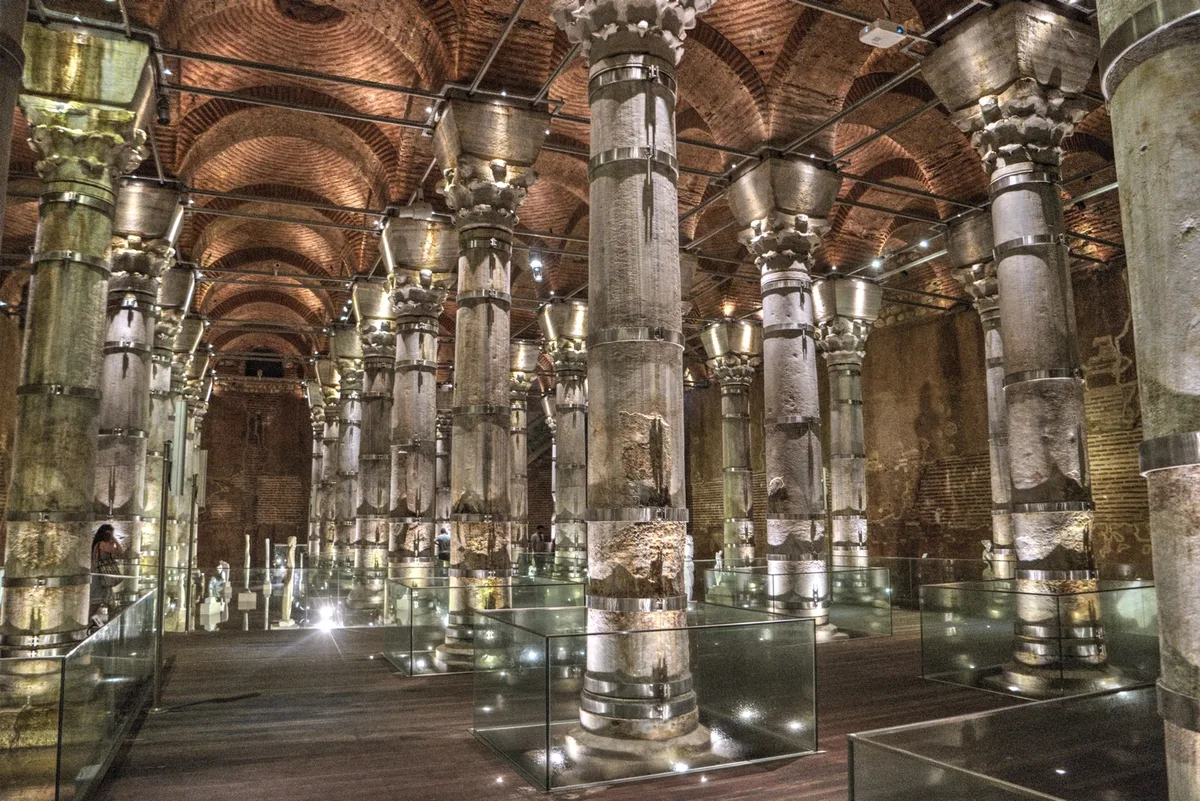
Photo: Izabela Miszczak / CC BY-SA 4.0
What Your Eye SeesA 5th-century stone-and-brick chamber reached below street level, its grid of tall marble columns standing in still water beneath a vaulted roof.
ContextBuilt by Emperor Theodosius II between 428 and 443 to store water from the Valens Aqueduct, the Şerefiye Cistern is a 20-by-40-metre hall under the old city, now open as a museum with a 360-degree light show.
Source: Kültür ve Turizm Bakanlığı; Wikipedia (Şerefiye Cistern)
DidYou
Know
This is one of the city's oldest surviving cisterns, older than the famous Basilica Cistern, yet it was so completely forgotten that it lay buried beneath a private estate and later a municipal building until demolition revealed it intact in 2010.
Share→ Thirty-Two Marble Columns
The roof of 45 brick sail vaults rests on 32 marble columns about 11 metres tall, their Corinthian capitals carved with acanthus leaves, the stone was quarried on Marmara Island.
→ Corners That Curve
Look at the corners of the chamber: they sweep inward in a curve instead of meeting at a right angle, a Byzantine device so the walls could better resist the pressure of stored water.
Sources: Wikipedia (Şerefiye Cistern); Ministry of Culture and Tourism (Turkey); Istanbul Archaeology Museums
Ancient Roots
Time Traveler
29. Bulgarian St. Stephen Church (Demir Kilise)
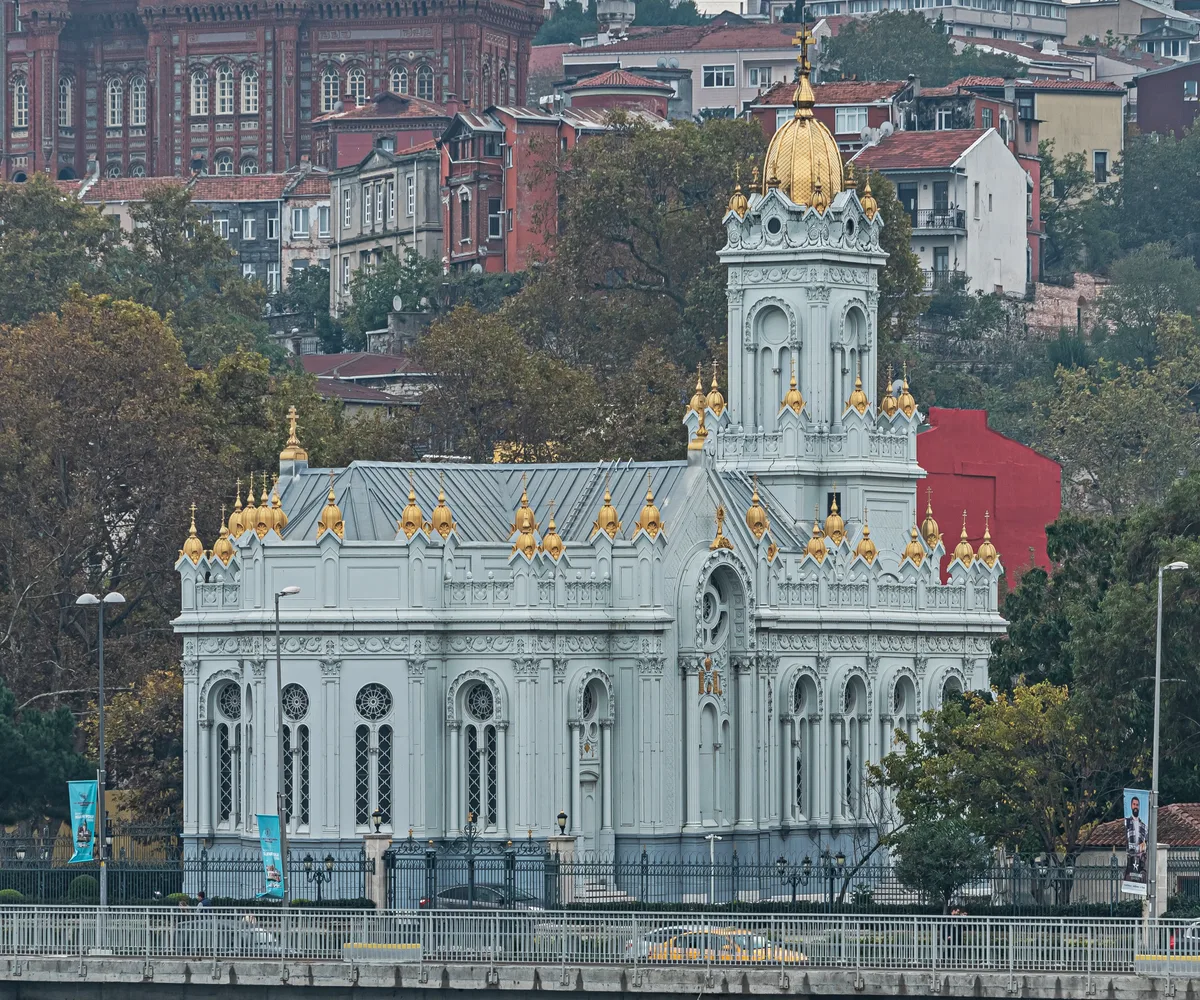
Photo: A.Savin / FAL
What Your Eye SeesA richly ornamented Bulgarian Orthodox church on the Golden Horn shore in Balat, its painted metalwork facade crowned with a gilded dome.
ContextOn the shore of the Golden Horn stands the Bulgarian Orthodox St. Stephen Church, built in 1898 after a fire destroyed its wooden predecessor, it is made of prefabricated cast iron and is known simply as the Iron Church. Designed by the Ottoman Armenian architect Hovsep Aznavur.
Source: Kültür ve Turizm Bakanlığı; Wikipedia (Bulgarian St. Stephen Church)
DidYou
Know
The 500-tonne structure was cast in Vienna by the Austrian firm R. Ph. Waagner, floated down the Danube and across the Black Sea on barges, then assembled on the Golden Horn shore, one of the world's few surviving prefabricated iron churches.
Share→ Bolts, Not Mortar
The 'stone' walls are cast-iron panels fixed over a steel skeleton, look closely at the joins and you'll see the round heads of bolts and rivets holding the church together instead of mortar.
→ A Dome Gilded In 2010
Look up at the central dome, gleaming with fresh gold, a plating added in 2010 for the church's patron feast day, paid for with donations from Bulgarians in Plovdiv.
Sources: Wikipedia (Bulgarian St. Stephen Church); Ministry of Culture and Tourism (Turkey); Istanbul Municipality
Euro Heritage
Spiritual Seeker
30. Tiled Pavilion (Çinili Köşk)
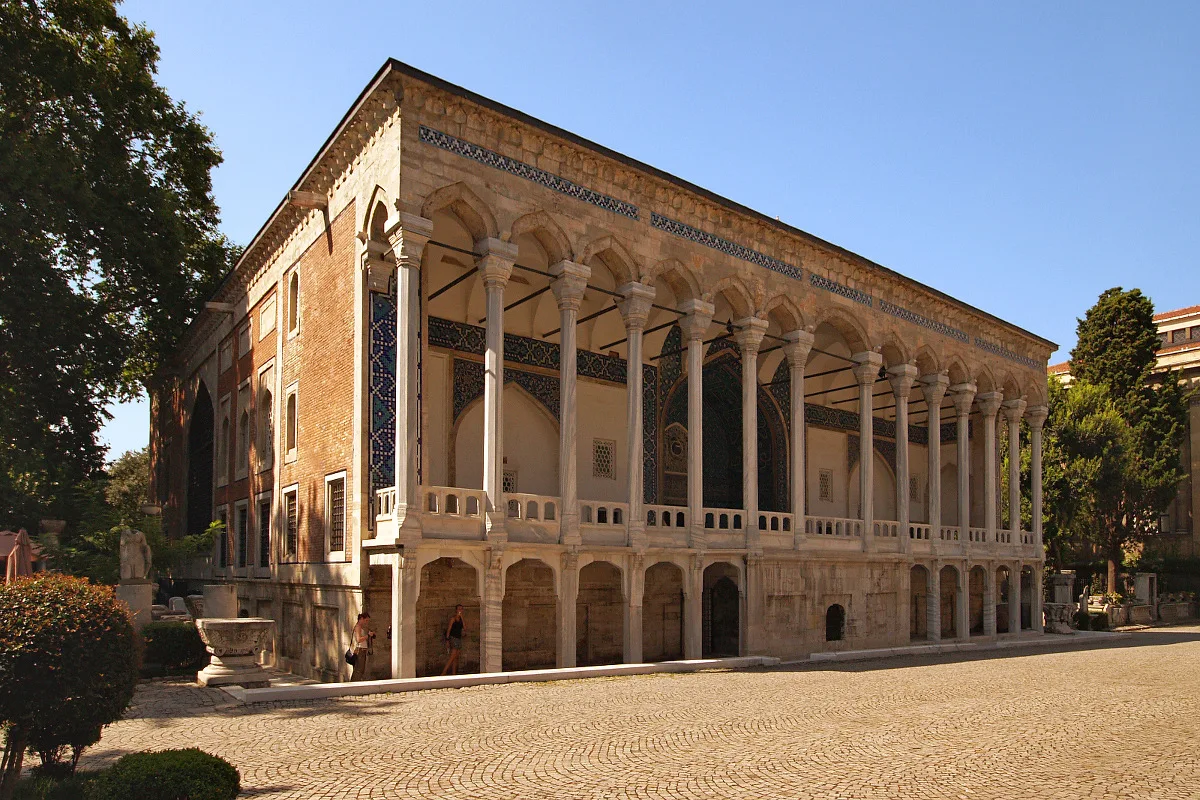
Photo: Stegop / CC BY-SA 4.0
What Your Eye SeesA low, domed pavilion of cut stone and glazed tile, its entrance fronted by a marble portico of fourteen columns, opening onto a tiled terrace (eyvan) above the gardens of Gülhane.
ContextCommissioned by Mehmed II (the Conqueror) in 1472 as a pleasure pavilion within the outer gardens of Topkapı Palace, the Çinili Köşk, meaning "Tiled Pavilion", is the oldest building in the Istanbul Archaeological Museums and one of the city’s earliest examples of Ottoman civil architecture. After serving as the Ottoman Empire’s first imperial museum from 1880, it reopened in 2026 following a long restoration, displaying Seljuk and Ottoman tiles and ceramics from the 12th to the 19th century.
Source: Wikipedia (Çinili Köşk); Kültür ve Turizm Bakanlığı; Milliyet (18 Ağustos 2026)
DidYou
Know
Mehmed II stocked his new Tiled Pavilion with Chinese celadon his court believed could detect poison, the white porcelain was said to flush or crack at the touch of toxins, so the sultan's tableware doubled as a silent guard against assassination.
Share→ The Fourteen-Column Portico
At the entrance, a marble portico of fourteen columns shelters the façade, leading into a vaulted hall (eyvan) whose walls are clad in mosaic tiles. The rear of the building rises two storeys above the slope toward the Bosphorus, while the entrance side appears single-storey, a deliberate play of levels on the hillside.
→ The Tiered Wall Fountain (Selsebil)
Inside one of the ground-floor rooms, a tiered wall fountain (selsebil) was added in 1591 under Murad III, its carved inscription giving the date. The room it occupies, with water channeled through a marble basin, is among the most richly tiled spaces in the pavilion.
Sources: Wikipedia (Tiled Kiosk); Ministry of Culture and Tourism (Turkey); Istanbul Archaeology Museums
Ancient Roots
 The Collector
31. Istanbul Archaeology Museums (İstanbul Arkeoloji Müzeleri)
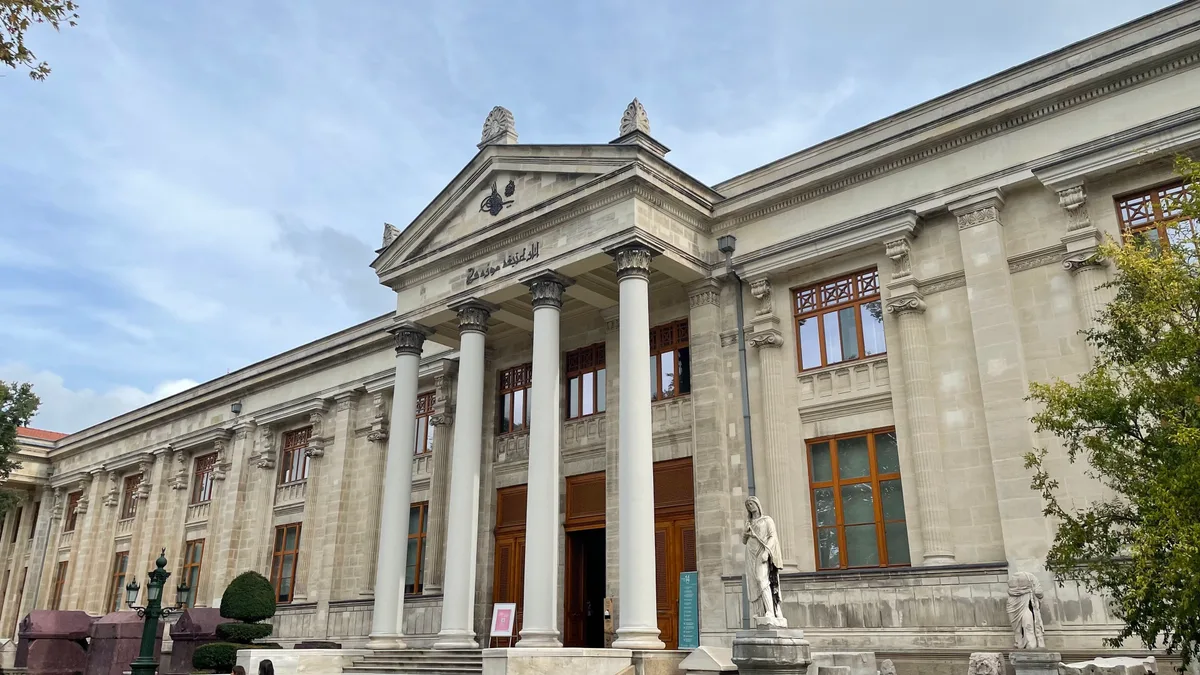
Photo: Metuboy / CC BY-SA 4.0
What Your Eye SeesA pale-stone neoclassical palace of columns and pediments rising above Gülhane Park, the Ottoman Empire's first purpose-built public museum, its own facade modelled on the sarcophagi it houses.
ContextFounded in 1891 as the Imperial Museum, this is a complex of three buildings in the grounds of Topkapı Palace: the main Archaeological Museum, the Museum of the Ancient Orient, and the Tiled Kiosk, a pavilion built in 1472 by Mehmed II.
What makes it unlike any ordinary museum is that it was conceived as a nation's memory before it was filled: the neoclassical main building (designed by Alexandre Vallaury, with wings added in 1903 and 1908) was raised specifically to display the sarcophagi Osman Hamdi Bey had just unearthed at Sidon, in modern Lebanon, and its very facade was carved to echo those finds. Inside lie objects that anchor world history: the Alexander Sarcophagus, and clay tablets of the Treaty of Kadesh, often called the earliest known peace treaty.
Among its Roman sculptures are two portraits of Emperor Hadrian, a marble statue found at Hierapytna in Crete and a rare bronze unearthed at Adana. The same emperor threads through the other landmarks featured here: he raised Rome's Pantheon and was entombed in what is now Castel Sant'Angelo, and his eastern tour of 130 CE gave Antalya its Hadrian's Gate.
The Alexander Sarcophagus points to Anatolia's battlegrounds: the conqueror who besieged Termessos and bypassed Sillyon both lie along Turkey's south coast.
Source: Wikipedia (Istanbul Archaeology Museums); Turkish Museums (official); UNESCO
DidYou
Know
The man who opened the museum in 1891, Osman Hamdi Bey, was not only its founder and first director but also the most celebrated painter of Ottoman Turkey, his "The Tortoise Trainer" sold in 2019 for £6.3 million, then a record for a Turkish painting.
Share→ The Alexander Sarcophagus Isn't Alexander's
Carved from Pentelikon marble in the late 4th century BC and found in the royal necropolis of Sidon, Lebanon by Osman Hamdi Bey in 1887, its reliefs show Alexander the Great at the Battle of Issus, but it likely held Abdalonymus, the king of Sidon whom Alexander appointed after that battle. Faint traces of paint survive on the carving.
→ The Building Quotes Its Own Collection
Architect Alexandre Vallaury shaped the 1891 facade's columns and mourning-figure reliefs after the very sarcophagi displayed within, the Sarcophagus of the Mourning Women above all. The museum was built to house what its director had just excavated, not the other way around.
→ The World's Earliest Peace Treaty, On Clay
Look for the clay tablets of the Treaty of Kadesh in the Museum of the Ancient Orient: concluded around 1259 BC between Ramesses II of Egypt and Hattusili III of the Hittites. A replica is displayed at the United Nations in New York.
Sources: Wikipedia (Istanbul Archaeology Museums); Turkish Museums; UNESCO; Wikipedia (Treaty of Kadesh)
Ancient Roots
Time Traveler
 Global Voyager
32. Theodosian Walls (Theodosian Surları)
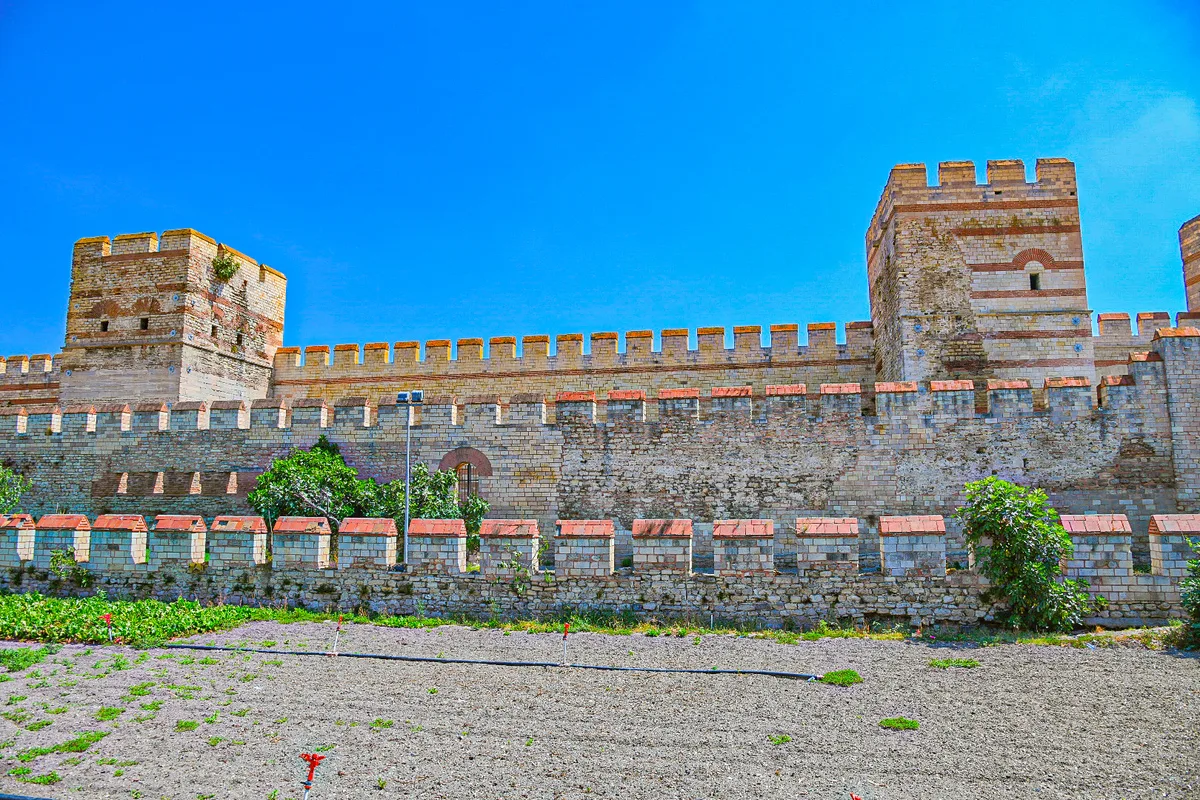
Photo: Apaleutos25 / CC BY-SA 4.0
What Your Eye SeesA roughly 6.5 km line of double stone ramparts and towers snaking across the hills west of the old city, fragments still standing where no army ever broke through by force.
ContextBuilt under Emperor Theodosius II and completed in 413, the Theodosian Walls ran about 6.5 km from the Golden Horn to the Sea of Marmara as a double line: an inner wall roughly 12 m high with some 96 towers, and an outer wall fronted by a wide moat. For a thousand years this was the most formidable defensive system of the medieval world, and the city behind it outlasted sieges by Avars, Arabs, Rus' and Bulgars.
The walls were never taken by assault in all that time. Constantinople fell in 1453 not because the ramparts failed but because the defenders, too few to man both lines, concentrated on the Mesoteichion, the low middle stretch where the Lycus stream cut through. Mehmed II knew it was the weak point, planted his cannon there, and on 29 May 1453 the city was entered through a breach in that very section.
Source: Wikipedia (Walls of Constantinople; Fall of Constantinople); UNESCO (Historic Areas of Istanbul); Britannica
DidYou
Know
After a devastating earthquake in 447, Theodosius II set the city's chariot-racing factions, the Blues and the Greens, to rebuild the walls, and they finished in a recorded 60 days; three inscriptions still set into the wall credit the feat.
Share→ The Brick Bands
Look at the brick bands running through the limestone at regular intervals, between seven and eleven courses. They were not only decorative: the brick bonded the stone facing to the mortar core, letting the wall flex in earthquakes.
→ The Marble Tower
At the southern end, the North and South Marble Towers of the Golden Gate are built of gleaming white Proconnesian marble, the last surviving pieces of a triumphal arch that Byzantine emperors rode through in victory, later wrapped into the Yedikule fortress.
→ The Tower Shapes
The towers are mostly rectangular, yet a cluster along the central ridge are built octagonal or polygonal, a deliberate plan so defenders on the corners could sweep the wall's blind angles with arrows. The shift in shape is visible as you walk the line.
Sources: Wikipedia (Walls of Constantinople); UNESCO (Historic Areas of Istanbul); Wikipedia (Yedikule Fortress); Ministry of Culture and Tourism (Turkey)
Ancient Roots
Silk Road Legacy
33. Yedikule Fortress (Yedikule Hisarı)
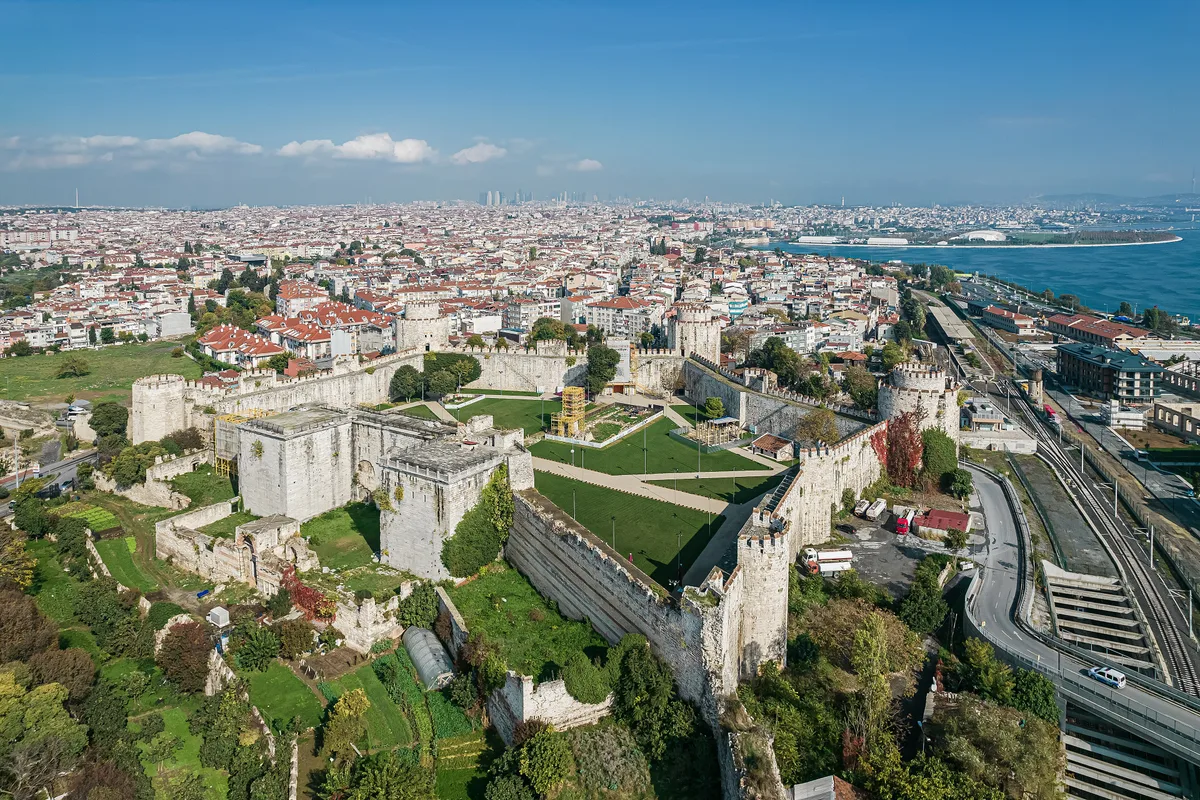
Photo: A.Savin / FAL
What Your Eye SeesSeven stone towers enclosing a marble triumphal arch on the Marmara shore, a fortress raised by wrapping Ottoman walls around a Byzantine victory gate.
ContextIn 1458, Mehmed II raised a fortress where the land walls met the Sea of Marmara, adding three massive towers to the two pylons and two marble towers of the Golden Gate, the great ceremonial entrance of Byzantine Constantinople, probably raised around 390 under Theodosius I and later woven into the Theodosian walls. The result, the "Castle of Seven Towers," wraps a white Proconnesian marble arch whose bronze doors were once gilded; emperors rode through it in triumph, and a small domed Conqueror's Mosque now marks the courtyard's heart.
Yedikule became the empire's most feared prison. Ambassadors of enemy states awaited their fate in its dunes, and in 1622 the teenage Sultan Osman II, "Genç Osman", was dragged here and strangled with a bowstring, the first Ottoman sultan ever deposed and killed by his own Janissaries.
Source: Wikipedia (Yedikule Fortress); Fatih Belediyesi; Turkish Archaeological News
DidYou
Know
Mehmed II used one of Yedikule's towers as the imperial treasury, and the fortress also held enemy ambassadors as prisoners of state, among them, at different times, a future Doge of Venice and a Russian ambassador with his entire staff.
Share→ The Gilded-Gate Sockets
Look at the marble arch for the square cavities where bronze statues, including a victory goddess in a chariot, and gilded Latin inscriptions were fixed. They vanished in later earthquakes and looting, but the empty sockets remain.
→ The Seven Towers
Two Byzantine marble towers and two pylons of the Golden Gate were kept, and Mehmed II added three Ottoman towers to make the seven that give the fortress its name; the northern Marble Tower is built almost entirely of gleaming white Proconnesian marble.
→ Genç Osman's Tower
The sultan was killed in a dungeon in the tower that now bears his name; its lower storey is a plain, dark cell, pointed out to visitors as the place he died.
Sources: Wikipedia (Yedikule Fortress); Fatih Municipality; Ministry of Culture and Tourism (Turkey); UNESCO
Ancient Roots
34. Mihrimah Sultan Mosque (Mihrimah Sultan Camii)
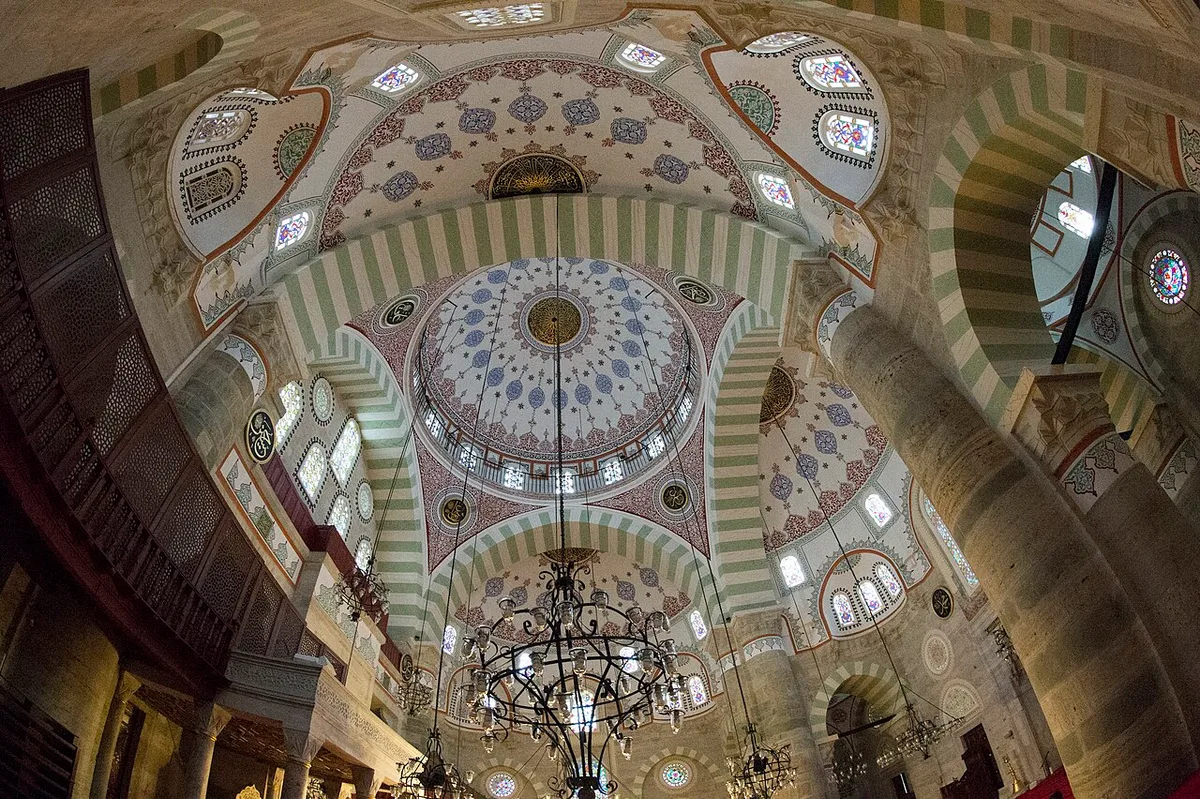
Photo: Dosseman / CC BY-SA 4.0
What Your Eye SeesA broad, luminous mosque on a raised platform at the Üsküdar ferry landing, its single great dome flanked by three half-domes, Sinan's first experiment with the form.
ContextCommissioned by Mihrimah Sultan, daughter of Süleyman the Magnificent and wife of Grand Vizier Rüstem Pasha, and designed by Mimar Sinan, this mosque was built at the Üsküdar waterfront between 1543–44 and 1548. Known as the İskele (jetty) Mosque after the ferry landing it faces, it rises on a high basement with a broad double portico and a fine marble ablutions fountain.
It was Sinan's first mosque to use half-domes: he flanked the main dome with three of them on three sides, an structural experiment that let light pour through. Above the prayer hall the dome carries sixteen windows, and the stained glass set into the dome and the half-domes gives the interior an unusual, luminous calm, from the Bosphorus the two mosques Mihrimah built on opposite continents seem to gaze at one another.
Source: Wikipedia (Mihrimah Sultan Mosque, Üsküdar); Archnet; Üsküdar Belediyesi
DidYou
Know
The name Mihrimah means "Sun and Moon" in Persian. A long-standing Istanbul legend holds that Sinan, who designed her mosques, arranged the Üsküdar and Edirnekapı Mihrimah Sultan mosques so that on her name-day the sun sets behind one and the moon rises over the other.
Share→ The Waterside Substructure
The mosque sits on a tall vaulted basement; the ground falls so steeply, seen from the water, two full storeys of stone show beneath the prayer hall, a deliberate lift so the dome meets arriving passengers at eye level.
→ The Marble Şadırvan
The broad double portico shelters a twenty-sided marble ablutions fountain; a second arcade was added precisely to shield it, and the worshippers, from the wind off the sea.
→ The Bosphorus Silhouette
From the water the building reads as one great dome on a tall drum with a single slim minaret at the shoreline, the compact riverside silhouette Sinan would repeat, larger, at the Edirnekapı Mihrimah Sultan Mosque on the opposite side of the city.
Sources: Wikipedia (Mihrimah Sultan Mosque); Archnet; Wikipedia (Mihrimah Sultan Mosque, Üsküdar); Üsküdar Municipality
Spiritual Seeker
35. Museum of Turkish and Islamic Arts (Türk ve İslam Eserleri Müzesi)
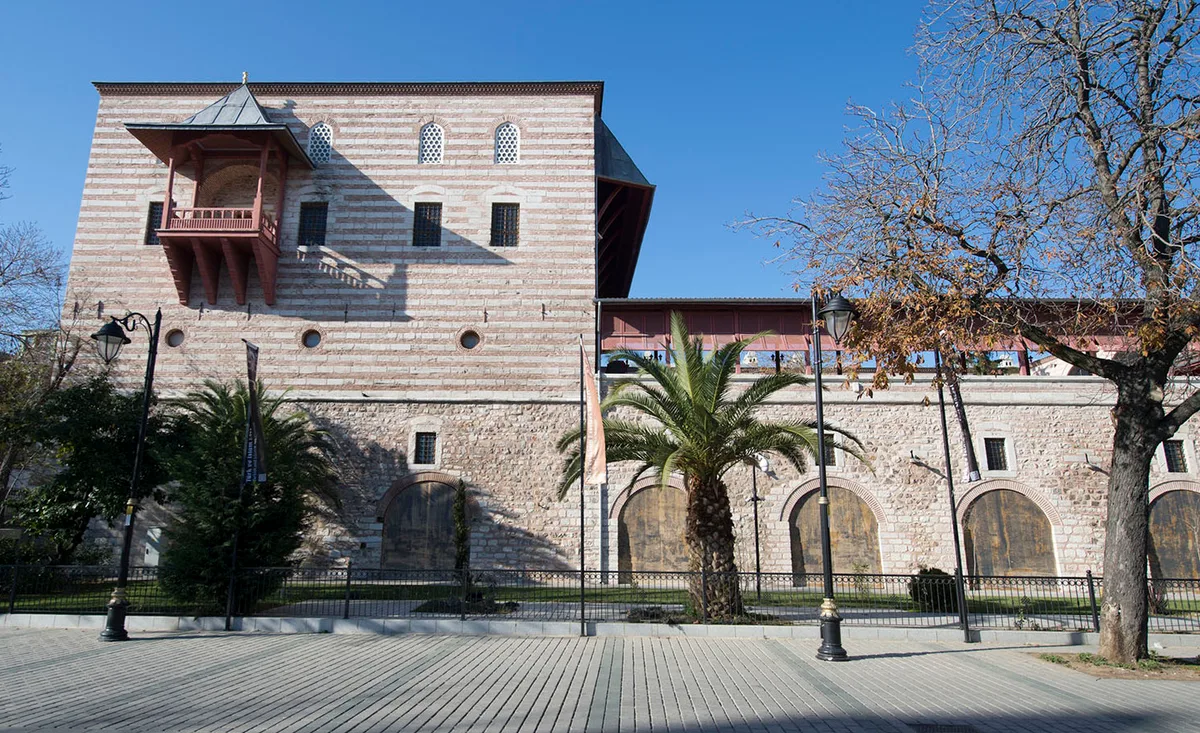
Photo: Dosseman / CC BY-SA 4.0
What Your Eye SeesA 16th-century Ottoman palace on the Hippodrome, its stone façade looking across at the Blue Mosque, and inside, one of the world's finest carpet collections.
ContextHoused in the İbrahim Pasha Palace, the museum opened in 1914 as the first in Turkey to gather Turkish and Islamic art together, and moved into this building in 1983. The palace was given by Süleyman the Magnificent in 1520 to his son-in-law and grand vizier, Pargalı İbrahim Pasha, and apart from the imperial residences it is one of the earliest Ottoman palace buildings to survive.
The building is itself the prize, a rare example of 16th-century Ottoman civil architecture, its carved stone façade stepping down the terrace of the old Byzantine Hippodrome. But it is the collection, not the building, that draws scholars from across the world: the museum's carpet rooms are reckoned among the most important anywhere.
Source: Wikipedia (Turkish and Islamic Arts Museum); muze.gov.tr (TIEM); Turkish Cultural Foundation
DidYou
Know
The museum began in 1914 inside the Süleymaniye Mosque's imaret (soup kitchen), founded on the initiative of Osman Hamdi Bey, the same archaeologist who unearthed the Sidon sarcophagi now in the Istanbul Archaeology Museums.
Share→ The İbrahim Pasha Façade
The palace's stone walls carry a rare carved relief programme of Ottoman civil architecture; the building steps down the Hippodrome terrace on massive vaulted substructures, a deliberate display of a vizier's power across from the imperial mosques.
→ The Carpet Rooms
The carpet halls hold around 1,700 pieces, from 13th-century Anatolian Seljuk rugs to the "Holbein" and "Lotto" Ushak carpets that European painters copied for centuries, considered the finest such collection in the world.
→ The Hippodrome Terrace
The palace was built directly on the spina of the Byzantine Hippodrome; from its windows you look down on the same ground where chariot races ran, beside the Obelisk of Theodosius.
Sources: Wikipedia (Turkish and Islamic Arts Museum); Turkish Cultural Foundation; muze.gov.tr; Ministry of Culture and Tourism (Turkey)
Silk Road Legacy
36. Galata Mevlevi Lodge (Galata Mevlevihanesi)
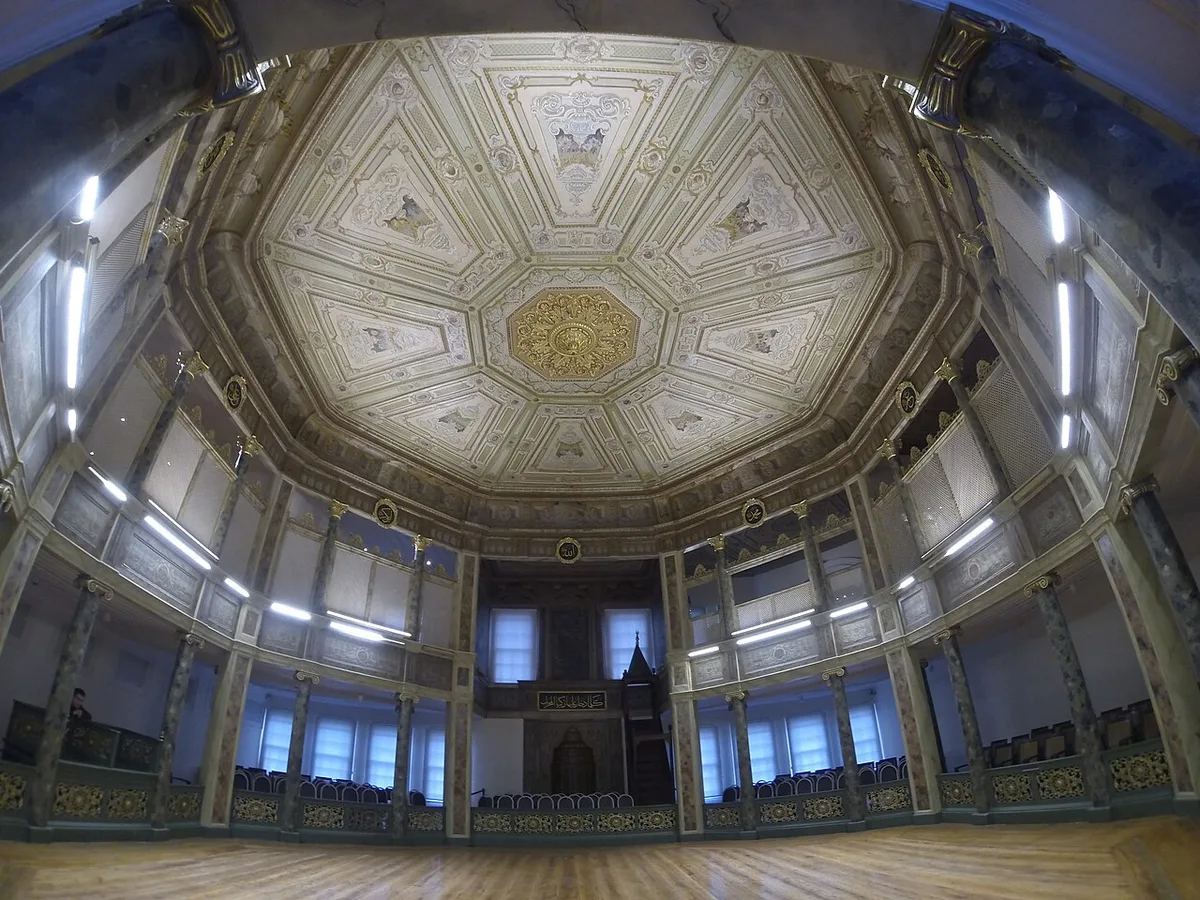
Photo: Nevit Dilmen (talk) / CC BY-SA 3.0
What Your Eye SeesA walled garden off İstiklal Street holding the oldest Mevlevi lodge in Istanbul, its octagonal semahane (whirling-ceremony hall) still standing where dervishes turned for centuries.
ContextFounded in 1491 by İskender Pasha on the Galata ridge, the Galata Mevlevihanesi is the oldest Mevlevi lodge in Istanbul. Rebuilt after fires, above all the 1765 Tophane blaze, its present buildings took shape through the 18th and 19th centuries, and the lodge functioned until the Mevlevi orders were closed in 1925.
The heart of the complex is the semahane, an octagonal ritual hall whose layout has barely changed since 1608, surrounded by two tiers of mahfil (gallery) boxes. In the garden cemetery rest masters of Ottoman letters and music, among them the poet Sheikh Galib (1757–1799), whose mystic verse is still recited, and the neyzen (reed-flute players) and composers of the Mevlevi tradition.
Source: Wikipedia (Galata Mevlevi Lodge Museum); müze.gov.tr; TDV İslâm Ansiklopedisi
DidYou
Know
The whirling (sema) ceremony was performed here for centuries; when the Mevlevi orders were abolished in 1925, the lodge became a museum of Ottoman literature and music rather than a working tekke (dervish lodge).
Share→ The Mahfil Boxes
The semahane's two tiers of mahfil (gallery) boxes line the upper walls, and the central floor is left open for the whirling ceremony, the space was built to be watched from above as much as entered.
→ The Cümle Kapısı
The main gateway, rebuilt in 1819 by Halet Efendi in fine Ottoman Baroque, is flanked by a sebil (a kiosk for free water), a fountain and a library, a small civic complex in stone.
→ The Garden Tombs
The hazire (enclosure cemetery) holds the mausolea of Sheikh Galib and Halet Efendi and the graves of composers and neyzens; the white marble tomb of Sheikh Galib dates to 1819.
Sources: Wikipedia (Galata Mevlevi Museum); TDV İslâm Ansiklopedisi; muze.gov.tr; Ministry of Culture and Tourism (Turkey)
Spiritual Seeker
Which movies filmed at the Grand Bazaar in Istanbul?
The Grand Bazaar appears in From Russia with Love (1963), the Liam Neeson thriller Taken 2 (2012), the Daniel Craig Bond opener Skyfall (2012), and Dan Brown's Inferno (2016), its roofs and alleys used for chases and surveillance.
Which films feature Hagia Sophia?
Hagia Sophia appears in From Russia with Love (1963), where Bond retrieves consulate blueprints inside, and in Dan Brown's Inferno (2016), where Robert Langdon deduces a weapon is hidden there. It is also recreated in the video game Assassin's Creed: Revelations (2011).
Which video game is set in Constantinople (Istanbul)?
Assassin's Creed: Revelations (2011) is set in 16th-century Constantinople, present-day Istanbul, letting players roam landmarks such as the Galata Tower, Hagia Sophia and the Basilica Cistern as the assassin Ezio Auditore.
Where did Agatha Christie stay in Istanbul?
The Pera Palace Hotel. Christie was a regular guest there in the 1920s–30s, staying in Room 411, which the hotel preserves as the 'Agatha Christie Room' and claims is where she wrote Murder on the Orient Express. Her estate says the novel was more likely drafted on an archaeological dig in Iraq.
What is the oldest structure in Istanbul?
The Obelisk of Theodosius, a 3,500-year-old Egyptian obelisk originally erected at the Temple of Karnak in Luxor. Emperor Theodosius I brought it to Constantinople in AD 390 and placed it on the Hippodrome's central spina. Its hieroglyphic inscriptions record the victories of Pharaoh Thutmose III.
Is Hagia Sophia still open to visitors?
Yes. Hagia Sophia was reconverted into a mosque in July 2020 but remains open to all visitors outside of prayer hours. Non-Muslim visitors enter through a designated side entrance, and the upper gallery with its Byzantine mosaics stays accessible to everyone.
What is the Grand Bazaar?
The Grand Bazaar (Kapaliçarsi) is one of the world's oldest and largest covered markets, built in 1461 under Mehmed II and expanded over the following centuries. It covers 30,700 square metres across 61 covered streets with more than 4,000 shops, drawing between 250,000 and 400,000 visitors daily.
These landmarks reward close attention. Vestigia is a field companion for people who look longer, with curated context, architectural detail, and the stories most visitors walk past. Free on the App Store and Google Play.