Agra Historical Landmarks
1. Taj Mahal
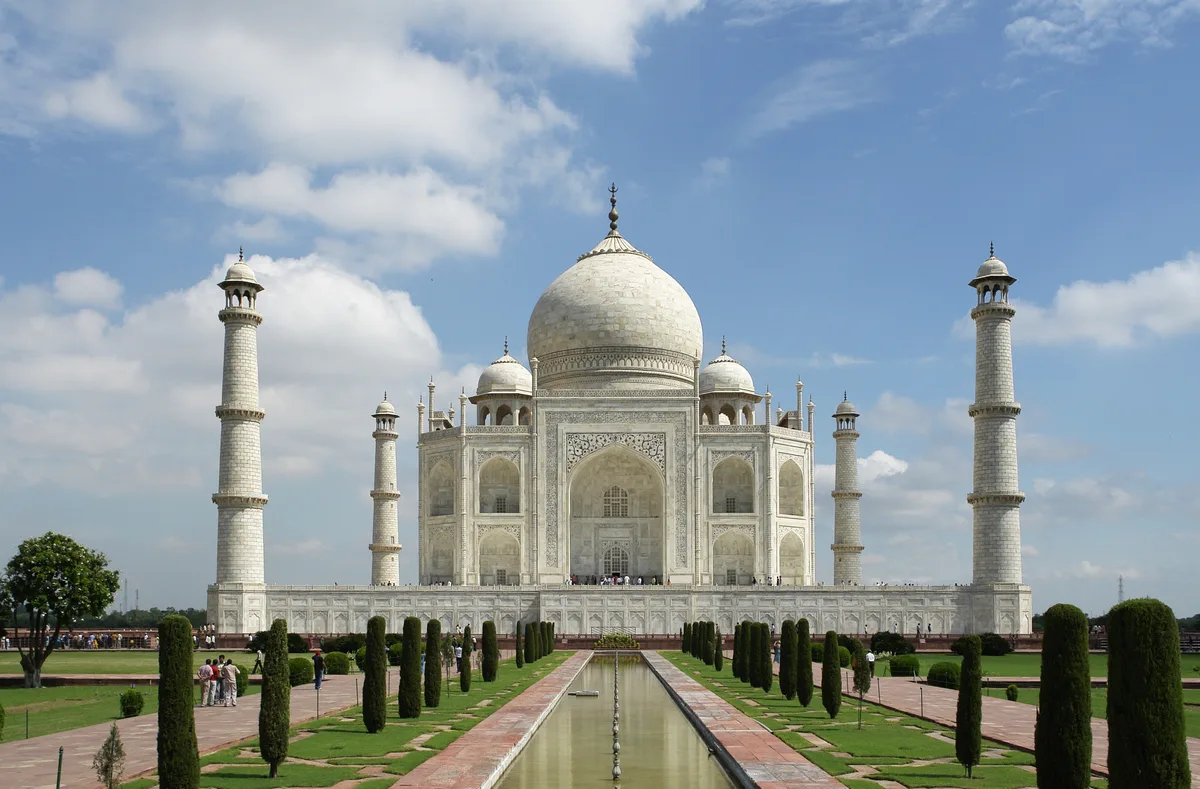
Photo: Yann; edited by Jim Carter / CC BY-SA 4.0
What Your Eye SeesA perfectly symmetrical mausoleum of white marble flanked by four minarets, standing on a raised platform at the end of a long reflecting pool. Its central dome rises 73 metres against the Yamuna River.
ContextCommissioned in 1632 by Emperor Shah Jahan to house the tomb of his favourite wife Mumtaz Mahal, who died during childbirth. Construction took 21 years and employed 20,000 artisans. The Taj Mahal is widely considered the finest example of Mughal architecture, a synthesis of Persian, Indian, and Islamic styles.
On ScreenThe Taj Mahal was a filming location for Slumdog Millionaire (2008) and the James Bond film Octopussy (1983).
Source: UNESCO; Britannica; Wikipedia (Taj Mahal); Wikipedia (Taj Mahal); Slumdog Millionaire production notes; Octopussy production notes
 Did
DidYou
Know
The Taj Mahal's white marble is slightly translucent, letting different wavelengths of light penetrate at different angles, pink at dawn, milky white at dusk, golden by moonlight. The four minarets are said to tilt slightly outward so if they collapse in an earthquake, they fall away from the main tomb.
Share→ The Calligraphy Panels
The large panels of calligraphy on the four iwans are meticulously measured stone inlay, not paint. The letters are graded in size, the upper letters are larger than the lower ones so they appear equal when viewed from the ground, an optical correction used centuries before modern understanding of perspective.
→ The Missing Crown
The finial atop the main dome was originally a solid-gold structure weighing 466 kg, crowned with a crescent and standing about 30 feet tall. In 1810 it was removed by British officer Joseph Taylor, who is widely believed to have taken the gold for himself; a gold-plated copper replacement was installed instead. The finial was replaced again in 1876 and in 1940, the version seen today is the fourth.
→ The River Axis
The Taj is positioned so that the Yamuna River serves as a natural mirror. The complex was laid out on a hasht bihisht (eight paradises) plan: a char bagh garden divided by water channels into quadrants, with the mausoleum set at the river end of the axis rather than in the centre, a departure from the earlier Timurid char bagh tradition.
Sources: ANU (rubens.anu.edu.au: The Calligraphy of the Taj Mahal); Wikipedia (Amanat Khan); The Economic Times (Taj Mahal's golden 'Taj'); The Times of India; Tawarikh-e-Agra (via TOI); tajmahal.gov.in (The Gardens); Wikipedia (Taj Mahal)
 Eastern Spirit
2. Agra Fort
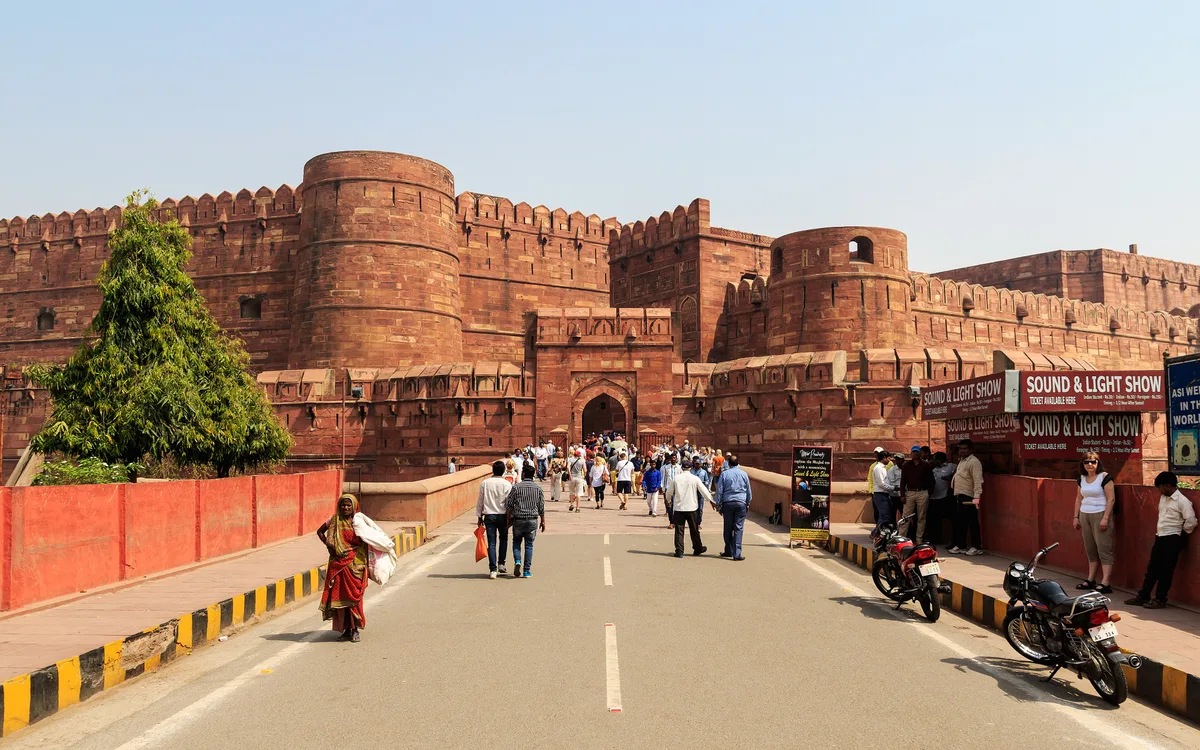
Photo: A.Savin / FAL
What Your Eye SeesA massive red sandstone fortress with 20-metre-high walls curving at the base, enclosing a 2.5-kilometre perimeter. Inside, white marble palaces, audience halls, and mosques rise above the sandstone battlements.
ContextBuilt primarily under Emperor Akbar between 1565 and 1573, the Agra Fort served as the main residence of the Mughal emperors until 1638, when Shah Jahan moved the capital to Delhi. It was later where Shah Jahan was imprisoned by his son Aurangzeb and spent his final years gazing at the Taj Mahal from an octagonal tower.
On ScreenAgra Fort was a filming location for the James Bond film Octopussy (1983).
Source: UNESCO; Britannica; Wikipedia (Agra Fort); IMDb (Octopussy); 007.info; kinoafisha.info
DidYou
Know
The fort originally contained over 500 buildings, but only about 30 survive, the British army demolished the rest between 1803 and 1862 to build barracks.
Share→ The Inlay Mastery
The walls of the Diwan-i-Khas feature pietra dura (stone inlay) work in semi-precious stones, agate, jade, lapis lazuli, coral and cornelian set into white marble. The technique reached its peak under Shah Jahan, who also employed it extensively at the Taj Mahal.
→ The Chain Of Justice
Rising over the riverside bastions is an octagonal marble tower, the Shah Burj (also called Musamman Burj), the very tower that once anchored Jahangir’s fabled ‘Chain of Justice’. On his accession in 1605 he ordered a golden chain strung with 60 bells, run from the tower down to the bank of the Yamuna, so a wronged subject could shake it to summon the emperor. Not a link survives today, but the tower that held it still stands over the water.
Sources: PU.edu.pk (Mughal Inlay Art research); Wikipedia (Pietra dura; Agra Fort); Tuzuk-i-Jahangiri (Memoirs of Jahangir); Wikipedia (Agra Fort)
Eastern Spirit
3. Fatehpur Sikri
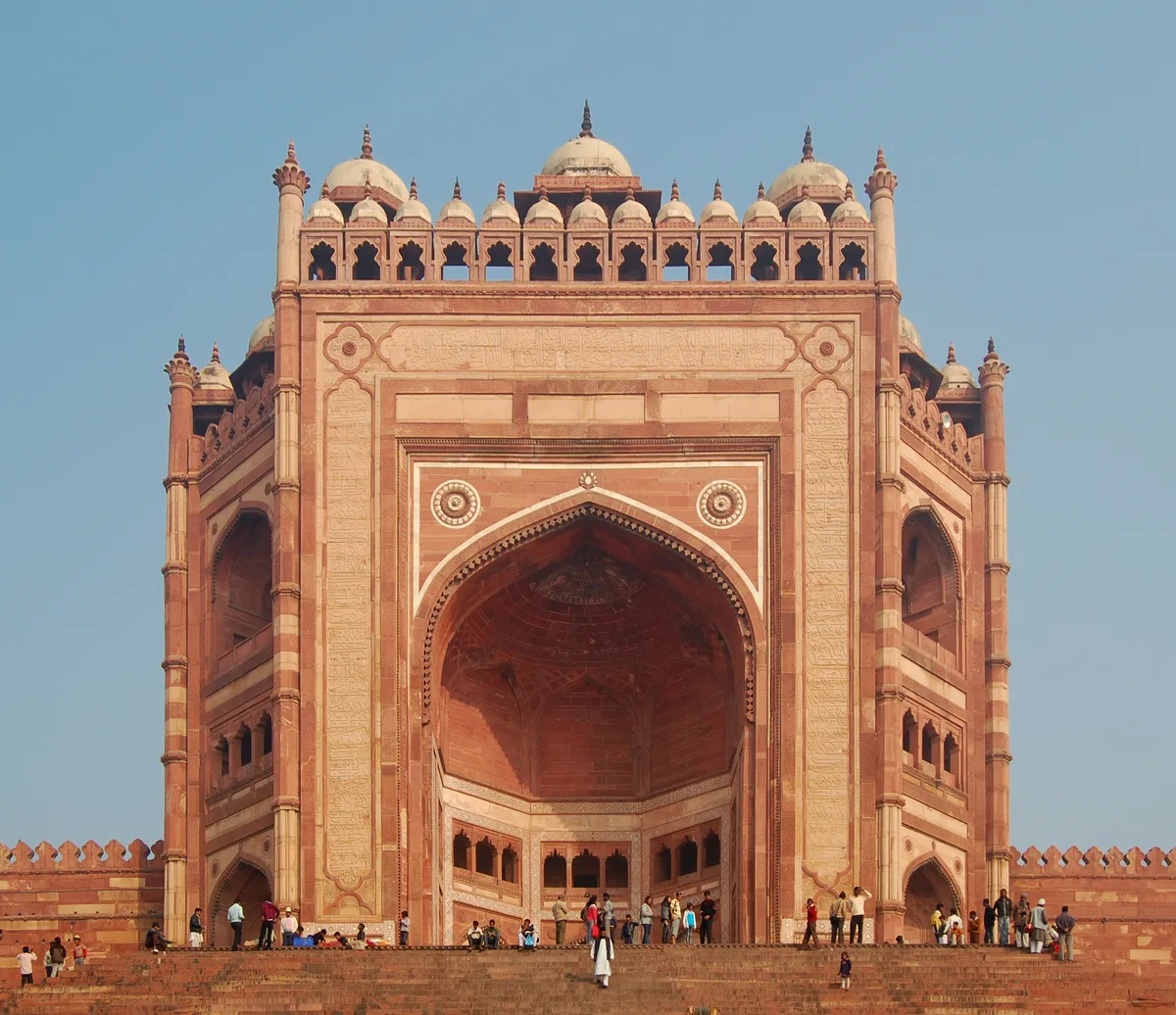
Photo: Marcin Białek / CC BY-SA 3.0
What Your Eye SeesA red sandstone ghost city spread across a rocky ridge, dominated by the 40-metre Buland Darwaza (Victory Gate) and the Jama Masjid courtyard. Palaces and administrative buildings surround open courtyards on an raised plateau.
ContextEmperor Akbar built Fatehpur Sikri as his new capital between 1571 and 1585, after a prophecy by the Sufi saint Salim Chishti foretold the birth of a male heir. But the city was abandoned only 14 years later due to an inadequate water supply, its sophisticated rainwater harvesting system could not sustain the growing population.
Source: UNESCO; Britannica; Wikipedia (Fatehpur Sikri)
DidYou
Know
Akbar conceived Fatehpur Sikri as a capital of Sulh-e-Kul, 'universal peace', hosting debates with Portuguese Jesuits, Jain and Hindu scholars alongside Muslim clerics in the Ibadat Khana, with a mosque, Jain temple elements and Hindu pavilion within the same walls. The bullet marks still scarring the Buland Darwaza are said to be from 18th-century conflicts long after the court had moved away.
Share→ The Carved Tree Pillar
In the Diwan-i-Khas, a single stone column rises from a square base through an octagonal shaft to a carved capital of 36 serpentine brackets supporting a circular platform. Four stone walkways radiate from the platform to the corners of the hall, from which Akbar is said to have held audiences with ministers of different faiths.
→ The Saint’s Tomb
The white marble tomb of Salim Chishti inside the Jama Masjid courtyard is still a place of pilgrimage. Devotees, especially would-be mothers, tie threads to the marble lattice screens as offerings, a living tradition that goes back centuries, though the tomb has been remodelled several times since it was first built in 1580–81.
Sources: USF ClipPix ETC (Diwan-i-Khas, Fatehpur Sikri); UNESCO (Fatehpur Sikri World Heritage List); Wikipedia (Tomb of Salim Chishti); Archnet (Tomb of Salim Chishti)
Eastern Spirit
Common Questions
Why was the Taj Mahal built?
Emperor Shah Jahan commissioned it in 1632 to house the tomb of his favourite wife Mumtaz Mahal, who died in childbirth. Construction took 21 years and employed 20,000 artisans. The white marble is slightly translucent, letting different wavelengths of light penetrate at different angles, pink at dawn, milky white at dusk and golden by moonlight, and the four minarets are said to tilt slightly outward so that if they ever collapse, they fall away from the main tomb.
Why was Shah Jahan imprisoned in Agra Fort?
In 1658 Shah Jahan, the builder of the Taj Mahal, was deposed by his son Aurangzeb and imprisoned in Agra Fort, where he spent his final years gazing at the Taj Mahal from an octagonal tower. The fort was built primarily under Emperor Akbar between 1565 and 1573 and served as the main residence of the Mughal emperors until 1638, when Shah Jahan moved the capital to Delhi. The fort originally contained over 500 buildings, but only about 30 survive: the British army demolished the rest between 1803 and 1862 to build barracks.
One App, Every Landmark
These landmarks reward close attention. Vestigia is a field companion for people who look longer, with curated context, architectural detail, and the stories most visitors walk past. Free on the App Store and Google Play.