Amsterdam Historical Landmarks
1. Anne Frank House
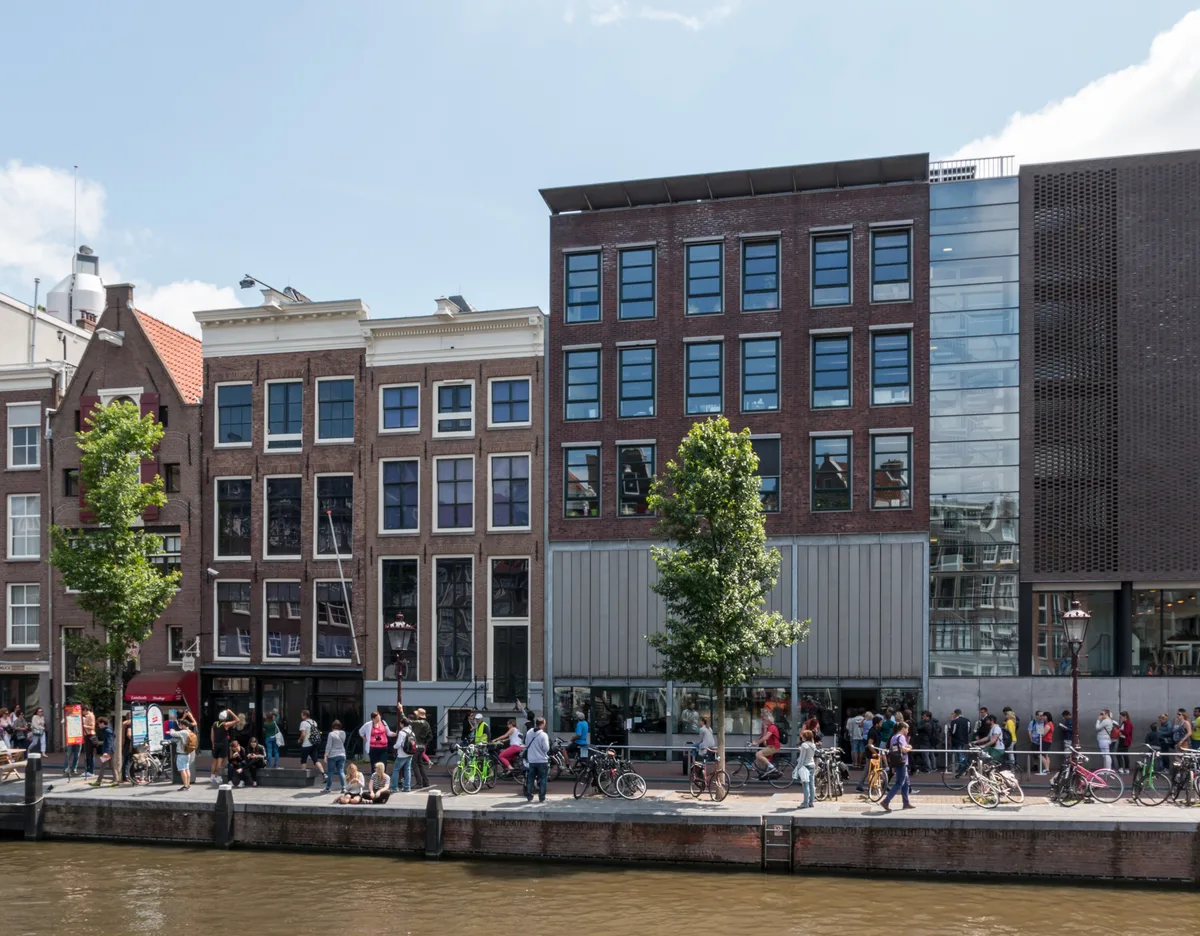
Photo: Jorge Láscar / CC BY-SA 2.0
What Your Eye SeesA narrow 17th-century canal house with a hidden annex behind a movable bookcase, preserved exactly as it was during World War II.
ContextBuilt in 1635 as a canal-side home with rear warehouses, this building became the hiding place for Otto Frank's family during the Nazi occupation of the Netherlands. Otto ran his Opekta pectin business from the ground floor; above it, Anne Frank wrote her diary between 1942 and 1944. Saved from demolition by a public campaign, it opened as a museum in 1960.
On ScreenThe Anne Frank House appears in the films The Diary of Anne Frank (1959) and The Fault in Our Stars (2014).
Source: Wikipedia (Anne Frank House); Anne Frank House (official); Wikipedia (Anne Frank House); The Diary of Anne Frank production notes; The Fault in Our Stars production notes
 Did
DidYou
Know
A March 1944 radio broadcast by Minister Gerrit Bolkestein, calling on the Dutch to save their wartime diaries, reached Anne Frank in hiding and inspired her to rewrite her journal into a book she called 'Het Achterhuis.' After the arrest, Miep Gies rescued the diary and kept it unread in her desk drawer until Otto Frank returned in 1945.
Share→ The Bookcase Door
The hidden entrance was a purpose-built swinging bookcase fitted with hinged shelves that held real books. The mechanism could only be operated from inside the annex, and the space behind it was so narrow that Otto Frank had to turn sideways to squeeze through.
→ The Height Marks On The Wall
In the Frank family's bedroom, pencil marks on the wallpaper trace the growth of Anne and her sister Margot during their years in hiding. The marks show Anne grew more than 13 centimetres in two years, while Margot grew only one centimetre in the same period.
→ The Map Of Normandy
Next to the height marks hangs a map of the Normandy coast, cut from the front page of the newspaper De Telegraaf of 8 June 1944, the day after the Allied landings. Otto Frank pinned it to the wall and used hat pins to track the progress of the Allied forces as the family followed the invasion on the radio.
Sources: Anne Frank House (official); Wikipedia (Anne Frank House); Wikipedia (Anne Frank)
 Euro Heritage
2. Rijksmuseum
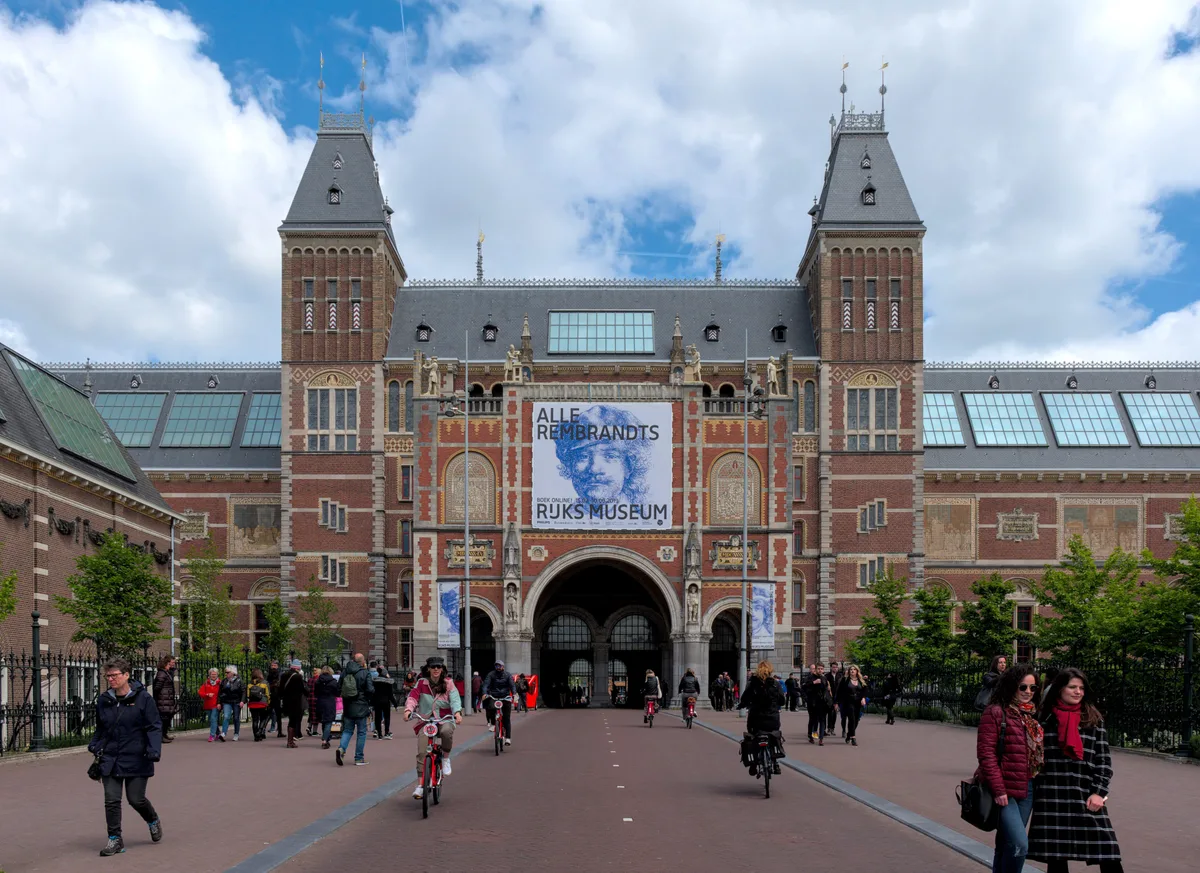
Photo: Gryffindor / CC BY-SA 3.0
What Your Eye SeesA monumental neo-Gothic palace of red brick and stone, with ornate towers, religious statuary, and a grand arched passageway running through the centre.
ContextArchitect Pierre Cuypers designed the Rijksmuseum as a cathedral of Dutch art, opening in 1885 after a 9-year construction. The building houses 8,000 objects spanning 800 years, including Rembrandt's The Night Watch and Vermeer's The Milkmaid. The 2003–2013 renovation cost €375 million, making it the most expensive museum renovation in Dutch history.
On ScreenThe Rijksmuseum appears in the film The Fault in Our Stars (2014).
Source: Wikipedia (Rijksmuseum); Rijksmuseum (official); Wikipedia (Rijksmuseum); The Fault in Our Stars production notes
DidYou
Know
King William III refused to open the museum when it was finished in 1885, sending stand-ins and reportedly calling its neo-Gothic design 'a convent.' The Catholic imagery was too contentious for Protestant Amsterdam, and the project had already weathered two decades of debate, from the first competition in 1863 to construction in 1876.
Share→ The Night Watch's Missing Pieces
Look closely at Rembrandt's masterpiece and notice it was cut down on all four sides in 1715, two figures on the left vanished entirely, the arch on the right was cropped, and the top of the parapet was removed. Gerrit Lundens' 1642 copy, painted before the mutilation, is the only record of the original composition.
→ The Architect Among The Decoration
Look among the historical and emblematic figures on the facade for a sculpted portrait of Cuypers himself, set into the side of tower six on the Museumplein side of the building.
→ The €375 Million Renovation
Step inside to see the result of the 2003–2013 renovation, which cost more than €375 million and hollowed out the building, rebuilt internally with a new Asian pavilion and a glass roof over the original courtyard, now the largest covered atrium in the Netherlands.
Sources: Rijksmuseum (official); Wikipedia (The Night Watch); Wikipedia (Pierre Cuypers); Wikipedia (Rijksmuseum)
Euro Heritage
 Gothic Soul
3. Royal Palace Amsterdam
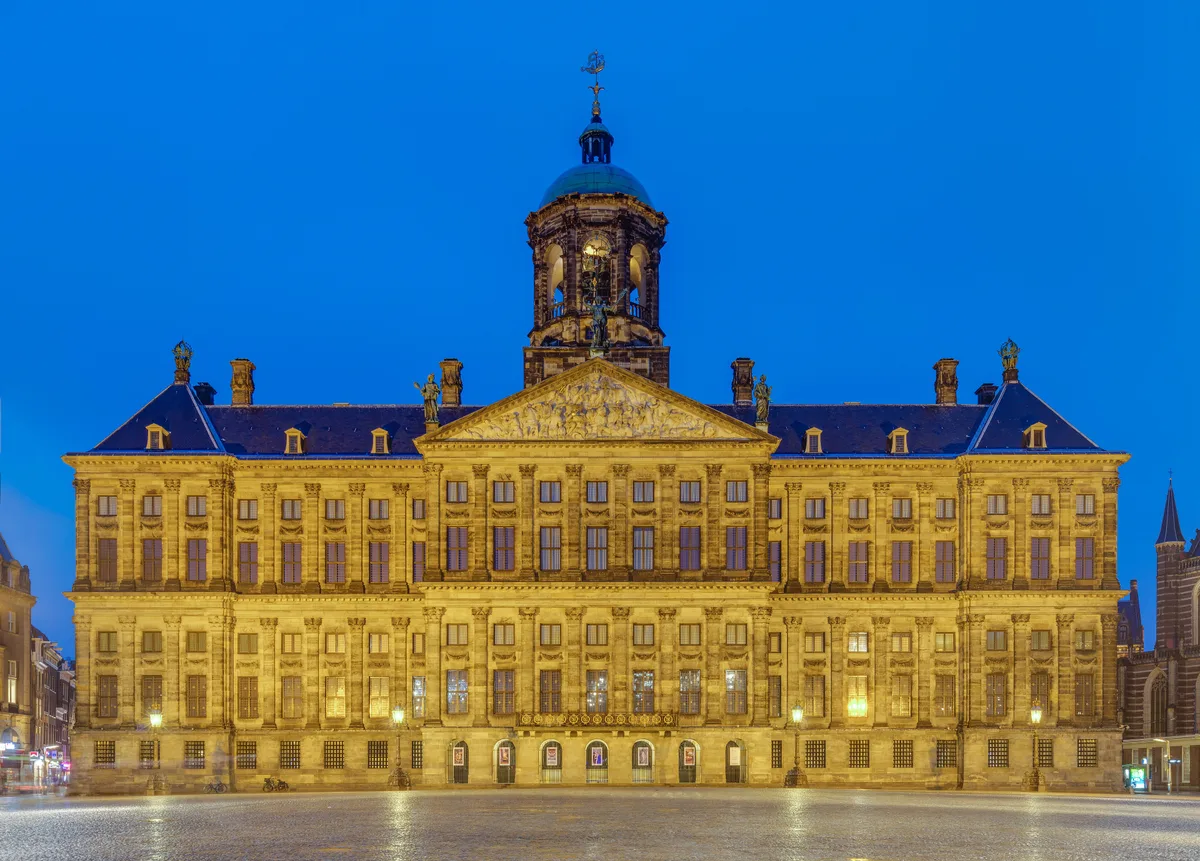
Photo: Tatiana Popova / CC BY-SA 4.0
What Your Eye SeesA severe classical sandstone palace rising above Dam Square, with a domed tower and an triangular pediment carved with allegorical figures and Moses' Tablets of the Law.
ContextBuilt 1648–1665 as Amsterdam's City Hall during the Dutch Golden Age, it was the largest secular administrative building in Europe. It was converted into a royal palace by Louis Napoleon in 1808. The structure rests on 13,659 wooden piles driven through 11 meters of soft clay and peat to reach the first sand layer.
On ScreenThe Royal Palace appears in the film Girl with a Pearl Earring (2003).
Source: Wikipedia (Royal Palace of Amsterdam); Britannica; Wikipedia (Royal Palace Amsterdam); Girl with a Pearl Earring production notes
DidYou
Know
Amsterdam's burghers built the city hall to dwarf any European palace, flaunting merchants above monarchs, and the poet Constantijn Huygens called it the 'Eighth Wonder of the World.' The royal family still uses it only for state visits, never as a residence.
Share→ The World In Marble
Look down at the floor of the Citizen's Hall, where three inlaid marble maps cover the entire surface, the eastern hemisphere, western hemisphere, and the northern celestial hemisphere. Cartouches describe the oceans with inscriptions that read, in Latin, 'the ocean embraces all things.' They are the largest marble floor maps in existence.
→ The Moses Pediment
The triangular facade facing Dam Square shows the Amsterdam Maiden receiving tribute from the four known continents. Moses' Tablets of the Law were placed directly below to remind city judges, not a monarch, that their rulings must be just. The pediment originally proclaimed civic rather than royal authority.
→ The Atlas Who Carries The Sky
On the palace's west side, look for the roughly six-metre bronze Atlas bearing the sky on his shoulders. The model for the statue was carved by Artus Quellinus in 1650–51, and generations of Amsterdammers told their children that if Atlas ever dropped the heavens, Amsterdam would fall too.
Sources: Royal Palace Amsterdam (official); Wikipedia (Royal Palace of Amsterdam)
Euro Heritage
 Baroque Master
4. Oude Kerk (Old Church)
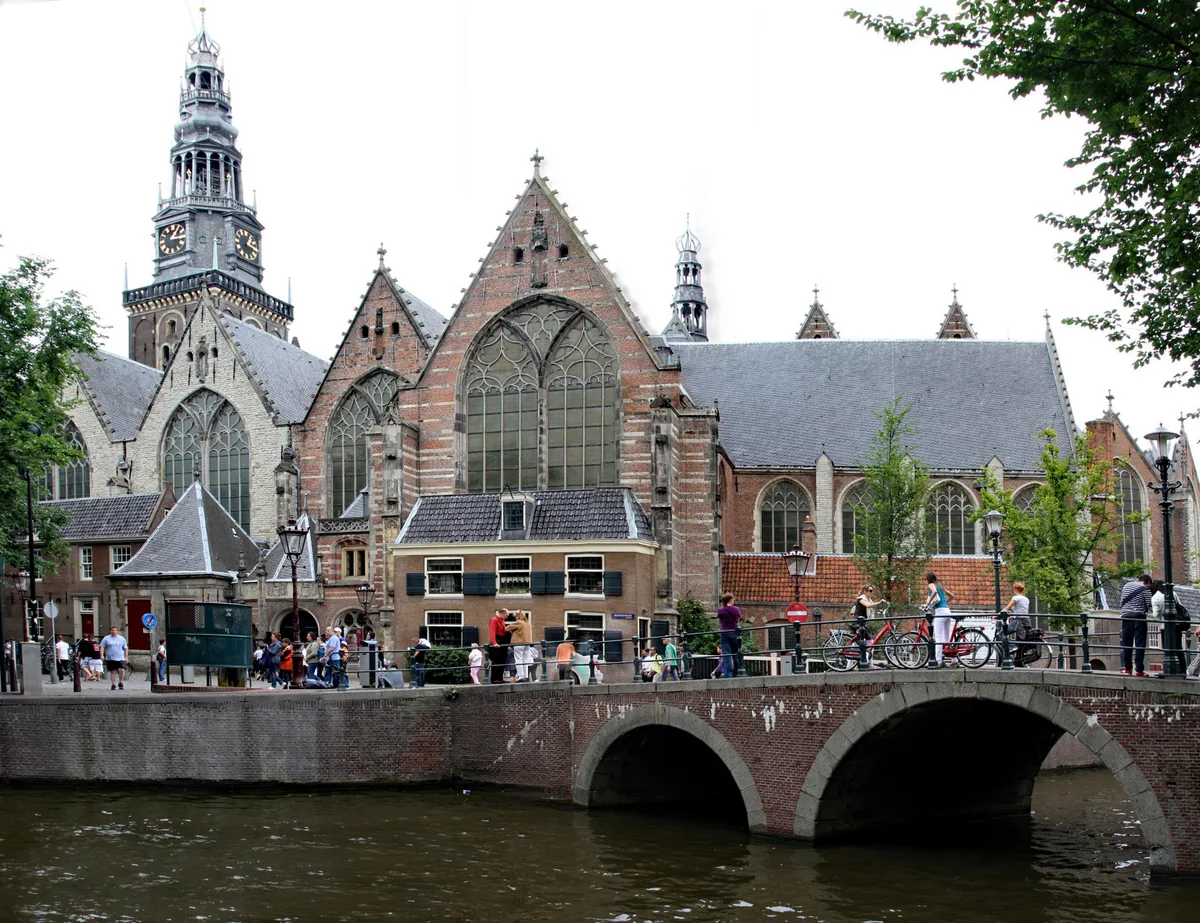
Photo: Dennis van Zuijlekom / CC BY-SA 3.0
What Your Eye SeesA spacious Gothic basilica with Europe's largest medieval wooden barrel vault, tall stained-glass windows, and a floor entirely paved with carved tombstones.
ContextDedicated in 1306 as a wooden chapel that was gradually rebuilt in stone, the Oude Kerk is Amsterdam's oldest surviving building. After the 1578 Alteration, its Catholic statues and frescoes were destroyed during the Protestant iconoclasm. Today it functions as a contemporary art venue and concert hall while remaining surrounded by the Red Light District.
Source: Wikipedia (Oude Kerk, Amsterdam)
DidYou
Know
The Oude Kerk floor is paved with the gravestones of thousands of Amsterdammers buried beneath it over five centuries, merchants, sailors and mayors lie under the very flagstones visitors cross, a city of the dead sealed beneath the living church.
Share→ The Shipwright's Vault
Look up at the oak barrel vault, whose ribs are joined entirely with mortise-and-tenon joints and wooden pegs, no nails or metal fasteners. Dendrochronology dates the oak to 1348, making it one of the oldest surviving wooden roofs in Northern Europe. The nail-free construction was standard practice for Dutch shipwrights, who built hulls the same way.
→ The Unmarked Grave Of Saskia
Rembrandt's wife was buried in 1642 in a grave indistinguishable from the thousands around it, no monument, no name, just a small numbered stone. Rembrandt himself was buried in an unknown pauper's grave in the Westerkerk 27 years later, his remains never identified.
→ A Carillon Built To Sing In Tune
The tower's 47-bell carillon counts fourteen bells cast by François Hemony in 1658, the rest date from the 20th century. With the blind carillonneur Jacob van Eyck, the Hemony brothers cast the first carillons whose bells could be precisely tuned, and their instruments became the standard across Europe. A separate drum mechanism, pinned like a giant music box, still plays the bells automatically to mark the hour.
Sources: Oude Kerk Amsterdam (official); Wikipedia (Oude Kerk, Amsterdam); Wikipedia (Saskia van Uylenburgh); Oude Kerk Amsterdam; Wikipedia (Pieter and François Hemony)
Euro Heritage
Gothic Soul
 Spiritual Seeker
5. Canal Ring (Grachtengordel)
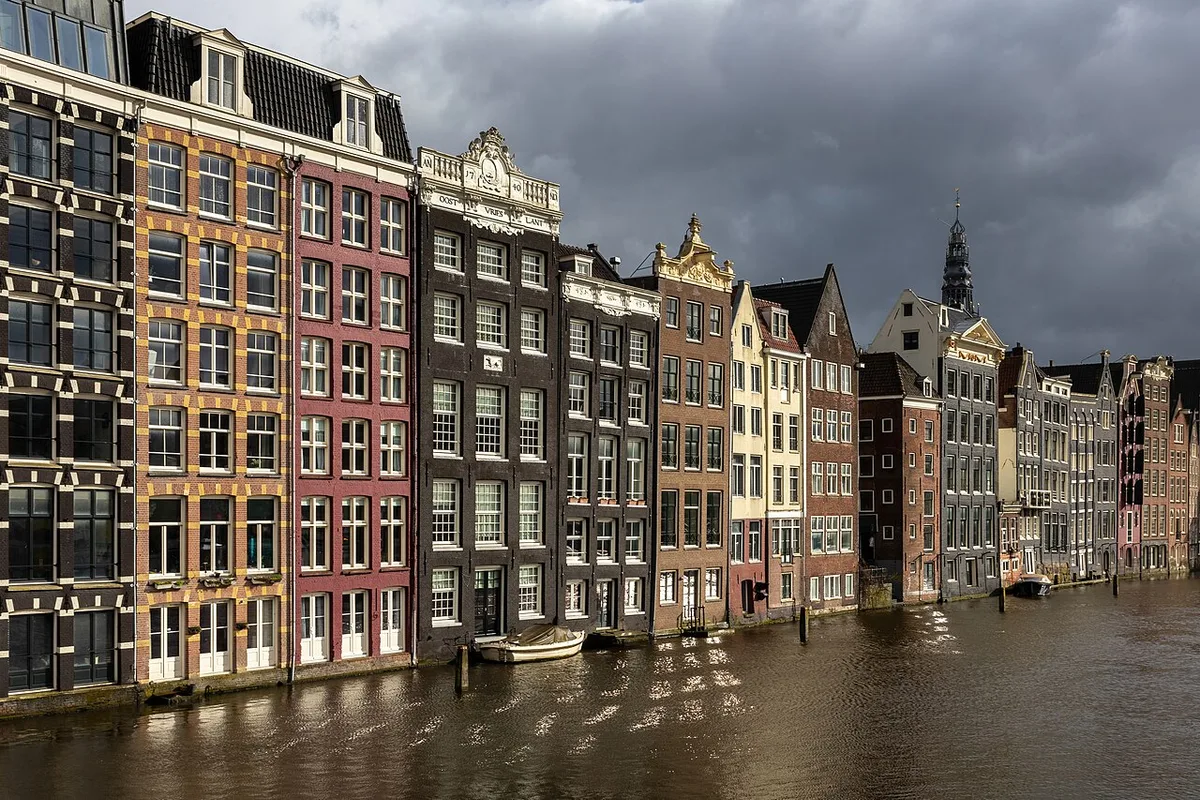
Photo: Basile Morin / CC BY-SA 4.0
What Your Eye SeesFour concentric semicircular canals lined with gable-roofed merchant houses, crossed by arched stone bridges, with the Singel, Herengracht, Keizersgracht, and Prinsengracht wrapping the old city center.
ContextThe Canal Ring was excavated between 1613 and 1663 during Amsterdam's Golden Age expansion, tripling the city's area by draining marshland. The three main canals were zoned by wealth: Herengracht for the richest patricians, Keizersgracht for merchants, and Prinsengracht for craftsmen and small traders. UNESCO inscribed the Canal Ring as a World Heritage site in 2010.
On ScreenAmsterdam's canal ring appears in the films The Fault in Our Stars (2014) and Ocean's Twelve (2004).
Source: UNESCO (17th-century canal ring of Amsterdam); Wikipedia (Grachtengordel); Wikipedia (Canal Ring); The Fault in Our Stars production notes
DidYou
Know
The three grand canals carry names of rank: Herengracht ('Lords' Canal'), Keizersgracht ('Emperor's Canal,' after Maximilian I) and Prinsengracht ('Prince's Canal,' after the Prince of Orange). Beyond them, the Singelgracht was dug not for homes but for defence and water management, ringing the residential belt.
Share→ The Tilted Houses
Look up at the canal-house gables, which were built to lean forward, 'op de vlucht' in Dutch, so that goods hoisted by the wooden beam and pulley at each gable would swing clear of the facade. Furniture, merchandise and even pianos went in through the upper windows, because the internal staircases were too steep and narrow for large objects.
→ The Golden Bend
Herengracht between Leidsestraat and Vijzelstraat is called the Gouden Bocht. The grandest double-width mansions were built in the 1660s–70s for arms merchants and VOC directors. The Trip family, whose wealth came from supplying cannon to armies across Europe, built some of the street’s most opulent houses.
→ The Seventeen Bridges View
From the corner of Reguliersgracht and Herengracht, an alignment of canals lets the viewer see 17 bridges in a single perspective. The view was painted by 19th-century artists and remains one of the city's most photographed scenes, yet most visitors never find the correct spot to look down.
Sources: Grachtenmuseum Amsterdam; Wikipedia (Amsterdam canal houses); Wikipedia (Gouden Bocht); Wikipedia (Reguliersgracht); Amsterdam tourism
 Modernist
6. Rembrandt House Museum
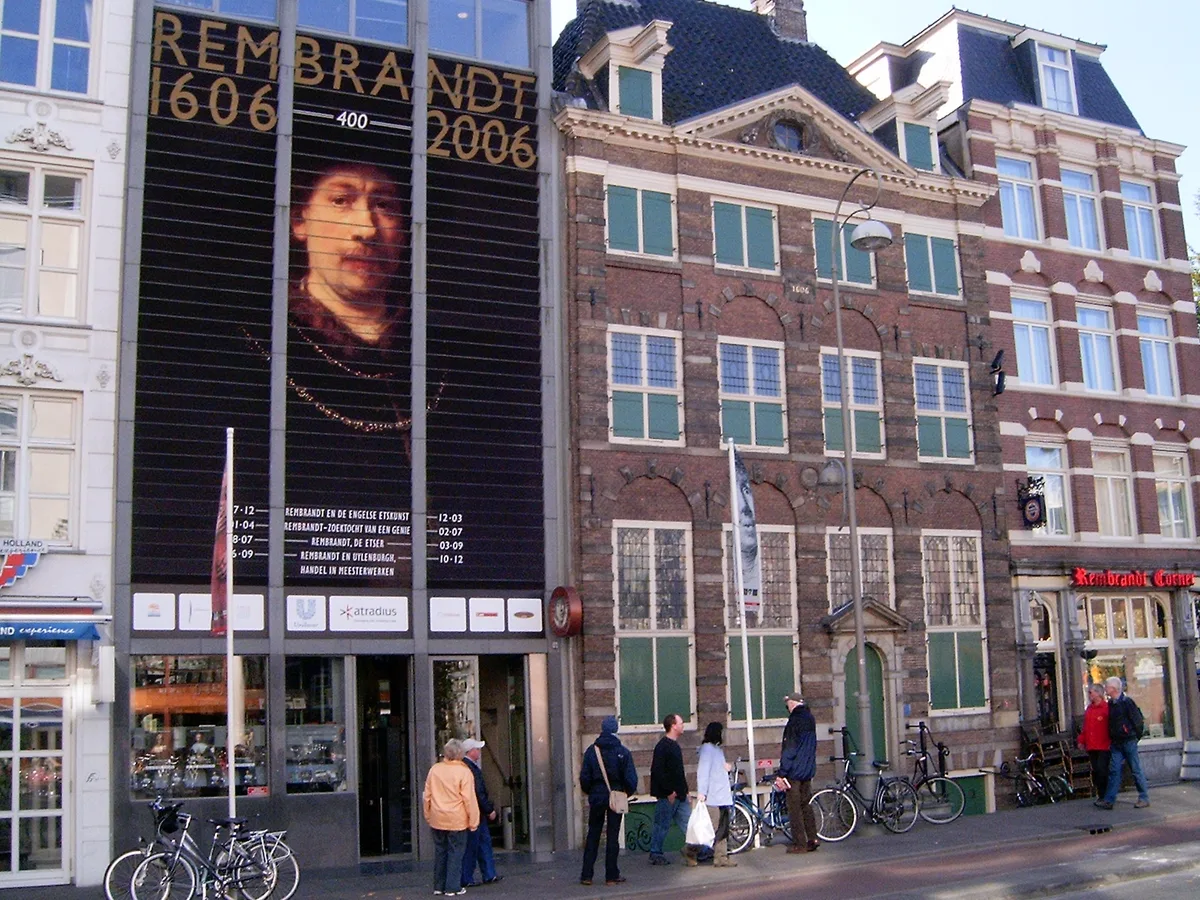
Photo: Gryffindor / CC BY-SA 3.0
What Your Eye SeesA 17th-century red-shuttered canal house with reconstructed period interiors, a printing press, and an artist's studio filled with pigments, copper plates, and natural curiosities.
ContextRembrandt van Rijn bought this house in 1639 for 13,000 guilders, a sum he never fully repaid. He lived and worked here until his 1656 bankruptcy, when his entire collection was auctioned off. The house was restored and opened as a museum in 1911, furnished with period pieces from the 17th century.
Source: Wikipedia (Museum Het Rembrandthuis)
DidYou
Know
Rembrandt ran one of the busiest workshops in Amsterdam from this house, training a generation of Dutch masters and pulling the etchings that made his name known across Europe. The collection he kept here, Roman busts, Japanese armour, even a taxidermied lion's skin, was so vast that its forced sale left one of the most complete inventories of any 17th-century artist's cabinet.
Share→ A House Born In The Same Year As Its Artist
Look at the house itself, built in 1606, the same year Rembrandt was born in Leiden. Around 1627 it was remodeled by the architect Jacob van Campen, who added an extra floor and a new facade with a triangular pediment, before he went on to design Amsterdam's Town Hall, today the Royal Palace on Dam Square.
→ A Studio Built Around The Light
Rembrandt's studio is lit by four north-facing windows, angled so the sun never shines directly in and the light stays even through the day. The room was reconstructed from a drawing Rembrandt himself made of the space, so the light that falls there today is the same painter's light he worked by.
Sources: Rembrandthuis (official); Wikipedia (Rembrandt House Museum)
Euro Heritage
 Renaissance
7. De Waag (Weigh House)
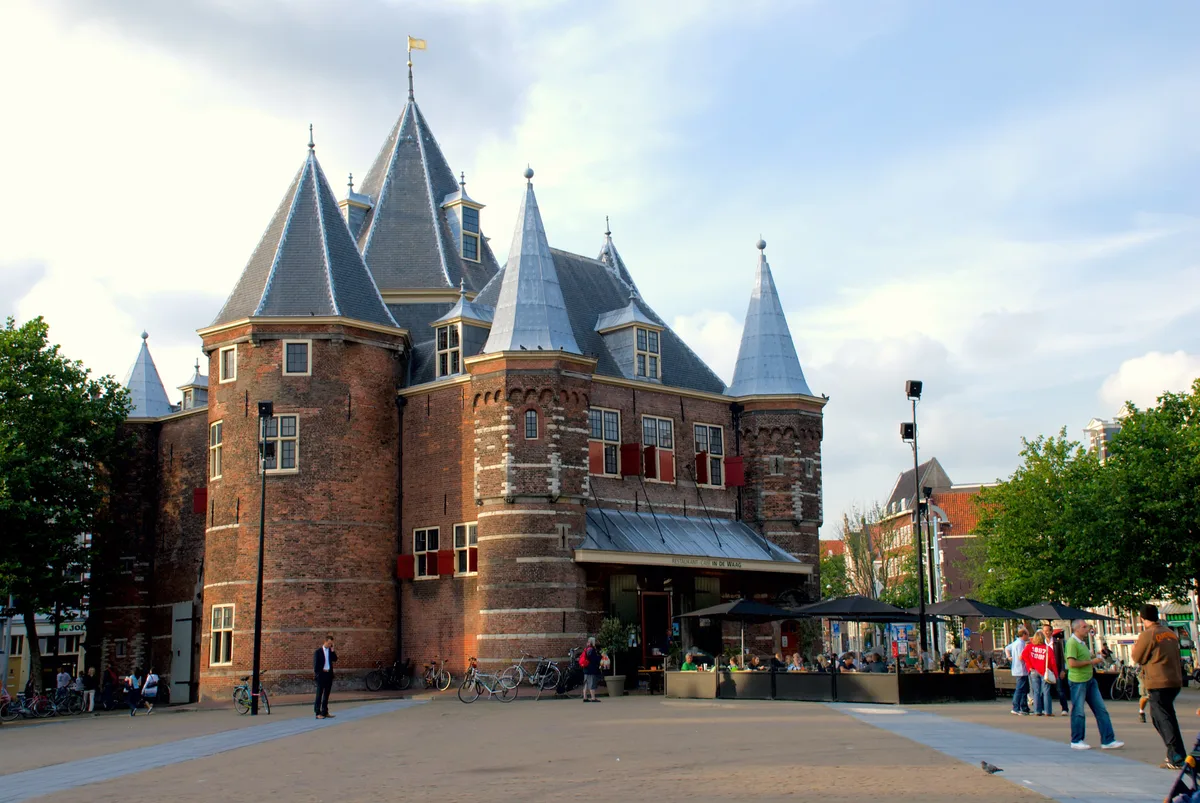
Photo: Kmhofmann at English Wikipedia. / CC BY-SA 3.0
What Your Eye SeesA stout brick city gate with five round towers rising above Nieuwmarkt square, its guild emblems still carved above the doorways that once led into medieval workshops.
ContextBuilt in 1488 as the Sint Antoniespoort, one of the gates in Amsterdam's late-medieval walls, De Waag is the oldest remaining non-religious building in the city. When the walls lost their purpose it became a weigh house in 1617, then a guild hall and an anatomy theatre. Today it houses a restaurant and the Waag Futurelab.
Source: Wikipedia (Waag, Amsterdam)
DidYou
Know
On the Waag's upper floor, Amsterdam's surgeons staged public dissections as civic spectacles, the very setting Rembrandt captured in his Anatomy Lesson of Dr. Nicolaes Tulp, with the guild's members gathered around an opened corpse.
Share→ The Guild Emblems Above The Doors
Look up at the guild emblems above the doors: the blacksmiths', painters', masons' and surgeons' guilds each had their own entrance, and each guild's emblem is still carved above its door. The masons' portal includes sculpture work by Hendrick de Keyser.
→ A Date Stone That May Be Wrong
Look for the oldest gable stone in Amsterdam, which decorates the tower facing the Geldersekade and records that the first stone of the gate was laid on 28 April 1488. Building archaeologists now suspect the gate is older, city archive documents mention Saint Anthony's Gate before that date, possibly as early as around 1425.
→ The Doors That Face The Wrong Way
None of the Waag's four large semi-circular entrances lines up with the street or canal it leads toward, and the main gate on the Nieuwmarkt side sits at a visible angle. The building's own historians describe this cluster of medieval towers as one that “does not really fit in its surroundings”, a leftover from the gate's military origins.
Sources: Wikipedia (Waag, Amsterdam); Waag (official); Waag Society (official); Wikipedia (Theatrum Anatomicum)
Euro Heritage
Gothic Soul
8. Begijnhof (Beguinage)
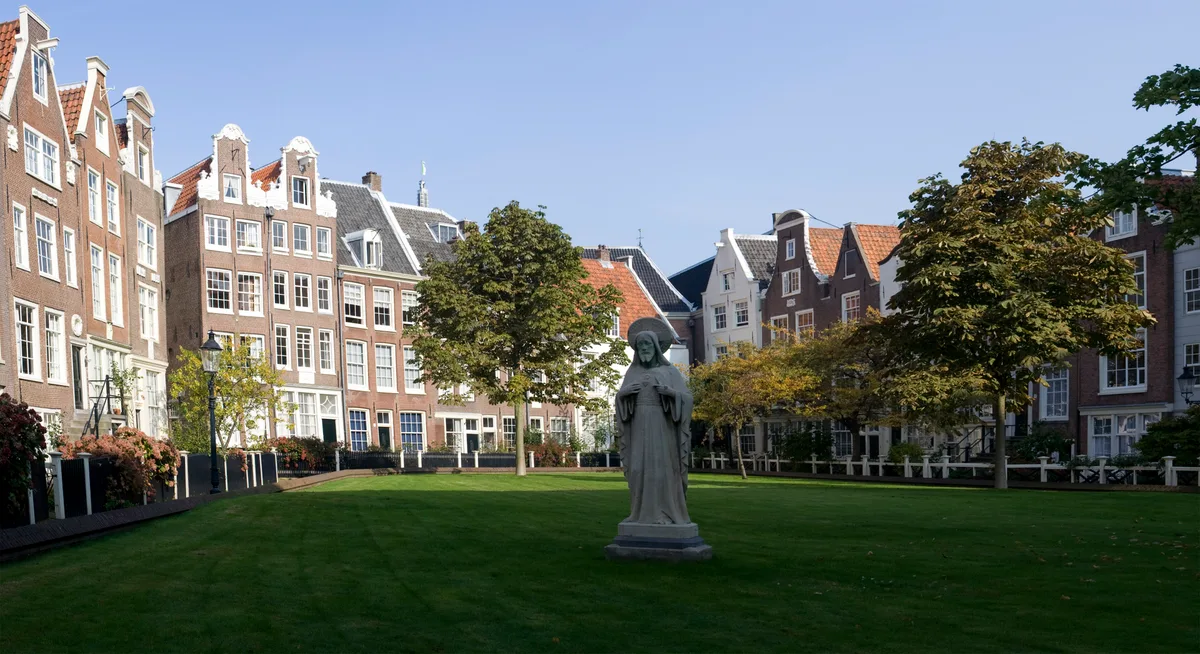
Photo: Massimo Catarinella / CC BY-SA 3.0
What Your Eye SeesA hidden, traffic-free courtyard ringed by gabled brick houses from the 17th and 18th centuries, enclosing two churches and a centuries-old wooden house in the middle of Amsterdam’s centre.
ContextThe Begijnhof is one of the oldest hofjes in Amsterdam, a beguinage, a community of Catholic women who lived a semi-religious life without taking monastic vows. First mentioned in 1307, it survived the Reformation and is still inhabited today by single women.
Source: Wikipedia (Begijnhof)
DidYou
Know
When Amsterdam turned Protestant in 1578, the Begijnhof was the only Catholic institution allowed to stay, because its houses were the beguines' private property, not Church land, the city could not simply seize them. The courtyard still shelters single women today, as it has for seven centuries.
Share→ The Houten Huys, One Of Two
Look for Begijnhof 34, the Houten Huys (Wooden House), one of only two wooden-fronted houses left in the centre of Amsterdam, timber construction was banned in 1521 after a series of fires. Dendrochronology now dates it to around 1528–29, later than the long-assumed 1452, and it still holds a fragment of a 15th-century painting of Mary with the Unicorn.
→ A Pulpit By The Young Mondrian
Inside the English Reformed Church, look for the pulpit carved with panels designed by Piet Mondrian, decades before his abstract grids, commissioned for Queen Wilhelmina's accession to the throne in 1898 and inaugurated on 28 May 1899. The church also holds a brass lectern donated in 1689 by King William III and Queen Mary.
→ The Church Hidden Behind Two Houses
Across the courtyard from the English Church stands the Begijnhof's Catholic chapel, built in 1671 behind the facade of two ordinary townhouses. From outside it looks like a private home, but inside it opens into a three-aisled church by the architect Philips Vingboons, where the beguines worshipped in secret until religious freedom was restored in 1795.
Sources: Wikipedia (Begijnhof, Amsterdam); UvA Amstelodamum; English Reformed Church Amsterdam (official); Mondrian Route; Wikipedia (Begijnhof Chapel, Amsterdam); Het Begijnhof (official)
Spiritual Seeker
What is the oldest non-religious building in Amsterdam?
De Waag. Built in 1488 as the Sint Antoniespoort city gate, it is the oldest surviving non-religious building in Amsterdam. When the city walls lost their purpose, it became a weigh house in 1617, then a guild hall and anatomy theatre.
What is the oldest building in Amsterdam?
The Oude Kerk (Old Church), dedicated in 1306. It is Amsterdam's oldest surviving building, predating the first canal ring by more than two centuries. De Waag is the oldest non-religious building; the Oude Kerk is the oldest overall, a former Catholic church.
Where did Anne Frank hide during World War II?
The Anne Frank House. Built in 1635 as a canal-side home, it became the hiding place for Otto Frank's family from 1942 to 1944, where Anne wrote her diary in the Achterhuis above the warehouse.
Where did Rembrandt live and work in Amsterdam?
The Rembrandt House Museum. Rembrandt van Rijn bought the house in 1639 for 13,000 guilders and lived and worked there until his 1656 bankruptcy, when his entire collection was auctioned off. It opened as a museum in 1911.
What is the oldest wooden house in Amsterdam?
The Begijnhof contains Amsterdam's oldest wooden house, in one of the city's oldest enclosed courtyards (first mentioned in 1307). After the 1578 Protestant takeover it was the only Catholic institution allowed to remain, because the houses were the beguines' private property.
Where is the I Amsterdam sign?
The giant red-and-white "I Amsterdam" letters stood at Museumplein in front of the Rijksmuseum from 2004 until December 2018, when the city council removed them over mass-tourism concerns. A set still stands at Schiphol Airport, and others tour events around the city.
Where is Rembrandt's Night Watch painting?
The Night Watch (1642), Rembrandt's largest and most famous group portrait, hangs in the Rijksmuseum, one of the most recognized paintings in the world and a centerpiece of the museum's Gallery of Honour.
Is 1666: Amsterdam an Assassin’s Creed game?
No. 1666: Amsterdam is not an Assassin’s Creed game, though it shares a creator: Patrice Désilets, the original creative director who created Assassin’s Creed, left Ubisoft and built it independently at his studio Panache Digital Games. Set in a plague- and witch-hunt-era 17th-century Amsterdam, it follows a wrongfully accused man caught between a woman-hunt and the city’s secrets. After roughly 16 years in development it launches in Early Access on 25 August 2026, a standalone story, not part of the Assassin’s Creed universe.
These landmarks reward close attention. Vestigia is a field companion for people who look longer, with curated context, architectural detail, and the stories most visitors walk past. Free on the App Store and Google Play.