Kuala Lumpur Historical Landmarks
1. Sin Sze Si Ya Temple
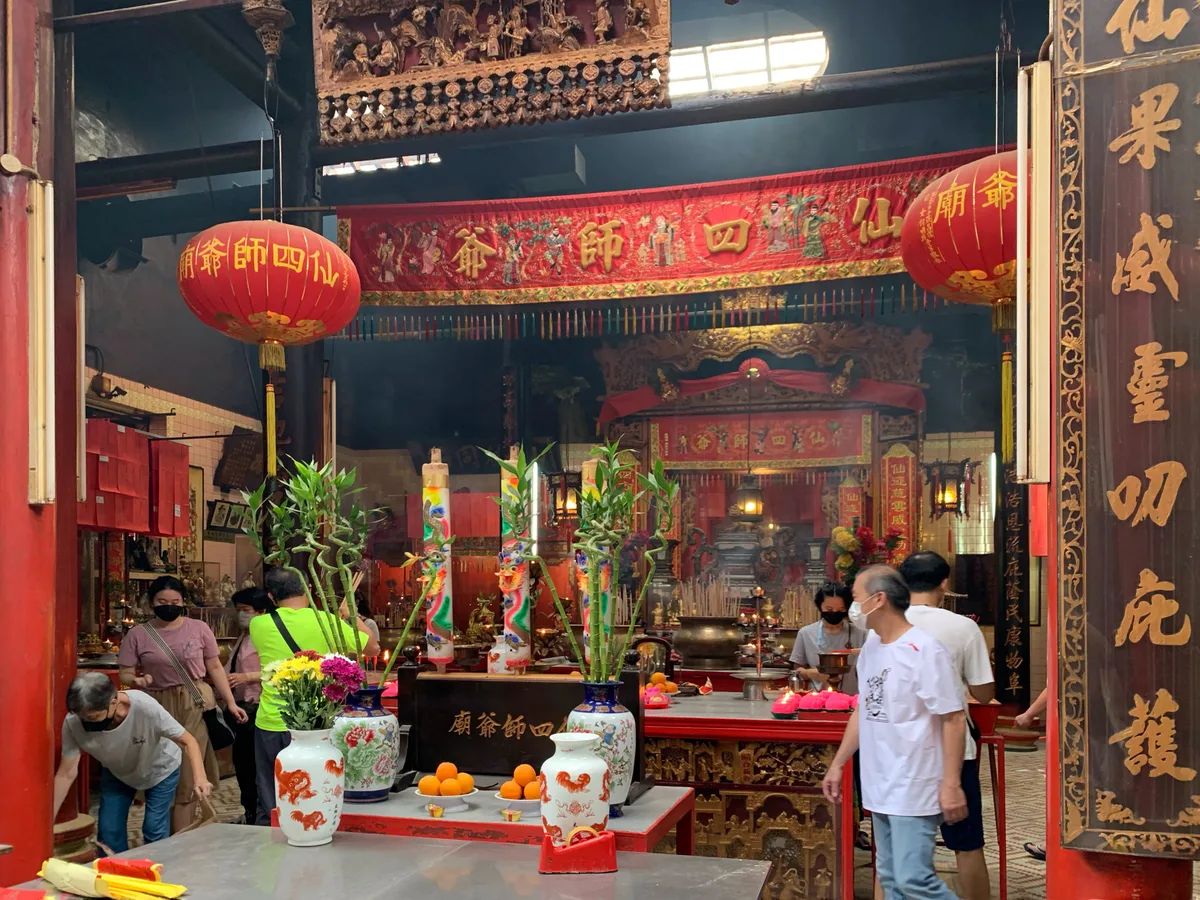
Photo: Chainwit. / CC BY-SA 4.0
What Your Eye SeesA snug wooden shrine squeezed into a turn-of-the-century shopfront along Jalan Tun H.S. Lee, its red-and-gold altar glow dimmed by centuries of incense smoke. Ornate carved roof ridges, joss-paper banners and a narrow lane of small deities crowd beneath the low ceiling, where the smoke of burning incense curls up past old painted beams.
ContextSin Sze Si Ya is the oldest Taoist temple in Kuala Lumpur, founded in 1864 with the backing of Yap Ah Loy, the Kapitan Cina who became the effective founder and de facto ruler of the young tin-mining town. For much of its early life the temple served far more than worship: it doubled as a gathering hall, a registry and a first shelter for the stream of Chinese labourers arriving from southern China to work the mines during the tin-boom years.
Source: Wikipedia (Sin Sze Si Ya Temple); Tourism Malaysia
 Did
DidYou
Know
Did you know the temple's two deities are not ancient gods but local men deified after the Selangor Civil War? Sin Sze Ya was a Kapitan slain in 1861, legend says white blood flowed from his neck as a divine omen, and Si Sze Ya a comrade who died fighting; Yap Ah Loy enshrined them, and their cult spread to dozens of branch temples across Peninsular Malaysia.
Share→ Two Sedan Chairs At The Door
Flanking the temple entrance stand two wooden sedan chairs dating from the late 1800s, once used to carry the statues of the deities through the streets during religious processions.
→ Two Hanging Carved Panels
Among the decorations inside the temple are two hanging carved panels, part of the old carved wooden fittings that have survived the building's many repairs.
Sources: Travelfish (Sin Sze Si Ya Temple); Lonely Planet (Sin Sze Si Ya Temple)
 Eastern Spirit
 Spiritual Seeker
2. Sri Maha Mariamman Temple
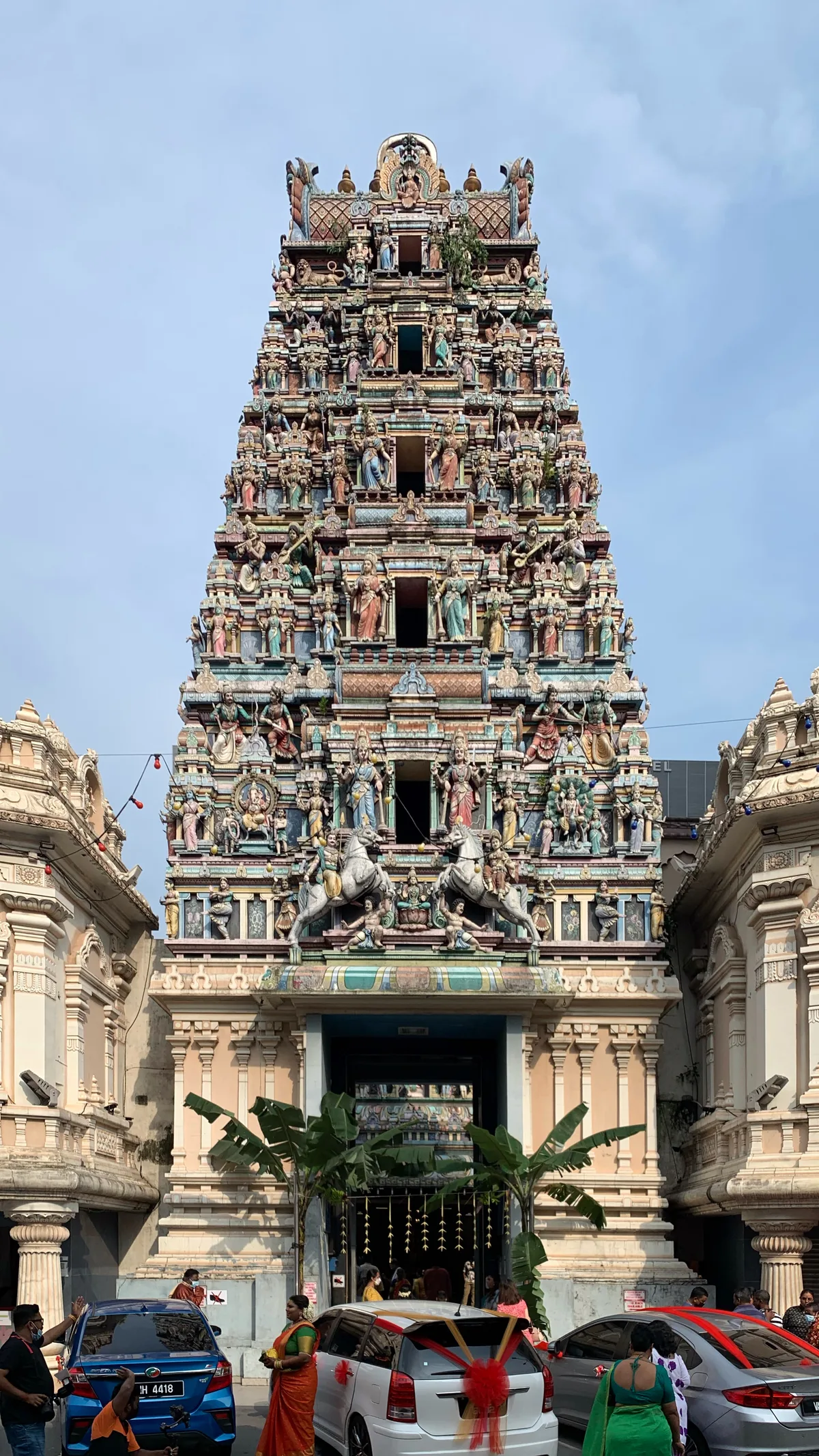
Photo: Chainwit. / CC BY-SA 4.0
What Your Eye SeesA vividly painted South Indian temple rising behind a tall stone-carving work on the roof, its daunting five-tiered gopuram topped with a dense crowd of sculpted gods, stacked above a deep red and gold façade on bustling Jalan Tun H.S. Lee. Inside, a marble hall glows beneath colourful wall-paintings and the shrine to the goddess Mariamman.
ContextSri Maha Mariamman is the oldest Hindu temple in Kuala Lumpur, established in 1873 by K. Thamboosamy Pillai, a South Indian immigrant who became one of the city's wealthiest early citizens. Originally a modest structure, the temple was demolished and rebuilt into its present grand form in 1968, crowned by a tall five-tiered Raja Gopuram gate tower that makes it one of the most photographed Hindu temples in Malaysia.
Source: Wikipedia (Sri Mahamariamman Temple, Kuala Lumpur); Tourism Malaysia
DidYou
Know
Did you know this temple began not as a public shrine but as the private family altar of the tycoon K. Thamboosamy Pillai, who kept it closed to all but his household until the 1920s, and it is now reputed to be the richest Hindu temple in Malaysia?
Share→ 228 Gods On The Tower
Look up at the gopuram: its 22.9-metre height is crowded with 228 painted idols of Hindu deities, sculpted by the Tamil Nadu artisan S. T. Muniappa and his team from southern India.
→ A Silver Chariot In The Grounds
Kept inside the temple grounds is a 6.5-metre silver chariot built from 350 kilograms of silver, fitted with 240 bells and a pair of horses, which carries Lord Muruga and his consorts to the Batu Caves during Thaipusam.
Sources: Wikipedia (Sri Maha Mariamman Temple); Tourism Malaysia (Sri Maha Mariamman Temple)
Eastern Spirit
Spiritual Seeker
3. Guan Di Temple
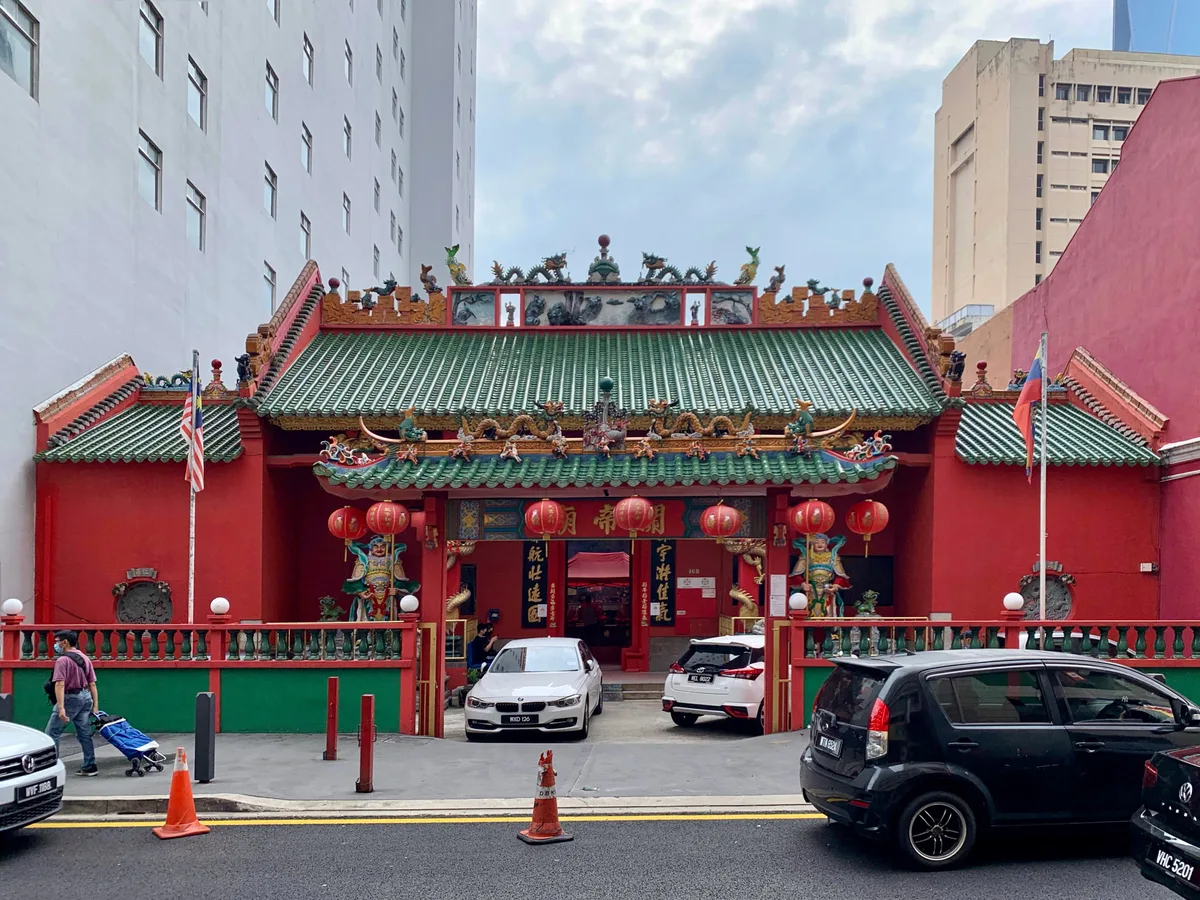
Photo: Chainwit. / CC BY-SA 4.0
What Your Eye SeesA striking red-and-green Chinese temple set within a busy neighbourhood, its sweeping tiled roofs rising in a series of dragon-mounted ridges. Gold lanterns glow from the eaves, thick coils of incense hang over the doorway, and the fierce figure of Guan Yu, the god of war, looms at the heart of the altar.
ContextGuan Di Temple was founded in 1888 by the Selangor and Federal Territory Kwong Siew Association, formed by settlers from the Kwong Siew region of southern China to honour Guan Yu. It has long been more than a shrine: the association behind it managed community welfare, providing a forum and charitable help for its clan members on hard times.
Source: Wikipedia (Guan Di Temple, Kuala Lumpur); Tourism Malaysia
DidYou
Know
Did you know Guan Di, the god honoured here, is the patron of righteous brotherhood, revered as protector by both the police and the triad gangs alike? A general of the Three Kingdoms era deified for loyalty and integrity, he draws devotees seeking protection and business success to this 1888 temple.
Share→ A Bronze Blade At The Altar
At the main altar the temple keeps its most treasured relic: the Green Dragon Crescent Blade, a bronze weapon believed by legend to weigh around 59 kilograms, which devotees try to lift for good luck.
Stone Lions And A Gilded Sign
A pair of stone lions guards the entrance, while a gilded signboard inscribed with the temple name in Traditional Chinese hangs above the gate, and dragon-carved columns support the front veranda.
Sources: Wikipedia (Guan Di Temple); Tourism Malaysia (Guan Di Temple)
Spiritual Seeker
4. St. Mary's Cathedral
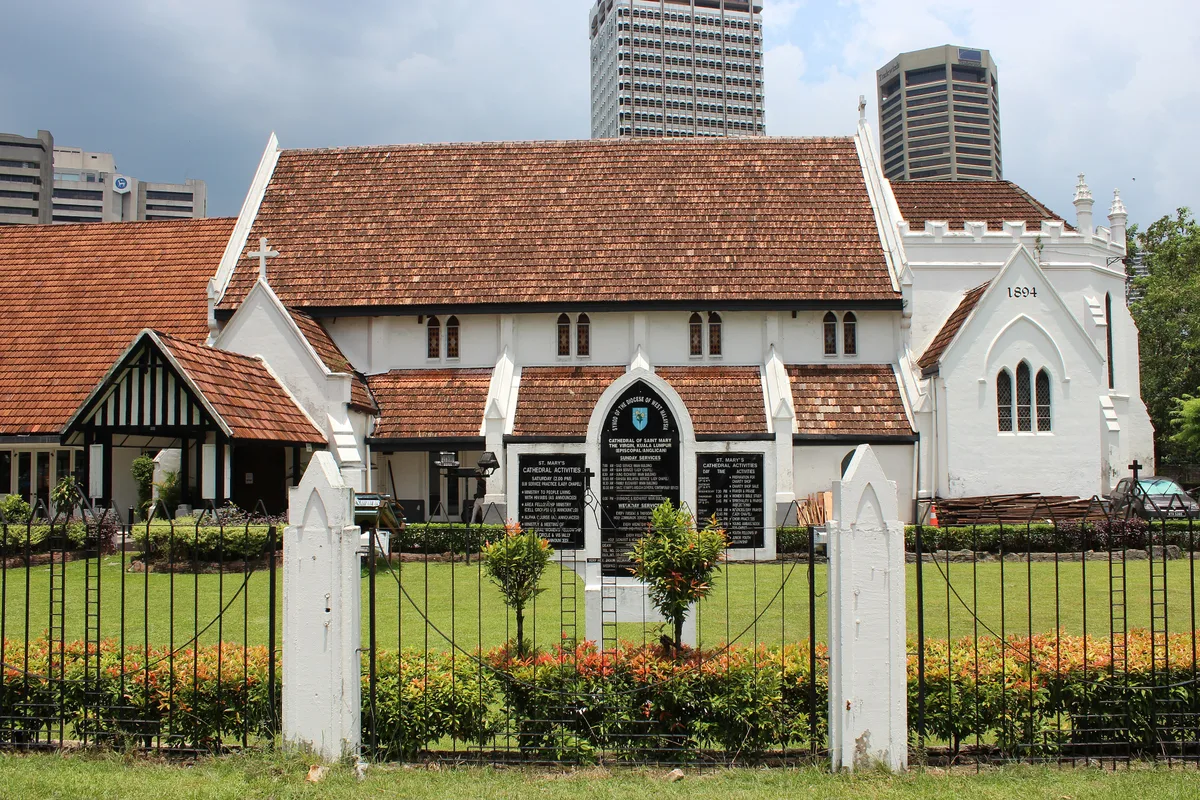
Photo: Flaming Ferrari / CC BY-SA 3.0
What Your Eye SeesA red-brick Gothic Revival Anglican church with sharp pointed windows, a delicate bell tower and steep pitched roofs, trimmed in pale stone, standing beside the open lawns of Merdeka Square. Inside, tall windows cast light along the aisles of the neat, high space.
ContextThe Anglican parish was formally founded with a temporary wooden church in 1887, and the present brick cathedral was completed in 1894 beside the old Padang, the town's great central square. It became the seat of the Anglican Diocese of West Malaysia, and its position at the edge of the square meant it stood at the very centre of the country's colonial and early national life.
Source: Wikipedia (St. Mary's Cathedral, Kuala Lumpur); Tourism Malaysia
DidYou
Know
Did you know St. Mary's is the oldest brick church in Malaysia? Consecrated in 1895 as 'the first brick church erected in the native States of the Malay Peninsula', its Early English Gothic walls have stood beside the padang for well over a century.
Share→ A Pipe Organ By A Master Of The Craft
In the organ loft sits a pipe organ built by Henry Willis, the celebrated English organ maker who also built the organ for St Paul's Cathedral in London and the original Grand Organ of the Royal Albert Hall.
→ A Plaque To The Engineer Who Built The Railroads
Inside the cathedral a commemorative plaque honours C.E. Spooner, the general manager of the Federated Malay States Railways, whose great engineering projects shaped the colonial state around the square outside.
Sources: Wikipedia (St. Mary's Cathedral); Malaysia 1786–1957 (britishmalaya.home.blog)
 Euro Heritage
 Gothic Soul
Spiritual Seeker
Gothic Soul
Spiritual Seeker
5. Sultan Abdul Samad Building
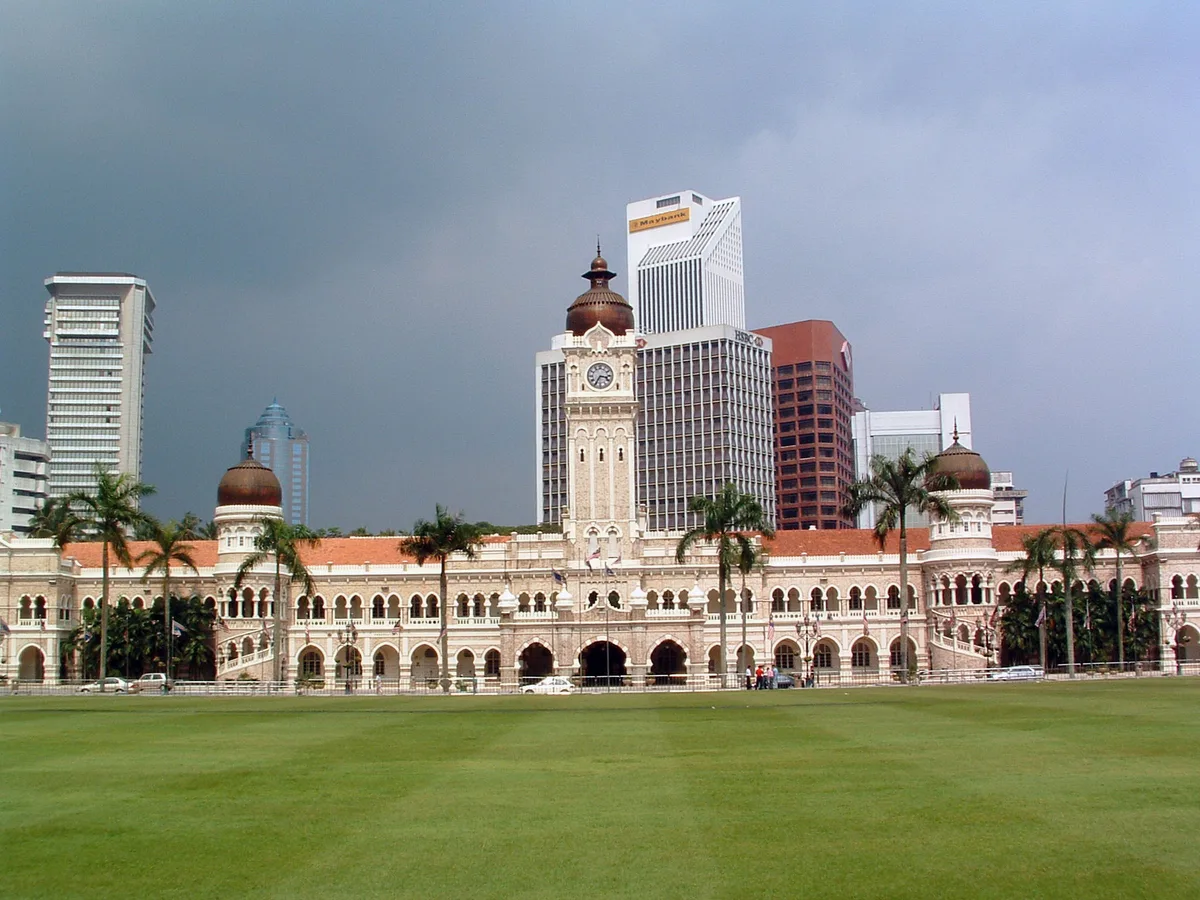
Photo: Gerold Kogler / CC BY-SA 3.0
What Your Eye SeesA long cream-and-brick façade running along Jalan Raja, its rhythm of cusped arches leading the eye to a great square clock tower. Horseshoe-arched verandahs and rows of domes rise above the square, in a blend of Moorish and Indo-Saracenic influence that is unlike anything around it.
ContextThe Sultan Abdul Samad Building was the showpiece of British-colonial Malaya: its foundation stone laid on 3 September 1894 and the building opened on 4 April 1897. It stretches 137.2 metres (450 ft) along Jalan Raja, its 41-metre (135 ft) clock tower rising over the padang, and for decades it was the largest government building in Malaya. The structure is credited to A.C. Norman, though the final design was chiefly the work of the young architects A.B. Hubback and R.A.J. Bidwell.
On ScreenThe Sultan Abdul Samad Building was a filming location for the film Police Story 3: Supercop (1992).
Source: Wikipedia (Sultan Abdul Samad Building); Britannica; Wikipedia (Sultan Abdul Samad Building); Police Story 3 production notes
DidYou
Know
Did you know the foundation stone, laid in 1894, sealed a time capsule inside? Along with Straits coins and the day's newspaper, it held a piece of Selangor tin, a snapshot of the state buried beneath one of Malaya's grandest buildings.
Share→ A One-Ton Bell In The Clock Tower
The clock tower houses a one-ton bell that strikes on the hour and half-hour, its mechanism made by Gillett & Johnston of Croydon and first chiming in June 1897.
→ 'Merdeka' Written On The Tower
Since 2007 the word 'Merdeka' ('Independence') has been fixed at the bottom of the clock tower, a permanent reminder on the building itself of the independence proclaimed across the square in 1957.
Sources: Wikipedia (Sultan Abdul Samad Building); Britannica (Sultan Abdul Samad Building)
 Silk Road Legacy
6. Masjid Jamek
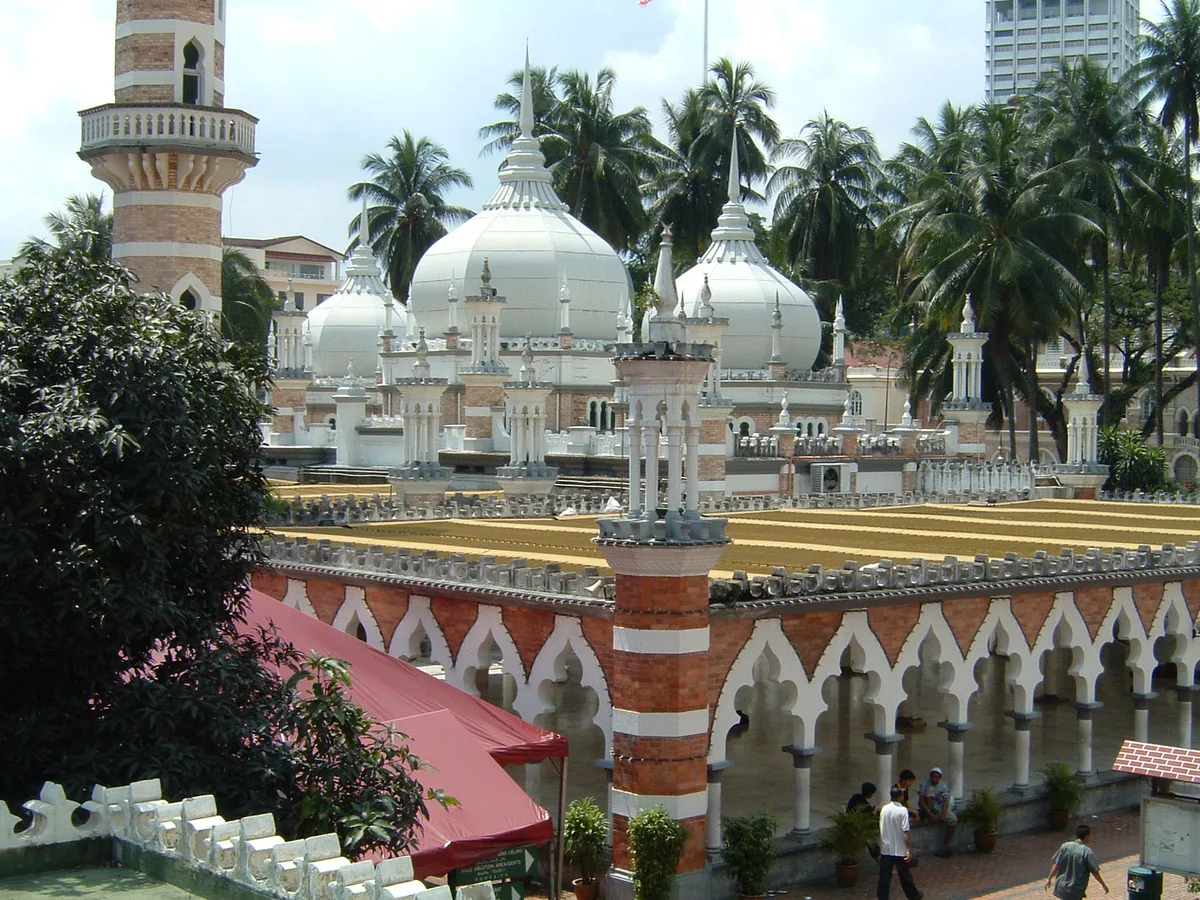
Photo: Earth / CC BY 2.5
What Your Eye SeesA serene riverside mosque of red brick and white plaster panels, capped with graceful horseshoe domes and slim minarets, set among lawns where the city's two rivers converge below an old footbridge in the heart of the historic quarter.
ContextMasjid Jamek is the oldest mosque in Kuala Lumpur, completed in 1909 on the very ground where the Klang and Gombak rivers meet, widely regarded as the site of the city's founding. It was designed by A.B. Hubback in a Moorish style with domes, minarets and surrounding gardens, and in 2017 the mosque was officially renamed Sultan Abdul Samad after the Sultan of Selangor.
Source: Wikipedia (Jamek Mosque); Tourism Malaysia
DidYou
Know
Did you know that when the Sultan of Selangor laid Masjid Jamek's foundation stone in 1908, nine coins, three gold sovereigns and six silver dollars, were buried beneath it as a colonial good-luck charm? The mosque rose on ground that had been Kuala Lumpur's first Muslim cemetery.
Share→ Pink-And-White Banded Minarets
The mosque's two main minarets are banded in pink and white brick and plaster, a pattern once nicknamed 'blood and bandage' and shared with the Sultan Abdul Samad Building across the street.
→ Two Shades Of Brick In The Walls
Look closely at the walls: the original 1909 section and the later extension are built of visibly different coloured bricks, so the mosque's growth can be read directly in the masonry.
Sources: Wikipedia (Jamek Mosque); Tourism Malaysia (Jamek Mosque)
Silk Road Legacy
Spiritual Seeker
What is the clock tower building in central Kuala Lumpur?
The Sultan Abdul Samad Building, the showpiece of British-colonial Malaya. Its foundation stone was laid in 1894 with a time capsule inside, holding Straits coins, the day's newspaper and a piece of Selangor tin. The building opened in 1897, stretches 137.2 metres along Jalan Raja, and for decades it was the largest government building in Malaya. Its 41-metre clock tower rises over the padang (the great green square), a now-iconic view of the city.
Where was Kuala Lumpur founded?
At the meeting point of the Klang and Gombak rivers, where Masjid Jamek, the city's oldest mosque, was completed in 1909. The mosque rose on ground that had been Kuala Lumpur's first Muslim cemetery. When the Sultan of Selangor laid its foundation stone in 1908, nine coins, three gold sovereigns and six silver dollars, were buried beneath as a colonial good-luck charm. The mosque was designed by A.B. Hubback in a Moorish style with domes and minarets.
These landmarks reward close attention. Vestigia is a field companion for people who look longer, with curated context, architectural detail, and the stories most visitors walk past. Free on the App Store and Google Play.