Washington DC Historical Landmarks
1. US Capitol
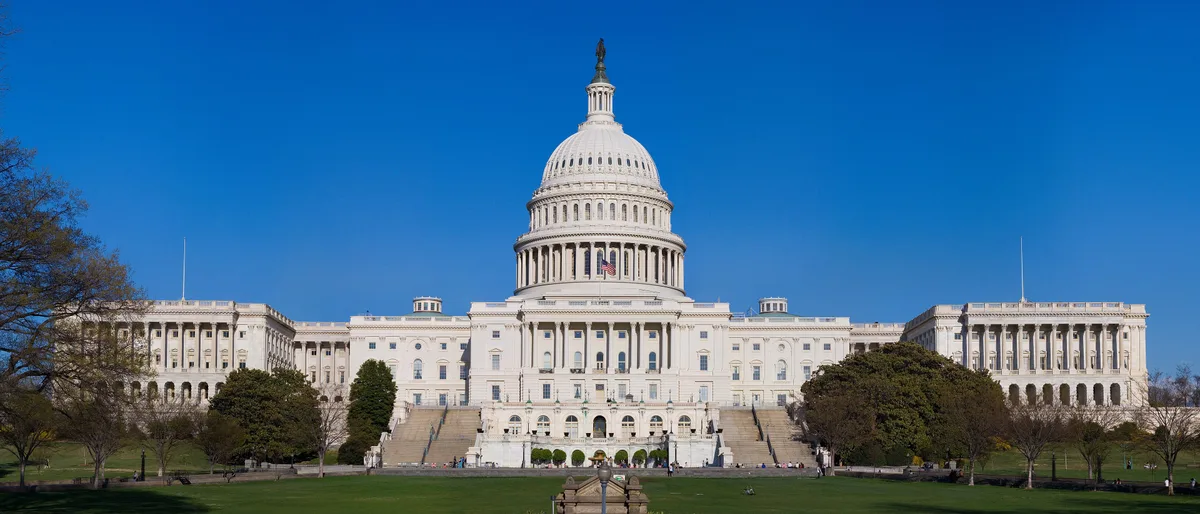
Photo: Noclip / Public domain
What Your Eye SeesA vast Neoclassical building of white marble and sandstone crowned by a dome of white-painted cast iron, its east and west fronts approached by broad steps and colonnaded terraces. The dome rises above a facade of columns and pediments, and the building stretches nearly 750 feet (229 m) across Capitol Hill, closing the eastern vista of the National Mall.
ContextThe Capitol has been the home of the United States Congress since 1800, when the federal government moved to the new capital. The original design by William Thornton was begun in 1793, and the building was still unfinished when British troops burned it in 1814. The crowning cast iron dome, designed by Thomas U. Walter and completed in 1863 at the height of the Civil War, turned the Capitol into the familiar silhouette that anchors the National Mall.
On ScreenThe US Capitol appears in the film Mr. Smith Goes to Washington (1939) and the series House of Cards.
Source: Architect of the Capitol; Wikipedia (United States Capitol); Wikipedia (United States Capitol); Mr. Smith Goes to Washington production notes; House of Cards production notes
 Did
DidYou
Know
The Capitol's cast-iron dome weighs close to nine million pounds and is painted white to look like the stone of the building below it - a trick that hides the fact the dome is metal, not masonry.
Share→ The Statue Of Freedom
Look up at the dome's bronze Statue of Freedom by Thomas Crawford, 19.5 feet (5.9 m) tall, she wears a helmet crested with an eagle's head and feathers. She faces east, toward the rising sun, so visitors approaching from the Mall see her only from behind.
→ The Crypt’s 40 Columns
Step beneath the Rotunda into the Crypt to see 40 stout Doric columns of sandstone supporting the floor above. The room was designed in the 1790s as the intended burial chamber of George Washington, whose body was never brought here, the Crypt instead became the building's entrance and is now a museum space.
Sources: Architect of the Capitol; Wikipedia (United States Capitol)
 New World
 Time Traveler
2. White House
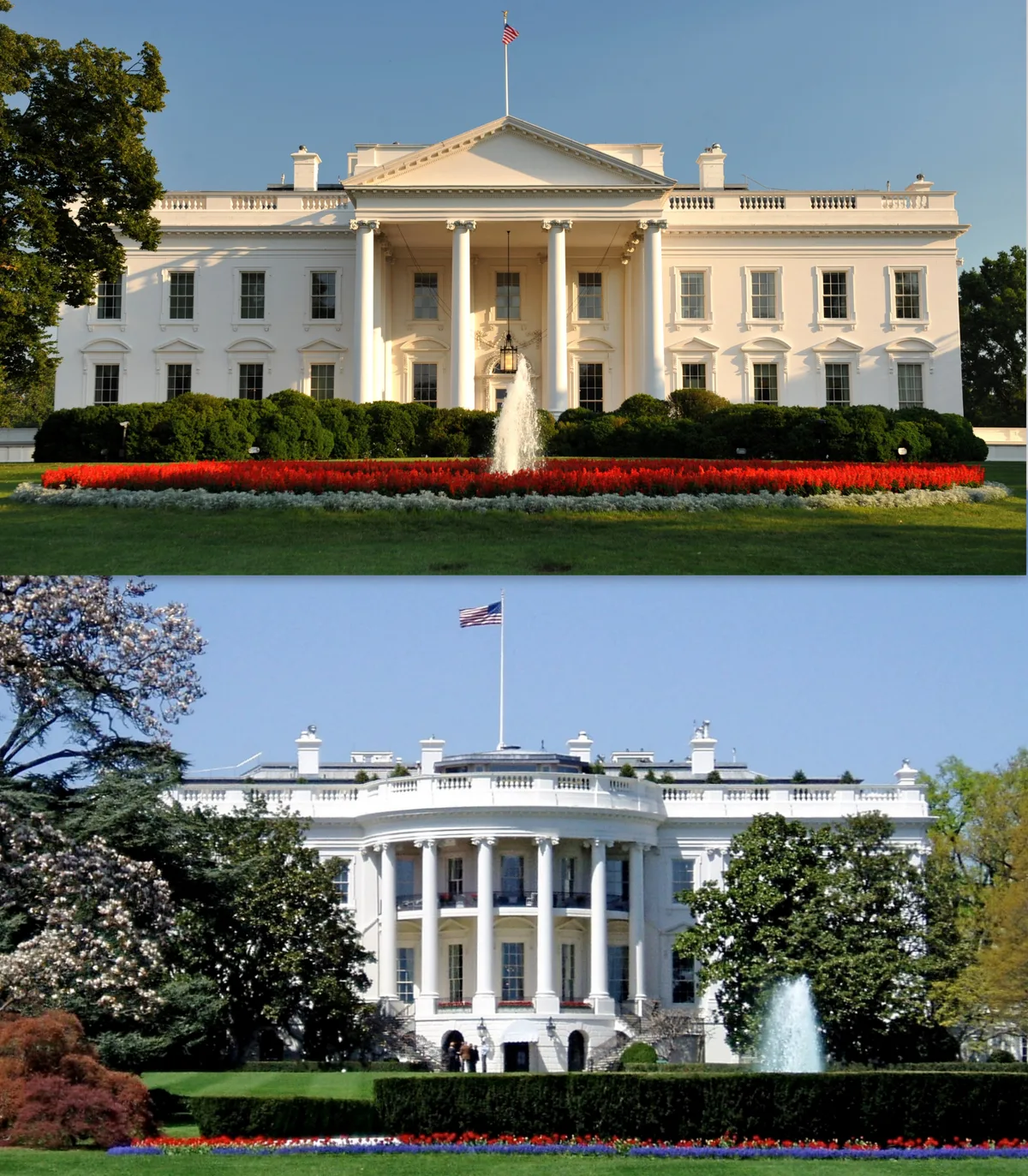
Photo: (top)Cezary p(bottom)MattWade / CC BY-SA 4.0
What Your Eye SeesA white-painted Neoclassical mansion of Aquia Creek sandstone, its central block fronted by a columned portico beneath a triangular pediment. The North Portico overlooks Pennsylvania Avenue, while the curved South Portico colonnade faces the lawn and the Washington Monument beyond.
ContextChosen by President George Washington and designed by James Hoban, the White House was built from 1792 to 1800 of Aquia Creek sandstone. Its walls were lime-whitewashed from 1798 to protect the porous stone; the nickname 'White House' was already in use by March 1812, before British troops burned it on August 24, 1814. Officially named 'White House' by Theodore Roosevelt's executive order in 1901, it has been home to every president since John Adams.
On ScreenThe White House is destroyed by the alien attack in Independence Day (1996), one of the film's most famous shots, and also appears in Olympus Has Fallen (2013) and White House Down (2013).
Source: White House Historical Association (How did White House get its name); Wikipedia (White House); Wikipedia (White House); Independence Day production notes
DidYou
Know
As enemy troops closed in during the War of 1812, First Lady Dolley Madison cut the Gilbert Stuart portrait of George Washington from its frame and saved it; a violent storm that night is credited with sparing the mansion's outer walls.
Share→ The White Lime Wash
Look closely at the white paint: the lime whitewash dates to 1798 to protect porous Aquia Creek sandstone, the nickname was already in use by March 1812, and after the August 1814 burn the walls were re-whitewashed and later repainted in 1818, continuing the pre-existing tradition. The soft stone still requires constant repainting.
→ The North Portico
Look at the columned North Portico facing Pennsylvania Avenue, added in 1829 under Andrew Jackson, the original entrance was a plainer opening. The curved South Portico colonnade, older still, was added in 1824 during James Monroe's presidency.
Sources: White House Historical Association (How the White House Got Its Name); Wikipedia (White House); White House Historical Association
New World
Time Traveler
3. Washington Monument
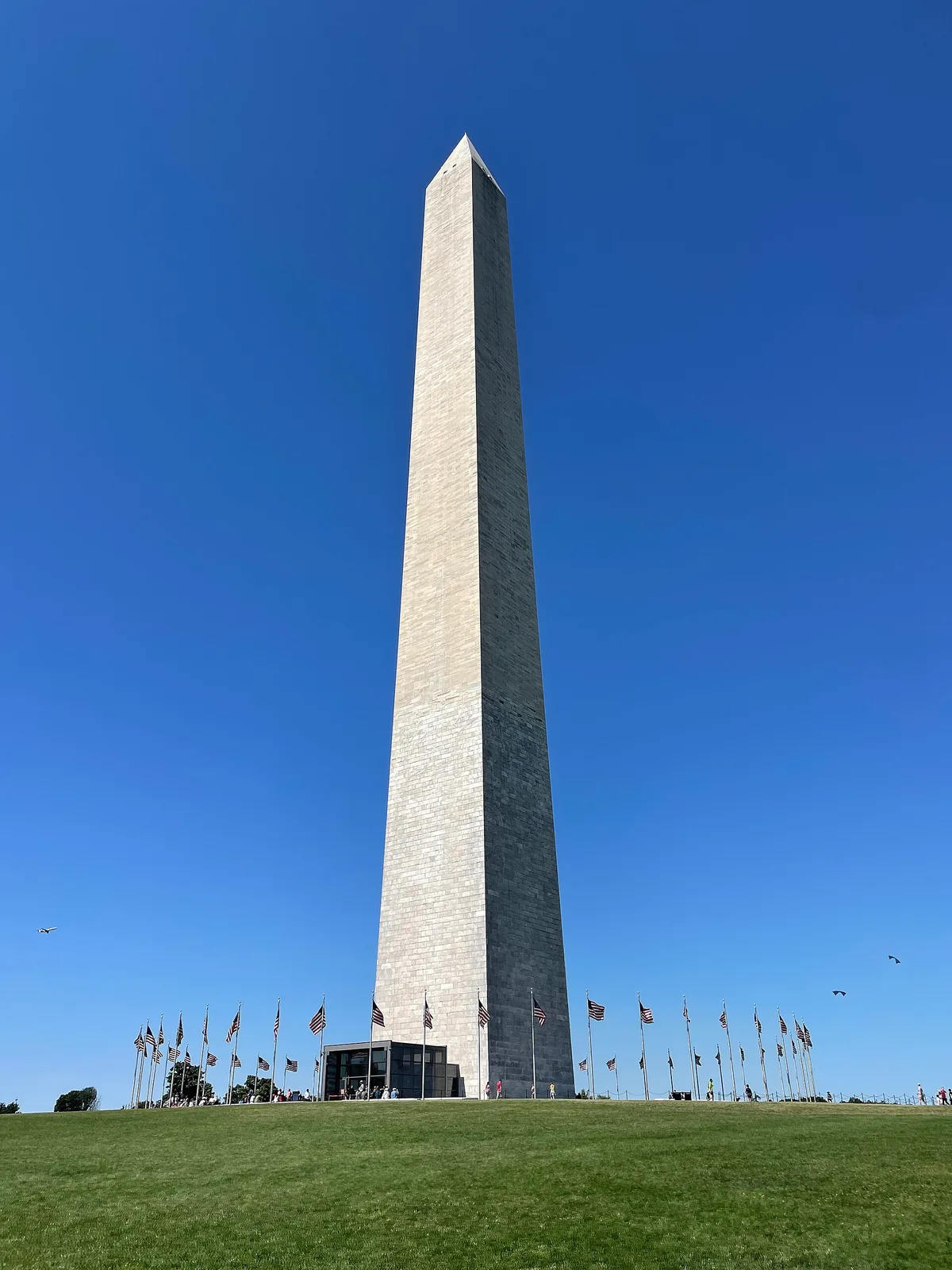
Photo: Greyfiveys / CC BY-SA 4.0
What Your Eye SeesA colossal white marble obelisk rising 555 feet (169 m) from the National Mall, the world’s tallest free-standing stone structure. Its tapered shaft, capped by a small pyramidion of aluminum, is visible from nearly every part of the city and anchors the Mall’s central axis.
ContextDesigned by Robert Mills and begun in 1848 under the Washington National Monument Society, the obelisk stalled in 1854 at roughly a third of its height when funds ran out and the Civil War intervened. Construction resumed in 1876 under the US Army Corps of Engineers, using marble from a different quarry, and the monument was completed and dedicated in 1884–85.
The change of quarries left a visible horizontal seam partway up the shaft, where the older, lighter stone meets the newer. Intentionally a plain Egyptian obelisk, Mills' first design called for a colonnaded base and a statue of Washington by a chariot, it was simplified to the unadorned shaft that now anchors the National Mall.
On ScreenThe Washington Monument appears in the films Spider-Man: Homecoming (2017) and National Treasure: Book of Secrets (2007).
Source: National Park Service; Wikipedia (Washington Monument); Wikipedia (Washington Monument); Spider-Man: Homecoming production notes
DidYou
Know
When it topped out, the Washington Monument was the tallest structure on Earth - a record it held only until the Eiffel Tower rose in 1889. Set into its shaft are 193 memorial stones, one of them a gift from Pope Pius IX that vandals stole in 1854 and tossed into the Potomac, never recovered.
Share→ The Color Seam
Look closely at the shaft roughly 150 feet (46 m) up: the marble changes tone. That seam marks the 1854–1876 construction halt, the lower stone came from one Maryland quarry, the upper from another, and the two marble types weathered differently over more than a century.
→ The Aluminum Cap
Look up at the monument's tip: a 100-ounce pyramid of aluminum, then the largest piece of the metal ever cast, so precious it was displayed at Tiffany's in New York before being raised to the top in 1884.
Sources: NPS, Washington Monument; Wikipedia (Washington Monument)
New World
Time Traveler
4. Lincoln Memorial
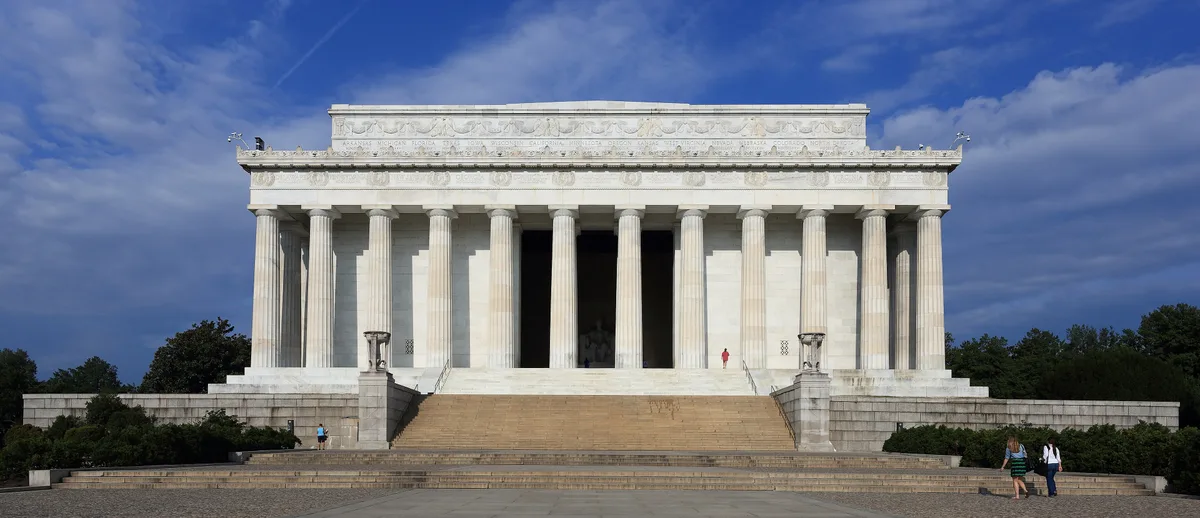
Photo: Martin Falbisoner / CC BY-SA 3.0
What Your Eye SeesA white marble Greek Doric temple with 36 fluted columns, its broad staircase leading to a cella open toward the west end of the Mall. Inside, beneath the carved words of Lincoln’s speeches, the colossal seated figure of Abraham Lincoln gazes out toward the Reflecting Pool and the Washington Monument.
ContextDesigned by Henry Bacon and dedicated in 1922, the memorial honors the 16th president as the savior of the Union. Its 36 columns represent the 36 states in the Union at Lincoln’s death in 1865, and the 19-foot (5.8 m) seated statue by Daniel Chester French is among the most recognized sculptures in America. The steps became the stage for Martin Luther King Jr.’s 1963 "I Have a Dream" speech.
On ScreenThe Lincoln Memorial is the backdrop for the scene in Forrest Gump (1994) in which Forrest addresses a crowd of Vietnam War protesters gathered at the Reflecting Pool.
Source: National Park Service; Wikipedia (Lincoln Memorial); Wikipedia (Lincoln Memorial); Forrest Gump production notes
DidYou
Know
The memorial was dedicated in 1922 with Robert Todd Lincoln - the honoree's only surviving son - in attendance; behind the seated statue, the walls carry the carved texts of the Gettysburg Address and Lincoln's Second Inaugural.
Share→ The 36 Columns
Look at the 36 fluted Doric columns, each representing a state at Lincoln's death on April 15, 1865, and the frieze above bearing the 36 state names. The memorial's cella faces east toward the Mall, not west.
→ Lincoln’s Unseeing Gaze
Look at the president's chair arms, where Daniel Chester French carved bundles of rods (fasces) without their blades, a symbol of authority with mercy. The statue faces east, toward the Reflecting Pool and the Washington Monument, so Lincoln looks out over the Mall he helped dedicate.
Sources: National Park Service (Lincoln Memorial); Wikipedia (Lincoln Memorial); NPS, Lincoln Memorial
New World
Time Traveler
5. Jefferson Memorial
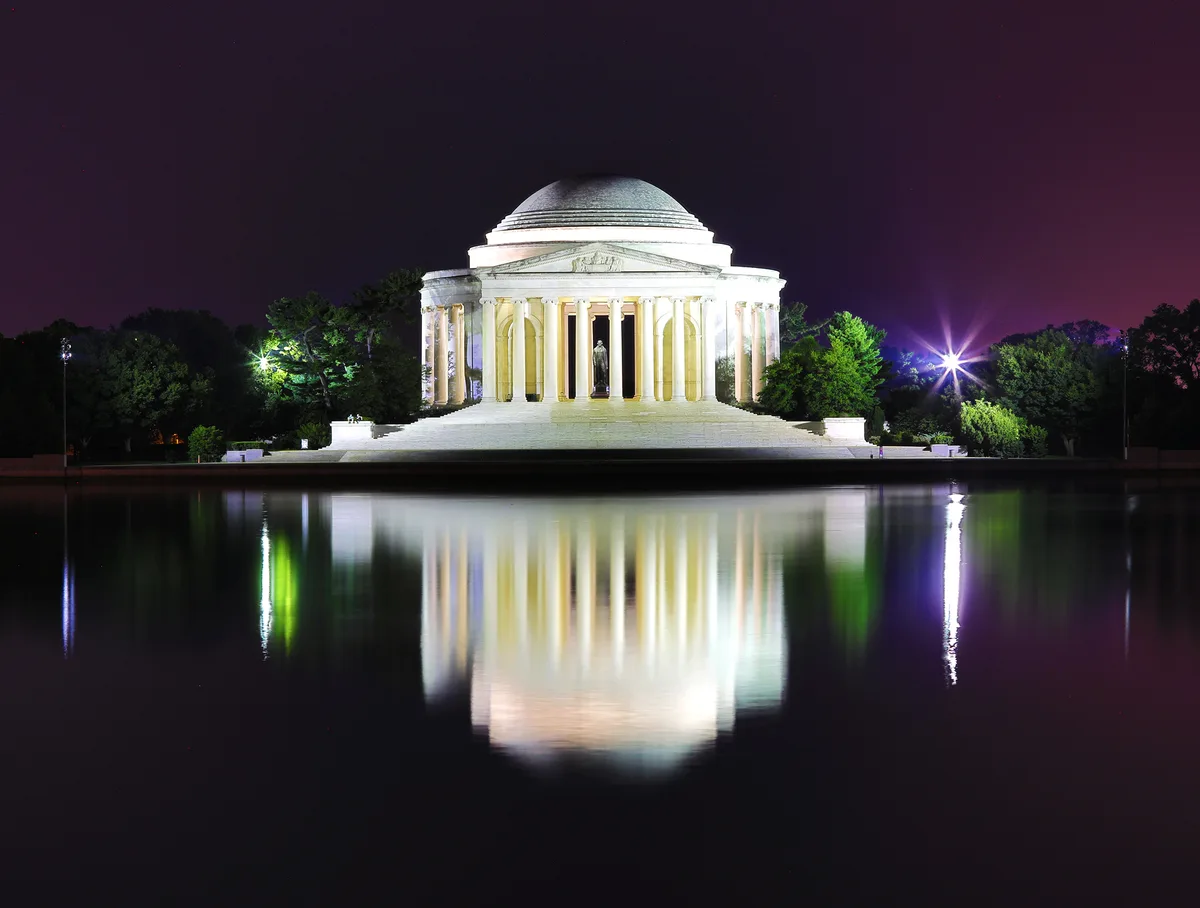
Photo: Brian Hamfeldt / CC BY-SA 4.0
What Your Eye SeesA circular, open-air rotunda of white marble modeled on Rome’s Pantheon, standing on a ring of columns at the edge of the Tidal Basin. Inside, a 19-foot bronze statue of Thomas Jefferson stands beneath the dome, surrounded by passages carved from the Declaration of Independence and his letters.
ContextDesigned by John Russell Pope and dedicated in 1943, on the 200th anniversary of Jefferson’s birth, the memorial sits among the famous cherry trees of the Tidal Basin. Pope died in 1937 and never saw it completed; the sculptor Rudulph Evans designed the bronze statue that was added in 1947.
Pope modelled its circular, columned dome on the Pantheon of Rome, a fitting echo, since Jefferson himself was an architect who designed his own neoclassical Virginia State Capitol. The open portico frames a view across the Tidal Basin, where the memorial's cherry trees draw crowds each spring.
Source: National Park Service; Wikipedia (Jefferson Memorial)
DidYou
Know
Wartime metal rationing meant the memorial opened without its centerpiece - a plaster Jefferson stood in for the bronze until Rudulph Evans's statue arrived after the war, making it one of the last major monuments delayed by World War II.
Share→ The Cherry Tree Setting
Walk the Tidal Basin and look at the memorial among the cherry trees, a 1912 gift of 3,020 trees (1912 gift of Tokyo/Yukio Ozaki) from Japan. In spring the blossoms frame the Pantheon-like dome, which is why this waterside site was chosen for the author of the Declaration of Independence.
→ The Declaration’s Words
Step inside to read the four panels quoting Jefferson's own writings, including the Declaration of Independence's preamble. The statue faces the White House along the same axis, a silent conversation between the author of the Declaration and the seat of the presidency he held.
Sources: NPS, Jefferson Memorial; Wikipedia (Jefferson Memorial)
New World
Time Traveler
6. US Supreme Court
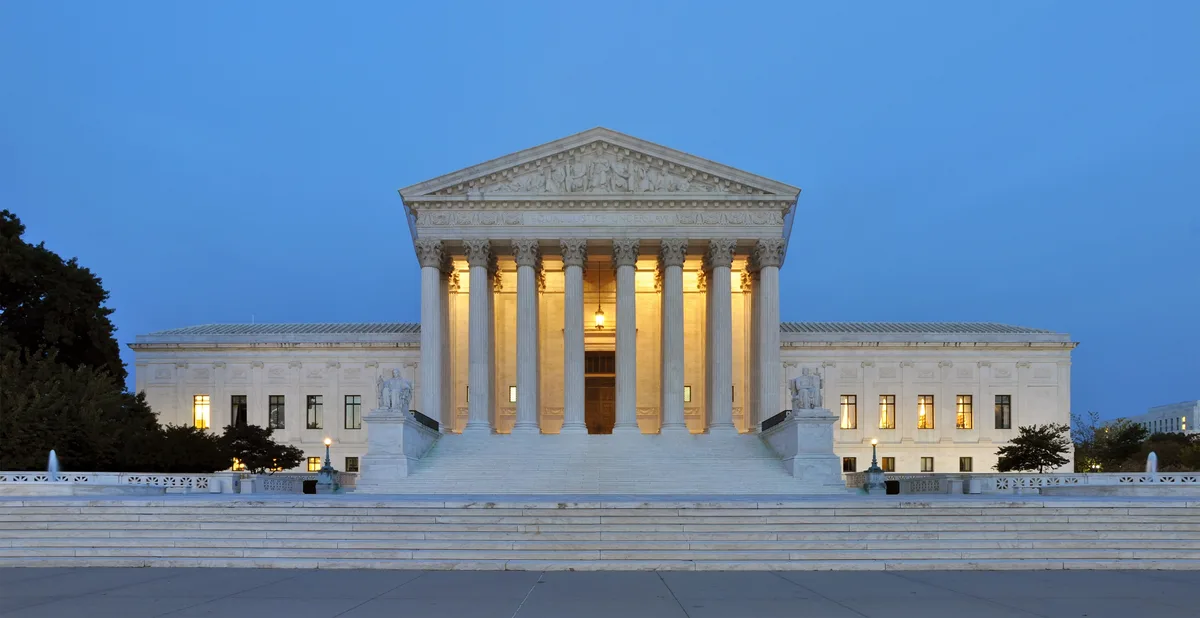
Photo: Joe Ravi / CC BY-SA 3.0
What Your Eye SeesA gleaming white Neoclassical courthouse of Vermont marble, its temple-front facade carrying a broad pediment above a 16-column Corinthian colonnade. Wide marble steps rise to the entrance, flanked by two seated marble figures and the motto “Equal Justice Under Law.”
ContextBuilt between 1932 and 1935 to designs by Cass Gilbert, the Supreme Court Building is the first home the Court has ever owned. Before it opened, the justices had met inside the US Capitol for 135 years, moving from chamber to chamber as Congress grew. Its gleaming Vermont marble earned the building the nickname "the Marble Palace."
The building fronts on the motto 'Equal Justice Under Law' carved above its east entrance. Inside, the nine justices hear cases beneath a bronze frieze of great lawgivers, a visual claim that the Court stands among the lasting institutions of constitutional government.
Source: Supreme Court of the United States (West Pediment); Wikipedia (United States Supreme Court Building)
DidYou
Know
When the justices moved into their own building, critics mocked its marble columns as extravagant while millions were jobless - but Gilbert meant the classical temple to argue that the judiciary was as lasting an institution as the Capitol's dome across the street.
Share→ The Two Seated Guardians
Look at the two marble figures flanking the main steps, by sculptor James Earle Fraser: on one side a woman holding a small figure of Justice ('Contemplation of Justice'), on the other a robed man with the tablets of law ('Authority of Law').
→ Equal Justice Under Law
Look up at the words carved directly below the pediment, above the columns: 'Equal Justice Under Law', the building's motto, chosen in consultation with architect Cass Gilbert. The east side carries its twin motto, 'Justice, the Guardian of Liberty.'
Sources: Supreme Court of the United States (supremecourt.gov); Wikipedia (United States Supreme Court Building)
New World
Time Traveler
7. Library of Congress
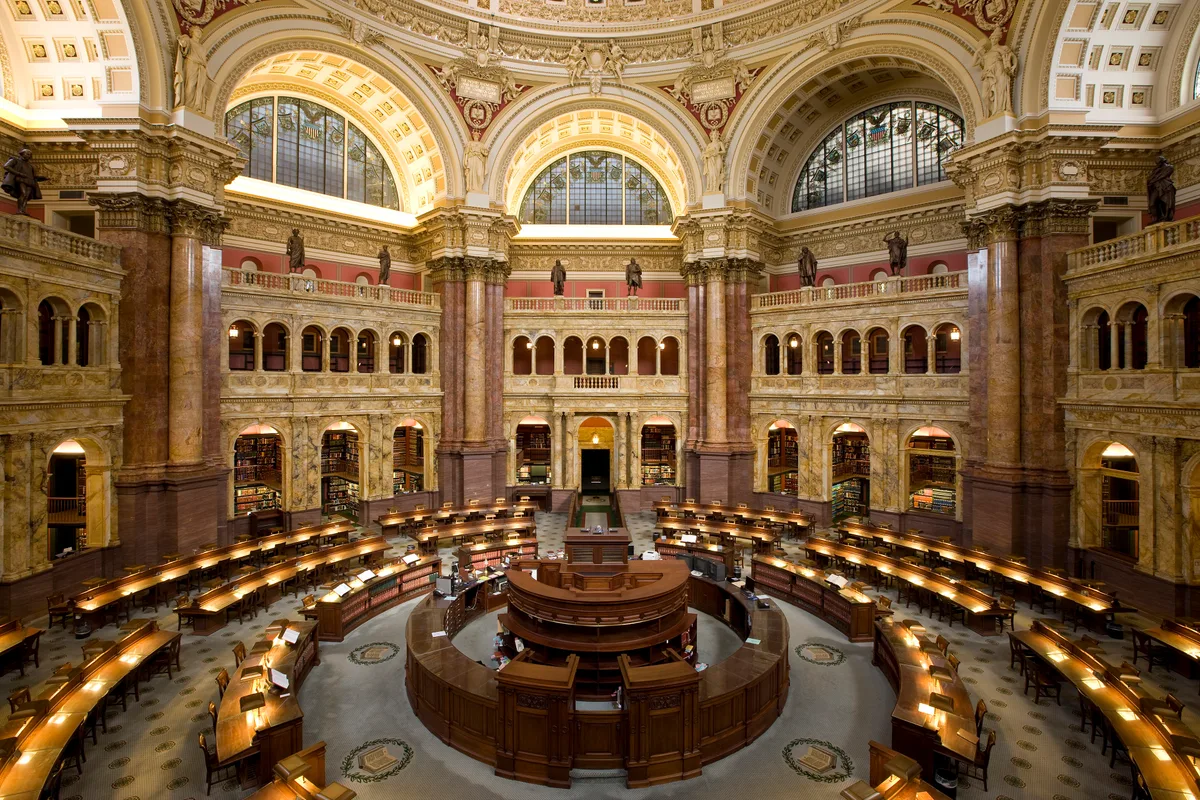
Photo: Carol M. Highsmith / Public domain
What Your Eye SeesA lavish Italian Renaissance palazzo of granite and marble, its central entrance crowned by a copper dome and framed by sculpted figures and bronze doors. Inside, the Great Hall’s mosaics and marble staircases lead to the circular Main Reading Room, whose dome rises 160 feet (49 m) above the desks.
ContextThe Thomas Jefferson Building, opened in 1897, was the first permanent home of the Library of Congress, designed by Paul J. Pelz and completed by Edward Pearce Casey. Its elaborate interiors, murals, mosaics, and marble by more than fifty American artists, made it the most expensive and ornate federal building of its era. Today the Library is the largest in the world, holding more than 170 million items.
On ScreenThe Library of Congress appears in the film National Treasure (2004).
Source: Wikipedia (Library of Congress); Britannica; Wikipedia (Library of Congress); National Treasure production notes
DidYou
Know
After British troops burned Congress's library in 1814, Thomas Jefferson sold his personal collection of 6,487 books for under $24,000 - declaring it covered 'no subject to which a member of Congress may not have occasion to refer' - and those shelves became the seed of the Library of Congress.
Share→ The Gutenberg Bible
Look for the Gutenberg Bible in a display case in the Great Hall, one of the world's few surviving copies, printed in Mainz in the 1450s on fine vellum, and among the Library's earliest landmark acquisitions.
→ The Reading Room Dome
Look straight up at the octagonal Main Reading Room dome, 160 feet (49 m) high and ringed with gilded names of great thinkers, Homer, Dante, Shakespeare, while a balustrade below carries bronze statues. It is the single most photographed interior in the building, yet most visitors never look straight up.
Sources: Library of Congress (loc.gov); Wikipedia (Library of Congress)
New World
Time Traveler
8. Smithsonian Castle
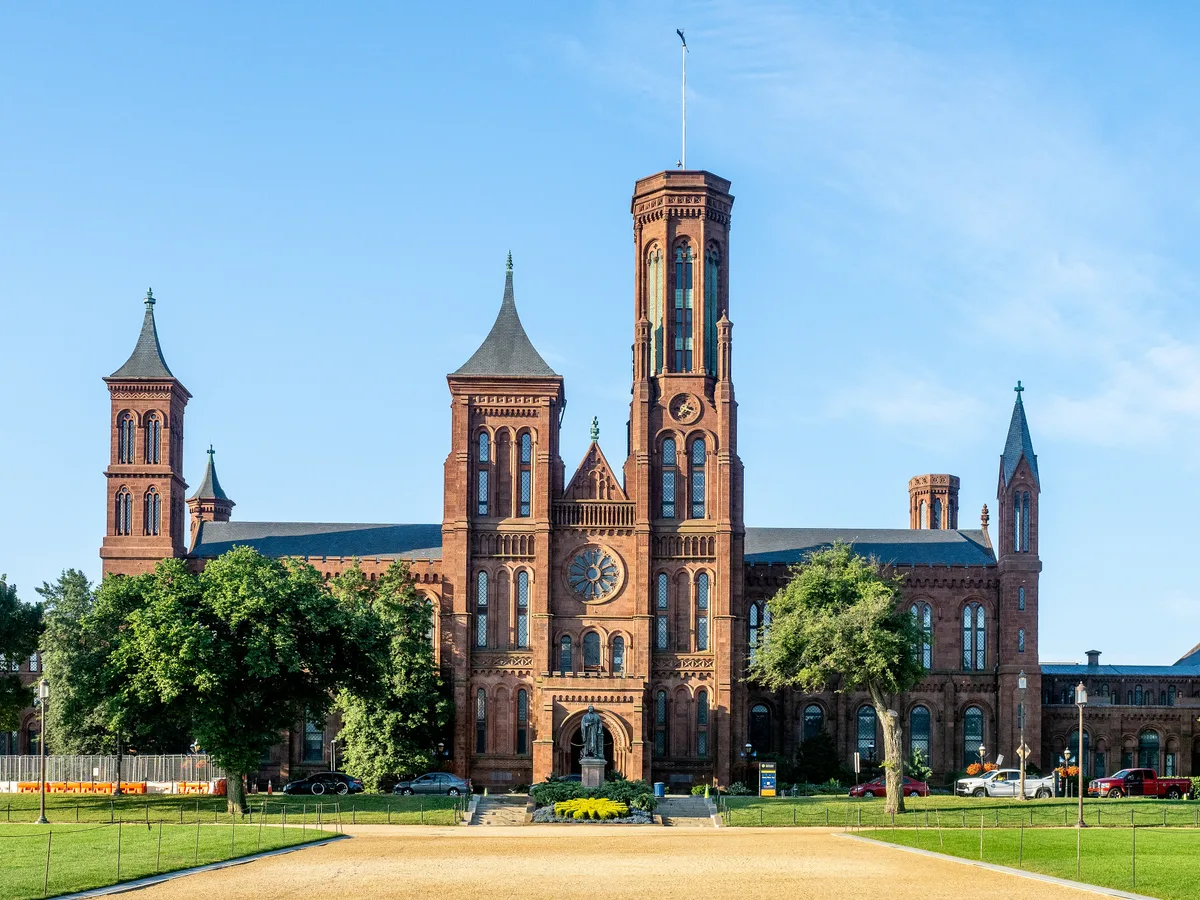
Photo: ajay_suresh / CC BY 2.0
What Your Eye SeesA long, castle-like building of deep red Seneca sandstone with round Romanesque arches, crenellated towers, and a tall central tower, softened by century-old ivy. It sits at the edge of the National Mall as the oldest building of the Smithsonian Institution.
ContextBuilt between 1847 and 1855 from designs by James Renwick Jr., the Castle was the Smithsonian’s first building. The institution was founded by the will of James Smithson, an English scientist who never visited America, leaving his fortune "to found at Washington, under the name of the Smithsonian Institution, an establishment for the increase and diffusion of knowledge."
Built of red sandstone in the Romanesque Revival style its architect called 'Norman,' the Castle was meant to look ancient and rooted, like a European university hall. Still the Smithsonian's information center, it links the Mall's scattered museums and holds the crypt where James Smithson is entombed.
Source: Wikipedia (Smithsonian Institution Building); Smithsonian
DidYou
Know
James Smithson died in Genoa in 1829, and a decade-long fight in the British courts was needed to send his bequest - more than half a million dollars, shipped as gold sovereigns - to Washington, where it founded the Smithsonian Institution.
Share→ The Red Stone
Look at the Castle's deep-red stone, Seneca sandstone, quarried along the Potomac near Washington and chosen for its rich tone and ease of carving. The warm red stone and the building's towers and crenellations gave the Institution its nickname, the Castle.
→ The Founder’s Tomb
Step behind the entrance into the North Tower to find the small crypt of James Smithson, brought from Genoa in 1904. The modest stone vault is one of Washington's quiet pilgrimage sites, the tomb of the Englishman who gave America its museums without ever seeing them.
Sources: Smithsonian Institution Archives; Wikipedia (Smithsonian Institution Building)
New World
Time Traveler
9. Washington National Cathedral
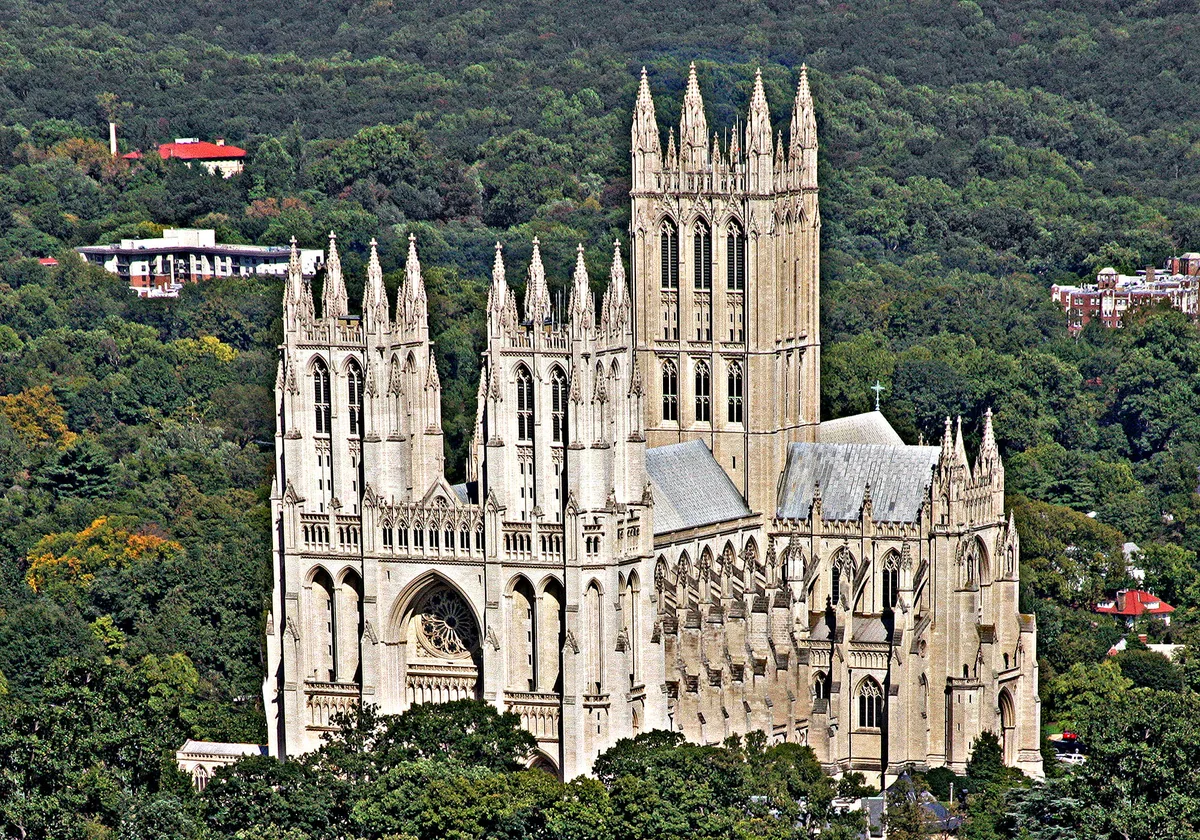
Photo: Duane Lempke / CC0
What Your Eye SeesA soaring Gothic Revival cathedral of Indiana limestone on the heights of Mount Saint Albans, its twin west towers, flying buttresses, and tall central tower echoing the great medieval cathedrals of England and France. Inside, pointed arches and ribbed vaults rise over a long nave.
ContextThe Cathedral Church of Saint Peter and Saint Paul, known as Washington National Cathedral, was begun in 1907, with President Theodore Roosevelt laying the foundation stone, and completed in 1990 after 83 years of construction. George Frederick Bodley and Henry Vaughan set its English Gothic design, and Philip Hubert Frohman, who worked on the cathedral for more than 70 years, carried it to completion.
Source: Wikipedia (Washington National Cathedral); Britannica
DidYou
Know
In August 2011 a 5.8-magnitude earthquake shook loose stones from the cathedral's central tower, crashing into the nave and launching a years-long restoration; the cathedral has also hosted the funerals of presidents Woodrow Wilson and Dwight Eisenhower.
Share→ The Darth Vader Grotesque
Look high on the northwest tower for the small carved head of Darth Vader, among hundreds of gargoyles and grotesques. It won a children's design contest in the 1980s and is now one of the cathedral's most hunted details, visible only with a zoomed-in look.
→ The Space Window
Look in the south aisle for the Space Window, which contains a real fragment of the Moon, a piece of lunar rock embedded in the stained glass, honoring the Apollo 11 mission. It is one of the few church windows in the world to hold a piece of another world.
Sources: Washington National Cathedral; Wikipedia (Washington National Cathedral)
 Gothic Soul
 Spiritual Seeker
10. Union Station
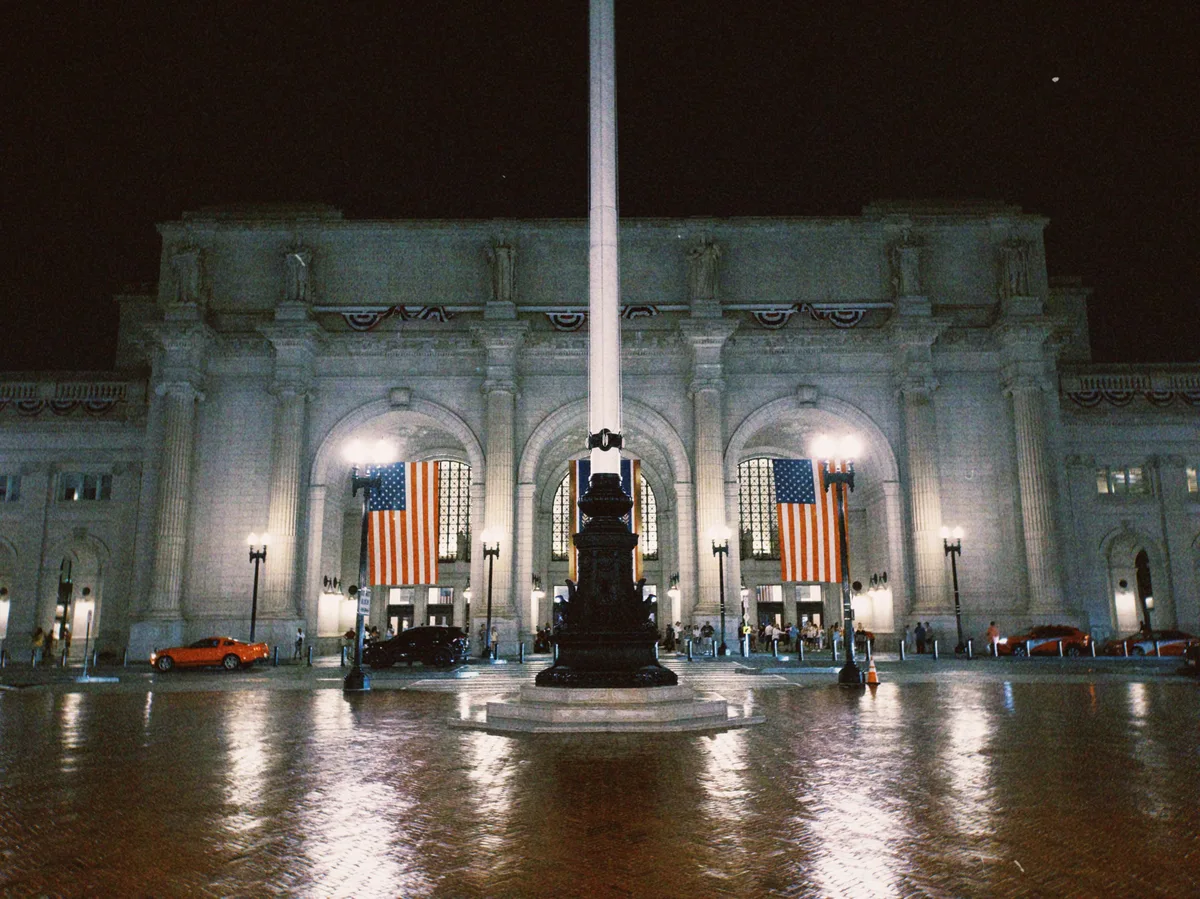
Photo: Pachiscool11 / CC0
What Your Eye SeesA monumental Beaux-Arts train station of white granite, its long facade crowned by a colossal triple arch and rows of Corinthian columns. The main hall’s vaulted ceiling, modeled on the Baths of Diocletian in Rome, rises 96 feet (29 m) above travelers arriving at the capital’s front door.
ContextBuilt between 1903 and 1907 to designs by Daniel Burnham, Union Station replaced a tangle of competing railway terminals that had once pushed onto the National Mall. Burnham, a leader of the City Beautiful movement, gave Washington a gateway worthy of its Roman-inspired streets, and at its opening the station was the largest in the world.
Burnham styled the station on the great imperial baths and triumphal arches of Rome, with a soaring white Main Hall and a coffered vault modeled on the Baths of Diocletian. The result was a gateway meant to impress visitors arriving in the capital, not merely a railway terminal.
On ScreenUnion Station appears in the film Mr. Smith Goes to Washington (1939).
Source: Wikipedia (Union Station, Washington, D.C.); Britannica; Wikipedia (Union Station); Mr. Smith Goes to Washington production notes
DidYou
Know
In its early decades the station was a civic stage: presidents, soldiers, and foreign dignitaries arrived by rail, and a private suite awaited the presidential car. When passenger rail collapsed in the 1960s, the station fell into neglect, until a 1980s restoration returned the vast main hall to Burnham’s grand civic space, now serving Amtrak and commuters.
Share→ The Roman Vault
Look up at the barrel-vaulted ceiling over the main hall, coffered in deep squares of gilded ornament, Burnham's deliberate echo of the Baths of Diocletian in Rome. The 96-foot height makes the hall feel like the interior of a colossal classical building, not a train station.
→ The Columbus Memorial
In the circle in front of the station stands the Columbus Memorial, a fountain crowned by a statue of Christopher Columbus by Lorado Taft, given to the city by Italian Americans in 1912. The plaza around it, Columbus Circle, takes its name from the monument.
Sources: Wikipedia (Union Station, Washington, D.C.); Union Station Redevelopment; Columbus Fountain
New World
Time Traveler
11. National Gallery of Art
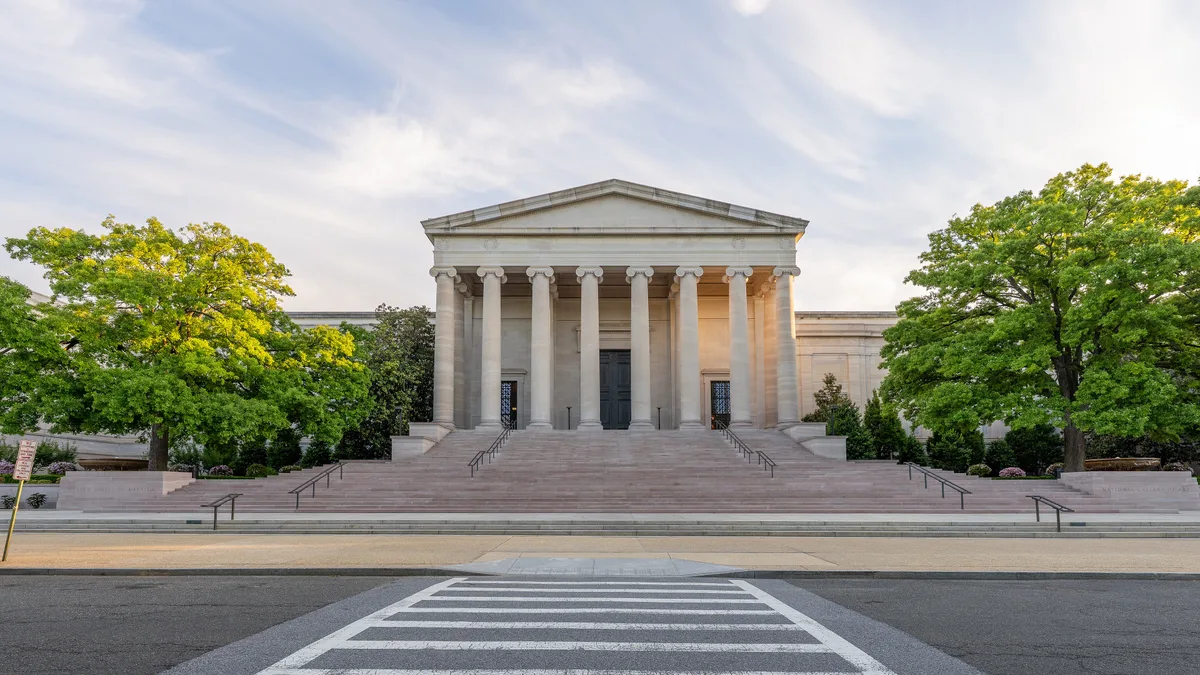
Photo: ajay_suresh / CC BY 4.0
What Your Eye SeesA long, low Neoclassical museum of pink Tennessee marble, its central rotunda crowned by a dome and its two wings stretching along the National Mall. The West Building’s colonnaded facade, designed by John Russell Pope, has stood as the nation’s art museum since 1941.
ContextThe National Gallery of Art was the gift of Andrew W. Mellon, Treasury secretary and art collector, who funded the building and gave his collection to the nation. Designed by John Russell Pope and opened on 17 March 1941, months before Pearl Harbor, its rotunda and garden courts house masterpieces from the Middle Ages to the 1900s.
A later East Building, a sharp-angled travertine structure by I. M. Pei opened in 1978, doubled the museum's modern and contemporary space. Linked to the original by an underground concourse, it gave the Gallery a second architectural voice beside Pope's classical rotunda.
On ScreenThe National Gallery of Art appears in the series House of Cards.
Source: Wikipedia (National Gallery of Art); Britannica; Wikipedia (National Gallery of Art); House of Cards production notes
DidYou
Know
In 1930–31 Andrew Mellon bought 21 Old Master paintings from the Soviet sale of the Hermitage via the Knoedler/Colnaghi/Matthiesen consortium for $6,654,000, including Raphael's Alba Madonna, to form the core of his gift.
Share→ The Pantheon Rotunda
Step through the main doors and the space opens into a circular rotunda with a coffered dome and marble columns, a deliberate echo of the Pantheon in Rome. From this Roman heart, galleries radiate like spokes, and a skylight floods the center with daylight.
→ The Pink Marble
The walls are clad in pink Tennessee marble, chosen by Pope for its warm tone. Look closely at the facade and you can see the natural bands of pink and gray that streak the stone, a signature of the Tennessee quarries, and the reason the building glows softly at sunset.
Sources: National Gallery of Art (nga.gov); Wikipedia (National Gallery of Art)
New World
 Renaissance
12. Old Post Office
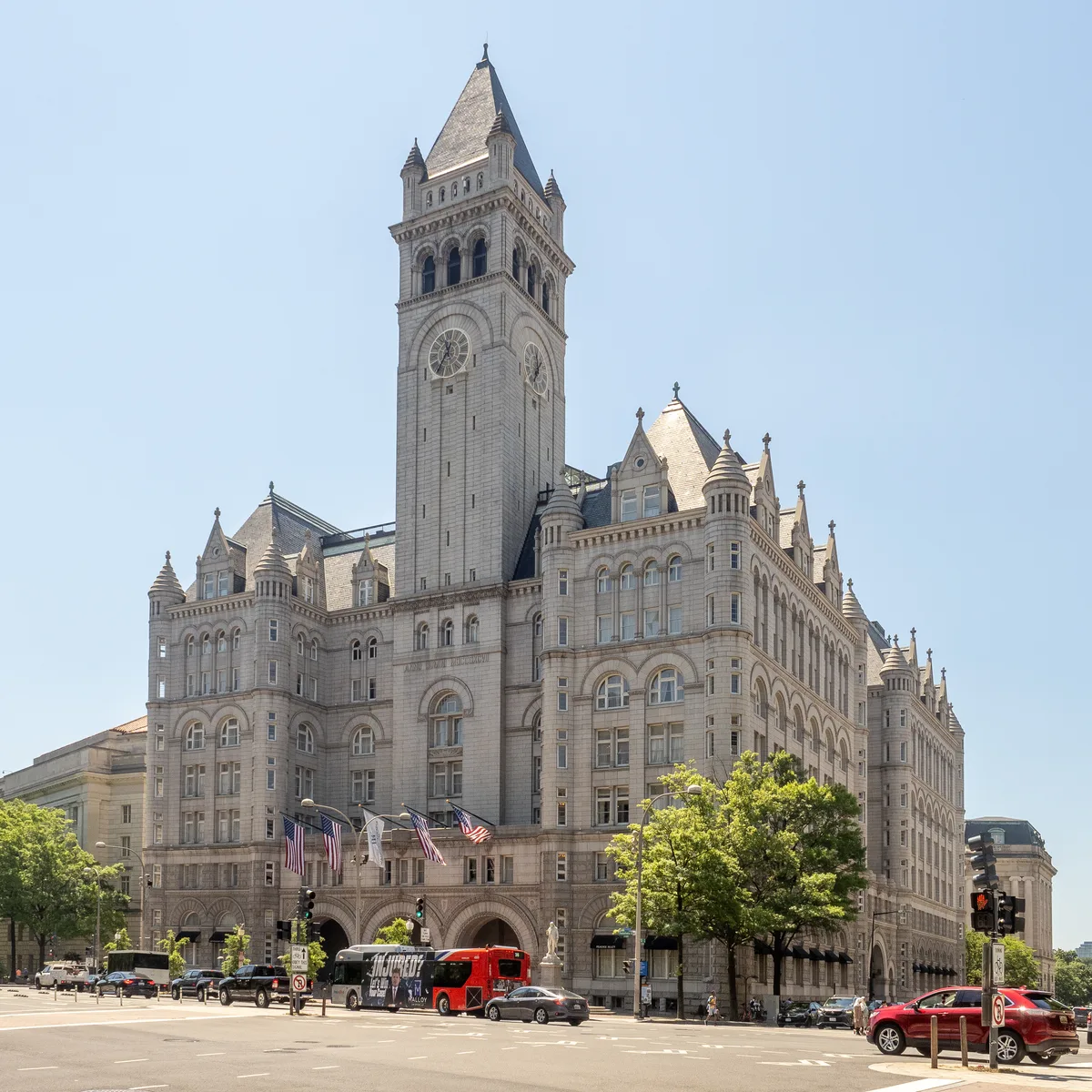
Photo: ajay_suresh / CC BY 2.0
What Your Eye SeesA nine-story Richardsonian Romanesque building of granite and red sandstone, crowned by a 315-foot (96 m) clock tower that rises above Pennsylvania Avenue. Its arched, rusticated stonework and sturdy silhouette make it one of the city’s most distinctive survivors of the 19th century.
ContextBuilt between 1892 and 1899 to designs by Willoughby J. Edbrooke, the Old Post Office was the federal government’s first general post office in Washington. Its clock tower, one of the tallest structures in the city when it was raised, anchors the Pennsylvania Avenue streetwall. The building now houses a luxury hotel, but its tower remains open to visitors.
Designed in the Romanesque Revival style with a rugged, fortress-like clock tower, the building was among the tallest in Washington when completed and offered views clear to Virginia from its belfry. Despite later threats of demolition, its tower survived as a public observatory over Pennsylvania Avenue.
Source: National Park Service; Wikipedia (Old Post Office, Washington, D.C.)
DidYou
Know
In the 1970s officials called the Old Post Office 'inefficient, obsolete, and beyond repair' and nearly razed it; a coalition of preservationists and members of Congress saved it, and the rehabilitated building became an early national model of adaptive reuse.
Share→ The Four-Faced Tower
Look up at the 315-foot clock tower, with its four great clock faces and lantern crown, the building's signature. Its observation deck at 270 feet (82 m) offers one of the finest free views over the Mall, the Capitol, and the White House, a vantage point most visitors miss.
→ The Bells Of Congress
Look inside the tower at the Bells of Congress, replicas of the bells of Westminster Abbey given for the American Bicentennial in 1976. They are one of the largest sets of change-ringing bells in North America, played at national occasions.
Sources: NPS, Old Post Office Tower; American Heritage
New World
Time Traveler
Which building in Washington DC has a Darth Vader gargoyle?
The Washington National Cathedral. High on its northwest tower, among the grotesques, sits a Darth Vader gargoyle, added in the 1980s after a children’s design competition; the winning drawing came from a 12-year-old. It is a real stone carving, not a movie prop, and remains one of the cathedral’s most-asked-about details.
Why is the Washington Monument two different colors?
Because construction stalled in 1854 at roughly a third of its height when funds ran out and the Civil War intervened, and when work resumed in 1876, the Army Corps of Engineers used marble from a different quarry. The change left a visible horizontal seam partway up the shaft, where the older, lighter stone meets the newer. The monument was completed and dedicated in 1884-85, and when it topped out it was the tallest structure on Earth, a record it held only until the Eiffel Tower rose in 1889.
What is carved on the walls of the Lincoln Memorial?
The full texts of the Gettysburg Address and Lincoln's Second Inaugural are carved into the chamber walls behind the statue. The 19-foot seated statue by Daniel Chester French is among the most recognized sculptures in America, and the memorial's 36 columns represent the 36 states in the Union at Lincoln's death in 1865. The steps later became the stage for Martin Luther King Jr.'s 1963 I Have a Dream speech.
These landmarks reward close attention. Vestigia is a field companion for people who look longer, with curated context, architectural detail, and the stories most visitors walk past. Free on the App Store and Google Play.