St. Petersburg Historical Landmarks
1. Winter Palace / Hermitage
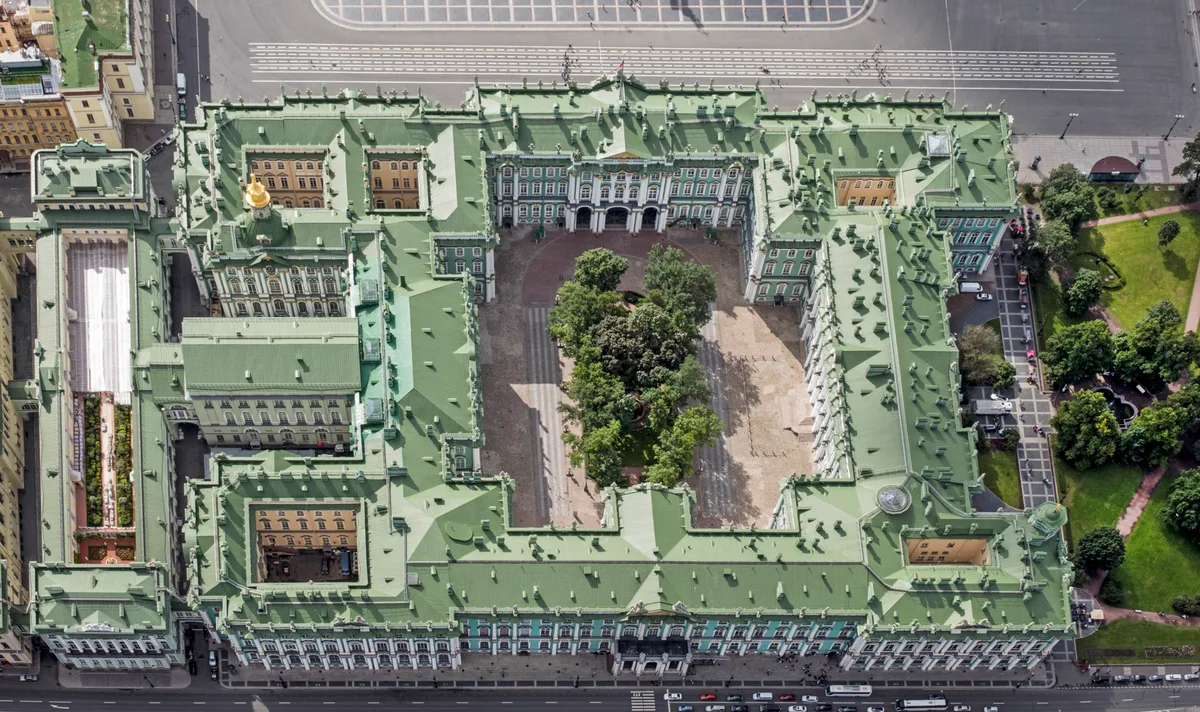
Photo: Godot13 / CC BY-SA 4.0
What Your Eye SeesA vast green-and-white Baroque palace stretching 215 metres along the Neva River, with a two-tier colonnade, rows of white statues and vases along the roofline, and gilded stucco ornament across every facade.
ContextBuilt 1754–1762 for Empress Elizabeth by Bartolomeo Rastrelli, the Winter Palace was the official residence of the Russian emperors from 1732 to 1917. After the devastating fire of 1837 that gutted the interiors, the palace was rebuilt within two years. Today it forms the core of the State Hermitage Museum, one of the world's largest art museums.
On ScreenThe James Bond film GoldenEye (1995) used the Hermitage as a filming location.
Source: UNESCO (Historic Centre of Saint Petersburg); Wikipedia (Hermitage Museum); Wikipedia (Winter Palace); GoldenEye production notes
 Did
DidYou
Know
The Winter Palace cost about 2.5 million rubles, a colossal sum raised from the treasury’s alcohol and salt taxes. Catherine the Great founded the Hermitage here in 1764 with 225 paintings bought from a Berlin merchant, and the collection has since grown to over three million works.
Share→ The Jordan Staircase
Designed by Rastrelli, the staircase was badly damaged by the fire of 1837 and rebuilt by Vasily Stasov using Rastrelli’s original plans. Named for the Feast of the Epiphany, when the tsar descended it for the ceremony of the “Blessing of the Waters” of the Neva, the double-height hall uses mirrors and painted ceilings to make the space feel far larger than it is.
→ The Malachite Room
Created after the 1837 fire as one of the last great interiors of the palace, the Malachite Room is lined with Ural malachite applied in the “Russian mosaic” technique, thin stone veneers over a marble base with almost invisible seams. In 1917 it served as the meeting room of the Provisional Government; during the October Revolution the ministers were arrested in the adjoining Small Dining Room, where they had taken refuge.
→ The Peacock Clock
In the Pavilion Hall of the Small Hermitage stands the museum's most beloved exhibit: the Peacock Clock, a three-metre automaton of gilded bronze and silver made by the English jeweller James Cox in 1766–1772. Prince Potemkin commissioned it for Catherine the Great; it arrived dismantled and was assembled by the Russian mechanic Ivan Kulibin. When wound, its life-size mechanical birds spread their tails, turn their heads and sing, the only large 18th-century automaton still working today.
Sources: Wikipedia (Jordan Staircase of the Winter Palace); Hermitage Museum (official); Wikipedia (Malachite Room); Wikipedia (Peacock Clock)
 Euro Heritage
 Baroque Master
2. Peter and Paul Fortress
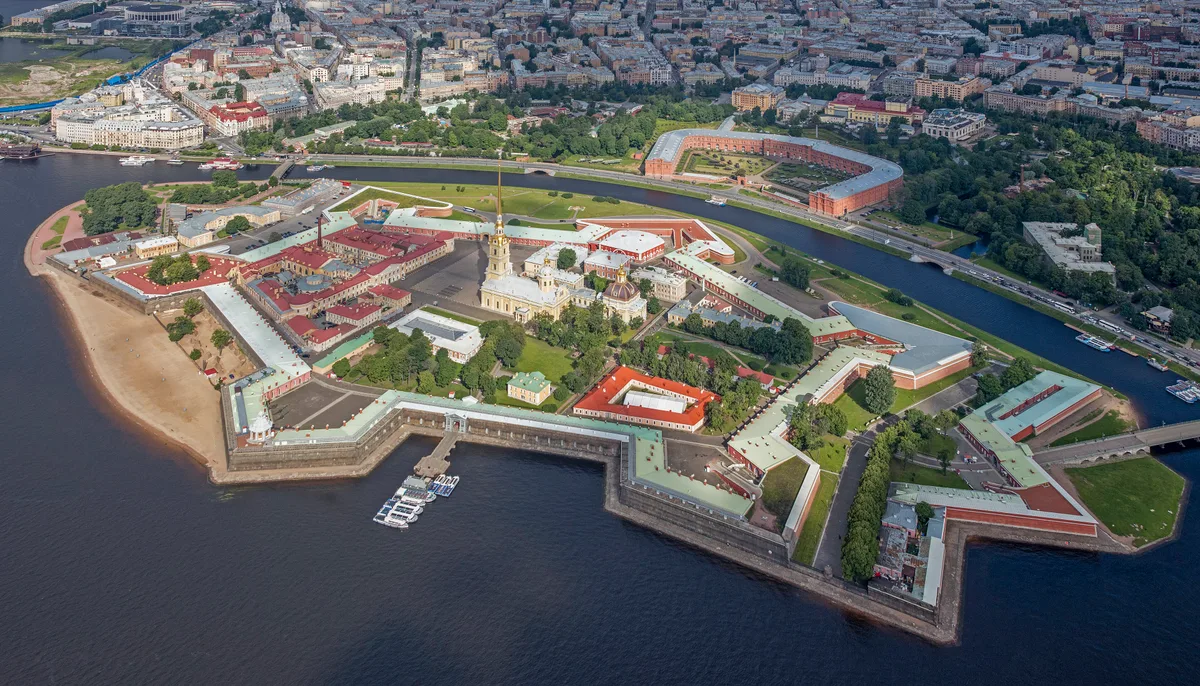
Photo: Godot13 / CC BY-SA 4.0
What Your Eye SeesA six-bastion star fortress on Hare Island, its granite walls rising directly from the Neva, dominated by the gilded spire of the Peter and Paul Cathedral reaching 122 metres into the sky.
ContextFounded on May 27, 1703, the date of St. Petersburg's birth, the fortress was built to defend the newly conquered Neva delta from Swedish attack. It never saw military action, but became the 'Russian Bastille', a political prison holding Dostoevsky, Gorky, and Peter the Great's own son Alexei. The cathedral within is the burial place of the Romanov tsars.
Peter's travels left a mark abroad too: in 1716 he climbed Rundetårn in Copenhagen, and his 'Russian Versailles' rose at Peterhof Palace.
Source: UNESCO (Historic Centre of Saint Petersburg); Wikipedia (Peter and Paul Fortress)
DidYou
Know
Its 122.5-metre bell tower, crowned by a gilded angel holding a cross, one of St Petersburg’s great symbols, is the tallest Orthodox bell tower in the world, and remained the city’s tallest structure for more than two centuries after its completion in 1733.
Share→ The Noon Cannon
A cannon fires a blank shot from the Naryshkin Bastion at exactly noon, a tradition that began in Peter the Great’s time, when the gun marked the start and end of the working day and warned of rising water in the Neva. From 1873 it fired at noon so citizens could set their watches; silenced in the revolutions, it was revived in 1957. In October 1917, after the cruiser Aurora’s famous blank shot, the fortress guns themselves fired around 30 shells at the Winter Palace.
→ The Trubetskoy Prison
Built in 1870–72 inside the bastion walls, this two-storey prison held political prisoners in 69 identical solitary cells, including the anarchist Pyotr Kropotkin, Alexander Ulyanov (Lenin’s elder brother) and Leon Trotsky. In 1917 it first held ministers of the tsarist government, then, after the revolution, the ministers of Kerensky’s Provisional Government. The cells survive with their original iron furnishings.
→ The Imperial Necropolis
The cathedral floor is a pavement of white marble sarcophagi covering most of the Romanov rulers, from Peter the Great to Nicholas II, whose remains were interred here in 1998. Peter’s own grave keeps the standard Carrara marble sarcophagus installed in 1865, plainer than the ornate jasper and rhodonite sarcophagi of Alexander II and his wife, which were completed only in 1906.
Sources: Museum of the History of St. Petersburg (Noonday Gun); Wikipedia (Peter and Paul Fortress); Museum of the History of St. Petersburg (Trubetskoy Bastion Prison); saint-petersburg.com; Wikipedia (Peter and Paul Cathedral); Museum of the History of St. Petersburg
Euro Heritage
Baroque Master
3. Church of the Savior on Spilled Blood
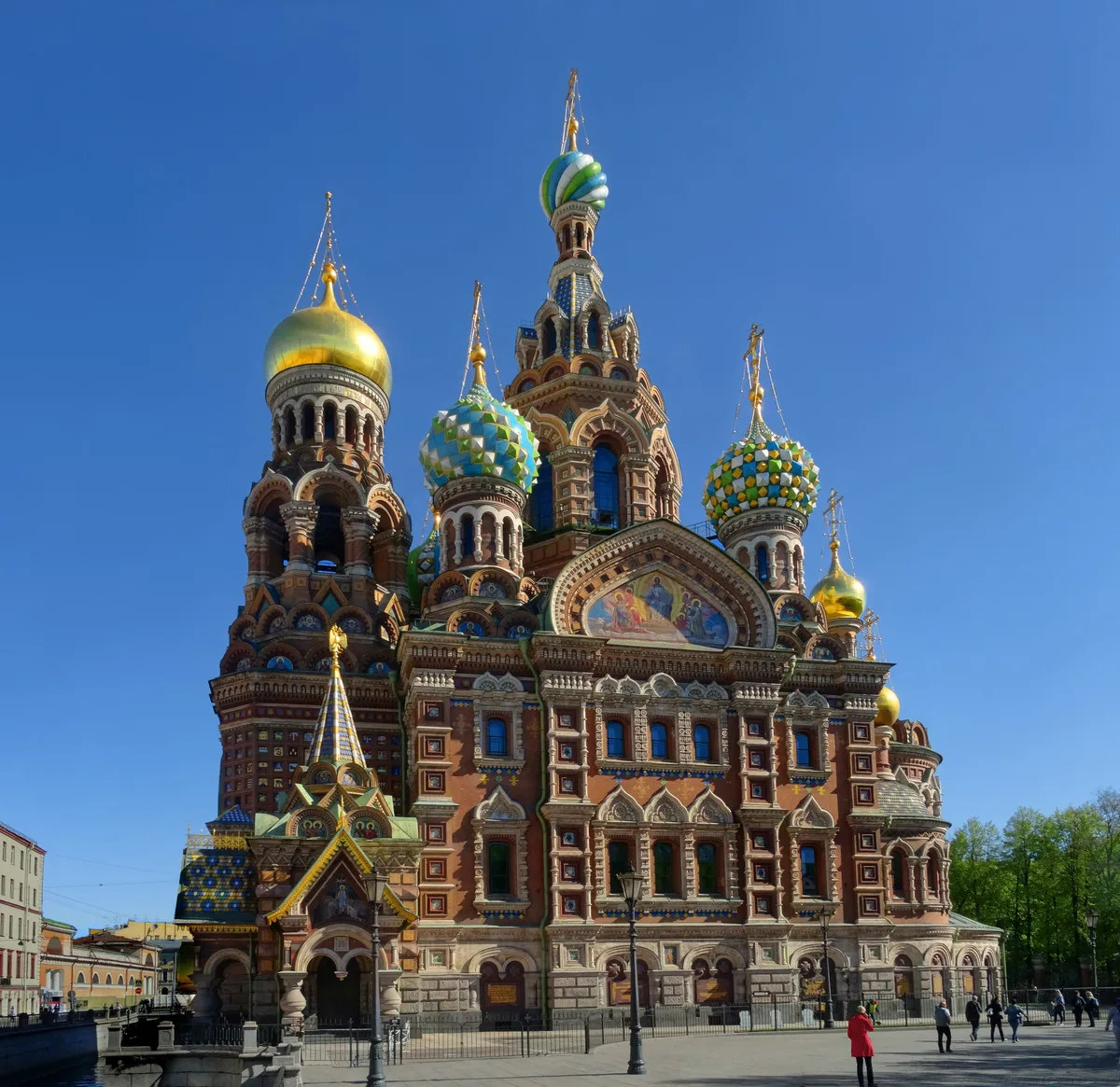
Photo: Je-str / CC BY-SA 3.0
What Your Eye SeesA fairy-tale Russian church with five enameled onion domes in blue, green, yellow, and white, its exterior covered in elaborate brickwork, tiles, and mosaic plaques, standing on the Griboyedov Canal.
ContextBuilt 1883–1907 on the exact spot where Tsar Alexander II was assassinated by a bomb thrown by the revolutionary group Narodnaya Volya in 1881. Alexander III commissioned the church as a memorial to his father, deliberately choosing a medieval Russian revival style that contrasted with St. Petersburg's classical European architecture.
On ScreenThe Church of the Savior on Spilled Blood appears in the animated film Anastasia (1997).
Source: UNESCO (Historic Centre of Saint Petersburg); Wikipedia (Church of the Savior on Spilled Blood); Wikipedia (Church of the Savior on Spilled Blood); Anastasia production notes
DidYou
Know
A canopy inside the church protects the actual cobblestones on which Alexander II was struck down, the roadway of his assassination preserved under glass. Above it, 7,500 square metres of mosaic clothe every wall and vault, one of the largest mosaic cycles in Europe.
Share→ The Veranda Of Plaques
A veranda runs around the base of the church, set with 20 monumental plaques of dark-red Norwegian granite whose gilded inscriptions recount the main events of Alexander II's reign in chronological order, from the emancipation of the serfs in 1861 to the conquest of Central Asia. Walking the perimeter, visitors pass a stone chronicle of the tsar the church was built to mourn.
→ The Coats Of Arms
The walls and bell tower are covered with mosaic coats of arms representing the provinces and cities of the Russian Empire that contributed funds for the church’s construction. The motif deliberately echoes the medieval churches of Muscovy, setting the building apart from the classical architecture of St. Petersburg.
→ The Church Crowding The Canal
The church is wedged onto the bank of the Griboyedov Canal so tightly that paved roads still run along both sides of the water, squeezed between its walls and the canal. Beneath it, the marshy embankment rests on a foundation of concrete, an unusual and technically demanding choice in the 1880s, designed to keep the heavy stone building stable and sealed against ground water.
Sources: Wikipedia (Church of the Savior on Blood); cathedral.ru; Saint Petersburg Encyclopaedia; Russian Museum
 Spiritual Seeker
4. St. Isaac's Cathedral
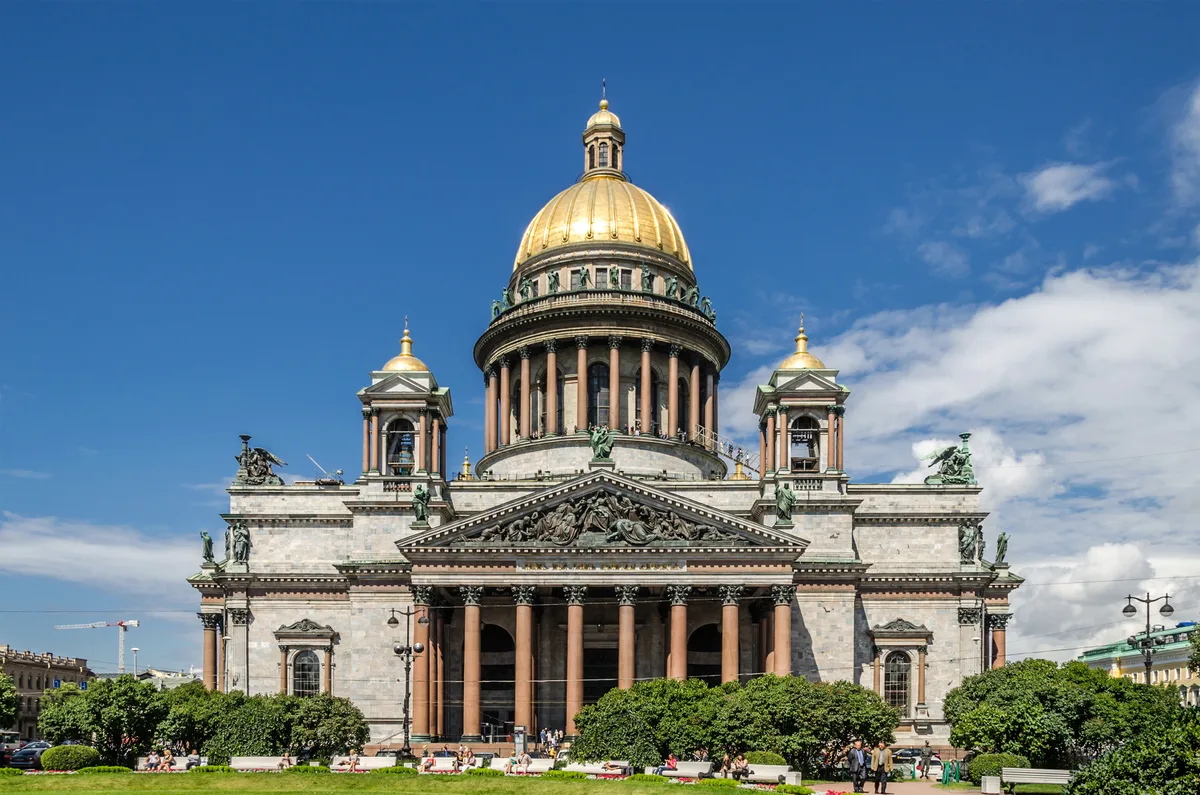
Photo: Florstein (Telegram:WikiPhoto.Space) / CC BY-SA 4.0
What Your Eye SeesA colossal neoclassical cathedral with a golden dome rising 101.5 metres, surrounded by 112 monolithic granite columns, faced in grey marble, dominating the St. Petersburg skyline.
ContextThe fourth church built on this site, St. Isaac's took 40 years to construct, an expression in Finnish, 'rakentaa kuin Iisakin kirkkoa' (to build like St. Isaac's Church), came to mean any never-ending megaproject. The French architect Auguste de Montferrand spent his entire career on this single building, dying just one month after its consecration in 1858.
On ScreenSt Isaac's Cathedral features in the James Bond film GoldenEye (1995).
Source: UNESCO (Historic Centre of Saint Petersburg); Wikipedia (Saint Isaac's Cathedral); Wikipedia (St Isaac's Cathedral); GoldenEye production notes
DidYou
Know
St. Isaac's was built on 24,000 piles driven into marshland, taking five years just to stabilise the ground. Its dome is plated with 100 kg of gold and the interior uses 14 varieties of stone. During WWII the dome was painted grey so it would not serve as an artillery landmark.
Share→ The 114-Ton Columns
The four porticoes are carried by 48 monolithic columns of pink rapakivi granite, each 17 metres tall and weighing about 114 tons, among the largest columns ever raised. They were cut in a single block, hauled from Finnish quarries, and set in place before the walls were built, using a wooden scaffolding and pulley system devised by the engineer Agustín de Betancourt.
→ The Malachite And Lazurite Columns
The iconostasis is framed by columns of Ural malachite and deep-blue lapis lazuli, worked in the “Russian mosaic” technique, thin stone veneers laid over marble cores with seams almost impossible to see. They are among the finest surviving examples of the craft anywhere.
→ The Altar Window Of The Risen Christ
Behind the iconostasis, a large, brightly coloured stained-glass panel of the Risen Christ takes pride of place in the main altar, stained glass being a feature rarely seen in an Orthodox church. The glowing image remains one of the cathedral's most striking interior details.
Sources: Wikipedia (Saint Isaac’s Cathedral); St. Petersburg State University (Mineralogy, Chapter 9); cathedral.ru (St. Isaac’s Cathedral); saint-petersburg.com (St. Isaac’s Cathedral); Presidential Library of Russia
Euro Heritage
Spiritual Seeker
5. Peterhof Palace
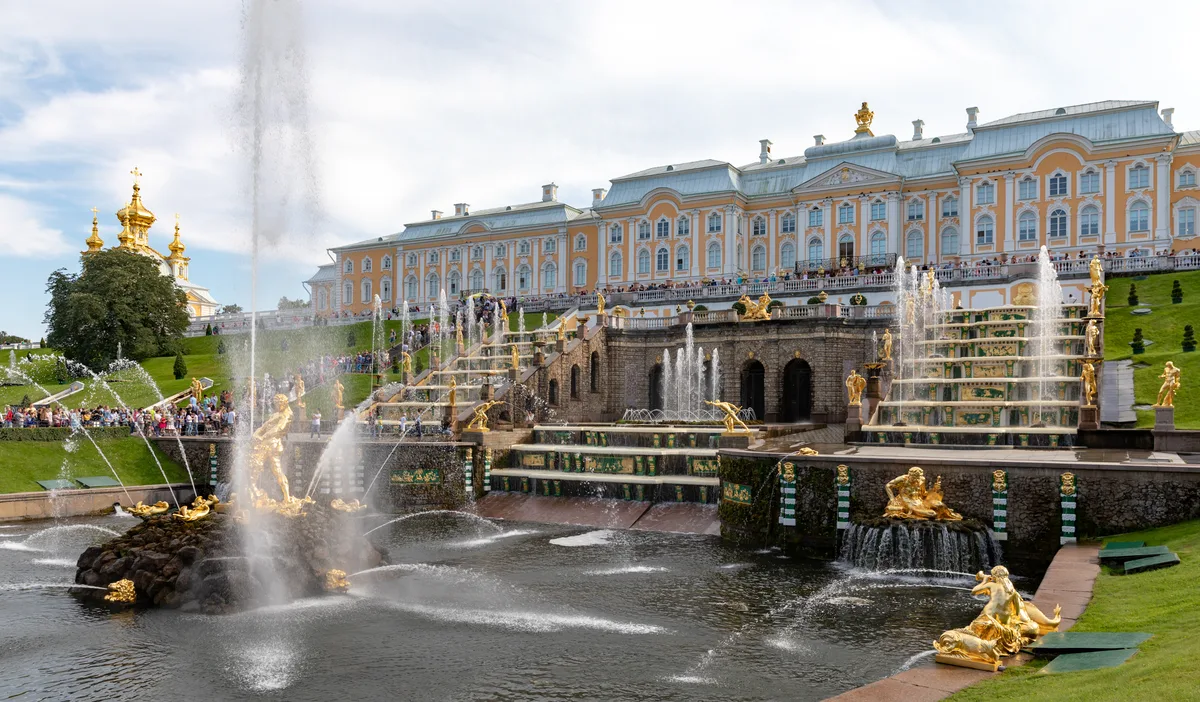
Photo: Ninara from Helsinki, Finland / CC BY 2.0
What Your Eye SeesA grand palace atop a 16-metre bluff, facing a spectacular cascade of 64 fountains that flows into a canal leading to the Gulf of Finland, surrounded by formal French gardens.
ContextCommissioned by Peter the Great in 1714 after visiting Versailles, Peterhof was designed as the 'Russian Versailles', a triumphant celebration of Russia's victory over Sweden in the Great Northern War. The palace and gardens were expanded by successive rulers, most notably Empress Elizabeth who commissioned Rastrelli to enlarge the Grand Palace.
Peter's curiosity reached Copenhagen, where he climbed Rundetårn in 1716, and his fortress birthplace stands at Peter and Paul Fortress.
Source: UNESCO (Historic Centre of Saint Petersburg); Wikipedia (Peterhof Palace)
DidYou
Know
The Grand Cascade’s 64 fountains and gilded statues run entirely on gravity, not a single pump, drawing water from springs about 20 km away through an 18th-century aqueduct. At its heart, the Samson Fountain shoots a 20-metre jet skyward, its lion symbolising Sweden’s defeat at Poltava.
Share→ The Chess Mountain Cascade
East of the Grand Palace, the Chess Mountain cascade is a broad chute tiled in black-and-white marble like a chessboard, with water cascading down a stairway flanked by polychrome marble dragons that spout water from their mouths.
→ The Trick Fountains
Peter the Great installed hidden “trick fountains” in the Monplaisir Palace gardens, benches that spray unsuspecting sitters, paths that drench walkers from below, and jets set off without warning. Designed to amuse guests at court, several still function today and catch modern visitors by surprise.
Sources: Wikipedia (Peterhof Palace); Peterhof State Museum (official); Peterhof Palace-Reserve (official)
Euro Heritage
Baroque Master
6. Catherine Palace (Tsarskoye Selo)
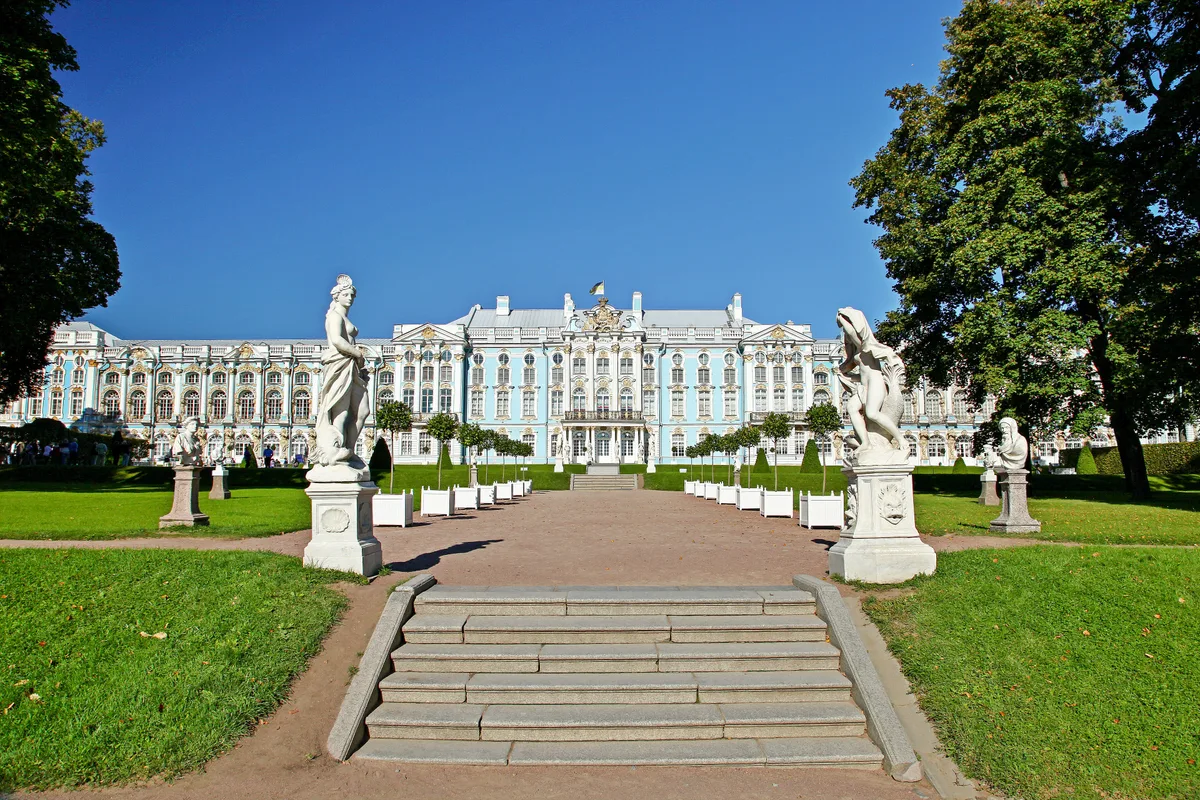
Photo: Alexander2018 / CC BY-SA 4.0
What Your Eye SeesA 325-metre-long palace in sky-blue with white columns and gold-tinged stucco, its facade adorned with caryatids, atlantes, and lion masks, capped by five gilded onion domes at the northern end.
ContextOriginally built as a modest summer residence for Catherine I in 1717, the palace was transformed by Empress Elizabeth into the most extravagant Rococo palace in Russia. Rastrelli's redesign (1752–1756) used 100 kilograms of gold for the exterior and interior decoration. The palace was deliberately gutted by German forces in 1944 and has been under restoration ever since, 32 of 58 destroyed halls have been recreated.
Source: UNESCO (Historic Centre of Saint Petersburg); Wikipedia (Catherine Palace)
DidYou
Know
The palace’s 325-metre facade is among the longest of any royal residence. Behind it lay the Amber Room, a gift from Prussia’s Frederick William I in 1716, panelled with nearly six tons of amber and dubbed the “Eighth Wonder of the World.” Looted by the Nazis in 1941 and never recovered, it was reconstructed and reopened in 2003.
Share→ The Golden Enfilade
Rastrelli’s suite of state rooms, the Golden Enfilade, runs along the palace as a chain of five antechambers and the Great Hall, arranged so that a single vista of carved, gilded doorways opens through the entire sequence, each room more ornate than the last.
→ The Cameron Gallery
Catherine the Great brought the Scottish architect Charles Cameron to Russia in 1779 to add a neoclassical gallery to the palace. Its upper storey is a colonnade of 44 white Ionic columns designed for strolling and philosophical conversation, a stark contrast to Rastrelli’s gilded Baroque.
→ The Hall Of Lights
The Great Hall, the ceremonial centrepiece and the largest room in the palace, stretches the full width of the building, its walls of mirror, gilded carving and double-height windows reflecting the vast ceiling fresco The Triumph of Russia. Here Elizabeth threw her balls and Catherine the Great gave her grand banquets.
Sources: Wikipedia (Catherine Palace); Saint Petersburg Encyclopaedia; Tsarskoe Selo State Museum (Cameron Gallery); saint-petersburg.com (Catherine Palace)
Euro Heritage
Baroque Master
7. Kunstkamera (Peter the Great Museum)
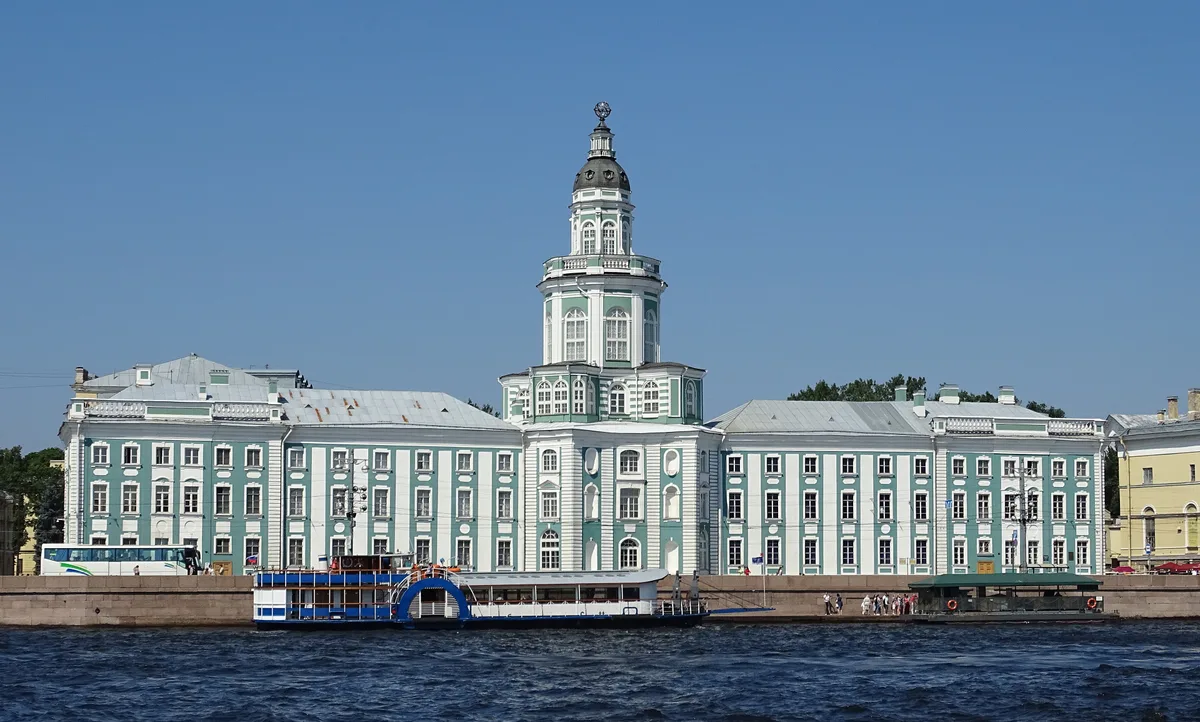
Photo: Ad Meskens / CC BY-SA 4.0
What Your Eye SeesA turreted early-Baroque palace on Vasilyevsky Island, crowned by a multi-tiered tower topped with an armillary sphere, the symbol of the Russian Academy of Sciences.
ContextRussia’s first public museum, opened by Peter the Great in 1714 as his personal “cabinet of curiosities.” Peter ordered this purpose-built museum in 1718; it was completed in 1727, making it the first museum building in Russia and among the oldest in the world. It still houses ethnographic and anatomical collections and the famous Gottorp Globe.
Peter's European tours also took him to Copenhagen, where in 1716 he ascended Rundetårn, and his first museum grew beside Peter and Paul Fortress.
Source: UNESCO (Historic Centre of Saint Petersburg); Wikipedia (Kunstkamera)
DidYou
Know
Peter the Great built his collection of rarities from the spoils of his European tours, and the collection exploded when he bought up the cabinets of the Dutch naturalists Albertus Seba and Frederik Ruysch, tens of thousands of specimens, from preserved reptiles to anatomical preparations, that became the seed of Russia's first scientific collections.
Share→ The Giant Gottorp Globe
Inside the tower sits the Gottorp Globe, a 3.1-metre planetarium sphere where up to a dozen people could sit at a table while the globe rotated around them. Built in Gottorp in 1652–64 and given to Peter, it was almost completely destroyed in the 1747 fire; only its metal frame and door survived. Russian craftsmen rebuilt it by 1751.
→ The Tsar’s Pine Tree
Legend says Peter himself chose the site: walking along the wooded Neva bank he noticed a remarkable pine tree whose branch had grown into a ring like a padlock shackle, ordered the tree cut down, and placed the museum at that exact spot. A fragment of the trunk is still displayed in the museum.
→ The Monsters In The Jars
In the museum's anatomical halls, rows of glass jars hold preserved embryos, fetuses and organs with congenital malformations, the “monsters of nature” that Peter the Great ordered gathered from across Russia by royal decree, paying a fee for each specimen and fining anyone who concealed one. His purpose was scientific: to study them and dispel the superstition that surrounded birth defects.
Sources: Kunstkamera (official, Gottorp Globe); Wikipedia (Globe of Gottorf); Kunstkamera (official); Wikipedia (Kunstkamera); Russian Museum (official)
Euro Heritage
Baroque Master
 Renaissance
8. Menshikov Palace
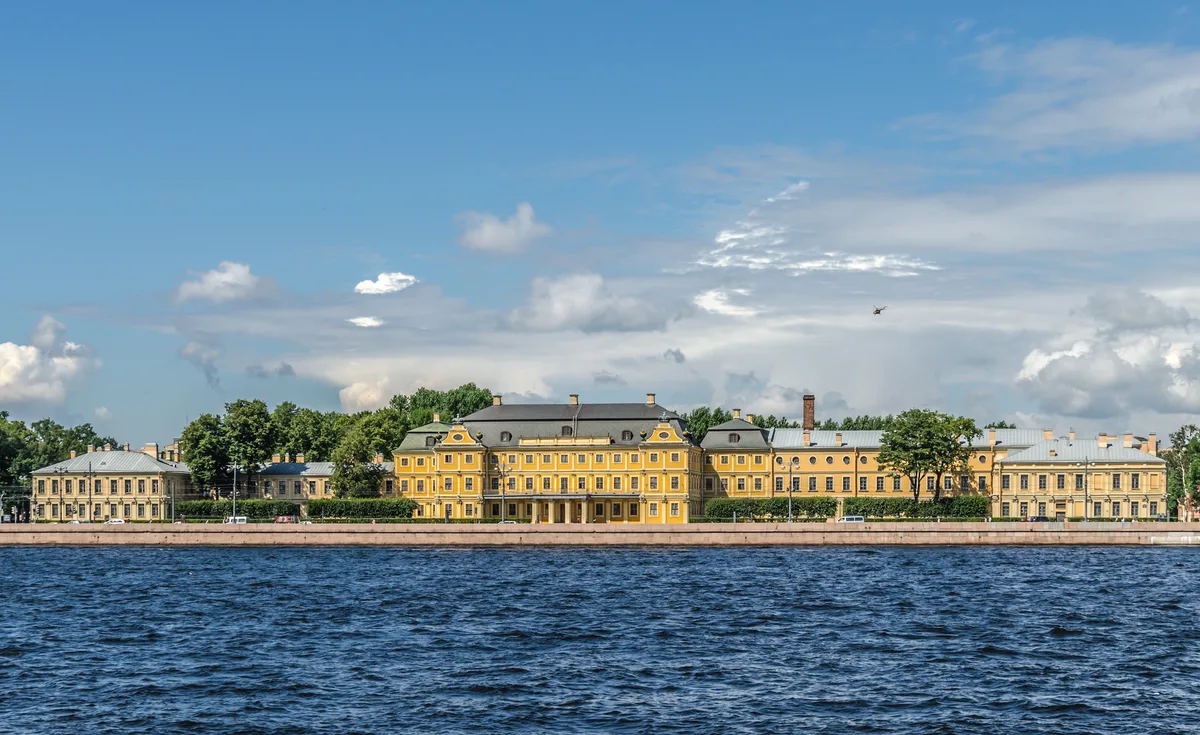
Photo: Florstein (Telegram:WikiPhoto.Space) / CC BY-SA 4.0
What Your Eye SeesA broad two-colour Petrine Baroque palace on the Universitetskaya Embankment, with pilasters, curved pediments and a high hipped roof, built when the city itself was still rising from the marshes.
ContextBuilt from 1710 for Alexander Menshikov, Peter the Great’s closest friend and the first governor of St. Petersburg, this was the first large stone building in the new capital. For years it was the city’s most opulent residence and the setting for official receptions. After Menshikov was exiled in 1727 the palace was confiscated; since 1981 it has been a branch of the Hermitage Museum.
Peter's vision extended to Copenhagen, he climbed Rundetaarn there in 1716, and to Peter and Paul Fortress, where the new city began.
Source: UNESCO (Historic Centre of Saint Petersburg); Wikipedia (Menshikov Palace)
DidYou
Know
From 1731, the palace became the home of Russia's first military academy, the Cadet Corps, where noble boys were trained as officers, turning a disgraced favourite's mansion into a cradle of the imperial army. It served this educational purpose for over a century before being restored and opened as a museum in 1981.
Share→ The Parade Staircase
The palace's principal staircase, built around 1716–1720, is a two-flight parade stair whose upper landing is divided by a row of Corinthian columns linked by arches. Its walls are painted to imitate marble, and the oak steps have been worn smooth by three centuries of visitors.
→ Rooms Tiled For A Sick Man
Several interiors are covered floor to ceiling in Dutch delftware tiles, added to protect against the damp that aggravated Menshikov’s tuberculosis. The chambers also preserve original walnut panelling and furniture from his time.
→ The Grand Hall
The palace's ceremonial heart is a double-height hall with a coffered ceiling, gilded stucco and allegorical frescoes of Peter's victories painted by Italian artists in the 1710s. Its oak-panelled walls, a rarity in Russia at the time, and great fireplace echo Dutch tastes, while the adjoining Great Chamber keeps five 17th-century tapestries.
Sources: saint-petersburg.com (Menshikov Palace); ancient-history-sites.com (Menshikov Palace); Lonely Planet (Menshikov Palace); saint-petersburg.com; Wikipedia (Menshikov Palace)
Euro Heritage
Baroque Master
9. Peter the Great's Log Cabin
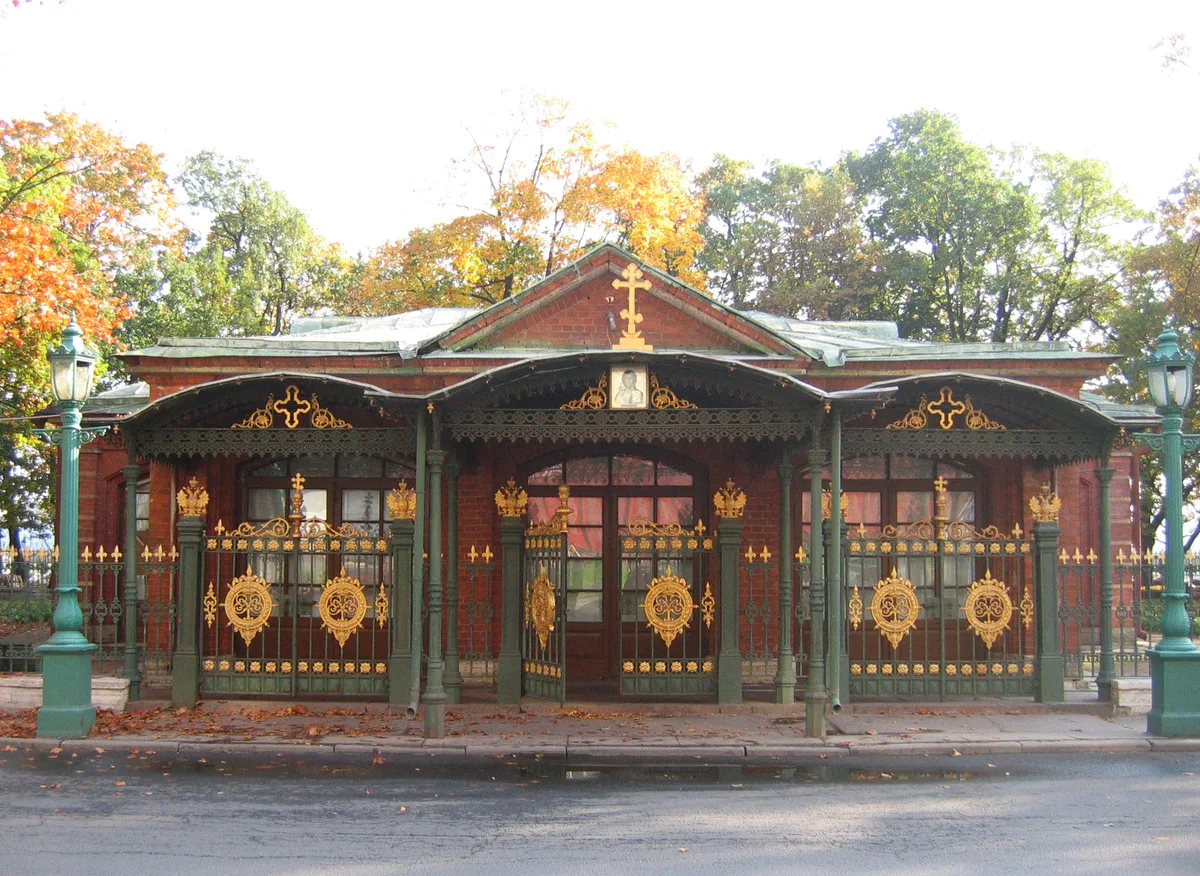
Photo: User:Yanachka / Public domain
What Your Eye SeesA tiny two-room log house of painted pine logs, tucked inside a protective brick and stone case on the Petrogradskaya Side, on the bank of the Neva.
ContextSt. Petersburg’s oldest surviving building, a 60-square-metre log cabin built in three days in May 1703, the very year the city was founded. Peter the Great lived here while he supervised the construction of the fortress and the new capital. The cabin is now a branch of the State Russian Museum.
From this cabin Peter oversaw the city and a Copenhagen climb: in 1716 he ascended Rundetårn. His fortress lies at Peter and Paul Fortress.
Source: UNESCO (Historic Centre of Saint Petersburg); Wikipedia (Cabin of Peter the Great)
DidYou
Know
So prized was Peter's first home that in 1723, within the tsar's own lifetime, the little log cabin was sealed inside a protective stone pavilion, a 'stone corset' that has shielded it from rot and weather ever since. Three centuries of swamp and frost have been weathered thanks to this enclosure, and the cabin still stands today as a branch of the State Russian Museum.
Share→ The Red-Striped Logs
The cabin was raised by soldiers of the Semyonovsky Regiment with no stone foundation, it stood directly on the ground. The log walls were painted with red stripes to imitate brick, and the rooms were known as the “red chambers.”
→ Peering Through The Cabin Windows
Visitors are not allowed inside the cabin and see its rooms through the windows. The study, the largest, keeps canvas-lined walls and Peter's armchair, said to have been carved by the tsar himself; beside it are a small dining room and a tiny bedroom of barely seven square metres. The three-leaf windows are glazed with crown glass, an expensive import in Peter's Russia.
→ A Captain’s House
A wooden mortar and “flaming” cannonballs once stood on the roof, marking the house of the “captain of the bombardier company”, the army rank under which Peter had enlisted. While he stayed here, the tsar’s personal standard flew from a tall flagstaff.
Sources: Wikipedia (Cabin of Peter the Great); Saint Petersburg Encyclopaedia; advantour (Cabin of Peter the Great); travelcultura; Russian Museum (official)
Renaissance
What palaces are in St Petersburg?
St Petersburg is defined by its imperial palaces. Our guide covers the Winter Palace, home of the Hermitage Museum, Peterhof Palace, Catherine Palace at Tsarskoye Selo, and Menshikov Palace, alongside the city’s fortress and cathedral landmarks.
What are the must-see landmarks in St Petersburg?
Our guide covers nine of the city’s landmarks: the Winter Palace (Hermitage), Peter and Paul Fortress, the Church of the Savior on Spilled Blood, St. Isaac’s Cathedral, Peterhof Palace, Catherine Palace, the Kunstkamera, Menshikov Palace, and Peter the Great’s Log Cabin.
These landmarks reward close attention. Vestigia is a field companion for people who look longer, with curated context, architectural detail, and the stories most visitors walk past. Free on the App Store and Google Play.