Venice Historical Landmarks
1. St. Mark's Basilica
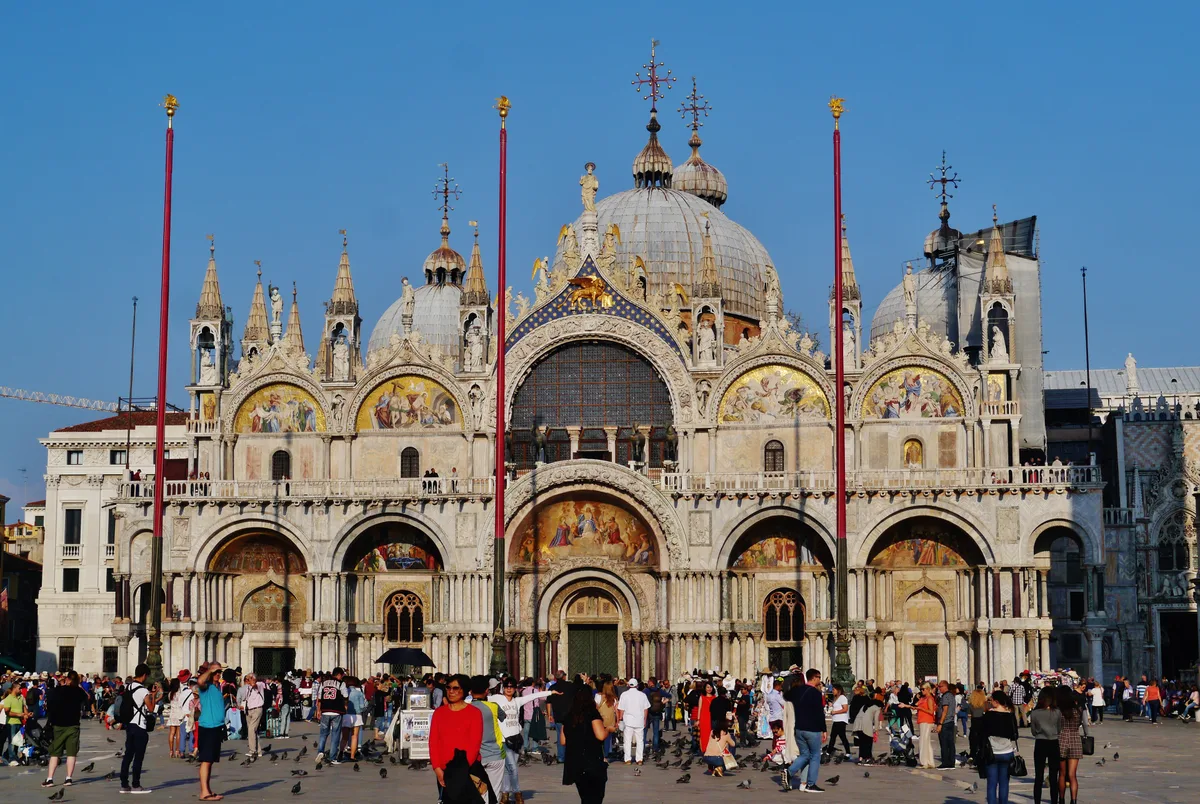
Photo: Zairon / Public domain
What Your Eye SeesFive grey-white domes rise above a facade crowded with columns, gold mosaics, and four bronze horses, all facing St. Mark's Square and the lagoon.
ContextCommissioned under Doge Domenico Contarini in 1063, St. Mark's Basilica was built as the doge's private chapel to house the relics of St. Mark, the first bishop of the Coptic church, stolen from Alexandria in 828. Consecrated in 1094, it fused a Greek-cross plan modelled on the Church of the Holy Apostles in Constantinople with Venetian brick, its five domes rebuilt in brick and later sheathed in gold mosaics after the Fourth Crusade brought plundered columns and marbles from Constantinople.
Contarini, a merchant prince who steered Venice from lagoon town to Adriatic power, meant the basilica to outshine any church in Italy, not with height, but with light. By cladding brick in polychrome marble and gold, he turned a private palace chapel into the republic's treasury of stolen Byzantium.
On ScreenSt. Mark's Square appears in The Tourist (2010).
Source: Wikipedia (St. Mark's Basilica); St. Mark's Basilica Official; thatfilmspot.com; sceen-it.com
 Did
DidYou
Know
The four bronze horses above the entrance are not Venetian originals. They were looted from the Hippodrome of Constantinople during the Fourth Crusade in 1204 and shipped to Venice as war booty.
ShareThe Horses Are Copies
Look at the four bronze horses above the great portal. The ones you see outside are precise copies from the 1980s; the originals, pitted by centuries of sea air and once gilded, stand inside the basilica museum to halt corrosion.
Gold Under Your Feet
Step into the narthex and notice the floor: white, green, and red marble inlay in geometric patterns that undulate slightly. The uneven surface is not poor craftsmanship, the whole basilica is slowly sinking into the lagoon mud, and the floor has buckled with it.
Sources: Wikipedia (Horses of Saint Mark); Wikipedia (St. Mark's Basilica)
 Euro Heritage
 Spiritual Seeker
2. Doge's Palace
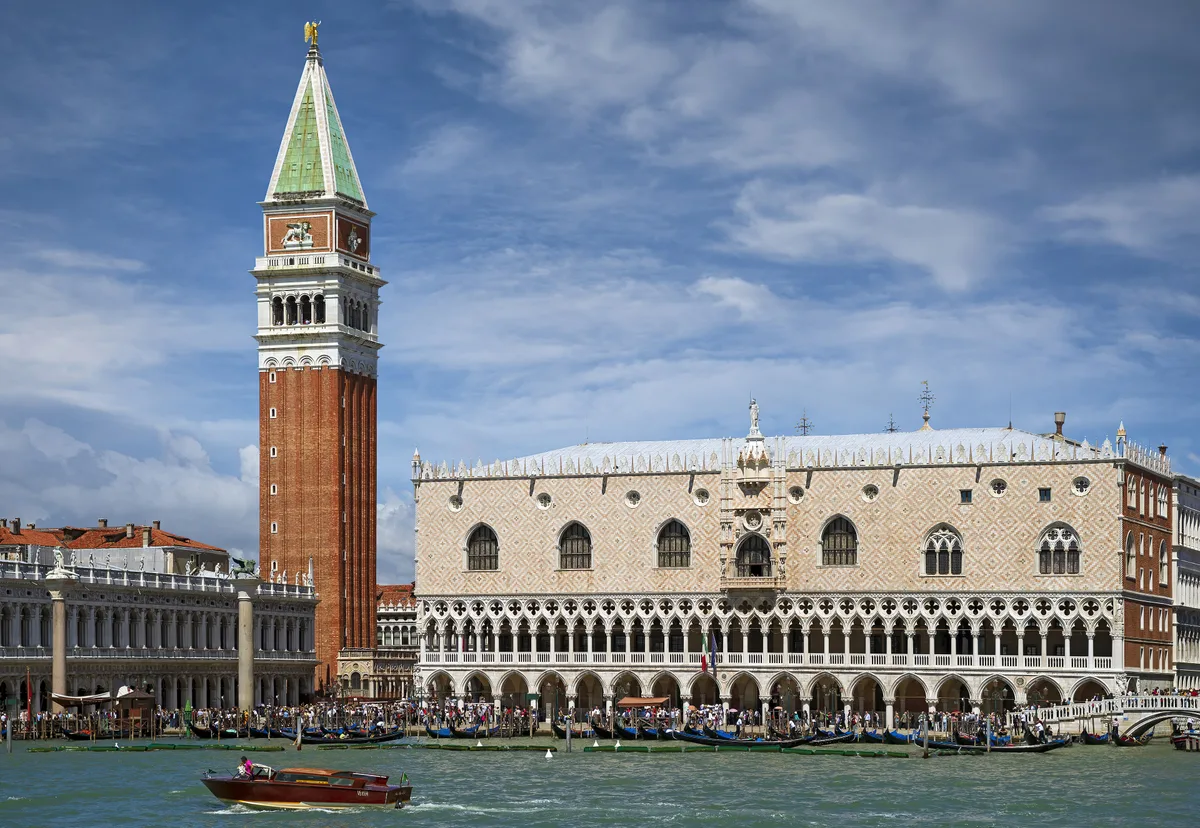
Photo: Didier Descouens / CC BY-SA 4.0
What Your Eye SeesA pink-and-white diamond-patterned wall floats above two open arcades of pointed arches and slender columns, facing both the lagoon and St. Mark's Square.
ContextBegun around 1340 and extended under Doge Francesco Foscari from 1424, the Doge's Palace was not a royal residence but the republic's combined palace, parliament, court, and prison. Its Venetian Gothic facades, built in Istrian stone and pink Verona marble, were deliberately inverted, solid above, open below, to make the seat of government look light, not fortress-like.
Foscari, who ruled for an unusually long 34 years, pushed the palace to face the Piazzetta to give the Great Council room for a growing oligarchy, turning a fortified dogal house into a civic stage for Venetian state ceremony.
On ScreenThe Doge's Palace appears in The Tourist (2010).
Source: Wikipedia (Doge's Palace); Britannica (Doge's Palace); sceen-it.com (The Tourist); solosophie.com
DidYou
Know
The palace's Great Council Hall once held one of the longest canvases ever painted: Tintoretto's Paradise, 22 by 7 meters, still hanging where the republic's 1,200 patricians voted.
ShareThe Pink Lace Is Stone
Look closely at the upper wall facing the lagoon. The white and pink diamond pattern is not paint but thin marble veneer, each lozenge cut and set like marquetry, with the mortar joints almost invisible from the ground.
The Mouths That Swallowed Secrets
Walk along the arcade and spot small marble faces with open mouths, the Bocche di Leone. Citizens slipped anonymous denunciations through the slit; the lions' mouths led directly to the magistrates' inboxes inside.
Sources: Wikipedia (Doge's Palace); VisitMuVE (Doge's Palace)
Euro Heritage
 Gothic Soul
3. Rialto Bridge
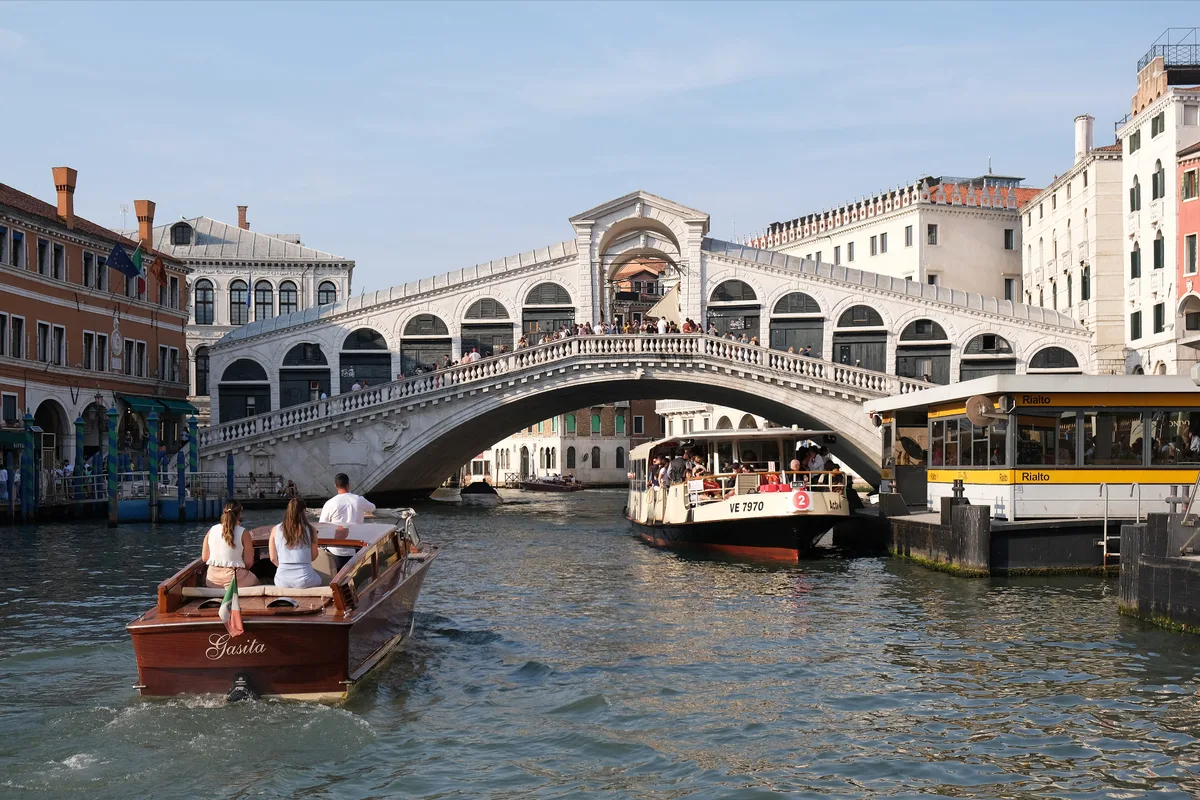
Photo: kallerna / CC BY-SA 4.0
What Your Eye SeesA single great arch of white Istrian stone spans the Grand Canal, its roadway lined with two rows of shops under a central portico, with stairs rising on both sides.
ContextDesigned by Antonio da Ponte and built between 1588 and 1591, the Rialto Bridge replaced a series of wooden bridges that had collapsed or burned since the 12th century. At 28 meters long and 7.32 meters high, its single arch was an engineering leap that many contemporaries, including Michelangelo, had declared impossible in stone.
Da Ponte, a 70-year-old engineer who had already rebuilt the Doge's Palace after the 1577 fire, beat proposals from more famous architects by insisting a single arch would not block boat traffic or require mid-canal piers that the soft lagoon bed could not support.
On ScreenThe Rialto Bridge appears in Casino Royale (2006).
Source: Wikipedia (Rialto Bridge); Britannica (Rialto Bridge); 007.com (Casino Royale); bondlocations.com
DidYou
Know
The bridge rests on 12,000 wooden piles driven into the lagoon mud, alder and larch trunks that have petrified underwater and still support the 1,500-ton stone arch after more than 400 years.
ShareShops Inside a Bridge
Look midway along the span and notice the central portico is flanked by shops on both sides. The roadway splits around them, so you can cross without ever seeing the canal, a deliberate throwback to the medieval ponte di botteghe tradition.
The Stone That Breathes
Crouch near the balustrade and spot the small relief of the Annunciation on the bridge's southern side. The Istrian stone was chosen because its tiny pores close on contact with water, making it almost waterproof in the lagoon spray.
Sources: Wikipedia (Rialto Bridge)
 Renaissance
Euro Heritage
Renaissance
Euro Heritage
4. Bridge of Sighs
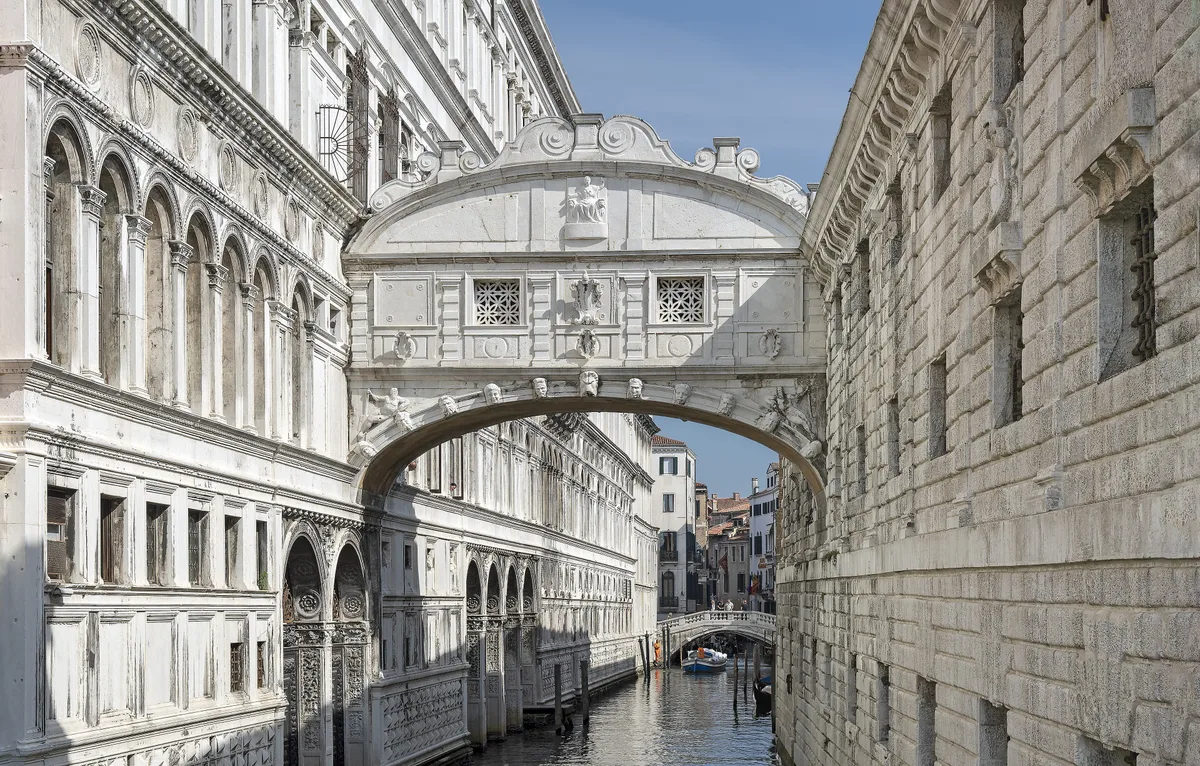
Photo: Didier Descouens / CC BY-SA 4.0
What Your Eye SeesA small, fully enclosed white limestone bridge with two tiny windows barred by stone, arching 11 meters over the narrow Rio di Palazzo between two much larger buildings.
ContextDesigned by Antonio Contino and built between 1600 and 1603, the Bridge of Sighs connects the Doge's Palace interrogation rooms to the New Prisons across the canal. Its Baroque limestone shell, quarried on the Croatian coast and carved with subtle rustication, hides a divided corridor, one passage for the accused, one for the convicted, so they would never meet.
Contino was the nephew of Antonio da Ponte, designer of the Rialto Bridge, and inherited his uncle's office as proto, or chief architect, of the republic, a family link that tied Venice's two most famous bridges to one workshop.
On ScreenThe Bridge of Sighs appears in From Russia with Love (1963), as Bond and Tatiana Romanova drift beneath it in a gondola in the film's final scene.
Source: Wikipedia (Bridge of Sighs); Britannica (Bridge of Sighs); onthetracksof007.com (Venice)
DidYou
Know
The name 'Bridge of Sighs' was not Venetian. It was invented in the 19th century by Lord Byron, who imagined the sighs of prisoners catching a final glimpse of Venice through its barred windows.
ShareTwo Corridors, One Bridge
Peer through the barred windows and notice the central stone wall inside. The bridge is split lengthwise into two narrow passages, so prisoners going to trial never crossed those returning to cells.
The Face in the Keystone
Look at the central mask carved where the arch meets the palace wall. The stern face, half-eroded by lagoon air, was meant to watch prisoners and remind them that the republic saw everything.
Sources: Wikipedia (Bridge of Sighs); Britannica (Bridge of Sighs)
 Baroque Master
Euro Heritage
Baroque Master
Euro Heritage
5. Ca' d'Oro
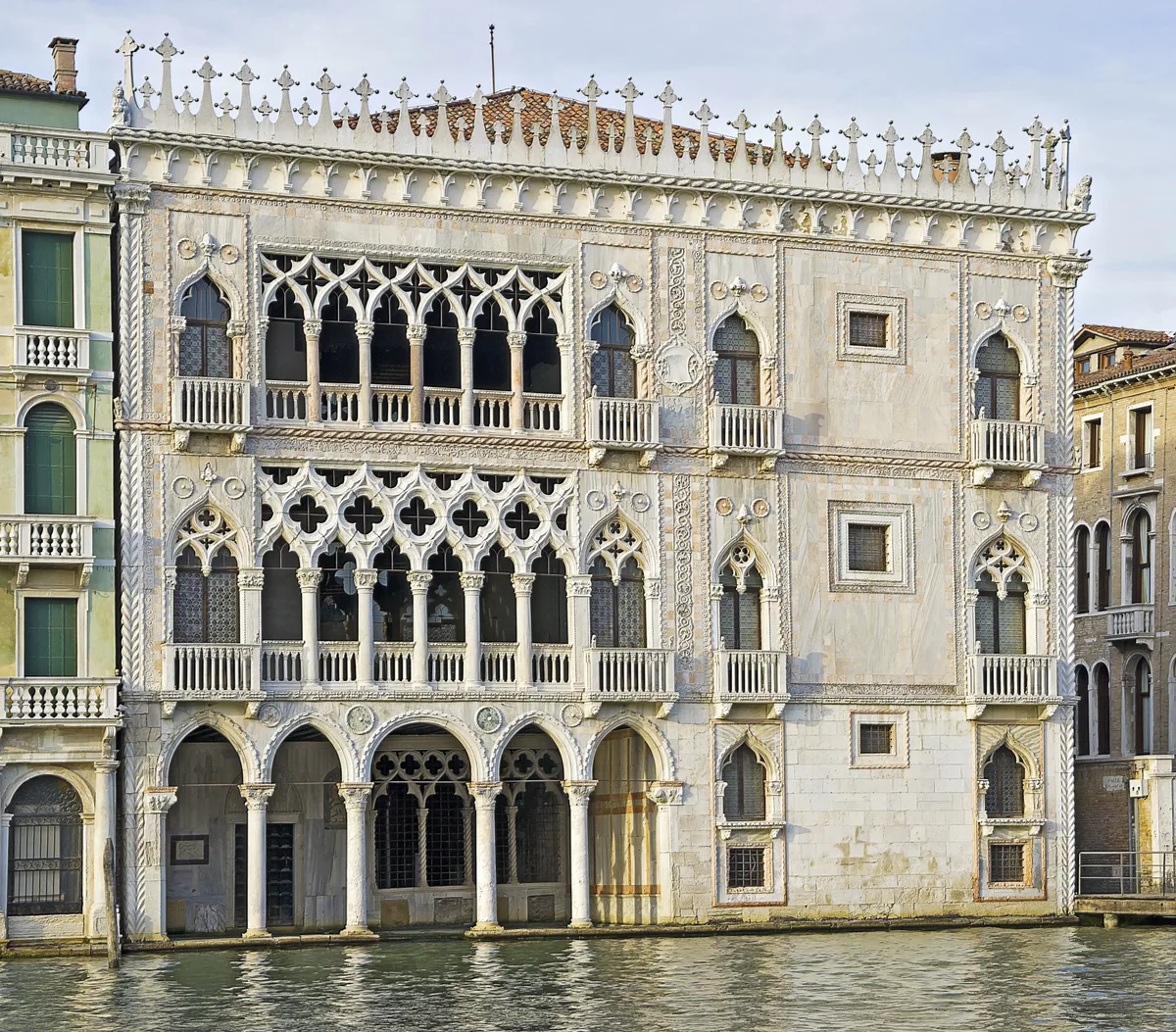
Photo: Didier Descouens / CC BY-SA 4.0
What Your Eye SeesA lace-like facade of pointed arches, quatrefoil tracery, and slender columns in white and pale red stone, with gilded touches at the parapet, facing the Grand Canal like open stone lace.
ContextCommissioned by the nobleman Marino Contarini and built between 1421 and 1440 by Giovanni Bon and his son Bartolomeo Bon with the Lombard sculptor Matteo Raverti, Ca' d'Oro was Contarini's bid to turn a family palace into a civic monument. Faced in Istrian white and Verona red marble and once entirely gilded, it was the only palace in Venice remembered not by family name but as the 'House of Gold.'
Contarini, whose family had already given eight doges, kept meticulous accounts, the only surviving building ledger for a Gothic palace, to prove that private wealth could rival the doge's own palace in splendor.
Source: Wikipedia (Ca' d'Oro); Galleria Giorgio Franchetti (Ca' d'Oro)
DidYou
Know
By 1600 almost no gold remained on the facade. Sun, salt, and lagoon air had stripped the gilding and polychrome within a century, but the name 'House of Gold' stuck so firmly that no later owner dared rename it.
ShareThe Gold You Cannot See
Look at the parapet balls and window finials. Tiny pitted holes remain where gold leaf was hammered into the stone and later pried off. The facade you see in pale stone was once red, white, and gold like a jewel box.
The Well Head by Bon
Step into the courtyard and find the well head carved in 1430 by *Bartolomeo Bon* himself. Its basket-weave pattern and quatrefoil openings are a signature you can trace from this palace to the Doge's Palace next door.
Sources: Wikipedia (Ca' d'Oro); Musei Veneto (Ca' d'Oro)
Gothic Soul
Renaissance
6. Santa Maria della Salute
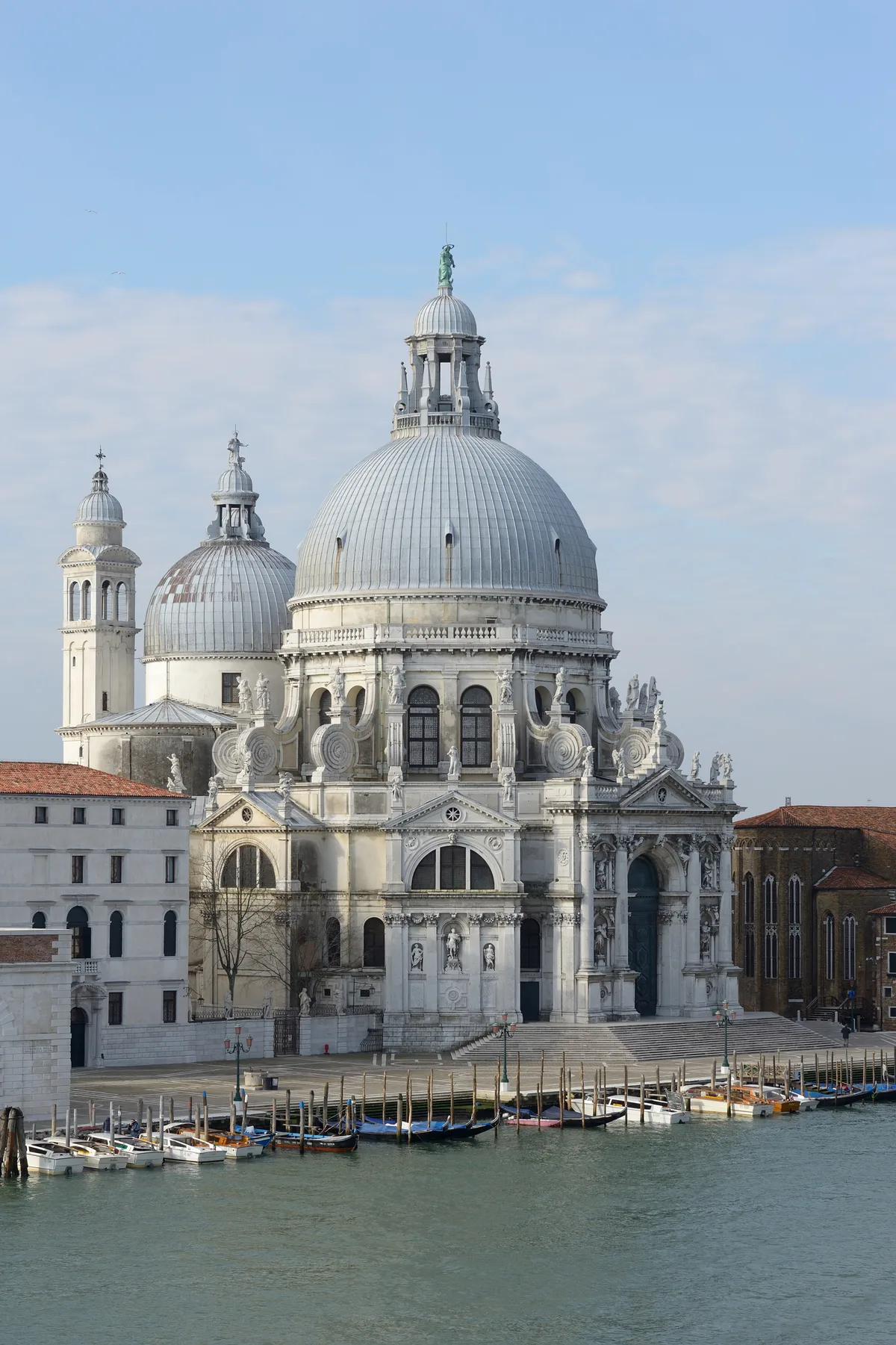
Photo: Wolfgang Moroder / CC BY-SA 3.0
What Your Eye SeesA colossal octagonal church of white Istrian stone, its great dome and two smaller domes and pair of campanili rising at the mouth of the Grand Canal where it meets the lagoon.
ContextDesigned by Baldassare Longhena and built between 1631 and 1687, Santa Maria della Salute was a votive church, a promise the Senate made to the Virgin Mary during the plague that killed a third of Venice. Longhena, then only 26, won a competition with a centralized octagon that quoted both the Pantheon and the great plague churches of the past.
Longhena died in 1682, five years before the last stone was set, having spent 56 years watching his one great church rise on 1,156,650 wooden piles driven into the lagoon barene.
On ScreenSanta Maria della Salute appears in Casino Royale (2006).
Source: Wikipedia (Santa Maria della Salute); Britannica (Santa Maria della Salute); bondlocations.com (Casino Royale); onthetracksof007.com
DidYou
Know
The church still fulfills its original vow. Every November 21, Venetians walk a temporary pontoon bridge from St. Mark's to the Salute for the Festa della Salute, carrying candles to give thanks for deliverance from plague.
ShareThe Crown on Top
Look at the lantern atop the great dome. A statue of the Virgin as Captain, holding a commander's staff, stands on a globe that itself acts as a wind vane, turning with the bora wind off the lagoon.
Snails in the Scrolls
Walk around the exterior and notice the huge volutes, scroll buttresses, that brace the octagon. Each is carved with a snail-like curl, Longhena's joke that the heavy stone, like a snail, needs to carry its house slowly.
Sources: Wikipedia (Santa Maria della Salute); Britannica (Santa Maria della Salute)
Baroque Master
Spiritual Seeker
7. Scuola Grande di San Rocco
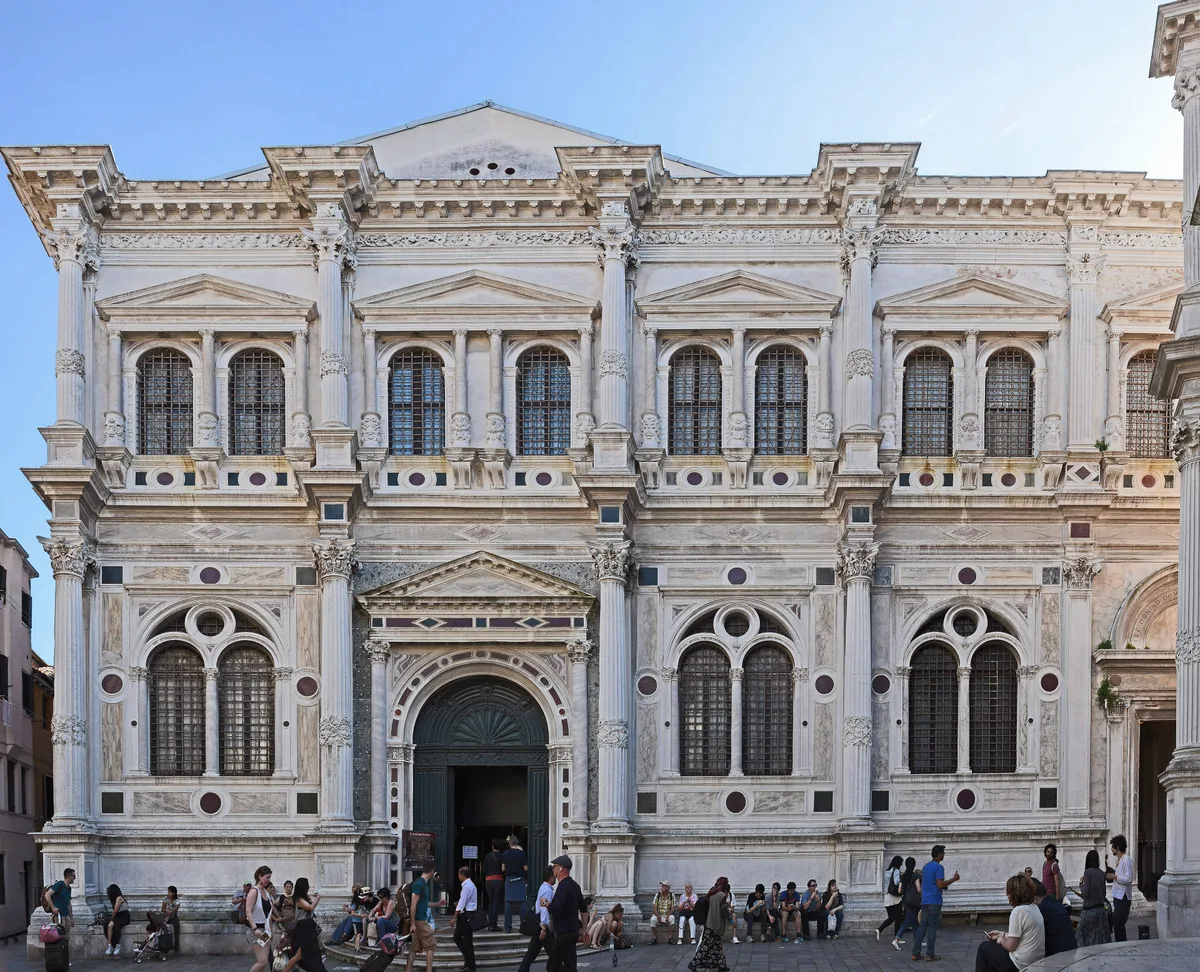
Photo: Didier Descouens / CC BY-SA 4.0
What Your Eye SeesA severe white Istrian stone facade with paired Corinthian columns below and oblong windows above, hiding behind it one of the densest displays of painting in Venice.
ContextBuilt between 1517 and 1560 as the hall of the confraternity (scuola) dedicated to St. Roch, the Scuola Grande di San Rocco is a civic palace of the cittadini, not the nobility. Its plain exterior, by Bartolomeo Bon and Scarpagnino, was deliberately austere; inside, Tintoretto covered the Chapter House and Upper Hall with more than 50 vast canvases between 1564 and 1588, painting almost without interruption for 24 years.
Tintoretto won the commission by gifting his Saint Roch in Glory rather than submitting a competition sketch, a gambit that so angered his rival Veronese that the scuole briefly banned him, then hired him for life.
Source: Wikipedia (Scuola Grande di San Rocco)
DidYou
Know
Tintoretto painted the Upper Hall's ceiling and walls for almost nothing, he accepted a tiny annual stipend just to keep the commission exclusive, then worked so fast that the scuole repeatedly tried to cap his output.
ShareThe Painted Ceiling You Walk Under
Look up in the Upper Hall. The entire ceiling is a single program by Tintoretto, its canvases not framed but set directly into the wood, so you walk under a continuous sky of Old Testament scenes where the figures seem to tumble toward you.
The Stair You Touch
Run your hand along the grand staircase. The balustrade is supported by paired columns of grey Bardiglio marble, each base carved with a different grotesque mask that the confraternity members would touch for luck on their way to meetings.
Sources: Wikipedia (Scuola Grande di San Rocco); Scuola Grande di San Rocco Official
Renaissance
Spiritual Seeker
8. The Arsenale
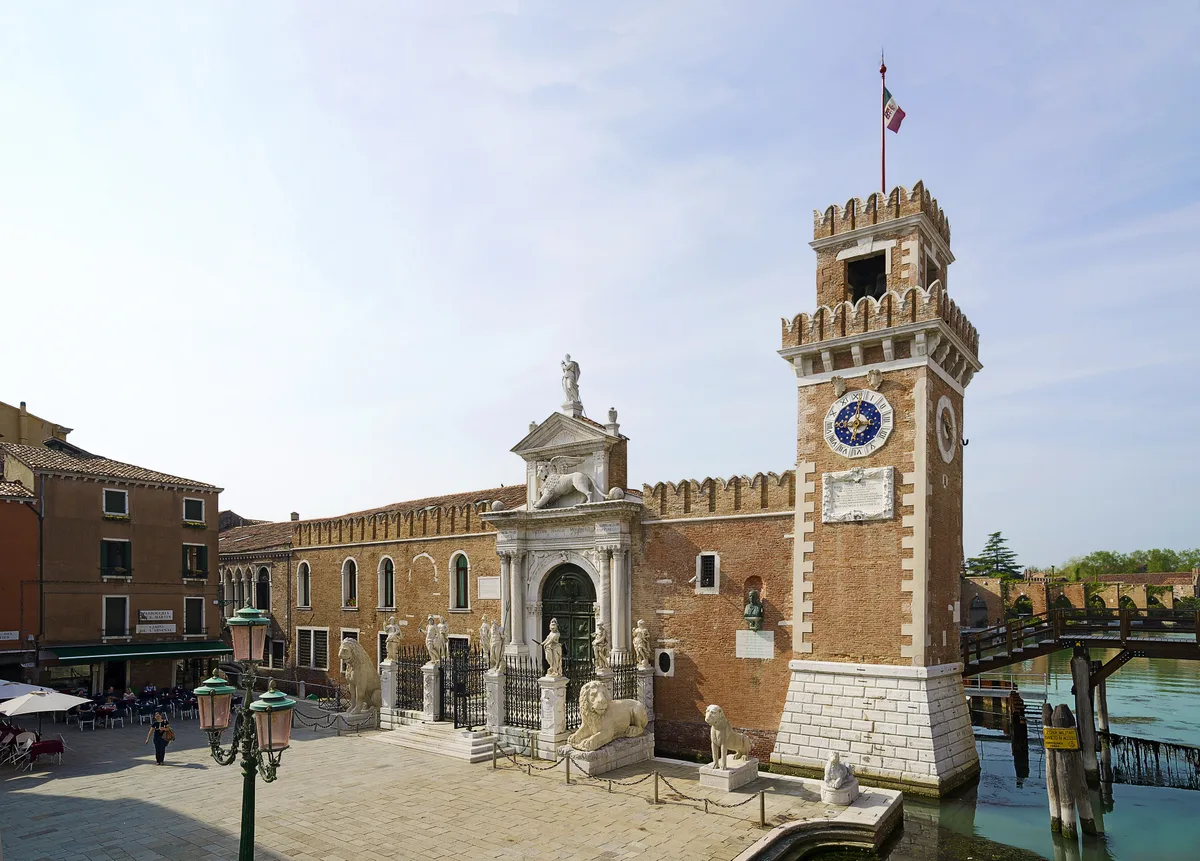
Photo: Didier Descouens / CC BY-SA 4.0
What Your Eye SeesA crenellated brick wall more than a kilometer long, punctuated by a monumental Renaissance gateway with four marble lions, behind which masts and chimneys rise above roofed sheds that once launched a galley a day.
ContextFounded in 1104 and expanded until about 1440, the Arsenale was the republic's state shipyard, the largest industrial complex in Europe before the Industrial Revolution, where the Venetian state built, armed, and repaired its entire fleet under one roof. At peak it employed 16,000 workers and could, by legend, produce a fully rigged galley in a single day by moving the hull along a production line.
The gateway, the Porta Magna (1460), was one of the earliest Renaissance structures in Venice, built when the republic was already turning its shipyard into theatre, carving its power into stone for every ambassador who entered by water.
On ScreenThe Arsenale serves as the Interpol headquarters in The Tourist (2010), where Elise visits its offices.
Source: Wikipedia (Venetian Arsenal); Britannica (Venetian Arsenal); wherefilmed.org; hotelarcadia.net; sceen-it.com
DidYou
Know
The word 'arsenal' entered most European languages from this Venetian yard. The Venetian term arsenàl, from Arabic dar al-sina'a (house of manufacture), was so famous that Dante placed it in the Inferno a century before it reached peak production.
ShareThe Lions That Came From Greece
Look at the four marble lions flanking the Porta Magna. Two are ancient Greek, looted from Piraeus in 1687 by Admiral Francesco Morosini, their flanks still bearing faint runic graffiti carved by Norse mercenaries in the 11th century.
The Door That Is a Triumph
Step up to the Porta Magna itself. The pediment is not medieval but early Renaissance, with paired columns and a lunette that deliberately quotes ancient Roman triumphal arches, announcing that Venice saw itself as the new Rome on water.
Sources: Wikipedia (Venetian Arsenal); Venetian Arsenal Official
Euro Heritage
 Time Traveler
What are the must-see places in Venice?
The classic first stop is Piazza San Marco, where St Mark's Basilica and the Doge's Palace sit side by side, with the Bridge of Sighs linking the palace to the old prison. From there the route usually runs to the Rialto Bridge, the oldest of the four bridges over the Grand Canal, and a vaporetto ride down the canal itself. For depth, the Gallerie dell'Accademia holds Venetian painting and the Ca' d'Oro a house-museum of the Renaissance.
When is the Venice Art Biennale in 2026?
The 61st International Art Exhibition, titled In Minor Keys, runs from 9 May to 22 November 2026 at the Giardini and the Arsenale. Its vision belongs to Cameroonian-Swiss curator Koyo Kouoh, who died in May 2025, and her team carried it out; the central show gathers 111 artists beside 100 national pavilions. The restored Central Pavilion at the Giardini reopened for this edition.
What is the Arsenale in Venice?
The Arsenale was Venice's state shipyard and its industrial heart, a walled district founded in 1104 where the republic built, armed and repaired its war fleet. By the 16th century it was among the largest manufacturing complexes in the world, and its system of moving hulls down a production line anticipates the modern factory. Today parts of the complex open to the public for visits and events.
Where did the horses on St Mark's Basilica come from?
The four bronze horses above the portico of St Mark's Basilica were taken from the Hippodrome of Constantinople when crusaders sacked the city in 1204. They were installed in Venice for more than 500 years, then taken to Paris by Napoleon in 1797 and returned in 1815. The originals are now kept in the basilica's museum to protect them, and the horses on the facade outside are replicas.
Why is the Bridge of Sighs called that?
The name was coined in the 19th century by Lord Byron, who imagined prisoners sighing at their last look at Venice as they crossed from the Doge's Palace to the prisons. The enclosed stone bridge, designed by Antonio Contino and built in 1600 to 1603, connects the palace's interrogation rooms to the first floor of the new prison, and in reality at least one prisoner was tortured inside it, as the frescoes above the bridge still hint.
These landmarks reward close attention. Vestigia is a field companion for people who look longer, with curated context, architectural detail, and the stories most visitors walk past. Free on the App Store and Google Play.