Edinburgh Historical Landmarks
1. Edinburgh Castle
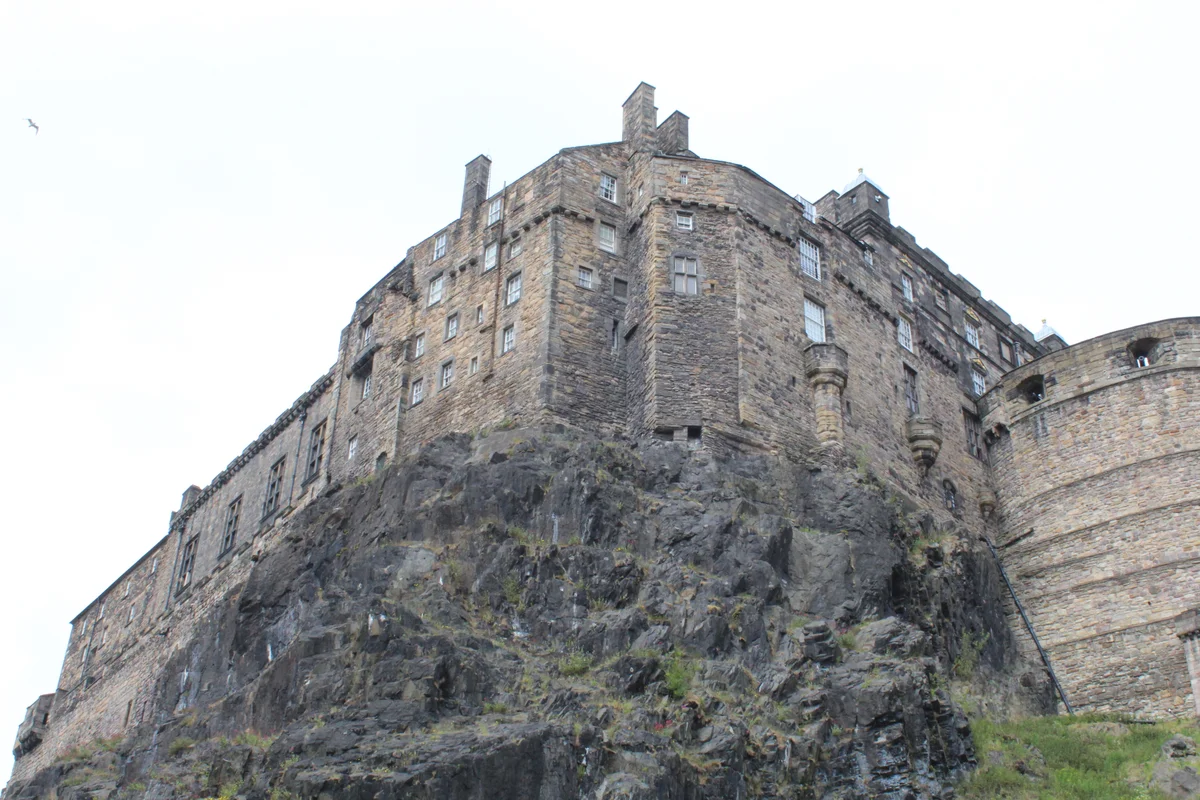
Photo: Chabe01 / CC BY-SA 4.0
What Your Eye SeesA massive royal fortress perched on a dark volcanic crag, its medieval curtain walls and squat towers rising directly out of the rock. Within the ramparts, a small Romanesque chapel and a crown of stone buildings cluster around the highest point of Castle Rock.
ContextCastle Rock has been a fortress since at least the Iron Age, but Edinburgh Castle took its lasting shape across the medieval centuries. Its oldest surviving structure is St Margaret’s Chapel, built around 1130 and attributed to David I, the oldest building in Edinburgh. For centuries the castle served as the royal residence and seat of Scottish kings, and it is one of the most besieged places in Britain: research in 2014 counted 26 sieges across its 1,100-year history.
On ScreenEdinburgh Castle and its esplanade appear in The Lost King (2022) and Filth (2013), with the castle's square doubling for countless fiction films over the years.
Source: UNESCO (Old and New Towns of Edinburgh); Wikipedia (Edinburgh Castle); Historic Environment Scotland (filming page)
Part of the journey: Castles of Scotland →
 Did
DidYou
Know
During Oliver Cromwell’s invasion of the 1650s, the Honours of Scotland, the crown, sceptre and sword, were kept out of his hands by being hidden at Dunnottar Castle and then buried under the floor of Kinneff Church. After the Restoration in 1660 they returned to Edinburgh Castle, where they were locked in an oak chest and forgotten for more than a century until Sir Walter Scott had the chest opened in 1818.
Share→ The Giant Gun By The Gate
Look for Mons Meg, the 51 cm (20 in) medieval bombard weighing 6.6 tons, gifted to James II in 1454, its blackened barrel burst on 30 October 1680 during a salute for the Duke of Albany. The original, pitted by sea air, now rests on the battlements.
→ The Chapel That Outlived The Castle
St Margaret’s Chapel, the tiny Norman chapel on the highest point of the rock, is the oldest surviving building in Edinburgh. Built around 1130 in the reign of David I, its plain stone walls and small round-arched windows have looked over the city for almost nine centuries.
→ The One O’Clock Gun
Every day at 1 p.m., except on Sundays, a gun is fired from the Mills Mount battery, a time signal first set up in 1861 so ships in the Firth of Forth could set their clocks. The cannon on the ramparts is the visible heart of a daily ritual older than the radio time signal.
Sources: Wikipedia (Mons Meg); Historic Environment Scotland (Mons Meg); Wikipedia (Edinburgh Castle); Historic Environment Scotland (One O'Clock Gun); Historic Environment Scotland
 Euro Heritage
 Time Traveler
2. Palace of Holyroodhouse
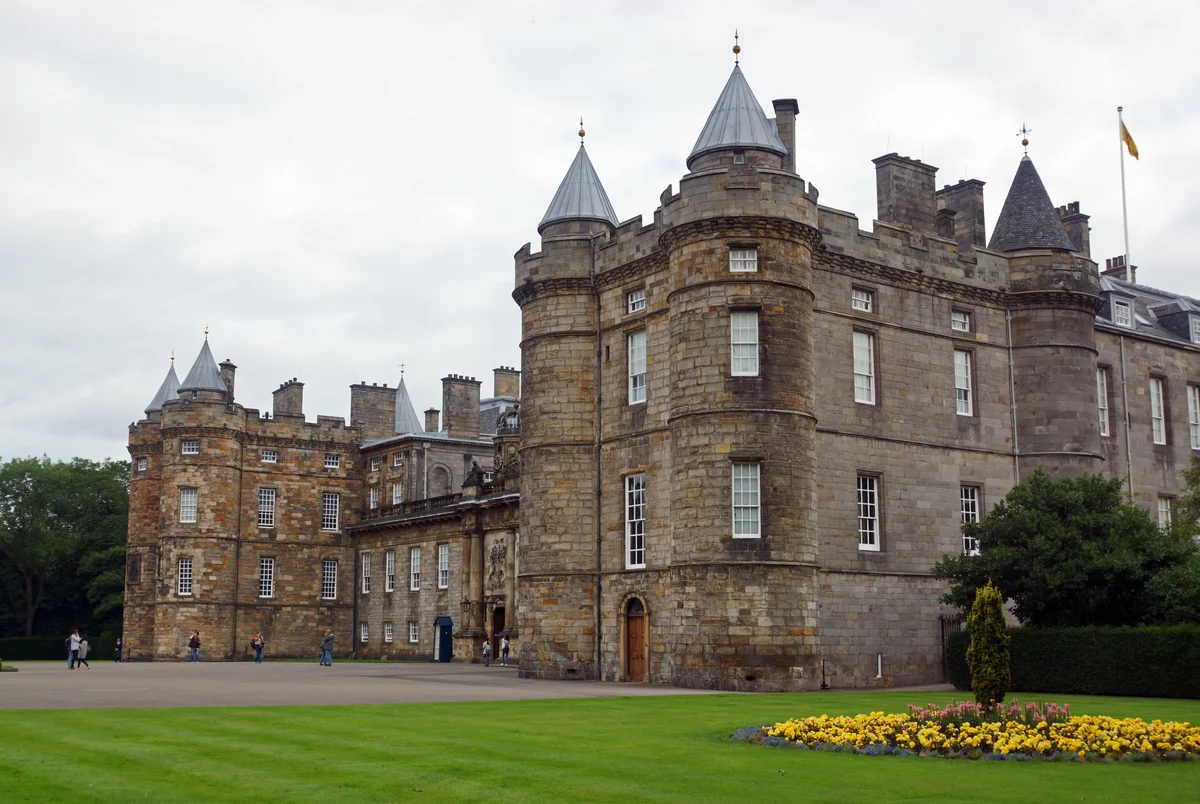
Photo: Allie_Caulfield / CC BY 2.0
What Your Eye SeesAn austere quadrangle palace of grey stone standing at the foot of the Royal Mile, its ordered 17th-century facades set beside the dramatic roofless ruins of a medieval abbey. Beyond the walls, the green slope of Arthur’s Seat rises above the grounds.
ContextKing David I founded an abbey on this spot in 1128, legend says after a vision of a white stag with a cross between its antlers. The adjoining palace grew over the centuries, and it was here that Mary, Queen of Scots lived between 1561 and 1567. The present building was rebuilt between 1671 and 1679 for Charles II by the architect Sir William Bruce, and it remains the official residence of the monarch in Scotland.
On ScreenThe Palace of Holyroodhouse appears throughout the series Outlander, standing in for the royal residence its characters visit in Edinburgh.
Source: UNESCO (Old and New Towns of Edinburgh); Wikipedia (Palace of Holyroodhouse); VisitScotland (Outlander); Starz
DidYou
Know
In March 1566, Mary, Queen of Scots was having supper in her private apartments at Holyrood with her secretary David Rizzio when her husband Lord Darnley and a group of conspirators burst in, dragged Rizzio into the outer room and stabbed him to death. The murder of Mary’s favourite played a part in the collapse of her marriage and her reign.
Share→ The Abbey Ruins At Its Side
Look beside the palace for the roofless nave of Holyrood Abbey, the surviving fragment of the 12th-century foundation. Its pointed windows and bare walls frame the sky, all that remains above ground of David I's great monastic church.
→ Two Centuries On One Facade
Look at the palace's austere main quadrangle, crowned with ordered arched windows and stone urns. Its cool symmetry contrasts sharply with the medieval abbey ruin beside it, Baroque order and Gothic ruin side by side.
Sources: Wikipedia (Holyrood Abbey); Historic Environment Scotland; Wikipedia (Palace of Holyroodhouse); Historic Environment Scotland (Palace of Holyroodhouse)
Euro Heritage
Time Traveler
3. St Giles’ Cathedral
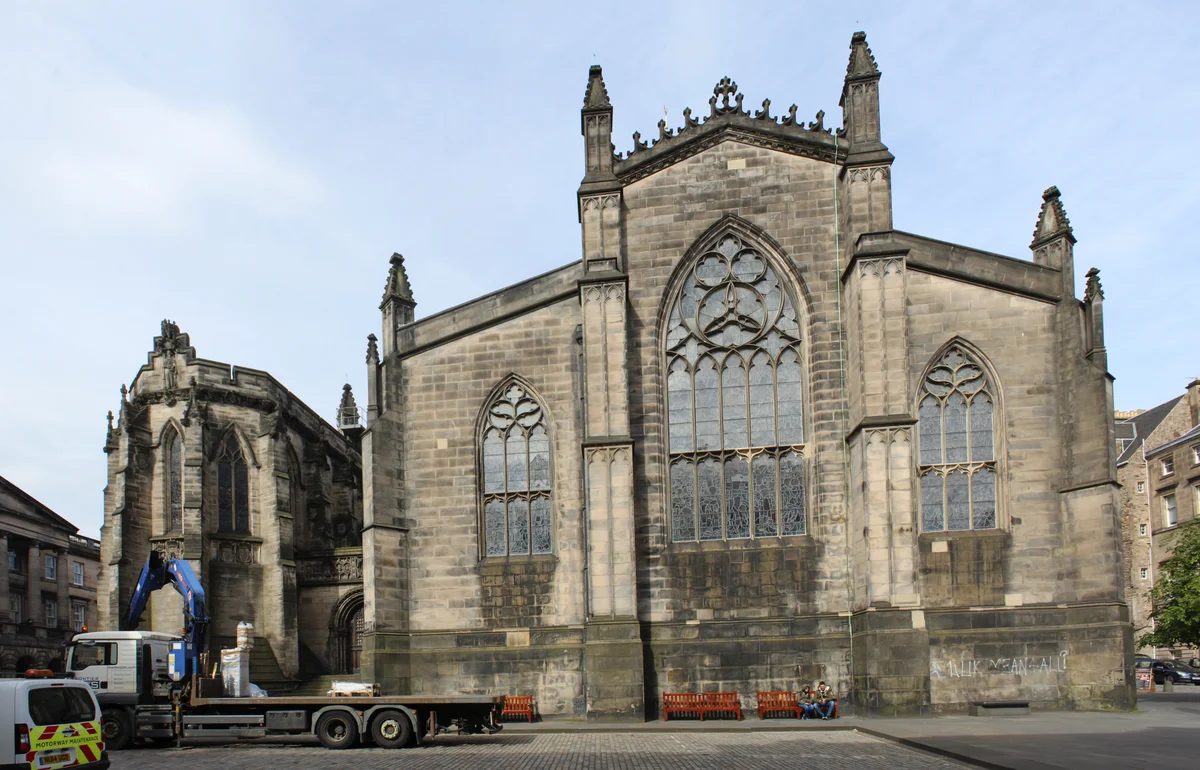
Photo: Chabe01 / CC BY-SA 4.0
What Your Eye SeesA great medieval church on the Royal Mile, its most striking feature the open crown spire, eight flying buttresses rising to a delicate stone crown high above the streets. Inside, the nave is tall and airy, lined with chapels and coloured glass, with the ornate Thistle Chapel at the south-east corner.
ContextSt Giles was founded by King David I in 1124 as the High Kirk of Edinburgh, the principal parish church of the city, and the mother church of Presbyterianism. It was the pulpit of John Knox during the Scottish Reformation of the 1550s, and it is where the young Mary, Queen of Scots clashed with the reformers. It is called a cathedral for its role in Scottish church life, though it has never been the seat of a bishop in the modern Church of Scotland.
On ScreenSt Giles' Cathedral and Parliament Square appear in the 2025 Netflix film Frankenstein by Guillermo del Toro.
Source: UNESCO (Old and New Towns of Edinburgh); Wikipedia (St Giles' Cathedral); edinburgh.org; IMDb
DidYou
Know
Set into the cobblestones just outside the cathedral’s west door is the Heart of Midlothian, a heart-shaped mosaic marking the entrance to the Old Tolbooth, Edinburgh’s notorious prison and place of public execution until 1817. Locals still spit on it for luck, a gesture once meant to show their disgust at the prisoners held within.
Share→ The Crown On The Skyline
Look at the crown spire, built around 1500, the most distinctive element of St Giles: eight open flying buttresses rise to a small lantern in the shape of an imperial crown. The unusual silhouette is Edinburgh's own, a stone crown set against the Old Town skyline.
→ The Thistle Chapel’s Hidden Angel
In the south-east corner, the Thistle Chapel (1911) was built by Sir Robert Lorimer for the Order of the Thistle. Among its elaborate oak carvings is a tiny angel playing the bagpipes, a detail most visitors walk past, tucked into the chapel’s forest of stone and wood.
→ The Stool Of Jenny Geddes
Look for the plaque and memorial marking the spot where, in 1637, Jenny Geddes is said to have flung her stool at the dean reading the new prayer book, the gesture that helped begin the Covenanting struggle, still kept in the cathedral's fabric.
Sources: Wikipedia (St Giles’ Cathedral); stgilescathedral.org.uk; Wikipedia (Jenny Geddes)
 Gothic Soul
 Spiritual Seeker
Euro Heritage
Spiritual Seeker
Euro Heritage
4. Scott Monument
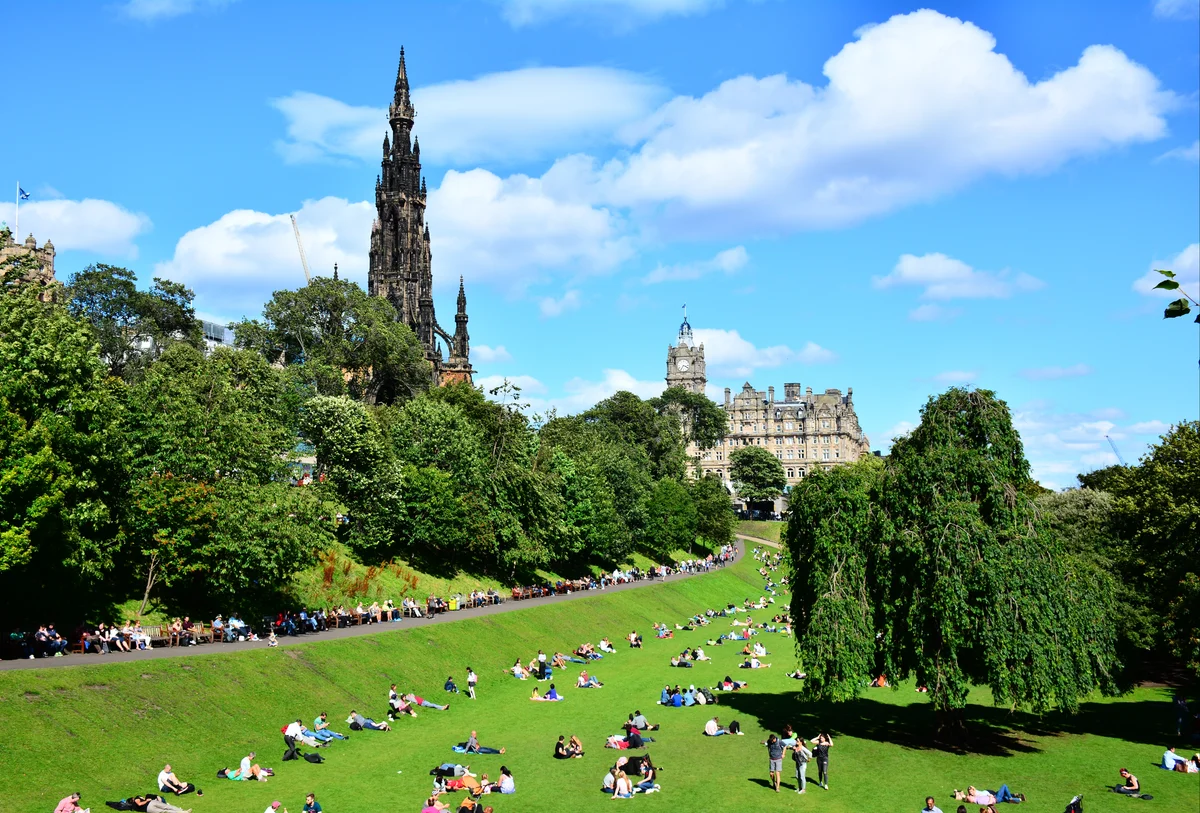
Photo: Mike McBey / CC BY 2.0
What Your Eye SeesA soaring Gothic spire of dark stone on Princes Street, its pointed pinnacles and arches climbing over 60 metres into the sky. The facade is covered in carved stone figures of characters from Scott’s novels, and at its base a white marble statue shows the novelist himself.
ContextThe Scott Monument was built between 1840 and 1844 to honour Sir Walter Scott, the novelist and poet who helped create the modern historical novel. It is the largest monument to a writer in the world. The design came from the self-taught joiner George Meikle Kemp, who entered the competition under a pseudonym and won, but drowned in the Union Canal in 1844, before the monument was finished.
On ScreenThe Scott Monument and Calton Hill overlook the Edinburgh of Cloud Atlas (2012), whose composite character Robert Frobisher lived on the castle side of the Old Town.
Source: UNESCO (Old and New Towns of Edinburgh); Wikipedia (Scott Monument); Wikipedia (Scott Monument)
DidYou
Know
The monument’s spire is 61.1 metres tall, and a narrow spiral staircase of 287 steps climbs to the top, where a viewing platform looks out over Princes Street Gardens and the Old Town. The dark colour of the sandstone has nothing to do with age alone, Edinburgh’s 19th-century soot darkened the stone within decades of it being cut.
Share→ The Story In Stone
Around the monument are carved figures of characters from Scott’s novels and poems, more than 60 of them, set into niches in the tower. High on the spire you can pick out figures like Rob Roy and characters from Waverley, turning the whole monument into a stone index of Scott’s imagination.
→ Scott And His Dog
Look at the base for the white marble statue by Sir John Steell showing Scott reclining with his deerhound Maida. The dog was Scott's real companion, after Maida died, a plaster cast was made so sculptors could get him right.
Sources: Wikipedia (Scott Monument); City of Edinburgh Council; Edinburgh Museums
Euro Heritage
Time Traveler
5. National Monument of Scotland
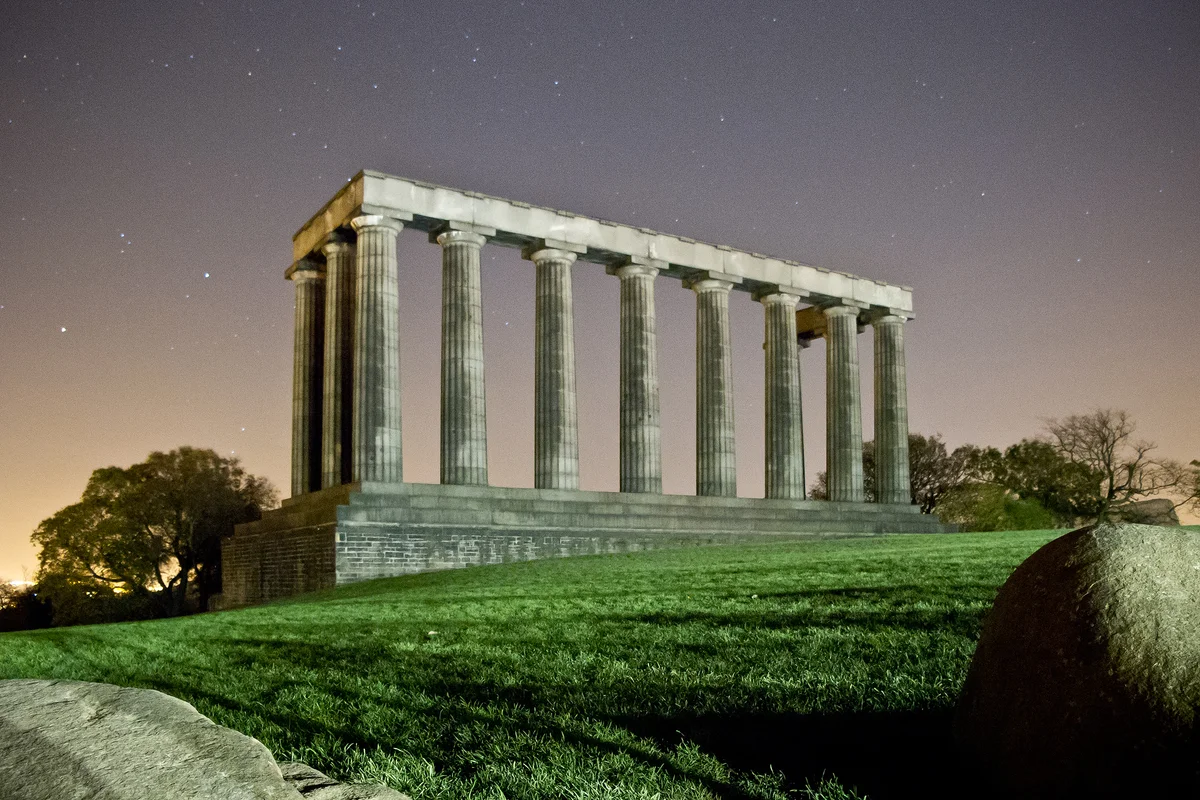
Photo: Carlos Delgado / CC BY-SA 3.0
What Your Eye SeesA row of twelve massive Doric columns standing alone on the crest of Calton Hill, their entablature open to the sky. Where the rest of a great temple should be, there is nothing, the columns frame the city and the Firth of Forth beyond.
ContextThe National Monument was intended as a full-scale replica of the Parthenon in Athens, built to honour the Scottish soldiers who died in the Napoleonic Wars. Designed by Charles Robert Cockerell and William Henry Playfair, construction began in 1826 but ran out of money in 1829, only the twelve columns of the west portico were ever raised.
Source: UNESCO (Old and New Towns of Edinburgh); Wikipedia (National Monument, Edinburgh)
DidYou
Know
The monument's unfinished state made it a byword for grand ambition cut short: Edinburgh's nickname for it was 'Scotland's Shame', some said 'Pride and Poverty', a Parthenon that never happened, frozen mid-rise on Calton Hill.
Share→ The Parthenon Proportions
The twelve columns are direct copies of the Parthenon’s, same Doric order, same proportions, even the same slight curve of the stylobate underfoot. Stand at the east end and you can feel the missing half: the temple was meant to run far further down the hill than it does.
→ The Columns That Hold Nothing
Look at the entablature above the columns: the architrave, frieze and pediment were all planned but only the lintel layer was ever laid. The open sky where the pediment should be is the monument’s real subject, a ruin made by funding, not by time.
Sources: Wikipedia (National Monument of Scotland); Edinburgh World Heritage
Euro Heritage
Time Traveler
6. National Museum of Scotland
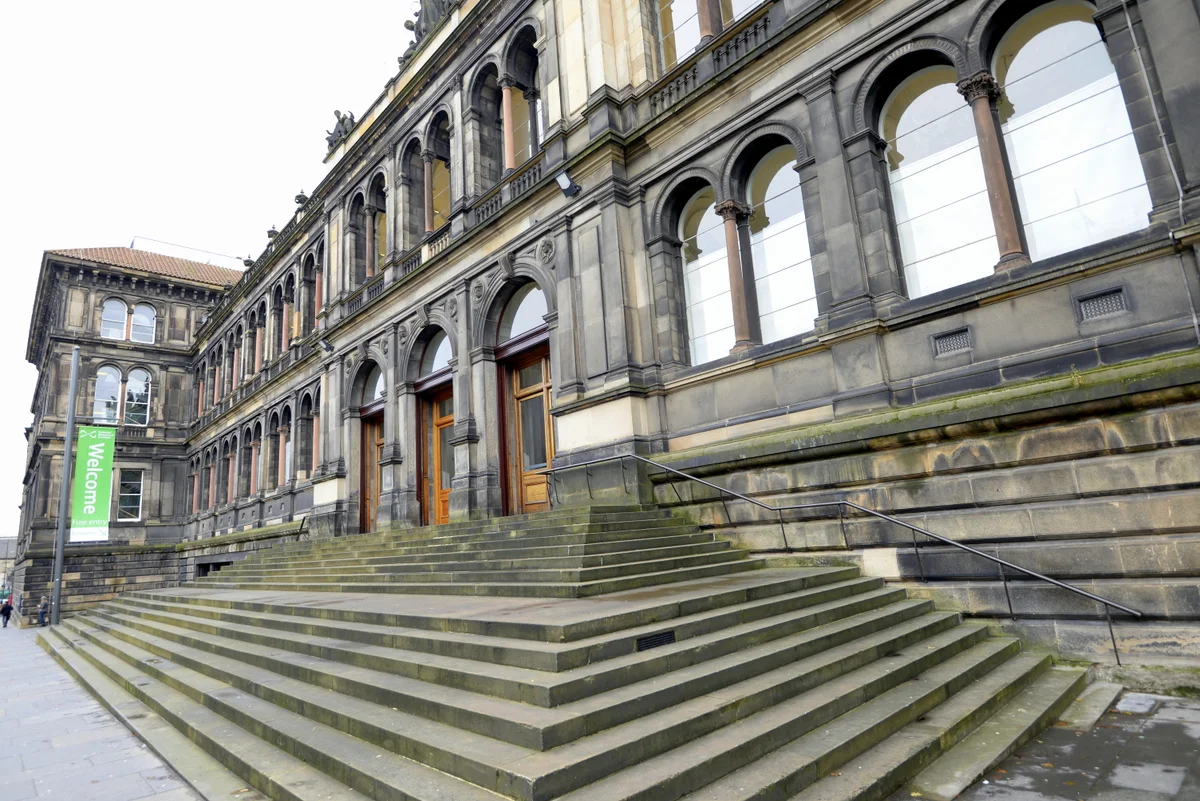
Photo: Osama Shukir Muhammed Amin FRCP(Glasg) / CC BY-SA 4.0
What Your Eye SeesA grand Victorian museum of red sandstone on Chambers Street, its long facade arched and columned in a Renaissance idiom. Inside, the centrepiece is a vast glass-roofed hall ringed by tiered cast-iron galleries that look like layered birdcages.
ContextThe National Museum of Scotland was built in two halves: the elegant Victorian wing on Chambers Street, opened in 1866, and the modern wing added in 1998. The Victorian hall was designed by Francis Fowke, the engineer who also designed the Royal Albert Hall in London, working with Robert Matheson of the Office of Works. Its interior is an homage to the Crystal Palace, iron and glass meant to celebrate the industrial age.
On ScreenThe National Museum of Scotland hosted the car chase and interiors filmed for Fast & Furious 9 (2021), officially listed by the museum as a filming location.
Source: UNESCO (Old and New Towns of Edinburgh); Wikipedia (National Museum of Scotland); National Museums Scotland (filming page); Film Edinburgh
DidYou
Know
The museum’s most famous resident is Dolly the sheep, the first mammal ever cloned from an adult cell, born at Edinburgh’s Roslin Institute in 1996. After her death in 2003 her preserved body went on display here, making the National Museum of Scotland home to one of science’s most celebrated animals.
Share→ The Birdcage Balconies
Stand in the Grand Gallery and look up: the tiers of delicate cast-iron balconies, nicknamed “birdcages,” run all the way to the glass roof. The ironwork is painted to imitate marble, a Victorian trick that makes the metal look like stone at a glance.
→ The Two Museums In One
The building is really two: the red sandstone Victorian wing on Chambers Street (1866) and the lighter, modern wing behind it (1998). From the street you see the 19th century; walk through the Grand Gallery and you step into a 21st-century museum of a completely different architectural language.
Sources: National Museums Scotland (National Museum); Wikipedia (National Museum of Scotland); nms.ac.uk
Euro Heritage
 Renaissance
7. Scottish National Gallery
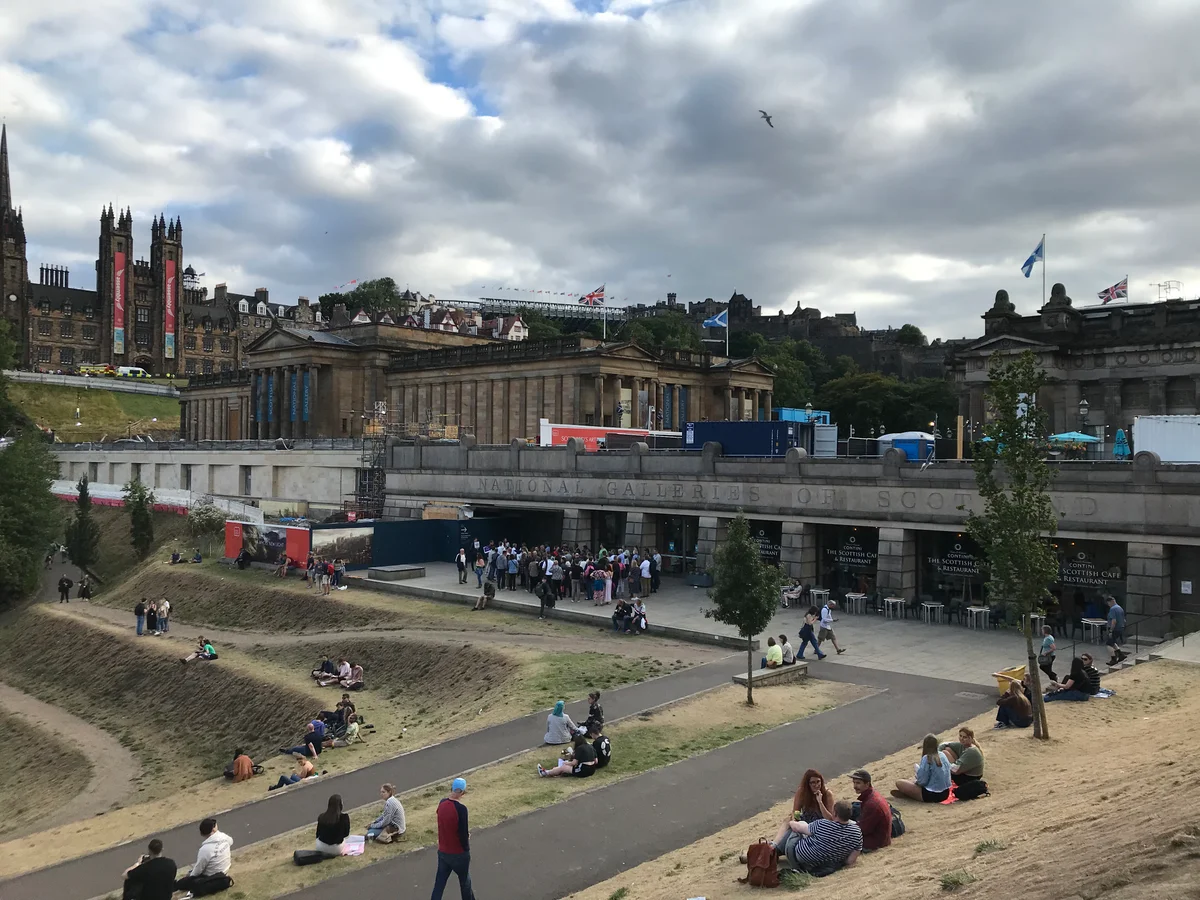
Photo: Anthony Foster / CC BY-SA 2.0
What Your Eye SeesA severe neoclassical building of pale stone set in gardens at the foot of The Mound, its entrance a long Ionic portico with rows of fluted columns. Inside, the galleries hang Scotland’s national collection of art, from the Renaissance to the early 20th century.
ContextThe Scottish National Gallery was built between 1850 and 1859 to a design by William Henry Playfair, the architect whose work gave Edinburgh its nickname “Athens of the North.” It stands on the site of the drained Nor Loch, at the foot of the artificial mound of earth built in the 1820s to link the Old and New Towns. It opened to the public in 1859 to house the national art collection.
Source: UNESCO (Old and New Towns of Edinburgh); Wikipedia (Scottish National Gallery)
DidYou
Know
One of the first purpose-built national galleries in Britain, its collection spans the great names of European art, Raphael, Titian, Turner and Van Dyck, shown beside the finest Scottish painters, from Ramsay and Raeburn to McTaggart, putting Scotland's art on the European stage.
Share→ The Temple At The Foot Of The Mound
The gallery’s Doric portico, with its two rows of columns and plain pediment, turns the building into a Greek temple in the middle of the city. It sits where the loch once spread, a neoclassical temple built on drained water, framing the view down towards the Castle.
→ Playfair’s Athens
Look at the gallery, the last great work of William Henry Playfair, architect of Old College, the National Monument's designs and this gallery, which earned Edinburgh its 'Athens of the North' nickname. Its pedimented silhouette is among his finest.
Sources: National Galleries Scotland (Scottish National Gallery); Wikipedia (Scottish National Gallery); nationalgalleries.org
Renaissance
Euro Heritage
8. Greyfriars Kirk and Kirkyard
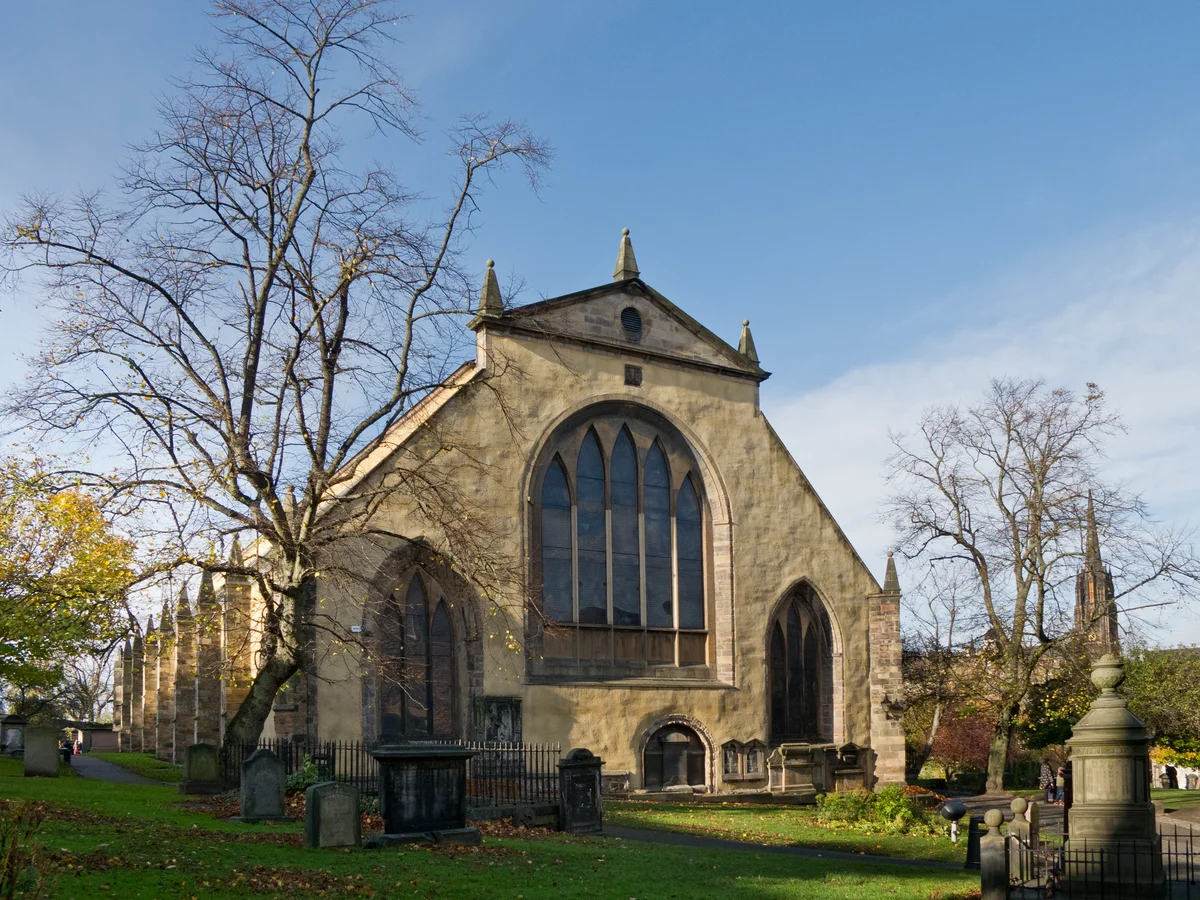
Photo: Carlos Delgado / CC BY-SA 3.0
What Your Eye SeesA solid 17th-century church of grey stone surrounded by one of Edinburgh’s oldest burial grounds. Tombstones and ornate monuments crowd the grassy kirkyard, enclosed in part by the massive medieval Flodden Wall, with the castle looming above the walls.
ContextGreyfriars Kirk was built in 1620 on the site of a Franciscan friary (the “grey friars”), and its kirkyard has served as a burial ground since 1561. It is one of the most historically charged places in Edinburgh: the National Covenant, the manifesto of the Scottish Covenanting movement against Charles I’s religious policies, was signed here in 1638, and the kirkyard holds the Martyrs’ monument to the Covenanters who died for their cause.
On ScreenGreyfriars Kirk and its kirkyard, where the story is set, appear in the 1961 Disney film Greyfriars Bobby.
Source: UNESCO (Old and New Towns of Edinburgh); Wikipedia (Greyfriars Kirkyard); Wikipedia (Greyfriars Bobby); IMDb
DidYou
Know
Below the kirk lies the Covenanters' Prison, an open-air enclosure in the lower kirkyard where captured Covenanters were held after the Battle of Bothwell Bridge in 1679, some for years, before trial or transportation.
Share→ The Dog At The Gate
Look at the corner of George IV Bridge for the statue of Greyfriars Bobby, the Skye terrier said to have guarded his master John Gray's grave here for fourteen years after Gray died in 1858. The 1873 statue by William Brodie, paid for by Lady Burdett-Coutts, is worn bright by visitors who stroke its nose for luck.
→ The Gravestones Of Hogwarts
Look among the gravestones for names Rowling is said to have noticed while writing in Edinburgh: Thomas Riddell (near 'Tom Riddle') and William McGonagall ('McGonagall'). Fans still seek the weathered stones, real Edinburgh names that echo through the Harry Potter books.
→ The Flodden Wall
Look for the Flodden Wall enclosing part of the kirkyard, the defensive wall built around Edinburgh in the early 16th century after the Battle of Flodden, one of the few places in the city where the great medieval wall still stands and can be touched.
Sources: Wikipedia (Greyfriars Bobby); Historic Environment Scotland; Wikipedia (Greyfriars Kirkyard); City of Edinburgh Council; Wikipedia (Flodden Wall)
Spiritual Seeker
Gothic Soul
Euro Heritage
9. John Knox House
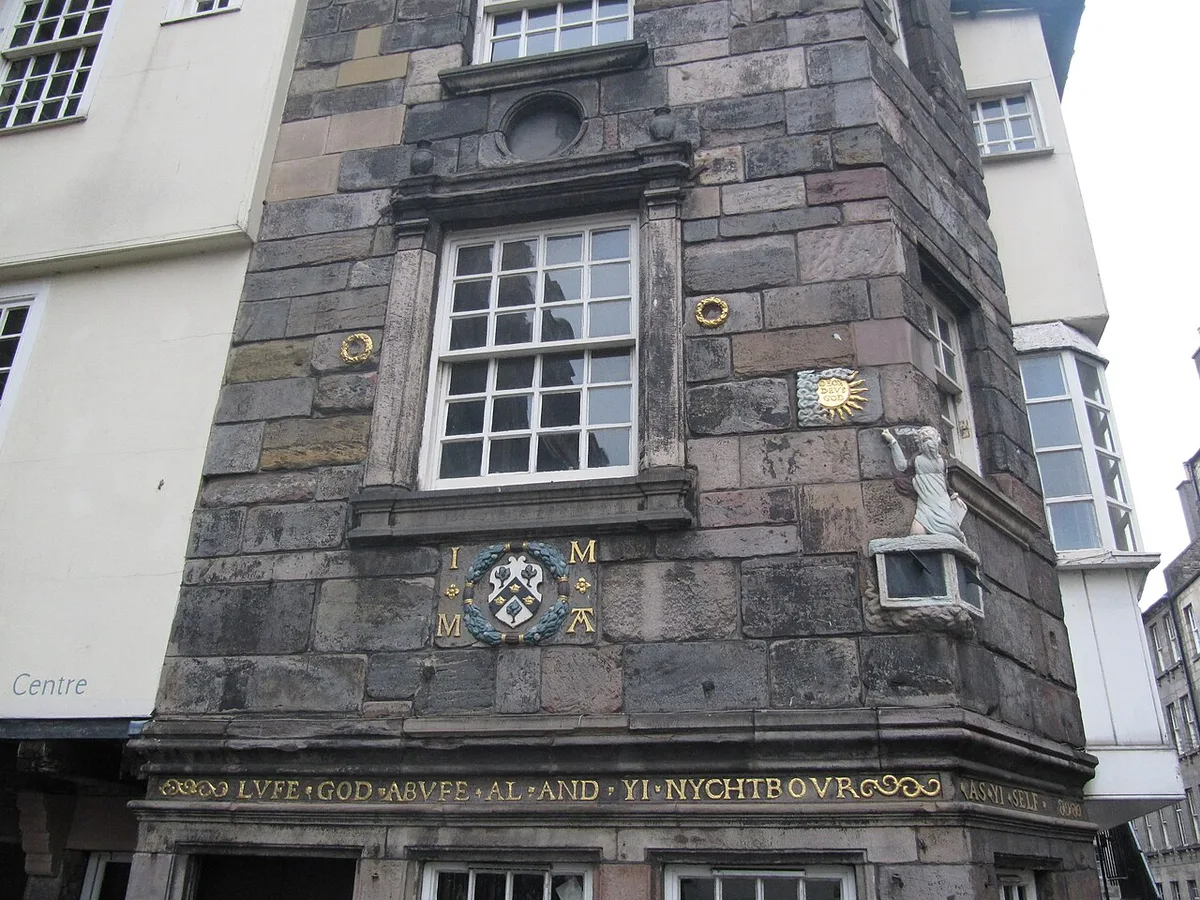
Photo: Palickap / CC BY-SA 4.0
What Your Eye SeesA tall medieval house on the Royal Mile with the upper storeys jutting out over the pavement. The front is carved with two Scots Bible quotations, and above the second-floor window a Moses figure holds a stone tablet beneath a sun symbol.
ContextJohn Knox House stands at the Netherbow, the historic gateway between the Burgh of Canongate and the City of Edinburgh. Dating from around 1470 and altered in the 1550s, it is among the oldest surviving medieval buildings in the city. It takes its name from John Knox, the leader of the Scottish Reformation, who is believed to have lived here between 1561 and his death in 1572, though the house was actually owned by James Mosman, goldsmith to Mary, Queen of Scots, and his wife Mariota Arres. It has been open as a museum since 1853.
Source: UNESCO (Old and New Towns of Edinburgh); Wikipedia (John Knox House)
DidYou
Know
During the Lang Siege of 1573 the building's owner was hanged for coining money for Mary Queen of Scots' supporters, meaning the house that bears John Knox's name once belonged to a man executed for treason.
Share→ The Motto In Old Scots
Above the ground-floor window the house carries the carved words “Lufe God abuve al and yi nychtbour as yi self”, “Love God above all and your neighbour as yourself”, in 16th-century Scots. A second inscription over the door reads “FEIR THE LORD AND DEPART FROM EVILL, PRO.3.”
→ Moses Against The Devil
Look above the second-floor window for the carved Moses figure holding a stone tablet, placed beneath a sun symbol containing the word for God in English, Latin and Greek. Moses was carved here as an example of how the written word protects against the devil.
→ The Devil’s Head In The Oak Room
Look in the Oak Room ceiling beams for the painted devil, a bared-breast figure with deer's ears hidden for centuries behind a later plaster false ceiling, now revealed during the 1934 restoration.
Sources: Wikipedia (John Knox House); Scottish Storytelling Centre (John Knox House); BBC News (2015); National Trust for Scotland (Gladstone's Land)
Spiritual Seeker
Time Traveler
Euro Heritage
10. Canongate Kirk
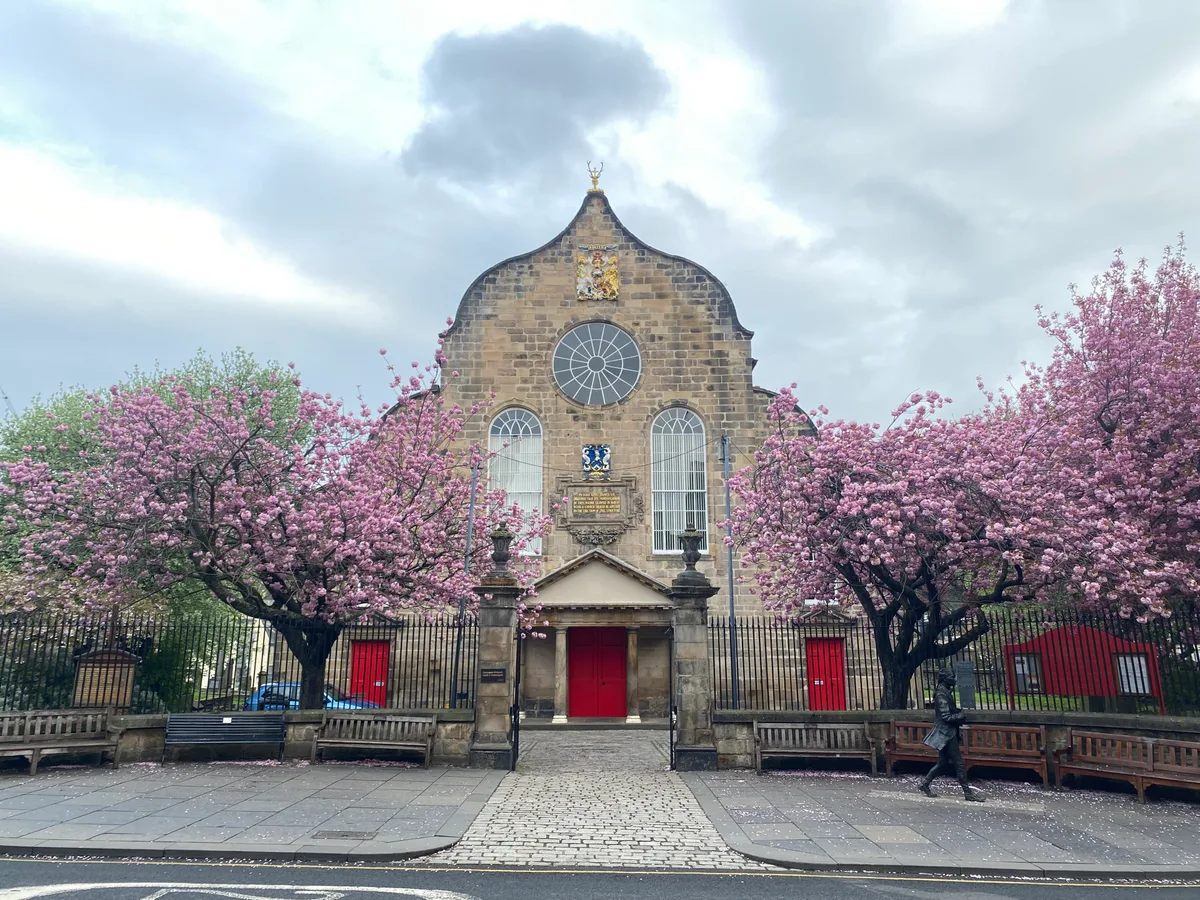
Photo: 瑞丽江的河水 / CC BY-SA 4.0
What Your Eye SeesA plain 17th-century kirk of grey stone with a Dutch gable and no tower, instead a small bellcote and a Doric portico mark the entrance. Across the road stands the old Tolbooth, and beside the kirk lies its kirkyard with the ancient Mercat Cross.
ContextCanongate Kirk is the parish church of the Palace of Holyroodhouse, Edinburgh Castle and the Scottish Parliament. It was built in response to a 1649 bequest from Thomas Moodie, after King James VII gave the Abbey Church of Holyrood to the Order of the Thistle. Construction ran from 1688 to 1691 under master mason James Smith, its cost met from Moodie’s 1649 bequest of 20,000 merks. Its interior is laid out like a Roman cross, a cruciform plan unusual for a post-Reformation kirk, and it was the venue for Zara Phillips and Mike Tindall’s wedding in 2011.
Source: UNESCO (Old and New Towns of Edinburgh); Wikipedia (Canongate Kirk)
DidYou
Know
The royal crest above the entrance is not that of James VII, who ordered the kirk built in 1688, but of William III. James VII was deposed in 1689 before the building was finished, and the arms over the door belong to the Protestant king who replaced him.
Share→ The Coachman’s Stone
Look in the kirkyard for the 'Coachman's Stone', a tombstone carved with a coach and four horses, a trade rendered in stone that tells exactly how the man buried beneath earned his living.
→ A Kirk Without A Tower
Look at the kirkyard entrance for the small bellcote and a Doric-columned portico beneath an unusual Dutch gable, a deliberately plain exterior for a post-Reformation kirk, which carries no tower.
→ Fergusson At The Gate
A bronze statue of the poet Robert Fergusson, sculpted by David Annand and erected in 2004, stands outside the kirk gate. Fergusson, who died aged 24, is buried in the kirkyard just a few steps from his own memorial.
Sources: Britain Express (Canongate Kirk); Wikipedia (Canongate Kirk); Canongate Kirk (Official)
Spiritual Seeker
Euro Heritage
Time Traveler
11. General Register House
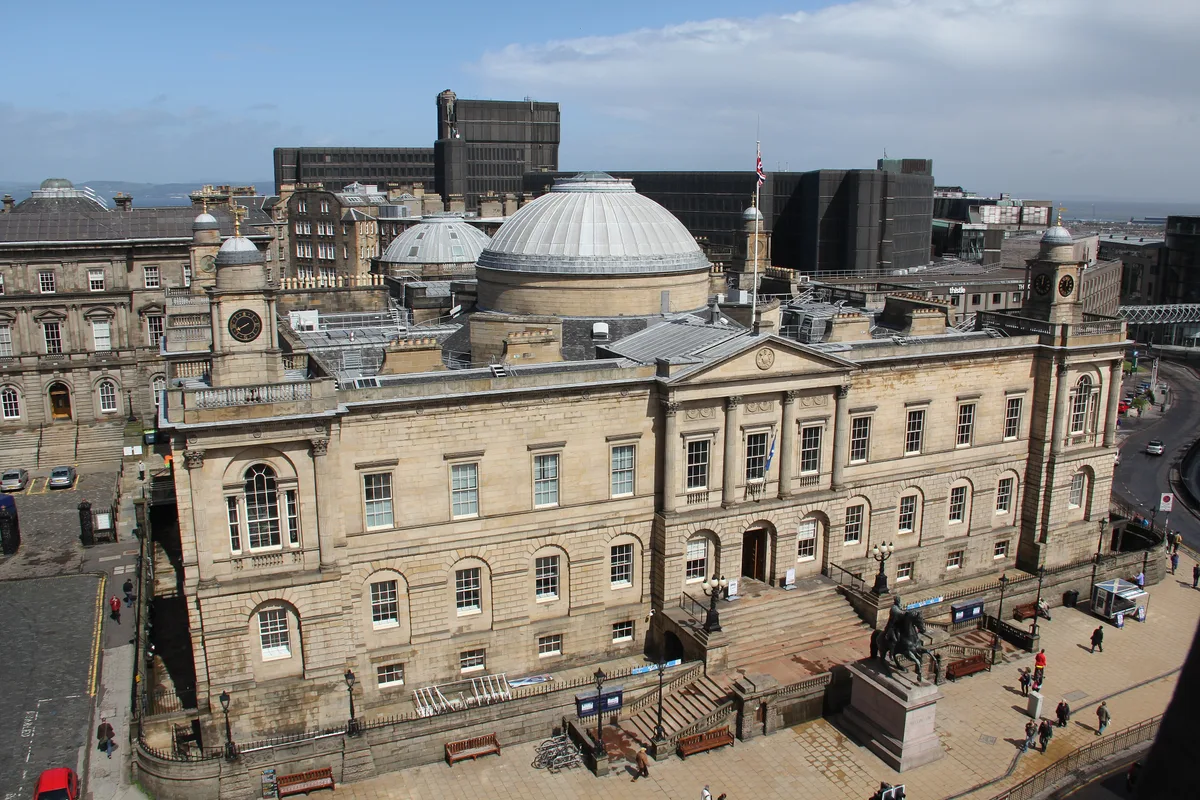
Photo: Niels Elgaard Larsen / CC BY-SA 3.0
What Your Eye SeesA grand neoclassical building at the east end of Princes Street, its front wall set back to make room for the equestrian statue of the Duke of Wellington. Above the entrance hang a clock and a weather vane, and behind the facade rises a great domed hall.
ContextGeneral Register House was designed by Robert Adam and built between 1774 and 1788, with construction pausing from 1779 to 1785 when the money ran out. It was the first building in the British Isles designed specifically for the public records of a state or nation, and it still serves as the home of the National Records of Scotland.
Source: UNESCO (Old and New Towns of Edinburgh); Wikipedia (General Register House)
DidYou
Know
While it stood roofless and unfinished, wits mocked the half-built shell as 'the most magnificent pigeon house in Europe', a national archive derided as a ruin before it was ever completed.
Share→ A Clock By The King’s Clockmaker
Look above the entrance for a weather vane and a clock made by Benjamin Vulliamy, clockmaker to the king, a royal maker's mark on a building raised for the state's records.
→ A King In The Rotunda
Look inside the round, Pantheon-inspired hall for a statue of King George III in one of the alcoves. The king himself had laid the building's foundation, and the statue was originally placed in the centre of the room.
→ Thistles Among The Romans
Look at the rotunda's plasterwork, where among the Roman and Greek scenes the designers tucked Scottish thistles, a national emblem hidden in plain sight among classical imagery.
Sources: Britain Express (General Register House); Wikipedia (General Register House); Edinburgh World Heritage (General Register House); National Records of Scotland
Euro Heritage
Time Traveler
12. Gladstone’s Land
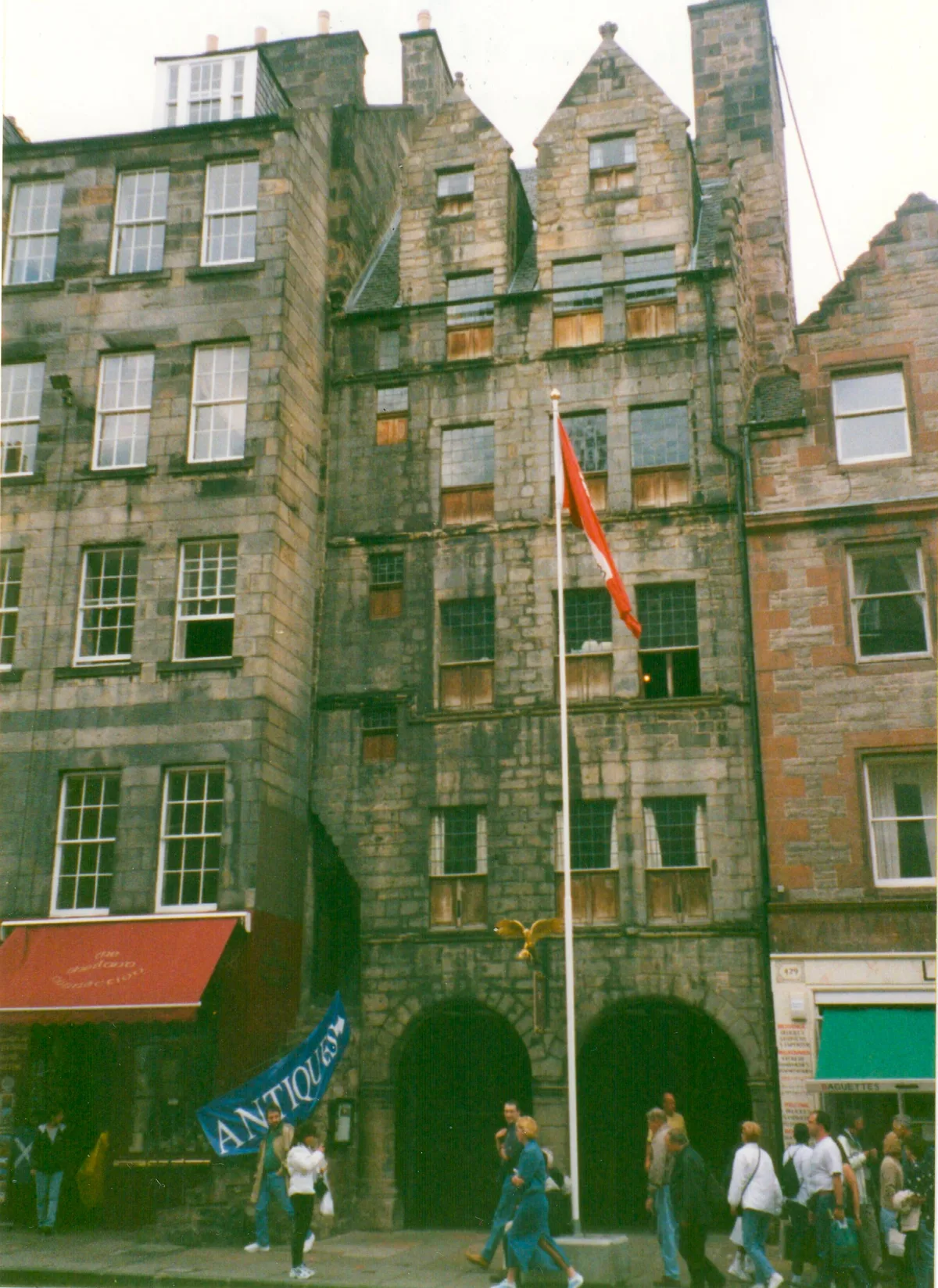
Photo: Humphrey Bolton / CC BY-SA 2.0
What Your Eye SeesA six-storey tenement on the Lawnmarket, its ground floor still an arcaded shop front, the last surviving example on the Royal Mile. Inside, a third-floor apartment preserves hand-painted ceilings from 1620.
ContextGladstone’s Land is one of the oldest buildings on the Royal Mile, a six-storey tenement at 477B Lawnmarket. In 1617 Thomas Gledstanes, a burgess of Edinburgh, bought the property and began remodelling it. The name is a family one: “gled” means “kite” or “hawk” in Scots, hence the gilded hawk symbol of the Gledstanes family, and Thomas was an ancestor of the Victorian prime minister William Gladstone. The building was saved from demolition in 1934 and opened to the public in 1935.
Source: UNESCO (Old and New Towns of Edinburgh); Wikipedia (Gladstone's Land)
DidYou
Know
Gladstone's Land is one of the few surviving 'lands', the tall narrow stone tenements that once packed the Royal Mile, its turnpike stair still winding from the street shop up to the attic.
Share→ The Last Arcade On The Mile
Look at the ground floor for the last surviving example on the Royal Mile of an arcaded shop front. Under the covered arcade, merchants displayed their wares and traded without standing in the rain.
→ Oysters In The Mortar
Look at the hand-painted ceiling from 1620, rediscovered under later plaster during the National Trust for Scotland's 1934 restoration, the monkey on the ceiling is among the figures that survived centuries hidden.
→ The Monkey On The Ceiling
In the third-floor apartment a hand-painted ceiling from 1620 survives, discovered hidden under lath and plaster during conservation in the 1890s–1900s. Visitors are invited to spot the painted monkey among the panels.
Sources: Britain Express (Gladstone's Land); Wikipedia (Gladstone's Land); National Trust for Scotland (Gladstone's Land); National Trust for Scotland
Time Traveler
Euro Heritage
13. Canongate Tolbooth
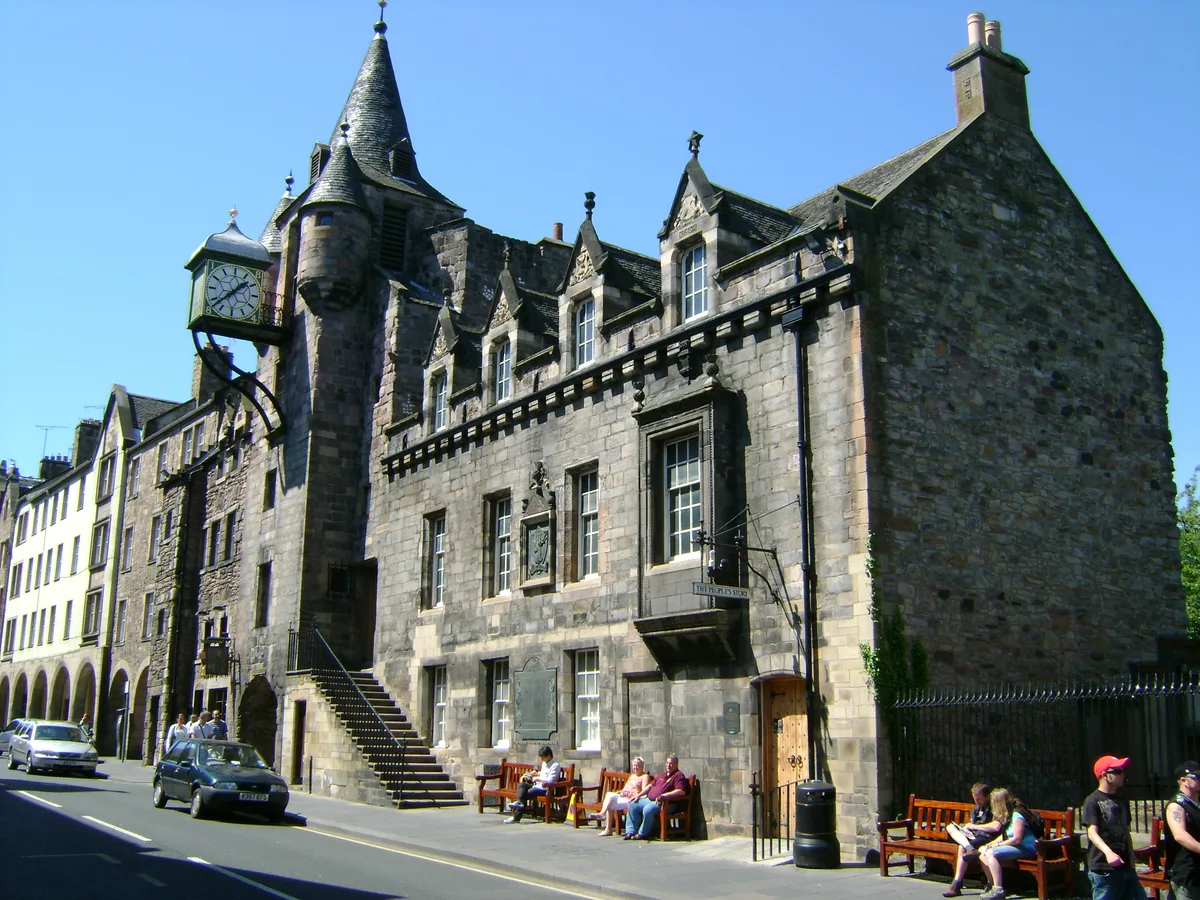
Photo: Kilnburn (talk) 19:41, 3 June 2009 (UTC) / Attribution
What Your Eye SeesA 16th-century tower of grey stone projecting over the Royal Mile, its base pierced by an arch that leads into Tolbooth Wynd. A clock dated 1884 hangs from wrought-iron brackets between two bartizans, and a conical spire tops the tower.
ContextCanongate Tolbooth was built in 1591 by Sir Lewis Bellenden, justice-clerk and feudal superior of the independent Burgh of Canongate. It served as the burgh’s council chamber, courthouse and jail, for a town that lay outside Edinburgh’s walls. After the burgh was absorbed into Edinburgh in 1856 the building became a police station, then a fire station, then a public library, and in 1989 it reopened as the People’s Story Museum.
Source: UNESCO (Old and New Towns of Edinburgh); Wikipedia (Canongate Tolbooth)
DidYou
Know
The tolbooth held debtors, witches and Covenanters after the Restoration; among them were Covenanters held after the Pentland Rising and later religious turmoil.
Share→ The LB Under The Arch
Look at the base of the arch into Tolbooth Wynd for the carved initials 'LB', for Lewis Bellenden, Lord Justice Clerk, who built the tower in 1591, the builder's mark still legible after four centuries.
→ A Clock Over The Street
Look for the clock dated 1884 suspended over the Royal Mile itself on wrought-iron brackets, hanging between two bartizans with ornamental gunloops, a public clock that sits above the heads of passers-by.
Sources: Edinburgh Museums (Canongate Tolbooth); Historic Environment Scotland (Canongate Tolbooth)
Euro Heritage
Time Traveler
Where in Edinburgh was Sherlock Holmes inspired?
Sherlock Holmes was created by Arthur Conan Doyle, born in Edinburgh in 1859, who studied medicine at the University of Edinburgh. The real model for Holmes’s powers of deduction was Dr Joseph Bell, a surgeon-lecturer at the Royal College of Surgeons whose observational skill Doyle admired, and the college still displays Conan Doyle’s own letter naming Bell as his chief inspiration. Fans trace the mood in the Old Town’s closes and staircases around Greyfriars and the Royal Mile.
Which Marvel film was filmed in Edinburgh?
Avengers: Infinity War (2018). Edinburgh was the only real-world location used in the whole film, the attack on Wanda and Vision unfolds beneath St Giles’ Cathedral and along the Royal Mile, with Cockburn Street and Waverley Station also used. The cathedral “rooftop” fight was actually staged on a built set at a disused warehouse, not the real roof. So the one Marvel film shot in Edinburgh is Infinity War.
What are the most famous castles in Scotland?
Scotland is castle country, and the most famous is Edinburgh Castle, perched on an extinct volcano above the Old Town and home to the Scottish Crown Jewels and the Stone of Destiny. Other renowned Scottish castles include Stirling Castle, where many Scottish monarchs were crowned, and the island fortress of Eilean Donan. Our Edinburgh page focuses on Edinburgh Castle itself, the city’s defining landmark and Scotland’s most-visited attraction.
These landmarks reward close attention. Vestigia is a field companion for people who look longer, with curated context, architectural detail, and the stories most visitors walk past. Free on the App Store and Google Play.