Heritage · Field notes
What Makes a Building a Historical Landmark?
Landmark status is a legal decision before it is a feeling. Here is how the lists actually work, and what to look for when a plaque is missing.
A historical landmark is a building or site that a public body has formally recognised for significance, and most systems also ask whether enough original fabric survives to carry that meaning. Age alone is rarely enough. UNESCO, national registers and local councils apply different tests: architecture, association with people or events, archaeology, or meaning to a community.
What does landmark designation actually mean?
Designation is an administrative act. A site is entered on a list kept by a public body, and the entry usually brings some control over demolition or alteration. The lists differ by country and by level of government, so the same building can be protected nationally, locally, or only by a private heritage society.
At the international level, UNESCO's World Heritage list recognises sites of "outstanding universal value" under at least one of ten criteria. Those criteria include creative genius, a unique testimony to a civilisation, and direct association with events or beliefs. World Heritage status is not a building code: the state that owns the site remains responsible for protecting it.
National systems use their own tests. In the United States, the National Register of Historic Places evaluates properties under four criteria. In England, listed buildings are graded I, II* and II, with Grade II covering the large majority of entries. Both systems can protect a building from demolition, but neither guarantees that the interior survives.
Does age alone make a building historic?
No. Age is a threshold, not a verdict. In the United States, a property generally has to be at least 50 years old before it can be considered for the National Register, and that age only opens the question. The property still has to meet one of four criteria: association with events, association with people, distinctive design or construction, or the potential to yield information.
That is why a heavily rebuilt medieval barn can fail while a mid-century housing estate can pass. The deciding question is not "how old is it" but "what does this building still demonstrate, and with how much of its original material".
Why do ordinary buildings qualify?
Because significance is not the same as grandeur. Some of the clearest cases are working buildings. Ironbridge Gorge in England, inscribed in 1986, preserves the infrastructure of the early Industrial Revolution. Saltaire, inscribed in 2001, is a complete model mill town built for textile workers. The Fagus Factory in Germany, inscribed in 2011, is an early modern factory whose glass and steel skin changed industrial architecture.
Local lists protect the same kind of ordinary fabric at a smaller scale. A corner shop, a school, a workshop or a row of terraces can carry more evidence of daily life than a palace, and that evidence is often the first thing lost in a renovation.
What does integrity mean on site?
Significance has to survive in the material. Conservators talk about integrity and authenticity: original fabric, setting, craft, and continuity of use. The Nara Document on Authenticity, adopted in 1994, made the point that authenticity is judged within a cultural context rather than against a single European template.
In practice, a facade rebuilt in cement with the old stones re-clad can keep its outline and lose its evidence. A roof replaced in the same material and technique can keep both. This is why official list entries describe materials, plan, and later alterations in such detail.
How can you read designation when you are standing there?
Start with what is original and what is repair. Three things are usually visible from the street:
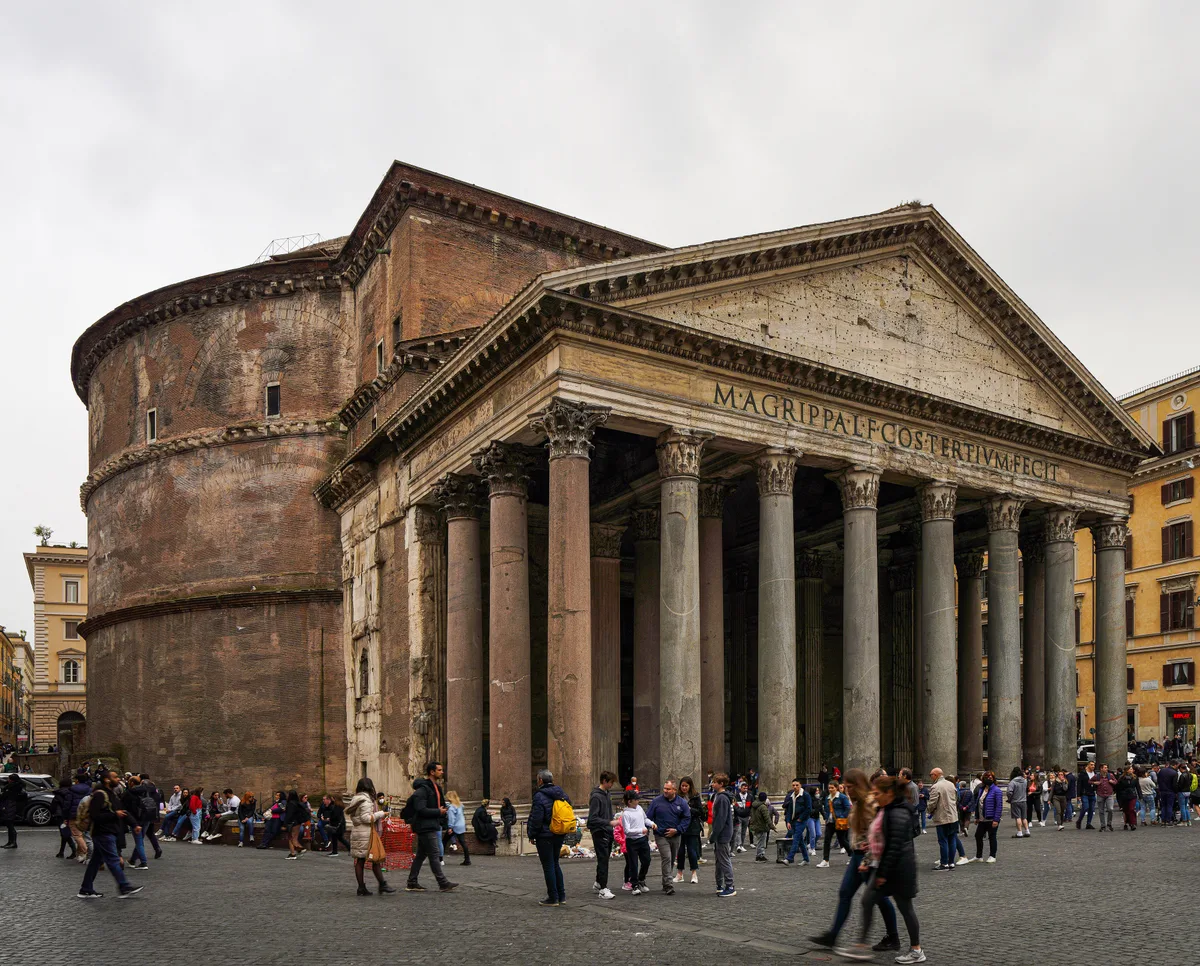
- Seams. Different stone, mortar or brick bonds often mark later repairs, raised roofs or rebuilt sections. At the Pantheon, the portico inscription names Marcus Agrippa, who built the first temple, while the concrete dome belongs to Hadrian's rebuilding of about AD 118 to 128. The building carries two centuries in one facade.
- Change of use. At Hagia Sophia in Istanbul, the buttresses and minarets record a life that continued long after the sixth-century church was finished. The fabric is the document, not the label beside it.
- The plaque. A blue plaque is commemorative, not protective. English Heritage's London scheme marks where notable people lived or worked, and it does not legally protect the building. Statutory listing is a separate register with separate rules.
UNESCO World Heritage, the national register and the local list are three different things. A building can be locally listed and not nationally listed, and a World Heritage site can contain buildings that are not individually protected.
The fastest way to read a facade is to ask what the material is doing. When you scan a structure in Vestigia, the app returns an identification and a short architectural reading. Treat that as a first pass, then check the official list if the distinction matters. Two city pages make good practice grounds: the Pantheon in Rome and Hagia Sophia in Istanbul.
Sources
- UNESCO, World Heritage criteria
- UNESCO, Operational Guidelines for the Implementation of the World Heritage Convention
- US National Park Service, National Register of Historic Places
- Historic England, Listed buildings
- ICCROM, The Nara Document on Authenticity (1994)
- UNESCO, Ironbridge Gorge
- UNESCO, Saltaire
- UNESCO, Fagus Factory
- Britannica, Pantheon
- English Heritage, Blue plaques