Cities · Field notes
European Cities Where the Past Is Still in the Stone
Not a ranking. Eight places where a specific piece of construction history is still doing structural work, and where you can see it from the street.
The cities below are not ordered by beauty or popularity. Each one keeps one construction detail visible in ordinary streets, from an unreinforced concrete dome to a wooden cage built for earthquakes. The detail to find is listed for each city, with a link to the full city guide for the rest of the stops.
Most old cities are described as open-air museums. That phrase hides the useful part: in a living city, the old fabric has to carry weight, shed rain and survive traffic. The places below were chosen because one piece of that work is still visible, and because the detail is easy to miss if you do not know where to look.
Rome: a dome that should not still stand
The Pantheon's dome is 43.3 metres across and the same height from the floor to the oculus, so the interior fits inside a sphere. It is still the largest unreinforced concrete dome in the world, almost two thousand years after it was poured. The concrete thins from about 5.9 metres at the base to 1.5 metres at the top, and the aggregate changes with height, which is a structural decision rather than a decorative one.
Look up before you look around: the Pantheon in Rome.
Athens: the Parthenon has almost no straight lines
The Parthenon is famous for proportion, but the precision is in the deviations. The platform curves gently upward toward the centre, the columns lean slightly inward, and each shaft swells a little in the middle. These corrections are hard to see one at a time, and obvious once you know to look along a line of columns.
Start at the Parthenon on the Acropolis and check the edge of the stylobate against the horizon.
Istanbul: a building that kept changing jobs
Hagia Sophia was finished in the sixth century as a church, became a mosque after 1453, and later a museum before returning to mosque status. The fabric records the sequence: massive buttresses added to hold the dome, minarets at the corners, and a patchwork of repairs in different stones. In the upper gallery, a runic inscription left by a Varangian guardsman is still cut into the balustrade.
Find the layers at Hagia Sophia in Istanbul.
Venice: a city standing on trees
Venice rests on short timber piles driven through lagoon mud to a firmer layer, and the piles survive because they sit below the water table, where there is almost no oxygen. The numbers are concrete: about 14,000 piles under the Rialto bridge alone, and roughly 10,000 oak trunks under St Mark's Basilica. The load is carried by friction between the pile and the soil, not by reaching bedrock.
See the structure at the Rialto Bridge and St Mark's Basilica.
Lisbon: a city rebuilt as a machine
After the 1755 earthquake, fire and tsunami, the Baixa was rebuilt with a timber frame inside the masonry walls, known as the gaiola pombalina. The frame uses diagonal braces in a cross pattern, so the building can move without collapsing, and components were prefabricated and standardised on an unusual scale for the period. The same system sits behind the facades you see on the grid streets today.
Walk the grid around Praca do Comercio and look at the uniform block heights rather than the individual facades.
Prague: a clock that kept older time
The astronomical clock on the Old Town Hall shows more than the hour. The outer ring carries golden numerals for Old Czech time, counted from sunset, and the dial tracks the position of the sun and moon and the signs of the zodiac. The calendar dial below, painted by Josef Manes in 1866, carries the months and the rural work that went with them.
Stand back to read the ring at the Astronomical Clock.
Vienna: the city under the cathedral
Beneath St Stephen's Cathedral are the catacombs, used for burials until Joseph II banned interments inside the city walls in 1783. By then about 11,000 people had been buried there, and the bones and coffins are still in place. The tour is the only way in, which keeps the space closer to an archive than an attraction.
The entrance is inside St Stephen's Cathedral.
Dubrovnik: a wall paid for in carried stones
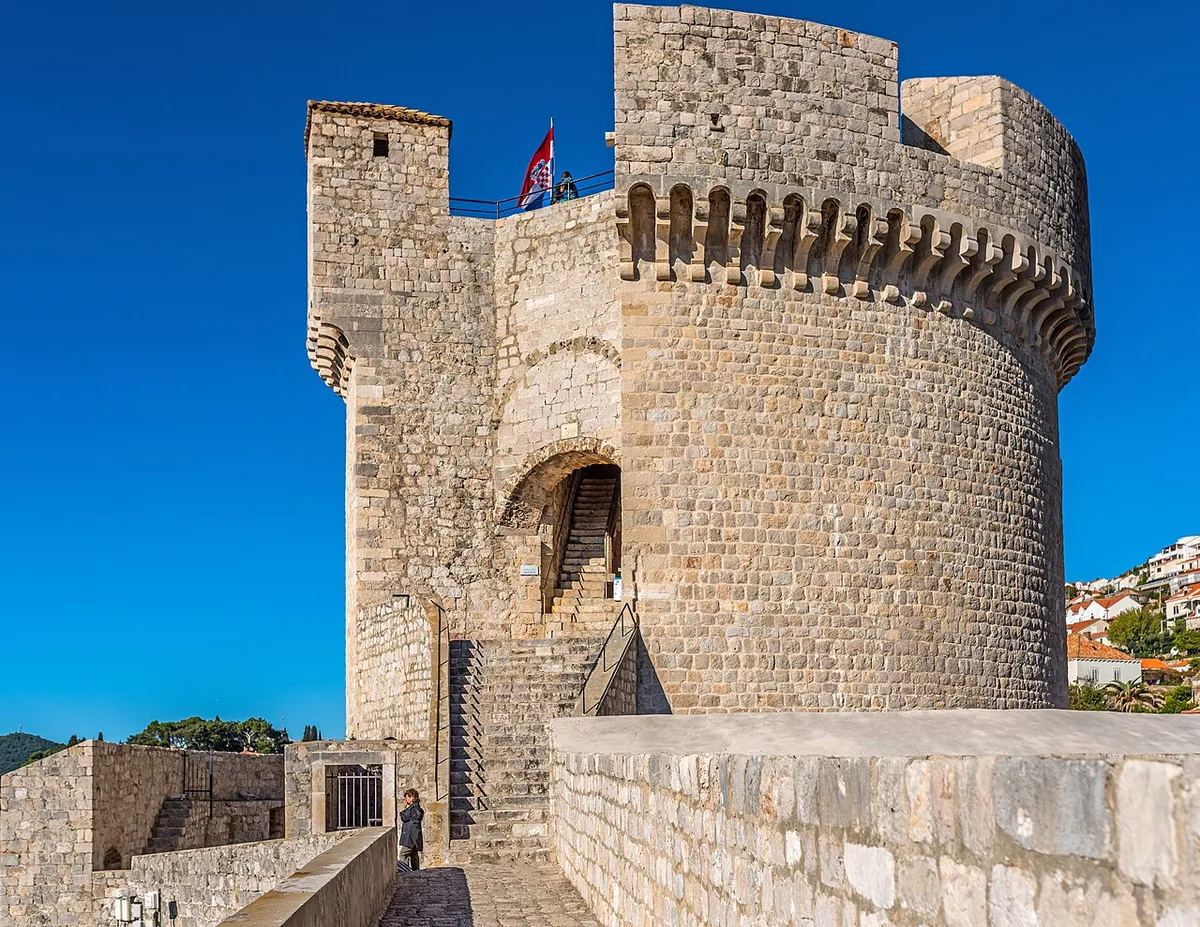
In 1462 the city's Small Council revived an order that people entering through the Gruz and Ploce gates had to bring a stone for the walls, sized to what they could carry. The order was short-lived, but it left a tradition, and the walls it fed are still the city's main structure. The Minceta Tower is the highest point, and its crown was added in the 15th century.
Walk the circuit from the Minceta Tower.
How to use this list
Pick one detail per city and give it ten minutes. Look along a line of columns, read the numbers on a dial, find where a wall changes stone. The rest of the city will still be there afterwards.
- Go early or late, when raking light shows seams and repairs.
- Scan the structure, then check one claim against what you see.
- Use the city guide for the stops that need a ticket.
For longer itineraries, the ancient cities of Turkey and Roman sites in Italy guides follow the same idea: one structure at a time, with the detail that makes the stop worth it. The full city index is at Cities.
Sources
- Britannica, Pantheon
- Pantheon Museum, The Dome and the Oculus
- Britannica, Parthenon
- Wikipedia, Hagia Sophia
- BBC Future, The ancient forest that supports Venice (2025)
- ESG, Seismic V: Lisbon reconstruction reference case
- Prague City Tourism, Old Town Hall with Astronomical Clock
- Wikipedia, Prague astronomical clock
- ORF III, Die Unterwelt der Stephanskirche
- HRT Radio Dubrovnik, Gradoplov (9 November 2021)